QOTD (2010-07-28)

The Rachel Maddow Show, July 22, 2010, on a survey sent to soldiers soliciting their opinions on Don’t Ask Don’t Tell:

Because this is America, rights are not supposed to be put to a vote. That’s why they’re called rights! That’s why we have a Constitution, and why we struggle every day to prove that we still honor it…. This is America, and the rights of man are inalienable, no matter what skeeves you out.

Maddow is not only one of the smartest and best-educated people on TV and pundits in the New York/Washington media, she says things that no one else in those media outlets will say. I have the greatest admiration for anyone who views their job as a calling, and when Maddow says things like this it makes me believe that she is one of those people.

QOTD (2010-07-23), Disconcertingly Lit-Critty Edition

David Lodge’s Nice Work may have been written in 1988, but it should be required reading for anyone in or near academe today:

You and I, Robyn, grew up in a period when the state was smart: state schools, state universities, state-subsidised arts, state welfare, state medicine–these were things progressive, energetic people believed in. It isn’t like that any more. The Left pays lip-service to those things, but without convincing anybody, including themselves. The people who work in state institutions are depressed, demoralised, fatalistic. Witness the extraordinary meekness with which the academic establishment has accepted the cuts (has there been a single high-level resignation, as distinct from early retirements?). It’s no use blaming Thatcher, as if she was some kind of witch who has enchanted the nation. She is riding the Zeitgeist.

There are some days when it’s just clearer than ever that neither those who have political power in Britain and America nor the zeitgeist have moved on from the Thatcher and Reagan era. The startling familiarity with which Lodge describes not just universities’ death by a thousand funding cuts, but also conversations about the utility of the humanities, the mission of local universities which are not Oxbridge, and even parodies of in-jokey, secret-code arguments about poststructuralism is kind of depressing for those of us who like to think that stuff changes over time. People have been having these kinds of arguments for generations upon generations, to be sure, but the urgency with which academics must defend themselves and their way of life seems to have come into our culture with the rise of the neocons and stayed in. Nice Work is a hilarious book, but it is also a book in which the academics are constantly under attack, in which the English-professor protagonist Robyn must fight as hard against the romantic suit of a manufacturing executive as she must to keep her non-tenure-track job. The one very easily becomes a metaphor for the other, a logical leap which is mirrored, somehow or other (I don’t quite know enough lit crit to work out how) by the deconstructionist analysis to which Robyn subjects Victorian realist novels in her professional life. Her job, essentially, is to make the realist novel seem unreal—but that’s a task also accomplished for her when she visits an actual factory and finds its hellish existence to be utterly alien to the green-quadded academic utopia she prefers to inhabit. But then in a scene where the aforementioned manufacturing executive subjects the arts faculty senior common room to a rigorous cost-benefit analysis, we’re reminded of how easily academic utopia can be industrialized, how perilous that sense of utopia is, and why we should all probably be concerned for our futures and the futures of our institutions, long after the end of the official Thatcher era.

QOTD (2010-07-19)

From Wilde, “The Critic As Artist”:

We, in our educational system, have burdened the memory with a load of unconnected facts, and laboriously striven to impart our laboriously-acquired knowledge. We teach people how to remember, we never teach them how to grow. It has never occurred to us to try and develop in the mind a more subtle quality of apprehension and discernment. The Greeks did this, and when we come in contact with the Greek critical intellect, we cannot but be conscious that, while our subject-matter is in every respect larger and more varied than theirs, theirs is the only method by which this subject-matter can be interpreted. England has done one thing; it has invented and established Public Opinion, which is an attempt to organise the ignorance of the community, and to elevate it to the dignity of physical force. But Wisdom has always been hidden from it. Considered as an instrument of thought, the English mind is coarse and undeveloped. The only thing that can purify it is the growth of the critical instinct.

If we were to go around today imitating Wilde and extolling the virtues of Criticism, we’d surely be ridiculed as elitists. And yet he’s right: we need more “discernment,” more shades of gray, more analysis rather than simple appreciation. Which is why, of course, it’s worth starting a Journal of Popular Gaga Studies. If we allow appreciation of our day’s cultural icons to lead to thoughtful criticism, we can accustom ourselves to applying our intellect to the world around us, and broaden our perspectives in the process.

QOTD (2010-07-14), Nineteenth-Century Camp Edition

In Love Stories, Jonathan Katz quotes this 1892 testimony from a reporter who exposed the goings-on of a West Village house of ill repute and was in part responsible for its proprietors promptly being called to trial on morals charges:

The reporter observed “these men go to different persons who entered and have drinks with them. I saw some of them leave with strangers and heard them use vile language.” For example, they would “refer to each other as ‘she’ and ‘her,'” and “would call each other ‘bitch.'” They also “spoke of each other as being ‘kept.””

Another witness, Officer Thomas Dolan, remembered: “They called each other ‘dear’ and ‘pet’ and told each other about what nice times they had the night previous.”

[…]

The effeminate who called himself Sarah Bernhardt “had his hair bleached in tissue red[,]” reporter Gramer recalled (Bernhardt, in later years, was known for her red hair). This fellow “carried the illusion as far as he could imitating her, wearing bangles and bangs and dance shoes. I was told he wore corsets and chemise.”

This hearsay raised an objection, and Judge Randolph B. Martine ordered Gramer to “leave out the corsets.”

Sometimes the continuity across decades of certain cultural identifiers is simply astonishing. I mean, “bitch” in 1892? It also makes me think of how class-dependent our broader understandings of history can be; we (or, well, I) think of 1892 as the year that Wilde’s relationship with Douglas began, but are not nearly as aware as we should be of the working-class bars of downtown New York in this period. We see them as suddenly relevant come 1969, of course, but it’s important to be aware that the groundwork for gay liberation was effectively being laid this early. Stonewall may have been a watershed in that it woke up the rest of America, but you don’t have a drag kickline singing to the police, “We are the Stonewall girls/We wear our hair in curls” without these West Village drag queens of an earlier generation who impersonated Sarah Bernhardt and various Gilbert and Sullivan heroines.

QOTD (2010-07-13)

Walt Whitman to his fan/secretary/biographer Horace Traubel, December 1888:

The world is so topsy turvy, so afraid to love, so afraid to demonstrate, so good, so respectable, so aloof, that when it sees two people or more people who really, greatly, wholly care for each other and say so—when they see such people they wonder and are incredulous or suspicious or defamatory, just as if they had somehow been the victims of an outrage.”

Note, here, that Whitman does not say “two men,” does not use the language which would signal homoeroticism. I mean not to draw us into another argument about Whitman and homoerotic identity politics, but rather to point out what a glorious spokesperson Whitman is for all kinds of improbable loves, and for the need of a little more love in this world. Whitman knew firsthand the pain of a country divided against itself in a war which laid out on the battlefield all kinds of questions of human dignity; he wrote about these questions, and wrote answers to these questions, and in so doing explained that we are all—whatever we look like, whatever kinds of bodies we have—part of the same people, and the same States, and have so much to give one another.

Perhaps Pete Seeger says it best in his introductions to “The Water is Wide”: “We can sing all sorts of militant songs, but if we can’t bridge that ocean of misunderstanding we are not going to get this world together.”

And how do we do that? I think Whitman, writing in the 1860 edition of Leaves of Grass, has the answer:

There shall from me be a new friendship—It shall be called after my name,
It shall circulate through The States, indifferent of place,
It shall twist and intertwist them through and around each other—Compact shall they be, showing new signs,
Affection shall solve every one of the problems of freedom,
Those who love each other shall be invincible,
They shall finally make America completely victorious, in my name.

[…]

It shall be customary in all directions, in the houses and streets, to see manly affection,
The departing brother or friend shall salute the remaining brother or friend with a kiss.

There shall be innovations,
There shall be countless linked hands—namely, the Northeasterner’s, and the Northwesterner’s, and the Southwesterner’s, and those of the interior, and all their brood,
These shall be masters of the world under a new power,
They shall laugh to scorn the attacks of all the remainder of the world.

The most dauntless and rude shall touch face to face lightly,
The dependence of Liberty shall be lovers,
The continuance of Equality shall be comrades.

These shall tie and band stronger than hoops of iron,
I, extatic, O partners! O lands! henceforth with the love of lovers tie you.

I will make the continent indissoluble,
I will make the most splendid race the sun ever yet shone upon,
I will make divine magnetic lands.

I will plant companionship thick as trees along all the rivers of America, and along the shores of the great lakes, and all over the prairies,
I will make inseparable cities, with their arms about each other’s necks.

For you these, from me, O Democracy, to serve you, ma femme!
For you! for you, I am trilling these songs.

QOTD (2010-07-07); or, Another Problem in Greek Ethics

From the second chapter of Jonathan Ned Katz’s Love Stories: Sex Between Men Before Homosexuality:

In December 1837 at Yale, Dodd composed or transcribed a revealing, rhymed ditty, “The Disgrace of Hebe & Preferment of Ganymede,” about a dinner for the gods given by Jove, at which the beautiful serving girl, Hebe, tripped over “Mercury’s wand,” exhibiting, as she fell, that part “which by modesty’s laws is prohibited.” Men’s and women’s privates were on Dodd’s mind—eros was now closer to consciousness. Angry at Hebe’s “breach of decorum,” Jove sent her away, and called Ganymede “to serve in her place. / Which station forever he afterward had, / Though to cut Hebe out… was too bad.”

Considering Dodd’s cutting out Julia Beers [his girlfriend] for John Heath, Anthony Halsey, and Jabez Smith [fellow college students for whom he professed love or intense friendship], his poem shows him employing ancient Greek myth, and the iconic, man-loving Ganymede to help him comprehend his own shifting, ambivalent attractions. At Yale, Dodd read the Greek Anthology and other classic texts and began to use his knowledge of ancient affectionate and sexual life to come to terms with his own—a common strategy of this age’s upper-class college-educated white men.

This passage leads to the sort of thesis-related observations I usually try to keep off this blog, but given the relationship of the work Katz does to the questions of close-reading I contemplated yesterday, and the broader implications of his thesis about the historical contextualization of identity categories, it’s worth discussing here. Briefly, Katz has written this book to talk about men who loved and desired other men in America, but before such a thing as homosexuality existed. Through detailed case studies and work with both literary and more traditionally historical sources, he makes a case for a 19th century in which men’s sexual identities and relationships to sexual identity were very different from those of men in our own time. He fights against an essentialist reading of homosexuality across generations, and focuses instead on how 19th-century American men perceived their own relationships with each other, not what modern Americans might read into them. He finds (well, so far; I’m only on Chapter 4) that men often lacked the appropriate vocabulary to define their love for each other, but that they certainly did not see it as part of a distinct identity, evidence of pathology, or indeed reason not to love, desire sex with, and marry women—and that goes for both Abraham Lincoln and Walt Whitman!

And so I’ve been getting myself in this “men before homosexuality were nothing like men after homosexuality” mindset, which is productive in that it allows me both to find Katz’s book very persuasive and to further my own thinking about what changed, theoretically and culturally, when homosexuality did emerge as an identity. But I found that easy suspension-of-my-own-sense-of-identity-categories challenged by the passage I quote above, simply because it does not sound like the experience of a man from before-homosexuality. It sounds like the experiences of young men from across the history of homosexuality (though particularly in its early history) who came to understand their sexualities as sexualities through the frame of classical literature and art. I titled this post the way I did because one of those men was John Addington Symonds, whose 1901 tract A Problem in Greek Ethics is about Athenian pederasty, and implicitly makes the argument that because Athenian sexual mores were different from late-Victorian Britain’s, there was no reason why Britain and its legal system shouldn’t change to accept himself and his fellow “Uranians” into the fabric of society (this was an argument Symonds certainly expressed in so many words in private, if not so explicitly in print). The secondary “Problem in Greek Ethics,” however, would seem to lie in Symonds’ adoption of ancient Greek sexual practices which do not map precisely onto modern homosexuality and would not have been considered “homosexual” then to seek cultural and artistic validation for a modern form of sexual deviance. This sort of essentializing is, it seems to me, in some sense endemic to being homosexual in the modern western world—and it is this sort of essentializing which Katz’s book fights against in part precisely because it is so endemic. (You know how academics are.)

And so to read about Albert Dodd’s bawdy Ganymede poem, and Katz’s observations about Dodd’s interest in Greek matters in 1837, far before the word “homosexual” enters the language or before the sundry proto-homosexual scandals of late-19th-century Britain get going, and to read them occurring out in the provinces, in New Haven, far away from the theoretical and academic and cultural work done to create homosexuality in London and Paris and Berlin, is to me to profoundly trouble the neat homosexuality-didn’t-exist-and-then-it-did narrative. It is to question what is homosexual and what isn’t, to challenge my coding of problems in Greek ethics as homosexual, and indeed to question Katz’s thesis (with which I otherwise agree strongly) about the mutability and historical contingency of identity categories. Is a search to understand one’s erotic impulses through ancient Greek literature something enduring across time, no matter what words exist in the language to describe it?

Blogger Historiann wrote yesterday about the importance of using “sideways” methodologies in building the narratives of people(s) and events (such as women, or people of color, or working-class people) whom written sources sometimes leave out. Sometimes these methodologies come with their own problems in ethics: Historiann gives the example of using the recorded lives of men in order to make inferences about the lives of women, but what does it do for women’s history if it’s still only told through the eyes of men? It seems as if the kind of work that Katz does moves similarly sideways, getting around the obvious lack of forthright records of 19th-century men’s sexualities by inferring and reading between the lines; I’m hoping to learn from his books how to employ similar strategies when writing my own thesis. But it seems to me as if there is always a tension between too much inference and too little (something else I learned from literary studies!), and that playing the inference game carries with it problems in ethics, Greek or otherwise. Am I undoing Katz’s work by assuming homosexuality on the basis of Hellenism? Or could he possibly be the one who is reticent to make a necessary logical leap. (What is truth, anyway?!)

This is a tricky business in which to get involved—and we should never lose sight of the concrete social and political ramifications our quirks of interpretation can have, when they make their ways beyond the ivory tower.
QOTD (2010-06-24), Pride Edition

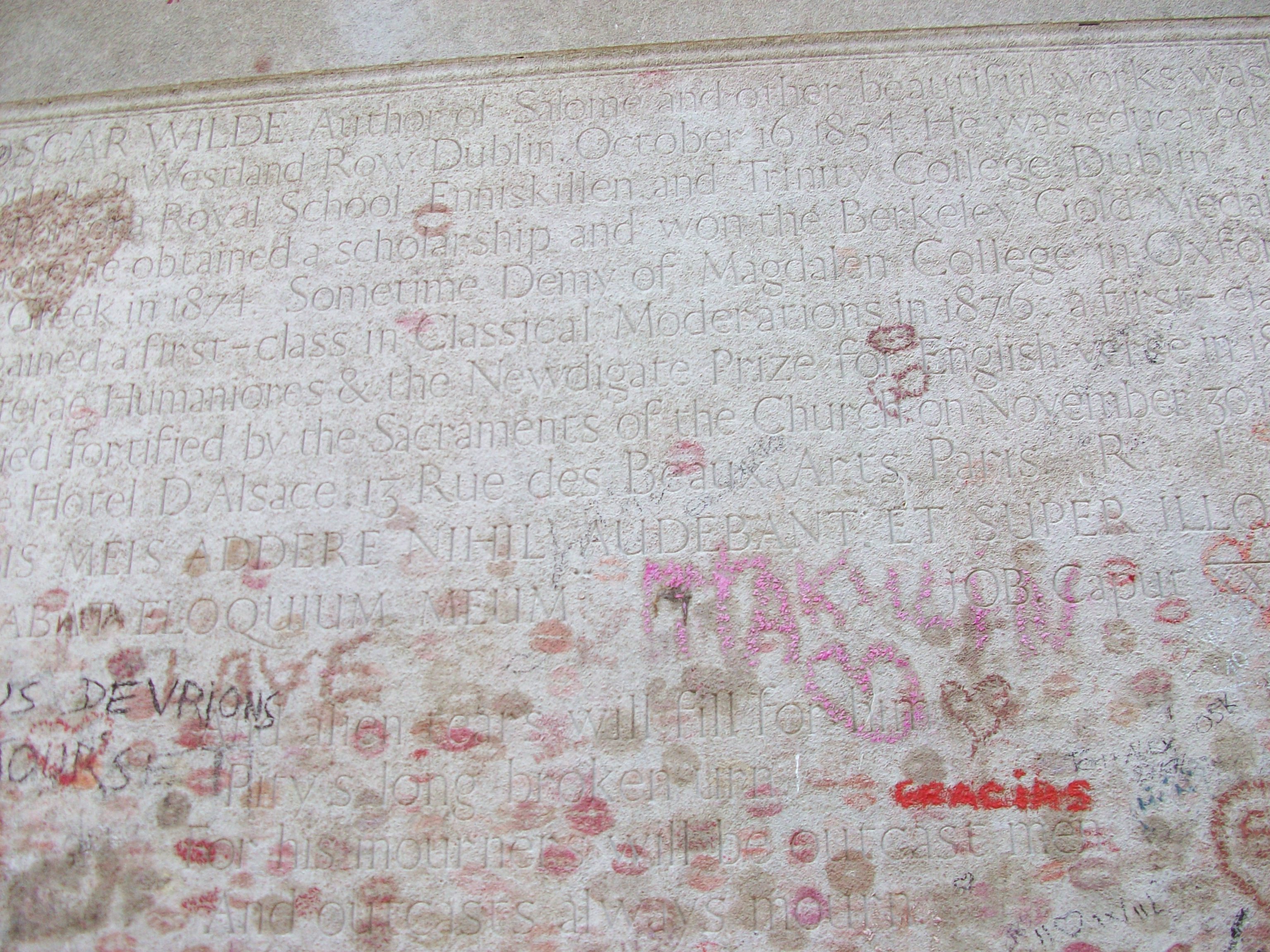
The inscription on the reverse side of Oscar Wilde’s funerary monument (designed by Jacob Epstein), Cemetière du Pere Lachaise, Paris:

OSCAR WILDE, author of Salomé and other beautiful works, was born at Westland Row, Dublin, October 16, 1854. He was educated as Portora Royal School, Eniskillen, and at Trinity College, Dublin, where he obtained a scholarship and won the Berkeley Gold Medal for Greek in 1874. Sometime Demy of Magdalen College in Oxford, he gained a first-class in Classical Moderations in 1876; a first-class in Literae Humaniores and the Newdigate Prize for English Verse in 1878. He died fortified by the Sacraments of the Church on November 30, 1930, at the Hotel D’Alsace, 13 rue des Beaux Arts, Paris. R.I.P., VERBIS MEIS ADDERE NIHIL AUDERBANT ET SUPER ILLOS STILLABAT ELOQUIUM MEUM JOB. Caput xxix.22

And alien tears will fall for him
Pity’s long-broken urn
For his mourners will be outcast men
And outcasts always mourn

His tomb was the work of Jacob Epstein, was given by a lady as memorial of her admiration of the Poet.

The verse, of course, is from “The Ballad of Reading Gaol”; what shocked me about this inscription is just how little of his career is memorialized in it. So much detail about his early life, right down to the street on which he was born, then Oxford—Salomé—and nothing else. In 1909, you could not pronounce the words “Importance of Being Earnest” or “Picture of Dorian Gray,” even on the memorial to the man who wrote them.

“For his mourners will be outcast men”: I have been thinking recently of the role that Wilde has played in the lives and literary imaginations of gay men looking to learn something about themselves, and the work his life and his letters did long after his death to further the development of community centered around a love that now dares (as we have seen in Pride celebrations all month) to speak its name. I hesitate to expand, as I have an article on the subject forthcoming and don’t want to give too much away, but the “outcasts” who “always mourn” do seem to crop up everywhere you look in this particular story. Outcasts mourned the death of Judy Garland, or so the legend has it, on June 28, 1969, before they fought back against the police officers raiding their bar on Christopher Street. And when plucked out of its context about a prisoner’s execution and placed on the tomb of the biggest gay martyr since St. Sebastian, it is so very touchingly interesting how that word “outcast” takes on its more particular meaning to the clued-in, no-longer-outcasts who come to Père Lachaise, to the only grave in Paris covered in red lipstick.

QOTD (2010-06-12)

Richard Ellmann, on the last page of his biography of Oscar Wilde:

His work survived as he claimed it would. We inherit his struggle to achieve supreme fictions in art, to associate art with social change, to bring together individual and social impulse, to save what is eccentric and singular from being sanitized and standardized, to replace a morality of severity by one of sympathy. He belongs to our world more than to Victoria’s. Now, beyond the reach of scandal, his best writings validated by time, he comes before us still, a towering figure, laughing and weeping, with parables and paradoxes, so generous, so amusing, and so right.

I have been a month in slowly making my way through this book, and all through it I have been torn between love for the words and the glamor of one of the western canon’s greatest figures, and irritation at the partiality and romanticism with which Ellmann treats his subject. Ellmann has crafted Wilde’s life into such a narrative, and you can see quite transparently how much the biographer has invested in the climax (the “two loves” speech in the witness box at the second trial) and how tragic the next 200 pages of decline and fall must therefore be. I read all 200 today, nevertheless, unable to tear myself away, the dramatist’s life itself a drama.

It is ahistorical, I think, to write anyone into history as a martyr, and yet that doesn’t eliminate the haunting despair that visits me whenever I read “The Ballad of Reading Gaol.” I am angry at Douglas for what he made Wilde endure, and I am angry at Wilde for enduring it, and I am angry at them both for what they put Constance through. Having read the story to its close, I am as invested in it as—perhaps, for deliberate comparison—those Americans waiting for the steamer with the mail from England were in the ending of The Old Curiosity Shop. (It changed a lot of things I thought I knew to learn from Ellmann that Wilde made his famous remark about laughing at the death of Little Nell when he was on bail awaiting his own inevitable prison sentence.) Yes: try as I might to rationally divorce my admiration of the man’s writing from his existence as a deeply flawed human being, I cannot help thinking, all the same, that he was most notoriously—most tragically—wronged (and I think the Malvolio quote not inapt here!).

It is of course Pride Month, LGBT History Month, or whatever you call that month when we celebrate the anniversary of a riot at a bar on Christopher Street in 1969. The past couple weeks (you might say, since this month’s inception) I’ve been reading Wilde almost exclusively, with only a brief two-day digression into Virginia Woolf. I wonder as always what good and what ill we do by loving these fallen heroes so much that they become martyrs to our cause, a cause that stands so very much outside their own historical moment. I only hope that we wrong Wilde no more notoriously than he has already been, because I can certainly attest that it is very difficult to stop.

And all men kill the thing they love,
By all let this be heard,
Some do it with a bitter look,
Some with a flattering word,
The coward does it with a kiss,
The brave man with a sword!

QOTD (2010-05-15), “Whitman Is Not a Gay Poet” Edition

From Michael Robertson, Worshipping Walt: The Whitman Disciples:

Whitman was not suggesting that all men were repressing a supposedly shameful tendency; rather, he was celebrating the seeds of a politically powerful democratic affection that existed within every person and that only needed encouragement to blossom. Whitman’s poems of adhesiveness were intended not to set a few men apart but to bring all Americans together.

It is this inclusiveness that has made arguments about Whitman’s sexuality so intense. When Oscar Wilde said, years after his visit to the United States, that the kiss of Walt Whitman was still on his lips, he was claiming an artistic consecration, a mark of special favor. Symonds and Carpenter used Whitman to defend the rights of a persecuted minority, to suggest that same-sex passion was natural and innate in a certain portion of the population. But Walt Whitman refused to consider himself as special or different. He was not a minority but a kosmos. In depicting himself he was depicting you, any reader, every reader—the erms of adhesive love are in all people. It is a message that remains more radical and unsettling than any that Symonds, Carpenter, or Wilde—for all their transgressive courage—ever offered.

Ahistorical determination to claim Whitman for the cause of homosexuality usually tends to ignore the fairly obvious contextual point that no one aside from a few German sexologists and their British acolytes was really developing a framework in which to understand men’s sexual attraction to men (in contrast to a more romantic “manly love of comrades”). It goes without saying that American contemporaries of Whitman’s would not have read the “Calamus” poems as homosexual or even precisely homoerotic, simply because of the cultural context in which they all existed; this is in part why Whitman so enthusiastically rebuffed Symonds’ and Carpenter’s attempts to read “Calamus” love as “Uranian.” Homoerotic relationships and men who engaged in them as a distinct social category did not exist for Whitman or in his America. As Robertson points out earlier in this chapter, an allusion to (female) prostitution elsewhere in Whitman’s oeuvre generated the cultural concern—and censorship&mdash that the “Calamus” poems never did.

But I think it is worth noting that in this passage, Robertson seems to be suggesting that even if a cultural construction of homosexuality had existed in Whitman’s America, he wouldn’t have considered himself part of it. Sexual orientation is ever a question of self-identification, and Whitman would neither have understood himself to be writing on gay themes nor would have understood himself to be gay. Indeed, identity politics and the ensuing cultural divisiveness were exactly what concerned Whitman: remember that so much of his poetry comes directly out of the Civil War; remember the degree of patriotic concern with which he mourned the death of Lincoln and worried about what it would mean to the Union. I don’t understand the amative-adhesive dialectic nearly as well as I should, and it is possible that it has more in common with Carpenter’s gender-transgressive utopian vision than we might expect. But recent attempts to call upon Whitman in the name of an identity politics do a disservice to the poet’s own, I believe more complex, cosmology.

At the entrance to the Dupont Circle Metro station in Washington, DC, there is a Whitman quote inscribed into the stone: it reads, “Thus in silence in dreams’ projections,/Returning, resuming, I thread my way through the hospitals;/The hurt and wounded I pacify with soothing hand,/I sit by the restless all dark night – some are so young;/Some suffer so much – I recall the experience sweet and sad…” So, I assume, was Whitman’s experience as a Civil War nurse adopted for the cause of an AIDS memorial, and so, once again, was Whitman’s cultural status as the bard of homoeroticism brought to bear on this particular memory of a virus which claimed a generation of gay men. I like, however, to think that Whitman—despite his own rejection of the Uranian association, and despite the ahistoricity of labelling him with an identity which did not exist in his cultural context—would not have hesitated to minister to dying AIDS patients in the virus’s first couple decades, nor as it continues to ravage indiscriminately today. At risk of lapsing into my own particular brand of ahistoricity, I can only believe that Whitman would treat the young gay man of the 1980s, wasting away in a hospital bed before his time, with the same reverence which he did the young soldier of the 1860s dying a not-entirely-different, equally-undeserved death. Adhesive and amative love, after all, are not needlessly squeamish about whom they touch.