QOTD (2009-09-20), and a Rant

From Lytton Strachey’s Eminent Victorians, in the section on Florence Nightingale:

As the years passed, a restlessness began to grow upon her. She was unhappy, and at last she knew it. Mrs. Nightingale, too, began to notice that there was something wrong. It was very odd; what could be the matter
with dear Flo? Mr. Nightingale suggested that a husband might be advisable; but the curious thing was that she seemed to take no interest in husbands. And with her attractions, and her accomplishments, too! There was nothing in the world to prevent her making a really brilliant match. But no! She would think of nothing but how to satisfy that singular craving of hers to be doing something.

Reader, I can relate. So much of my life recently has been a struggle not to feel guilt for not doing enough, for not putting the greater good ahead of my emotional (and intellectual!) needs as much as I feel that I ought to. Maybe the “general will” and “duty” and “freedom of the fully rational will” in the Rousseau and Kant and Hegel I’m reading in my political theory class is getting to me; maybe it’s just that I’ve made my activist bed, and now I have to lie in it. I have to actually comply with my own exhortations to action; I’ve adopted a community, and now I have to work for it. In the space of a year, I’ve gone from sitting around a lunch table bitching about the place to actually changing it for the better.

But at the end of the day, I don’t want to spend the rest of my life lobbying and writing emails and sitting through committee meetings and talking to people and doing the logistical organizing for events. Those things are really, really important, and I’m glad that people want to do them, and I’m glad that people continue. But I want to spend the rest of my life in the classroom and the library, and honestly, I don’t think that’s too much to ask. You can satisfy your long-term emotional needs, and still be doing something too.

In his Elements of the Philosophy of Right, Hegel outlines three forms of freedom (yeah, I know this is getting a little bizarre, for one of my posts. Bear with me). The first and most basic of these is the freedom of the immediate will, which is a sort of “life, liberty, property,” human-rights idea—the right to do what you want in your own home. The second is the freedom of the reflective will, which means making choices for yourself in accordance with a long-term vision of your personal happiness (e.g. if I judge that becoming a professor will bring me the greatest happiness, I should make choices that will result in my excelling at undergrad and grad school). The third, and according to Hegel, the highest form of freedom is that of the fully rational will, which holds that our freedom is embodied in the institutions of “ethical life”—the family, the state, and the civil society—and that to ensure our freedom we have to invest ourselves in and uphold those institutions, in so far as we judge them to be rational and moral (e.g. we might not have to live in accordance with a state that allows slavery, or a family structure that condones domestic abuse). However, each of these three forms of freedom builds on the others—they’re all necessary when it comes to being and acting as a free individual.

Now, this may seem like a total tangent and just a rehashing of my professor’s lecture last Thursday, and you’re probably wondering, “How does this connect back to Florence Nightingale, and what the fuck is Emily going on about?” But I’m inclined to read the Hegel like this: there is a side to living as a fully realized individual which involves acting in accordance with what will further the greater good of society and its institutions, and there is a side which involves acting in the way that will best further your own personal happiness. These are both constituent parts of Hegel’s freedom; they’re both necessary.

And so if, like Florence Nightingale, you’re going to assign a moral value to “doing something,” the best way to go about this is to ensure that “doing something” will result both in furthering your own personal happiness and the greater good. I haven’t finished the Strachey, and his take on Nightingale is obviously different from the folklore we get in school, but we learn about her today in terms of the greater good she served—not in terms of who she was as a person, and what her idea of happiness might have been. I’m not entirely sure it’s a good thing that we care so much about how selfless she was; selflessness (very obviously) implies that there is no “self.” No identity. No personhood. And if that’s what doing something entails, well frankly, I’m not too sure I want to be identifying with Nightingale and her desire to be constructive.

I went to talk with someone today about some administrative issues, and I wound up sitting in her office for over an hour ranting at her about all this stuff. (Well, I didn’t bore her with tales of Florence Nightingale and Lytton Strachey and Hegel, but the gist was the same.) It was then, taking up the poor woman’s time with my still-so-teenlike angst, that I realized I really need to get a grip. But you can babble about 19th-century intellectuals all you like, and still go to bed wondering what you’ve done all day that’s made the world a better place. My desire to become more culturally literate (as I sit in precept or at meals every day so very aware of the enormous gaps in my knowledge) is having it out in my head with my desire to become just a shell inhabited by a desire to fix the world, and it’s enough to make me want to move to Canada permanently before I explode. (In Canada, after all, we have marriage equality and much less sexism in politics and government health care and multiculturalism and French and beautiful scenery and a Conservative party that isn’t convinced that Armageddon is nigh.)

I don’t think I can keep going on like this. I feel as if one side is going to win out sooner or later—but I dread the guilt I will be consumed by when this happens, and the lingering fear that I won’t have made the right choice.


QOTD (2009-11-18)

From Paul Venable Turner, Campus: An American Planning Tradition:

Upon assuming the presidency of Princeton in 1902, Woodrow Wilson praised the new buildings by Cope [Blair and Little Halls and Dillon Gym], saying that they were the first stage in the formation of “a sort of circle and quadrangle,… girt about with buildings in the style that is historic,” and creating “a little town” unto itself. The specific style of Cope’s buildings, a picturesque interpretation of Tudor or Jacobean collegiate architecture, appealed for several reasons. It was consummately English, and thus, according to Ralph Adams Cram, it evoked “racial memories.” And it had aristocratic connotations, which were emphasized by the carving of heraldic shields on the facades of the new structures, in line with Princeton’s adoption of a coat of arms in 1896. Wilson praised this Tudor architecture with the observation that

by the very simple device of building our new buildings in the Tudor Gothic Style we seem to have added to Princeton the age of Oxford and Cambridge; we have added a thousand years to the history of Princeton by merely putting those lines in our buildings which point every man’s imagination to the historic traditions of learning in the English-speaking race.

So yeah, the reason why I am sitting in one of Princeton’s fin-de-siècle neo-Gothic dormitories writing about Princeton’s fin-de-siècle neo-Gothic dormitories is because Woodrow Wilson was a racist Anglophile. Great.

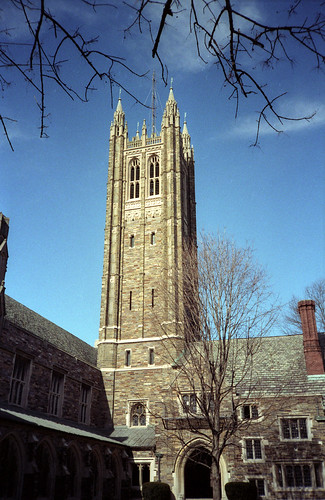
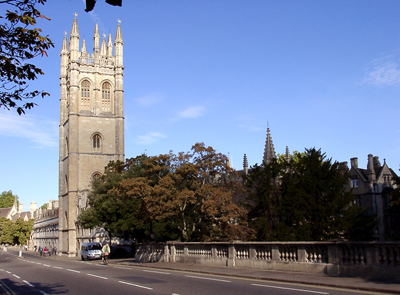
I read in another one of these Princeton architecture books that the Holder tower is meant to be a copy of the Magdalen College, Oxford tower. The two don’t actually look like each other at all (the Princeton Grad College tower is probably a bit closer), but it does sort of explain why I was looking at pictures of Oxford the other day and thinking there was something familiar about the Magdalen tower.

I have to confess, though, that while I’ve always known about how American Ivy League colleges like to imitate Oxbridge (there’s this museum in the British Cambridge somewhere that has a whole display on John Harvard and how he wanted to bring Cambridge to America—which, obviously, he quite literally did), I hadn’t really considered the racialized element of this situation. It makes me feel kind of uncomfortable, suddenly, about my enthusiasm for the Princeton-Oxford exchange-student program, and for American gothic architecture, and other aspects of the distinctly American brand of Anglophilia. I like to think that my own Anglophilia is a lot more realistic than many Americans’; I know that Britain is much more than Monty Python and the Royal Family and I try to keep abreast of the realities of modern Britain. But is it possible to achieve that “realism” when you’re still, at the end of the day, an American Anglophile? Can you be an American Anglophile without in some way associating yourself with this horrible Wilsonian version of academic Anglophilia?

QOTD (2009-10-09), and Theme of the Week

From Edmund White’s City Boy, on his first teaching gig, at Yale:

Once a week I took a train up to New Haven (a two-and-a-half-hour trip each way) to teach my twelve undergrads. I kept imagining that the students would be much better educated than I and would unmask me as a sham; after all, I thought, I’ve never read The Faerie Queene!

Of course few nineteen-year-olds, even at an Ivy League university, have read widely and deeply. They simply haven’t had enough time, especially when the admissions departments at such schools insist they be “well-rounded.” In high school they have to do some sort of community outreach, sing in the glee club, play lacrosse, work as a volunteer for their state senator in the summer, hold down a part-time job to learn the value of a dollar—and study with a tutor the rudiments of Mandarin Chinese twice a week after school. When would they find time to read Spenser or Flannery O’Connor?

This is of course so very true. I certainly didn’t read Spenser or O’Connor until university, and folks who don’t take English classes could easily get through without reading either. But in high school, I don’t think I would have had the desire to read Spenser or O’Connor; I wouldn’t have realized why it’s important to. University is good for many things, such as the mechanical process that is getting a bachelor of arts degree, and (in my case) giving one the intellectual tools one needs to be prepared for grad school. But I’ve found that the greatest thing university has done for me is to realize that there are people out there who will care if you have read Spenser or O’Connor, and people with whom you can have conversations about them. University reminded me that it is not shameful to delight in knowledge and in art.

This is something of the Theme of the Week, as you may realize. Ever since I spent Wednesday being more depressed than I’ve been in a while, I’ve been buoying my spirits by thinking of art instead of politics. Today I went to the Met for the first time in about 10 years, to look at art and appreciate the fact that there are things more profound than petty arguments (which is, really, all Washington politics is).

Without university, I might have intuited this, but I certainly wouldn’t have known it. When the only people agreeing with what you believe are related to you, you tend not to believe it. University has given me the power to get through my days not just with teeth-gritting attitudes of survival, but with rapturous delight.

I made a new sign for my wall. It says, “Seek Beauty.”

odalisque

Rededicating Ourselves to Banishing Hate and Finding Joy

The world is too much with us; late and soon,
Getting and spending, we lay waste our powers;
Little we see in Nature that is ours;
We have given our hearts away, a sordid boon!

—Wordsworth

100_0933
They broke their backs lifting Moloch to Heaven!
—Ginsberg

There is too much Moloch in the world. Too much gray modern ugliness. Too much hate-driven oppression, anguish, and despair. Sometimes the mechanic nature of modernity makes it awfully difficult to continue. And while I try not to overshare overmuch about my emotional state in this space, today I had a very, very difficult day coping with modernity. It is hard, in a world of NOMs and teabaggers and other threats to the sanity of the public discourse, to maintain an even keel. It’s challenging to look the world in the eye day after day, and to believe in that increasingly trite-sounding quotation about the arc of history bending towards justice. There is an expectation in our society that thoughtful people interested in the world around them engage with politics. But what if politics doesn’t want to engage? What if elections and campaigns and battles upon battles speak only to Moloch, not to humanity?

Sometimes reason just won’t do. Sometimes we have to step back and rely instead on art and eternal beauty. There are things that matter more than winning elections and coming out on top of the 24-hour news cycle. It is never wrong to do what we can to maintain our faith in the promise that we will find beauty all around us, if only we keep looking. If it comes to a choice, throw reason to the winds and run headlong for beauty!

In the back of my mind, there’s a voice telling me that this is the corniest post I’ve ever written. But you know what? It’s time I stopped worrying about that voice. There are so many things more important than it.

Once I pass’d through a populous city imprinting my brain for future use with its shows, architecture, customs, traditions,
Yet now of all that city I remember only a woman I casually met there who detain’d me for love of me,
Day by day and night by night we were together—all else has long been forgotten by me,
I remember I say only that woman who passionately clung to me,
Again we wander, we love, we separate again,
Again she holds me by the hand, I must not go,
I see her close beside me with silent lips sad and tremulous.

—Whitman


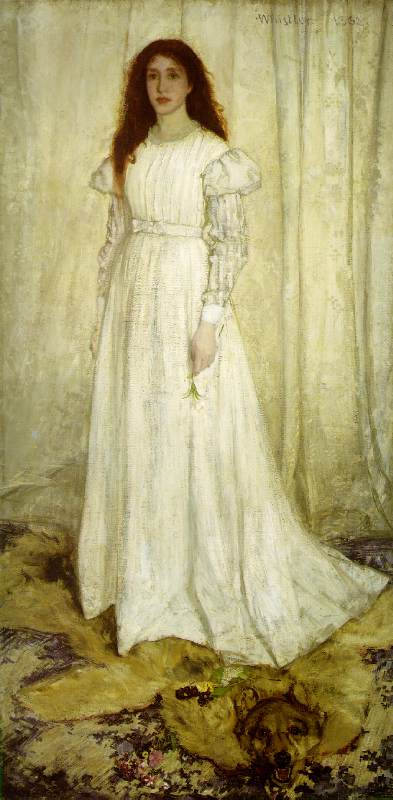
—Whistler

Failing to fetch me at first keep encouraged,
Missing me one place search another…

—Whitman

Holy the supernatural extra brilliant intelligent kindness of the soul!
—Ginsberg

America I’m putting my queer shoulder to the wheel.

QOTD (2009-10-28)

For my QOTD feature, I usually post words which I like, which resonate with me. Today, I am posting words that I hate, because I think that everyone needs to know what a certain tenured professor with an endowed chair at my university thinks about my community and the rights we’re fighting for. An interviewer is asking Prof. George what the fight for same-sex marriage is about, and he responds:

It’s about sex. Those seeking to redefine marriage began by insisting that what they were fundamentally interested in was gaining needed benefits for same-sex domestic partners. Legal recognition of same-sex partnerships was necessary, they said, so that partners could visit each other in hospitals, extend employer-provided health insurance and other benefits to each other, and so forth. Some people who said this were, I’m sure, being sincere. Most, however, were not telling the truth. Their goal was to win official approbation for sodomy and other forms of sexual conduct that historically have been condemned as immoral and discouraged or even banned as a matter of law and public policy. The clear evidence for this is the refusal of most same-sex “marriage” activists to accept civil unions and domestic partnership programs under which the benefits of marriage are extended, but which do not use the label “marriage” or (and this is very important) predicate these benefits on the existence or presumption of a sexual relationship between the partners. So, it is not really about benefits. It is about sex. The idea that is antithetical to those who are seeking to redefine marriage is that there is something uniquely good and morally upright about the chaste sexual union of husband and wife—something that is absent in sodomitical acts and in other forms sexual behavior that have been traditionally—and in my view correctly—regarded as intrinsically non-marital and, as such, immoral.

I’m sure I don’t need to tell you, dear reader, about the many, many LGBT Americans who have died alone in hospital because their partners were not admitted to see them. Dear reader, if marriage rights are about anything, they’re not sex. They’re about parenting and immigration and being able to be with the person you love in his or her last moments.

Prof. George says this about the generational shift in support for marriage equality:

The support of so many young people for regarding same-sex partnerships as marriages isn’t surprising, given the cultural power of the movement for sexual liberalism; but I seriously doubt that it makes the redefinition of marriage inevitable. Young people grow up. Most will marry and have children. They will perceive the ways in which moms and dads complement each other, especially (though not exclusively) in child rearing, and the ways their children benefit from paternal and maternal complementarity. Their vision of marriage and sexuality as having everything to do with feelings and romance will fade. They will learn something about love as an act of the will, and not merely a species of affection; and their understanding of what marriage actually is and why it exists will, in many cases, be deeply enriched. I do not claim that the experience of growing up, marrying, and bringing up children will lead all young people or even most who today say they favor the redefinition of marriage to change their minds; obviously, lots of married grown-ups with children today hold liberal views about sex. But I suspect that it will have a significant impact.

Dear reader, I’m sure I don’t need to tell you about the large quantities of adults who are fighting for marriage equality, especially those who would like very much to get married themselves. Every time I go to Pride or a protest, I see people my age, but also people of all generations. Just look at Frank Kameny: the folks who built this movement may have gotten older, but they haven’t stopped fighting for the causes they believe in.

Finally, Prof. George says this about the aftermath of Prop. 8:

Anyone who contributed money to the Prop 8 effort or played any identifiable role in supporting it was targeted for intimidation. They were depicted as agents of intolerance and enemies of equality. Pressure was put on their employers to fire or discipline them. (I speak from personal experience here: the president of Princeton University, where I am a member of the faculty, was deluged with letters demanding action against me.)

Regular readers may recall that I helped to organize a dance party outside the erstwhile headquarters of the largest single donor to Yes on 8—and that while I have sent President Tilghman many emails, I have never sent her one expressing my objection to Prof. George’s political advocacy. I believe that the solution to speech I find hateful and prejudicial is to speak up in turn in favor of equality and justice, and to do so louder and stronger and in a manner which attracts good media attention.

But if I were a Californian whose state citizenship had just been reduced once more to second-class, and I’d heard that one of the individuals directly implicated in this was a tenured professor with an endowed chair at one of the best undergraduate universities in the country, then yes, I might write to the office of its president to express my disapproval. It is very hard to look at these words, written so starkly on the page, and think that they come from the mouth of someone who is a part of my university, someone whom I have seen in the library or in the dining hall or at public lectures. It is very difficult to acknowledge that there is someone who holds a profession which I particularly exalt (who, indeed, professes) who holds some of the views which I consider to be the most vile and morally indefensible of all views.

Over the years, I have tried very hard to understand Prof. George, and ardent stalwarts of the conservative movement like him. The amount of potted psychoanalysis to which I’ve mentally subjected my political theory professor’s colleague could probably fill a rather large book, possibly even in a multivolume edition. But sometimes, like now, all the objective distancing and black humor falls down around my ears, and I am simply overcome with hatred for this man.

QOTD (2009-10-16)

Auden, “Musée des Beaux Arts,” offered without comment:

About suffering they were never wrong,
The Old Masters; how well, they understood
Its human position; how it takes place
While someone else is eating or opening a window or just walking dully along;
How, when the aged are reverently, passionately waiting
For the miraculous birth, there always must be
Children who did not specially want it to happen, skating
On a pond at the edge of the wood:
They never forgot
That even the dreadful martyrdom must run its course
Anyhow in a corner, some untidy spot
Where the dogs go on with their doggy life and the torturer’s horse
Scratches its innocent behind on a tree.
In Breughel’s Icarus, for instance: how everything turns away
Quite leisurely from the disaster; the ploughman may
Have heard the splash, the forsaken cry,
But for him it was not an important failure; the sun shone
As it had to on the white legs disappearing into the green
Water; and the expensive delicate ship that must have seen
Something amazing, a boy falling out of the sky,
had somewhere to get to and sailed calmly on.

In other literary news, Elizabeth Bishop’s letters are lovely, and the NYT’s reports of the sex in Edmund White’s City Boy (see antecedent post) seem, at a third of the way through, to be greatly exaggerated.

Have I mentioned how much I enjoy that my full-time job as a student, so to speak, is basically to read?

QOTD (2009-10-14)

Edmund White, in an interview with Salon, says one of my favorite things ever about same-sex marriage:

In the past, when gays were very flamboyant as drag queens or as leather queens or whatever, that just amused people. And most of the people that come and watch the gay Halloween parade, where all those excesses are on display, those are straight families, and they think it’s funny. But what people don’t think is so funny is when two middle-aged lawyers who are married to each other move in next door to you and your wife and they have adopted a Korean girl and they want to send her to school with your children and they want to socialize with you and share a drink over the backyard fence. That creeps people out, especially Christians. So, I don’t think gay marriage is a conservative issue. I think it’s a radical issue.

I adore White’s books for so many reasons, and I think the fact that I read five of them this summer has influenced a lot of my thoughts about the history of gay men these past few months. He’s got some wonderful prose, and he writes candidly about gay culture and being gay—that’s a strikingly rare combination, and a risky undertaking in a literary world that tends to ghettoize gay writers. The last few pages of The Beautiful Room Is Empty, in which he has this sort of dadaesque description of Stonewall, are some of the best writing I can think of, for example—not only is the prose just glittering in its surreality (I find it really difficult to describe why good prose is good; you’ll just have to take my word for it), it’s a great way of turning the conventional riotous watershed OMG-Judy-Garland-died-and-now-we-have-a-revolution-on-our-hands kind of narrative on its head.

The NYT reviews of White’s two memoirs, My Lives and now City Boy (I’m still waiting for my copy of City Boy to arrive from Amazon; I’ll report back when I read it) seem profoundly on edge about the frank discussion of sex that pervades them. I mean, this is the Times we’re talking about, so it’s not too surprising; the paper hasn’t always been the most with-it on gay stuff. But even I, who am utterly unshockable, remember looking awkwardly around to see if anyone on the bus was looking over my shoulder while I read what the Times facetiously calls “that S-and-M chapter” in My Lives. Even I was glad that, unlike a lot of other books I’ve read with a lot of sex in them, this one’s cover was discreet.

But I think we have to be profoundly thankful to White for writing literary books in which the narrator acknowledges his sexuality with at least the mannerisms of honesty (even if he’s applying creative license to what actually goes/went on in his head and his life). It’s an increasingly common thing, but it still takes a high degree of courage and literary acumen.

Oh yeah, and he teaches fiction at Princeton. What could be better?

QOTD (2009-10-05); or, In Which Rousseau Is Relevant to the 21st-Century Political Discourse

My political theory class has been much taken with the fact that it’s hard to grasp Rousseau from a present-day standpoint, and that the politico-social environment in which he was writing is just so radically different from our own. But this passage in the Social Contract stood out to me:

Again, it is true that in such cases it is impossible to be too careful about observing all the formalities required in order to distinguish a regular and legitimate act from a seditious tumult, and the will of an entire people from the clamor of a faction. And it is here above all that one must not grant anything to odious cases except what cannot be refused according to the full rigor of the law…. And it is also from this obligation that the prince derives a great advantage in preserving his power in spite of the people, without anyone being able to say that he has usurped it.

Someone should tell that to the teabaggers (not it!).

QOTD (2009-10-04)

Rousseau, On the Social Contract, Book III, Chapter I:

I am warning the reader that this chapter should be read carefully and that I do not know the art of being clear to those who do not want to be attentive

Dude, he’s totally talking to me. Totally.

This may be the shortest post I’ve ever written.