I just realized something.

Every year since ninth grade, I have written a long and conflicted post about why I do not observe the Day of Silence, an event held at many high schools and colleges around the country where students take a vow of silence for the school day in order to mark the less visible and involuntary silencing that many LGBT students undergo every day.

It just hit me that Princeton, as far as I know, does not observe the Day of Silence.

I have my reasons for not remaining silent—to put it simply, I’m a writer; I make action through words, and I always felt like someone needed to speak up for the silent—but the DoS is still a strong indication of how active and organized a school’s LGBT community is. My high school’s Gay-Straight Alliance managed to engage tons of LGBT students and allies every year in the DoS events, despite the high level of homophobia, despite repostering the DoS posters on a daily basis because intolerant people would tear them down. In all of my classes every year, there was at least one person who was silent. Universities do DoS too: it was founded at the University of Virginia, and continues all over—I remember that the UCLA DoS got covered in the LA Times last year. But not Princeton. It’s supposed to be Pride Week at Princeton, but you wouldn’t know it. If you just walked around campus, you would barely realize there were any gay people at Princeton at all—and Pride Week should be the one time when you know, beyond any reasonable doubt, that there is a gay community on a campus.

I don’t know whether a Day of Silence would be successful at Princeton. I notice the contrast from high school here, where students actually volunteer to speak in class. Kids have organizations to run. They have interviews. They’re not going to be silent on Friday. But it reminds me how hard it is to change an institution with a long history of prejudice and marginalization. And how sometimes, on rare occasions, I get this tiny dark feeling deep inside me that I picked the wrong university.

Institutional Queer Space

I am in the midst of a dilemma. It’s not a large dilemma, but it’s one where I honestly don’t know which side I’m leaning toward. It’s about whether to apply to be an LGBT peer educator at school next year.

When I first got the email from the LGBT list soliciting applications, and when I saw the posters around campus that were similarly soliciting, I immediately dismissed the idea from a personal standpoint. It’s not like I think having LGBT peer educators is a bad idea, or that they don’t serve a purpose by providing a resource for students, especially freshmen, who have questions—it’s that I couldn’t see myself in that role. As a self-described radical in my sexuality as well as in my politics, I’ve often found myself at odds with the mainstream of sexuality movements, and wasn’t sure how I would reconcile that with the curriculum that the peer education training would teach (not that, to be fair, I’m fully aware of what that curriculum is). I’m also, to be frank, reasonably conflicted about my own sexuality—I wasn’t sure it would be intellectually honest of me to be on a panel wherein I implicitly suggest comfort with my identity when that doesn’t entirely exist. I rationalized this decision: I think basically everyone I know is aware that I’ve got a one-track mind about sexuality issues, and that I know a lot about queer theory and queer politics for someone whose knowledge is all informal, and that I’m totally happy to talk about anything regarding sex. I figured that I make myself as accessible as any peer educator where LGBT issues are concerned.

But then, this morning, I read this article in the Prince:

Though many University students spend Saturday nights out on the Street in search of their next hook ups, Peter — a gay undergraduate — has found a safer and more discreet meeting place. Peter, whose name has been changed to protect his privacy, said that during his time at Princeton, he has hooked up with “about three guys” he met through posting personal ads on Craigslist.

On a campus that Peter said is “less accepting of gay life” than Harvard or Yale, some gay Princeton students like Peter turn to online venues like Craigslist in search of sexual partners. Posts on the site dating back one month showed 176 results matching the search criteria “Princeton,” “18-30” and “men-seeking-men.” Thirty of these results included the word “student,” and many others made reference to the campus or the University in some other fashion. A similar search on the site for Harvard students yielded just nine posts, while one for Yale students generated 22 responses.

The article goes on to say that, among other things, Peter was kicked out of two eating clubs for dancing and making out with other guys (which certainly wouldn’t generate a response if the contact was heterosexual), and that there are tons of closet cases here doing the same thing, posting ads that say things like ““Be a PU undergrad and discreet.” And I mean, I know that most of the gay people at Princeton are in the closet, but what is this, 1965? Institutionally speaking, the framework is such that it is very possible to be out at Princeton in a way that it might not be somewhere where there aren’t, for example, LGBT peer educators. Yet people aren’t, and I think the gay community here, though it exists, is seen as very distinct from the undergraduate student body as a whole: frequenting certain eating clubs, establishing certain social circles, clearly delineating which spaces (clubs, teams, religious groups, etc.) are safe, and which are not.

This is a huge problem, in my opinion. Space should not be so divided and it’s in the best interests of everyone, LGBT or not, to foster an environment where all LGBT people feel able to come out. Reading this article was genuinely troubling to me—and then I realized that if I wanted to do something about this situation, there was a totally obvious course of action: apply to be a peer educator. I remember my experience freshman week at the LGBT peer educators’ study break as underwhelming and not very informative, but maybe that’s because the first people I met here, even before I matriculated, were through the framework of the institutionalized LGBT community. Maybe being a peer educator could make a difference to some confused and closeted freshman who’s looking for that community, or who wants to be able to come out to her friends, or who wants to meet people with whom she can build LGBT community outside of the institutional framework. I mean, it’s certainly the easiest and most straightforward thing I could do to help more people come out at this very, very closeted campus.

But that still hasn’t resolved the situation. I don’t know what to do, and I’m really quite troubled about it. What do you think?

More on HIV

I’m sure this obsession is getting tedious, but I happened, by complete coincidence, on the following from the Princeton University Residential Living Policies Guide:

HIV Infection
The following excerpts are from “Guidelines for Students Regarding HIV Infection.”

Fundamental to Princeton’s response to HIV infection and other chronic illness is the commitment to respect the rights and reasonable concerns of everyone, including those individuals living with these conditions.

Accommodations for Students Living with HIV

The Rehabilitation Act of 1973, the Americans with Disabilities Act of 1990, and the New Jersey Law Against Discrimination protect students with disabilities. Under these acts and University policy, HIV infection is considered to be a disability. As with all disabilities, Princeton University will make reasonable accommodations for students living with HIV.

Peers of Students with HIV

Peers of those students who are HIV infected are expected to continue to carry out their academic responsibilities in a normal fashion. Should a student experience fear or anxiety with regard to interacting with a fellow student who is known or perceived to have HIV disease, he or she should contact a member of the Princeton University Health Services staff for information on HIV disease, or the Office of the Dean of Undergraduate Students for information about accommodating other requests. Students who wish to transfer to another residence to avoid contact with a fellow student who is HIV infected or perceived to be living with HIV do not have a right to such reassignment.

For further information, please refer to the “Princeton University Policy on HIV Infection” and the complete “Guidelines for Students Regarding HIV Infection” available through the Office of the Associate Provost for Administration, 3 Nassau Hall, or the Office of the Director of Clinical Services, Princeton University Health Services.

UPDATE: Here’s another fun tidbit: “An undergraduate who is to be married during the academic year must inform the Housing Department and provide his or her marriage license before the agreement is terminated.” I call heterosexism on the married student housing.

The Orange Bubble

“The Orange Bubble” is what people call Princeton, sometimes, because the school’s colors are ridiculously orange and black, and because Princeton has a way of insulating one from the real world. Its campus is suburban, in an awkwardly affluent community that bears little resemblance to most other suburban or rural college towns. Its students tend to have little interest in the outside world, or are so hyperscheduled that they don’t have a space for the outside world in their calendars. This was starkly apparent to me today.

My morning lectures today: in my sociology class, racial inequality in America and the legacies of slavery and segregation; and, in my gender and sexuality class, AIDS—a topic which, as my previous posts will attest, I am very shaken by. At lunch, however, I picked up a copy of the Daily Princetonian, as is my wont. Front page, above-the-fold news? The crazies who inhabit the Internet are angry that Princeton’s admissions rate went up by 0.54%. The piece was both an example of inadequate journalism and just general ridiculousness, quoting the most disgusting of comments that were vaguely sexist about University President Shirley Tilghman and Dean of Admissions Janet Rapelye, and complaining about grade deflation as usual. All of this is absurd, and has always been absurd, and there was nothing new about my usual lunchtime rant to my friends about people who are stupid, but today it seemed to contrast so starkly between my morning lectures.

In the afternoon things just magnified. In my journalism class, one of my classmates read a (really excellent) piece she’d written for the class, about a Berkeley co-op that she’d encountered when a spring break trip she took through Princeton’s community service program visited there. I was mind-boggled by how it must have been for this Princeton community service group to encounter all the unusualness of the Berkeley co-ops, and how alien it must have seemed. I think the author of the piece certainly didn’t let that come across when she introduced us to the co-op’s inhabitants, which was great. But I couldn’t help wondering about the culture shock.

To me, it is Princeton who is out of step with reality. I’ve grown up in this sheltered environment with this really specific idea of what’s sensible and sane and right. In a way, to me, the nudity and veganism practiced at the co-op in the piece are less weird than bitching about grade deflation or the fact that this university isn’t an old boys’ club anymore. But I’ve been wondering for hours now how skewed that perception is. What part of my day was the reality check? I still don’t know.

Anachronisms

I am a sucker for anachronism. It probably started back in the days when I was a middle-school kid who was convinced I should have been born in the 18th century, so that I could defend Bonnie Prince Charlie to the death. Or something like that. (It’s a long story.) But now I appreciate music from 30 or 40 years ago, and political sentiments from about the same era. I relish anything that seems at odds with 2009, with the Internet, with jaded cynicism, with the Princeton Organization Kid. And that’s why I’m writing about the band that was at Terrace last night.

Terrace is an eating club, and incidentally the only one in which I will voluntarily set foot. It is also known for its regular high-quality live music, and because I am lame and because most of the bands I like are dead (see previous paragraph), it’s basically the only place I usually see live music. Last night, though, the band was something else. It was playing punk music, which I suppose is not a particularly unusual thing for a band to do; however, it was also from London (which is less usual—at least, in Princeton, and not in London), and its singer/frontman looked to be in his fifties and not quite aware of it. He was wearing ripped jeans, a be-safety-pinned black t-shirt, and glitter-festooned sneakers that would have been quite chic in the early ’80s. Most of the time, he sort of yell-chanted songs; sometimes he played the drums; sometimes he made pronouncements about the evils of religion and George W. Bush (a few people in the audience yelled “He’s gone, man!” but the frontman appeared unaware of the past six months’ events); at one point he walked through the crowd on the dancefloor holding a pair of drumsticks in front of him like a cross—trying to cast out demons, perhaps? It was unclear. He would frequently preface a song by saying “I wrote this in 1978.” He jumped up and down with an energy and agility that 50-something-year-old men aren’t supposed to have. I’m pretty sure he had more in his system than the two beer bottles standing by the amps. But he was fantastic! He was so infectiously energetic! He made me want to jump up and down and yell “Down with Thatcher!” And that was the best bit. I feel like, as someone born in 1990, I really missed my opportunity to be furious at an evil neoconservative government. I do like punk music, in general, and I find it sad and disappointing that I missed the historical era when it would have been relevant.

The other kids at Terrace though the guy was entertaining, but I don’t think they really got him. They turned to their friends, half-laughing. “What’s he doing?” they asked when he exorcised the crowd with drumsticks. One drunk-seeming kid went up to him and criticized him for declaring that “Absolute power corrupts absolutely” without attributing the quotation. “Only at Princeton,” I thought. But I really felt sorry for him. People are angry at the government and the establishment now in such different ways than they were in the ’80s, and particularly at Princeton. I think people in the audience liked him because he was outlandish, or because they were drunk—not because they really sympathized with his message. Even I felt uncomfortable to hear him criticize religion—at Princeton, that’s not the sort of controversial ground you tread on.

I was thinking about this in terms of reading I was doing for class about the role of the media in both the first Gulf War and the invasion of Iraq. It was deeply weird to read a historical account of the invasion of Iraq, because I conceive of it as a current event. Six years isn’t so long ago. I remember the day we had a debate in my 8th-grade history class about whether it was right to invade Iraq. I remember how I was the only kid saying that we didn’t know whether Saddam Hussein really did have weapons of mass destruction. I remember how there were other kids in the class who thought that, but that they wouldn’t speak up, and I had to take on all the Bush supporters by myself. To my mind, we still know so little about the events and decisions surrounding the wars we’re now engaged in—not to mention the fact that we’re still engaged in them. How can we historicize them?

Maybe this is how my high-school history teacher, a Vietnam vet, felt when we learned about Vietnam in class. Maybe this is how my mom feels, when anyone talks about the DNCs and election night results of the ’70s and ’80s that she remembers watching on TV. And maybe this gets back to what the leader of the band at Terrace last night was doing, when he assumed what seemed to me to be such an anachronistic pose. If I may put words into his mouth for a moment, as far as he is concerned, the threat of Thatcherism isn’t over. Bush II was a convenient vehicle for that ire as well. But he’s a bit lost at present for a figurehead upon whom he can thrust his dissatisfaction with the establishment. His feelings are no less real. But he’s now forced to frame them historically, not in terms of current events. That’s got to be disorienting.

Maybe my temptation is to view anachronism as quaint, sort of like one of those living history museums, just for 20th-century social alienation instead of colonial America. But on a more intellectual level, I think there’s something to be said for not relegating, say, anti-Thatcher sentiment to history entirely. As I think we learned from the Bush presidency, the same political issues, the same sentiments, the same ideological battles come up again. And again. And again. We need to be keeping feelings of outrage on the forefront of our minds, because if we don’t, there’s a very real chance that we won’t notice when the next deeply objectionable thing happens. I know that I want to study and teach history in part so that we can learn from our mistakes—but while doing that, we still need to be aware that history isn’t a done deal. Everything that’s going to happen in the next week’s news cycle is eventually going to be history. What will we remember when it comes to make decisions based on its lessons?

Culture Shock

There are so many things in my life that I’m not blogging about. This week, I went to a professor’s office hours for the first time, and it wasn’t scary, so I’m over that hurdle. I’m also reading Milton for the first time, in my English class, which is this incredible experience. On Sunday, I’m going on a pilgrimage to Paterson, NJ, Allen Ginsberg’s birthplace, on a quest for his childhood homes, some form of spiritual enlightenment, and fodder for a piece I’m writing for class. I’ve been running around like mad this week, going to all sorts of things, from film screenings to quizbowl matches. It’s all wonderful, and I want to write about all of it, how intellectually fulfilling it is, how all my dreams for the future and really inhabiting this world of knowledge and scholarship are coalescing, how I’m becoming a writer as well.

But the weird thing is that what prompted me to go to my computer, go to WordPress, and write this post was the experience that turned all that upside-down. Now I’m very confused about myself and the mental place I’m at. Now I don’t know how at ease and how excited I feel about any of this.

I let some friends talk me into going to a conference on literary criticism and theory, sponsored by the English department, among other people (actually, according to the poster, by basically every humanities-centric entity in the university). And so I went, this morning, to two hours on poetry. I listened to three talks, by three very eminent scholars, standing in the back next to more presumably eminent scholars. I didn’t see any other undergraduates there, or anyone who looked young enough to be an undergraduate. That isn’t usually a problem. I’m very accustomed to being the youngest person in a room. And I’m very accustomed to academic gatherings. How many times have I fought to be able to sit at the grown-ups’ table when my parents’ colleagues come to our house for dinner?

But this was so very different, and you might already be able to see why—because I haven’t told you what those three scholars spoke about, and I haven’t told you what I learned from their talks. Because, you see, I was barely able to understand anything they were saying. I mean, I think I was kind of expecting that—I have no exposure to literary criticism; my only exposure to the study of English literature has been half a semester of Chaucer, Spenser, and Milton. But I still found myself in shock, a bit, at how the words washed over me, sort of like when I watch French-language TV and can pick out one word in three, or one word in five—not enough to piece together the overall meaning of the sentence. Or the paragraph. Or the talk. Bending my knees awkwardly to relieve the pressure of standing up so long braced against the back wall of the lecture hall, I tried to make myself “translate” more attentively, the way I do when the francophone person I’m trying to understand is not hosting a late-night talk show, but rather telling me what will be on the exam. But it was largely ineffective, and I resorted to simply seeming attentive, scribbling down notes not about the content of the talks, but about the fact that I didn’t understand.

Sometimes my parents’ colleagues talk shop when they come to our house for dinner, and then I don’t understand what they’re saying. Sometimes upperclassmen and grad students whom I eat dinner with at Princeton have conversations referencing knowledge that I lack. But never do I feel entirely out of place, there; never do I feel a genuine sense of embarrassment to lack familiarity with very obvious things like Freud or Wordsworth or a vocabulary of jargon that I can’t even remember enough to reiterate here. In the former contexts, it’s okay to just be an academic brat—in fact, that’s what I’m expected to be, when my parents’ colleagues ask them if I will study their disciplines, or I rant in the dining hall about something I’ve read in The Chronicle of Higher Education. And there’s nothing wrong with that—because that’s what I am.

Lately I’ve been cultivating this idea that I’m moving on from “academic brat” to “academic,” that I’m starting to learn higher-level ways of thinking, that I’m honing in on subjects I could study for the rest of my life, and that I’m slowly and steadily immersing myself even more irrevocably in academic culture. But what going to these talks this morning taught me—instead of anything that I’m sure was totally fascinating about the theory of poetry—was that I should stop trying to be something I’m not. That I should accept that I’m a college freshman and that therefore I don’t know shit about literary criticism or anything else theoretical, really. That I should go back to my 200-level lectures and catch up before I try to sit at the grown-ups’ table and really participate in the conversation.

One of the reasons I justified to myself attending these talks was that I volunteered to write an article about them for The Nassau Weekly, Princeton’s foremost student publication (of course). But now I’ve no idea what to say. I can’t talk about the substance of the talks because I didn’t understand them, and the self-deprecating essay on academia that I’d considered seems impossible to write in the context of my voluminous bubble of pride and pretentiousness being burst. So I guess I’m just going to have to start catching up, and maybe give the scholars who spoke this morning the respect of understanding what they were talking about a few years from now, when I’m not such a boorish and philistinic (?) freshman.
The Youth of Today

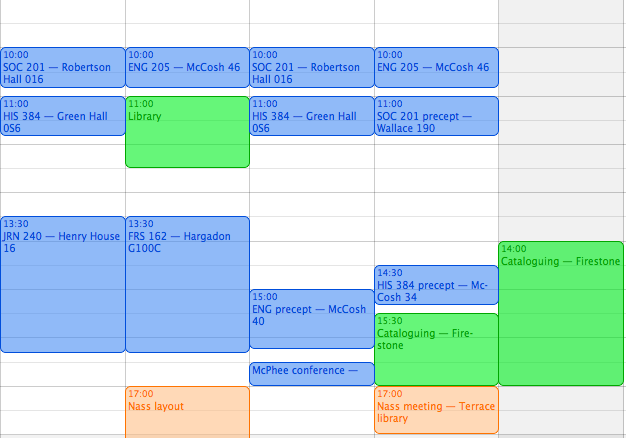
Brooks’ “Organization Kid.” That one NYT Magazine article that produced the college essay contest. That dude from Yale who couldn’t talk to his plumber. These articles about the country’s elite universities and the kids who attend them (the first two articles are about Princeton and UChicago, respectively). I know that when these articles came out, they provoked a lot of conversation among their subjects, those kids of privilege whose lives are on track from the best high schools to the best colleges to the best jobs, not stopping to look around, so overscheduled, so grade-obsessed, so politically moderate and so shallow. That portrayal is what provokes the outrage, anyway, among the Ivy League kids who read these articles. “I’m not like that!” they say.

I said that too, to all three articles. “The Organization Kid” was published in the Atlantic Monthly in 2001, when I was 11, but I read it some years later, when I was in high school. And when the NYT Magazine article came out in 2007, and William Deresiewicz and his plumber in 2008, I was still in high school, and I was applying to those colleges. As I applied to Princeton, UChicago, and Yale (among other places) and eventually came to choose Princeton, I hated these articles. They were so unfair, so one-sided, so unreasonably polemic. I dismissed them angrily, as the age-old phenomenon of the older generation unilaterally decrying the younger.

We read “The Organization Kid” in one of my classes at Princeton last semester, and I had occasion to go back and re-read the other two articles today. And after a semester and a half right in the center of the phenomena all three authors are talking about, I find that my knee-jerk reactions are very different. Instead of saying “Those colleges aren’t like that,” I find myself saying, “I’m not like that. Don’t lump me into your judgment of what Ivy League kids are like. I’m different.”

It’s a stupid reaction, isn’t it? It’s a perfectly egotistical reaction, exactly the one that one of those self-centered and spoiled brats would have. Maybe the Ivy League is working its evil spell on me, changing me so that I am one of Brooks’ overscheduled kids, Perlstein’s apathetic kids who aren’t like yesterday’s UChicago students, or Deresiewicz’s grade-grubbing, careerist kids, and maybe it’s closing my mind and my sense of perspective so much that I can’t see how these words of warning apply to me. But yeah: when we read “Organization Kid” in my freshman seminar last semester, and kids were saying how they didn’t think it was a valid assessment of Princeton culture at all, I found myself thinking “Are you blind? Have you not eavesdropped in the dining hall during weekday lunchtimes, or done the same in the eating clubs on Saturday nights? Aren’t you aware of the people around you—and indeed yourselves?” And then I am so insulted to see myself, as an Ivy League student, lumped in with Deresiewicz’s derision. I am not a grade-grubber (as I’ve said before); I don’t consider myself entitled. I went to an average public school and I know some great plumbers with interesting things to say. And I am also downright furious to read Deresiewicz characterize legacies (the children of alumni) as people “who aren’t up to standard to begin with.” Yes, technically speaking, I am a legacy at Princeton. But I went through way too much self-doubt because of it last semester to sit here now and be told that I’m not up to standard. I know that I’m qualified to be at Princeton and I know that I’m benefiting from the education in every conceivable way. Deresiewicz has no right to brand me with that iron, if that’s the metaphor. I’m sure it’s not. (But my legacy status can’t be blamed for my ineptitude with metaphors.)

Well. I meant for this to be a coherent essay, and I think it kind of got off-track. It’s quite a bit later in the day than when I started writing it, and I’m very tired and burned out. But I can tell that my life in the Ivy League is going to be a very long and winding road indeed. If my academic ambitions stay consistent, I could remain in the Ivy League for the rest of my life. But yes, I will keep my soul and my personality; yes, I will still get on quite well, thank you, with tradespeople; and yes, the radical fire still burns within me. So I’m going to stay true to form and keep blogging about why columnists are wrong about who I am. Oh hey, and if there are any columnists out there reading—next time you want to write an Ivy League article, pretty-please hit me up for an interview?

Campus Dailywatch (2009-02-10)

IvyGate’s roundup of today’s headlines in the Ivy dailies mentions the Daily Princetonian‘s above-the-fold piece about Meg Whitman’s bid for governor of California. This, indeed, is a rather silly article, very much in the mold of every Ivy League daily’s tendency to run a story every time some alumnus does something in order to fill space. To be fair, there is some decent Princeton-focused reporting in the article, but also a fair amount of cribbing from the WaPo and the Sacramento Bee.

But what I really wanted to mention is that IvyGate is overlooking the most incredible thing to come out of the Prince today—more incredible even than one eating club’s computer fuck-ups: a very odd column by opinion editor Barry Caro in defense of bicker.

Keep in mind that I hate bicker. It’s a disgusting institution that for several decades has been a stain on Princeton and a major detractor for a lot of folks who consider going here. So keep that bias in mind. Also keep in mind that Caro professes to be no fan of bicker himself—after all, he says, he joined a sign-in club. But statements like this still get to me: in response to other writers in the Prince who criticized bicker’s exclusivity and cliquishness, he writes, “I must have missed the all-Street meeting where club members are told that our mission is to mercilessly mock people.” Oh, so there has to be a meeting for something to be true? I’m not such a hardline radical that I don’t understand sarcasm, but cliquishness is kind of the entire point of eating clubs. Some people get in; some people don’t. That’s especially true for bicker clubs, where getting in is based not on a lottery, but on an evaluation of one’s personality and in some cases one’s appearance, one’s family background, and other such factors. This isn’t an overtly acknowledged factor, but even this freshman can see how folks posture and pretend and flip out about trying to act like the sort of person Club X would accept. It’s like the middle-school popular crowd all over again, but even worse—because now it’s 20-year-olds who really should know better.

Caro also says, “I’m also curious how Loh holds what I believe are two completely contradictory critiques of the eating clubs together in his head: that they both enforce conformity and are a reflection of social balkanization.” Clearly he hasn’t been around many young people’s social groups, because it’s perfectly obvious to me that when self-segregation according to stereotype occurs, there’s a certain amount of pressure to then live up perfectly to that stereotype. Think of the jocks, the drama kids, the rich and popular kids, all those groups from high school. And think about the social influences all those groups exert. Don’t you have to dress a certain way, hold a certain set of interests, profess a certain set of beliefs, in order not to get weird looks? I can’t believe that I’m the only kid who had that experience—and I know that, too, because I look around Princeton and see hundreds and hundreds of kids who are too scared or too unimaginative to break out of this heightened preppiness that the social environment at this university engenders. Even I’ve felt it—I came home at Christmas and bought some nicer clothes, so that I wouldn’t feel underdressed in class. I’m consciously trying to learn to modify my rhetoric so that it’s acceptable to the Princeton style of discourse. And I’m careful of the things I say so that I’m accepted, even if the groups from which I’m seeking acceptance are “alternative” crowds. It’s how the world works. Caro’s living in a fantasy land if he thinks that’s not what people do.

Caro concludes by saying that the eating clubs are what make Princeton special, and that if you don’t like it you should go elsewhere. Well, in a way that is a valid point, and many people have gone elsewhere. I almost did, and I can’t tell you how many kids I’ve talked to who didn’t apply to Princeton because they were so disconcerted by the Street. But personally, I don’t see a huge problem with making eating clubs an accessible option to everyone, regardless of financial ability or gender or social status or anything else. I think it’s deeply troubling to have it publicly acknowledged that exclusive elitism is at the center of Princeton’s social scene. And I’m angered and disgusted by folks who are so disinterested in making this university a place where anyone could want to go to benefit from the world-class academics. I really don’t think fulfilling President Tilghman’s green-hair line is too much to ask.

The Prince wrote me an email today, inviting me to come to their open house this week. I told them I wasn’t interested, and after reading this column (and the full-page ad from the Cato Institute on the facing page), I’m even more sure of that. I, after all, proudly write for the Nassau Weekly. It may be its own self-selecting social scene, but at least we publish coherent and intelligent articles that aren’t predicated on upholding everything that is wrong and outdated and elitist and exclusionary about Princeton’s social environment.

Campus Dailywatch (2009-02-09)

I don’t think any of today’s headlines can possibly surpassed by those of my own college daily. A couple highlights:

Thirteen go to hospital post-Bicker, proof of how disgusting, not to mention anti-intellectual, Princeton’s selective eating club scene is.

Class of 2012 president resigns to take off spring semester, for “personal reasons,” you see. I’ve heard rumors, but I probably shouldn’t repeat them on the interwebz—needless to say, the scandal that continues to plague our student government is pretty fucking entertaining.

On an unrelated note, I picked up a card from the table in the dining hall at lunch today. On the front, it says, “If you could ask God ONE QUESTION, what would it be?” The reverse lists some dates with discussion topics: “Why is there suffering?” “Who was Jesus really?” “What about Science [sic]?” “Is Jesus the only way to God?”

I won’t lie: I laughed for like five minutes and continued to repeat those questions over and over again in silly voices to the folks I was sitting with. Yeah, I know, I’m a terrible person.