BREAKING: Gender-neutral Housing Comes to Princeton!

I’ve never legit gotten to break a story before, but I just found out that some news I’ve known for 24 hours is now public: Princeton will have a gender-neutral housing option starting in this spring’s housing lottery for the 2010-11 school year.

The proposal, authored by student members of the Undergraduate Life Committee, with the help of yours truly, was approved by the ULC two weeks ago and then got a necessary second endorsement from the Council of Masters (of the six residential colleges) yesterday. It’s a pilot program which designates Spelman Hall, an apartment-style housing option for upperclass students (in which, significantly, every student gets their own bedroom), as gender-neutral. Instead of having to draw in groups of four students of the same gender, there will be no gender requirement on groups entering the Spelman draw. The ULC, the USG, the Housing office, and anyone else with a stake in the issue will be watching pretty closely to see how this plays out next year. Depending on interest, they may choose to expand gender-neutral housing to other upperclass dorms, or to keep it restricted to Spelman.

This is a big step forward for Princeton, which, until the ULC undertook this proposal, was the only university among the Ivy League and a set of other R1 universities that had never actively considered a gender-neutral housing proposal. While this pilot program may go on to affect relatively few people next year—particularly since it’s only an option for students eligible for the Spelman draw anyway—it’s a major change in university policy that brings Princeton quite dramatically and unequivocally into the 21st century. I can’t help gloating that it puts us ahead of Yale (which withdrew its pilot program last year to considerable undergraduate ire), and the fact that it happened with relatively little fanfare speaks very, very well for this university and its administration.

I’m extraordinarily proud that I can say I had a part in making this happen, however small. We all have to do what we can to make our communities places we can be proud of, and create circumstances that will be better for the next generation. Now we have to turn our attention to making sure the pilot program goes well next year, but I can’t resist taking at least a few days to bask in the warmth of having made real, discernible change to the policy of this place.

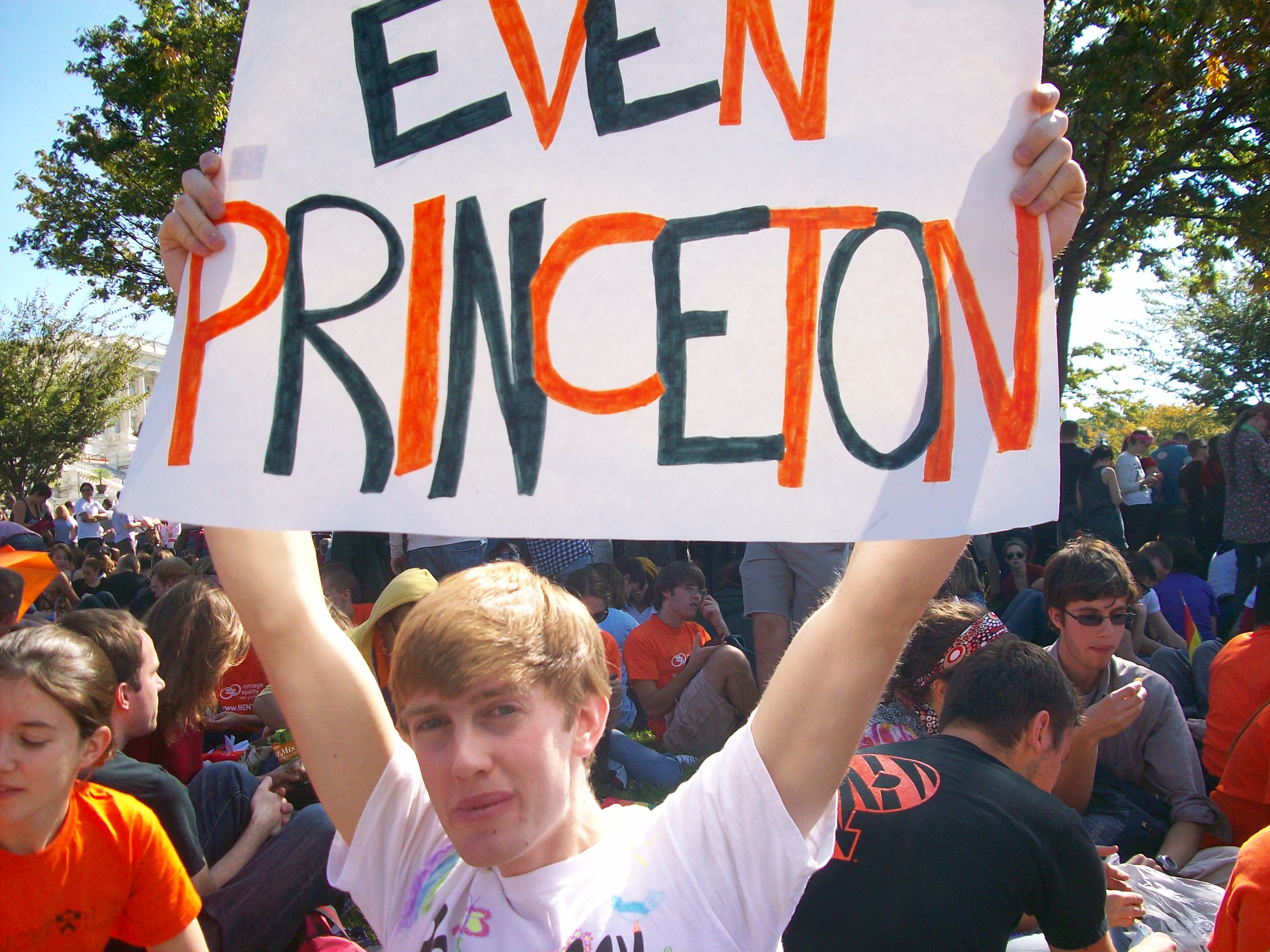
Even Princeton, folks. Even Princeton.

(cross-posted)

Even Princeton; or, This Is What Democracy Looks Like!

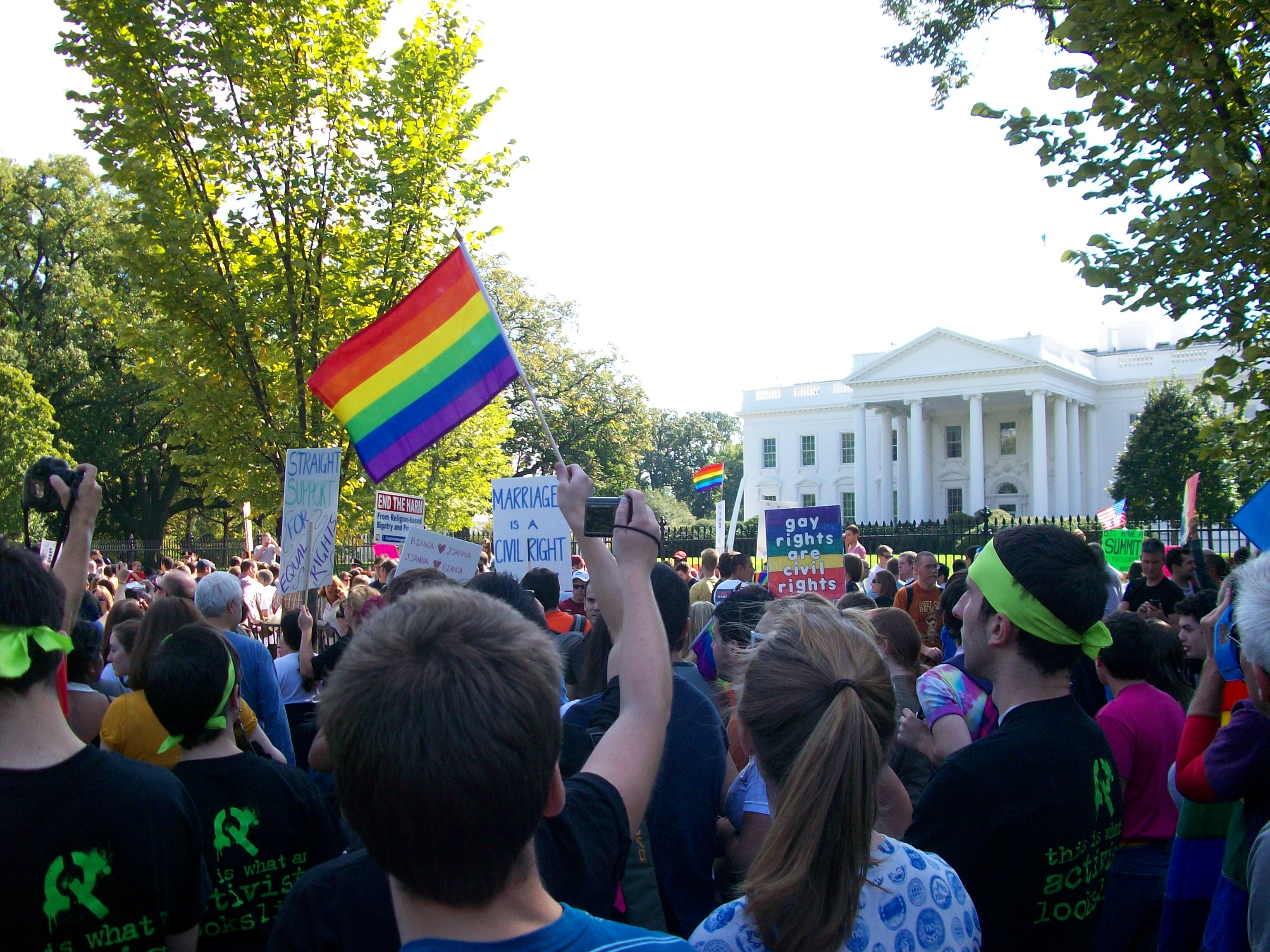
I have marched on the San Diego Hall of Justice and City Hall in Manhattan. I’ve protested in Princeton and at Scripps Ranch High School. Today, I marched on Washington. Today, like my mother before me and in the footsteps of a proud tradition of activists and organizers, I got in a van at 6:30am and drove down to Washington.

100_1212

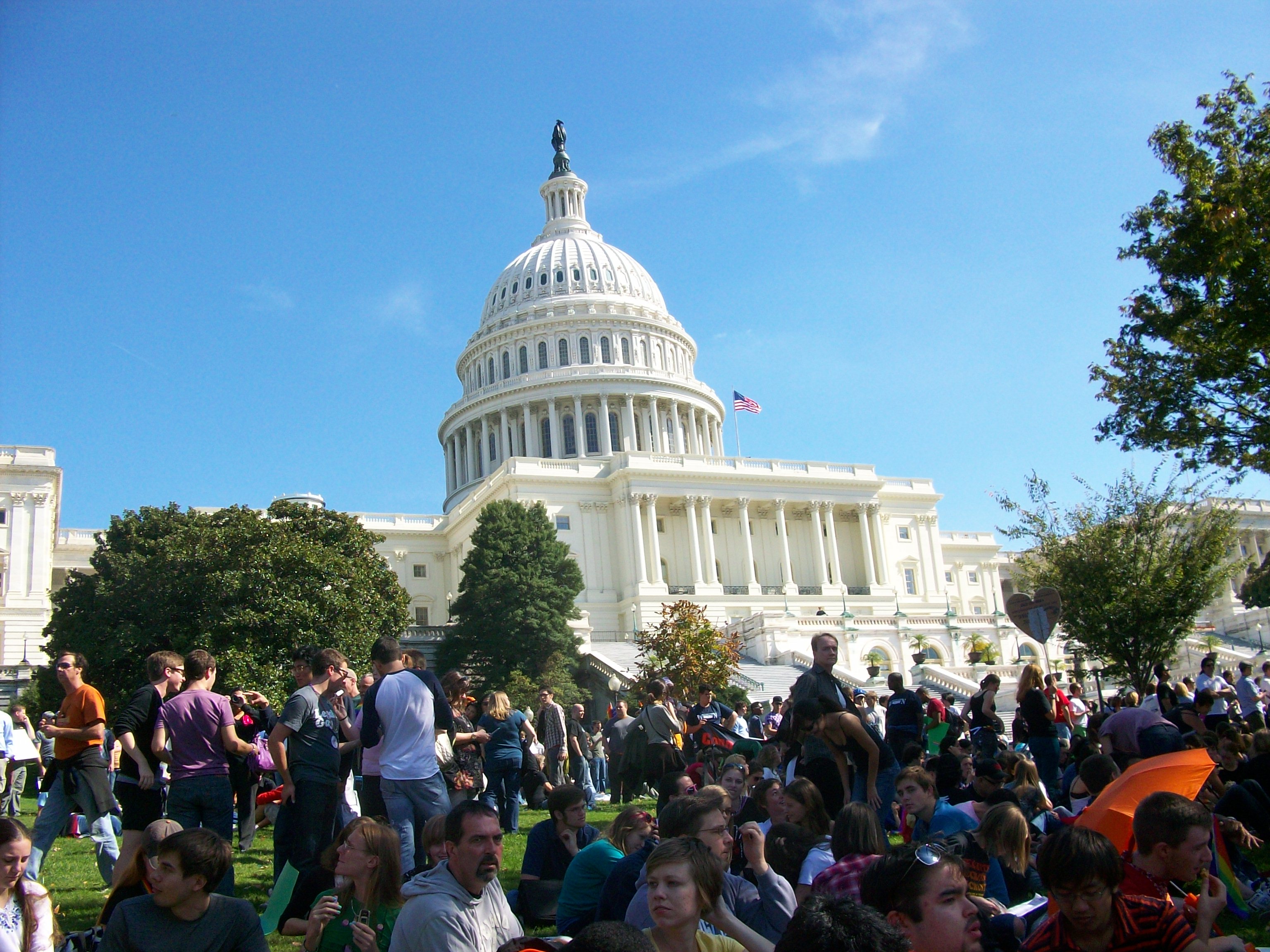
I marched. I chanted and shouted and cheered (I lost my voice). I cried, especially at the rally when Dan Choi spoke, when Staceyann Chin performed, and when Cleve Jones spoke. I cried most of all when the cast of Hair, who canceled a show to come to the march, sang “Let the Sunshine In.” Readers will perhaps be aware that no song is dearer to my heart than “Let the Sunshine In.” It represents all that is wonderful and all that is left unfulfilled with regard to the American promise. There was no way I could have heard it sung live on the steps of the US Capitol with rainbow flags flying everywhere and not have started to sob. I caught a couple minutes of video of the song, but all you can hear is my tired voice cracking as I try not to cry.

100_1234

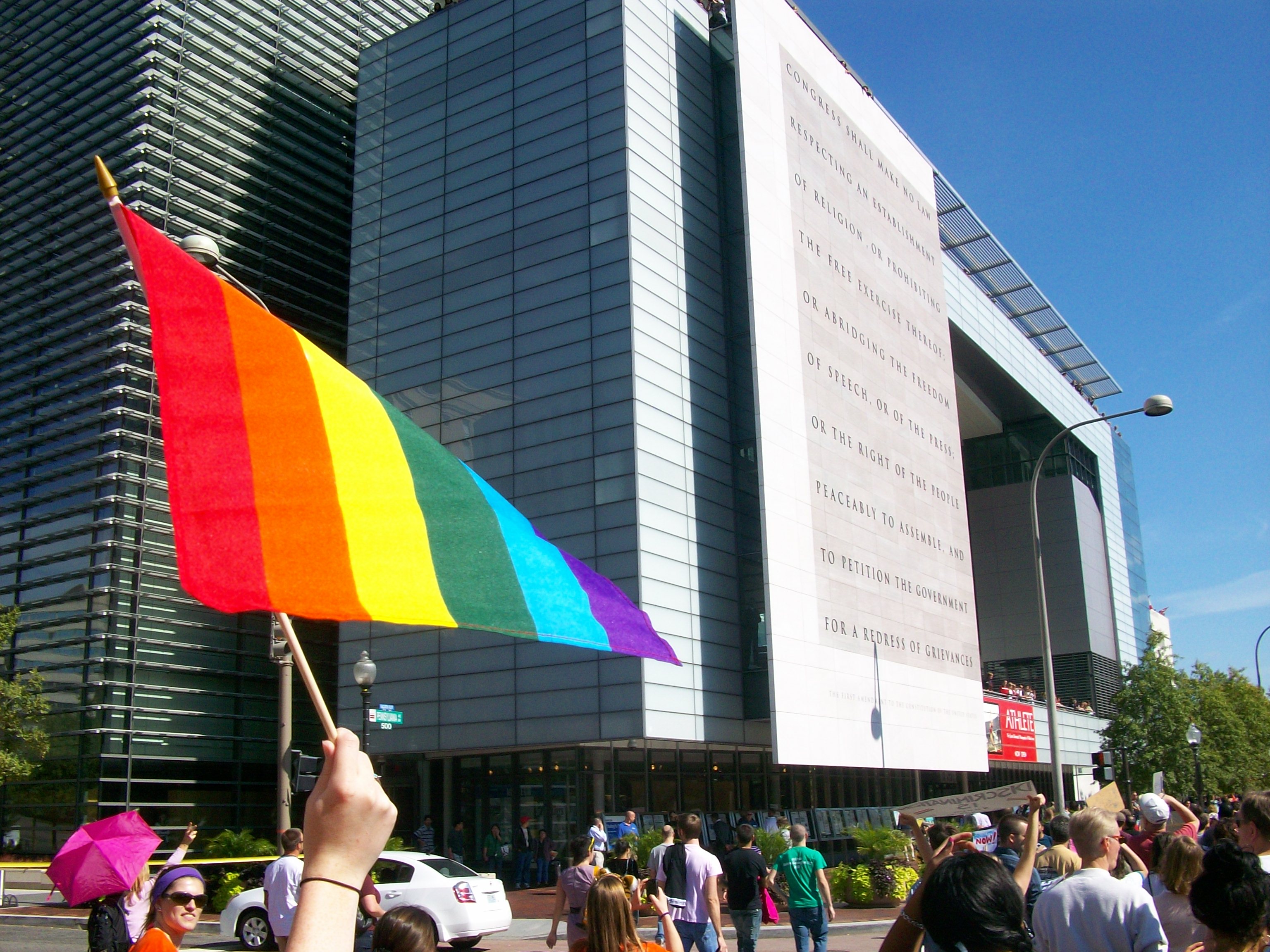
There is nothing so incredible when it comes to exercising your freedom of speech as marching past the White House, past federal buildings of all kinds, right up to the steps of the Capitol. There is nothing so incredible as marching in solidarity with your friends and your classmates, but also all the marchers around you. There is nothing so incredible as being able to get 70 people—many of them first-time marchers—from Point A to Point B, and realize that they, too, have loved every minute of it (thanks to EVERYONE, particularly the first-timers, for coming with us today!). There is nothing so incredible as someone coming up to your Princeton contingent to say “I graduated in ’05, and we would never have gotten together a group like this then.” Even in four years, things change. Just think where we’ll be only a few years from now.

100_1253

Some of the speakers at the rally referred to the activist legacy that brought us to the steps of the Capitol today. They referenced the civil rights March on Washington in 1963, and countless gay/LGBT rights marches. The invocation which began the rally called out not to God, but to the spirits of activists like Phyllis Lyon and Del Martin, Harry Hay, Frank Kameny, Harvey Milk, and many others. None of those people, in the time that they began their activism, could have brought 100,000 people to the steps of the Capitol to fight for LGBT civil rights. And yet without their struggles, that couldn’t have happened today.

100_1265

I came home tonight to two things: a tweet from a colleague-friend who proposed different means to the same or similar ends (in other words, Maine before marching), and a flyer from Princeton’s Anscombe Society, advertising their proposal for an Abstinence and Chastity Center on campus. In utterly different ways, both things questioned how I chose to spend my Sunday (and the past few weeks in planning for this Sunday). To my colleague-friend, I say that the fight for equality is not a zero-sum game; I’ve donated my time and my money to Maine even as I remain focused on making sure a contentious election in my own state works out. But doing so did not preclude me from marching today. As they say whenever we do these kind of things, we march for those who can’t—and so I marched today for second-class citizens not just in Maine, but all over America and all over the world. I marched for the people who are unable to come out or unable to travel; I marched—as one speaker at the rally said—for all the people who would have marched today had they not been lost to AIDS or to anti-LGBT brutality. As to Anscombe: I laughed when I saw the flyer that had fallen under my door; I wished I’d been able to tell the kid who dropped it so that I could tell him what a waste of a flyer it was. I wished I’d been able to make sure he knew how 70 kids at his university spent their Sunday.

100_1276

Tomorrow is National Coming Out Day, and my name will appear along with 600 others in an ad in the day’s honor in the Daily Princetonian. There is actually probably nothing more important in this struggle than coming out, and being brave enough to sign your name to something like this. But the old chant does go “Out of the closet and into the streets!” and I think the second clause is nearly as important as the first.

100_1275

(cross-posted)

The Winds of Change; or, What Do We Want? Equality! When Do We Want It? Now!

This is where our world stood 50 years ago:

homophiles

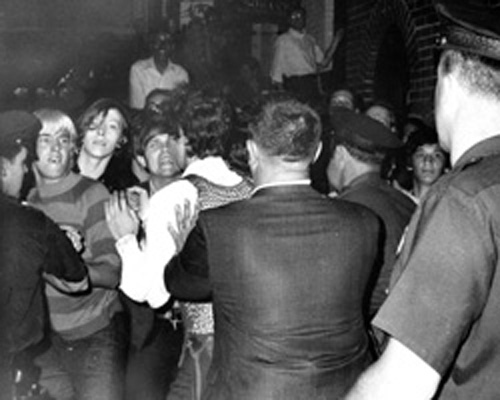
This is where our world stood 40 years ago:

stonewall_riots

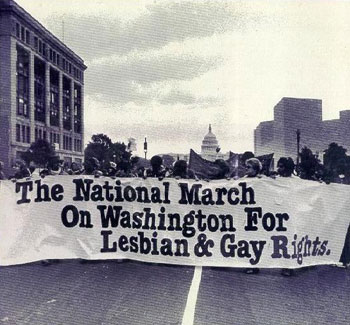
30 years ago:

1979_march

And, today, though circumstances may have changed drastically since then, we’re going to do it again. The arc of history bends towards justice, but sometimes you just have to march.

What do we want? Equality! When do we want it? NOW!

100_0501

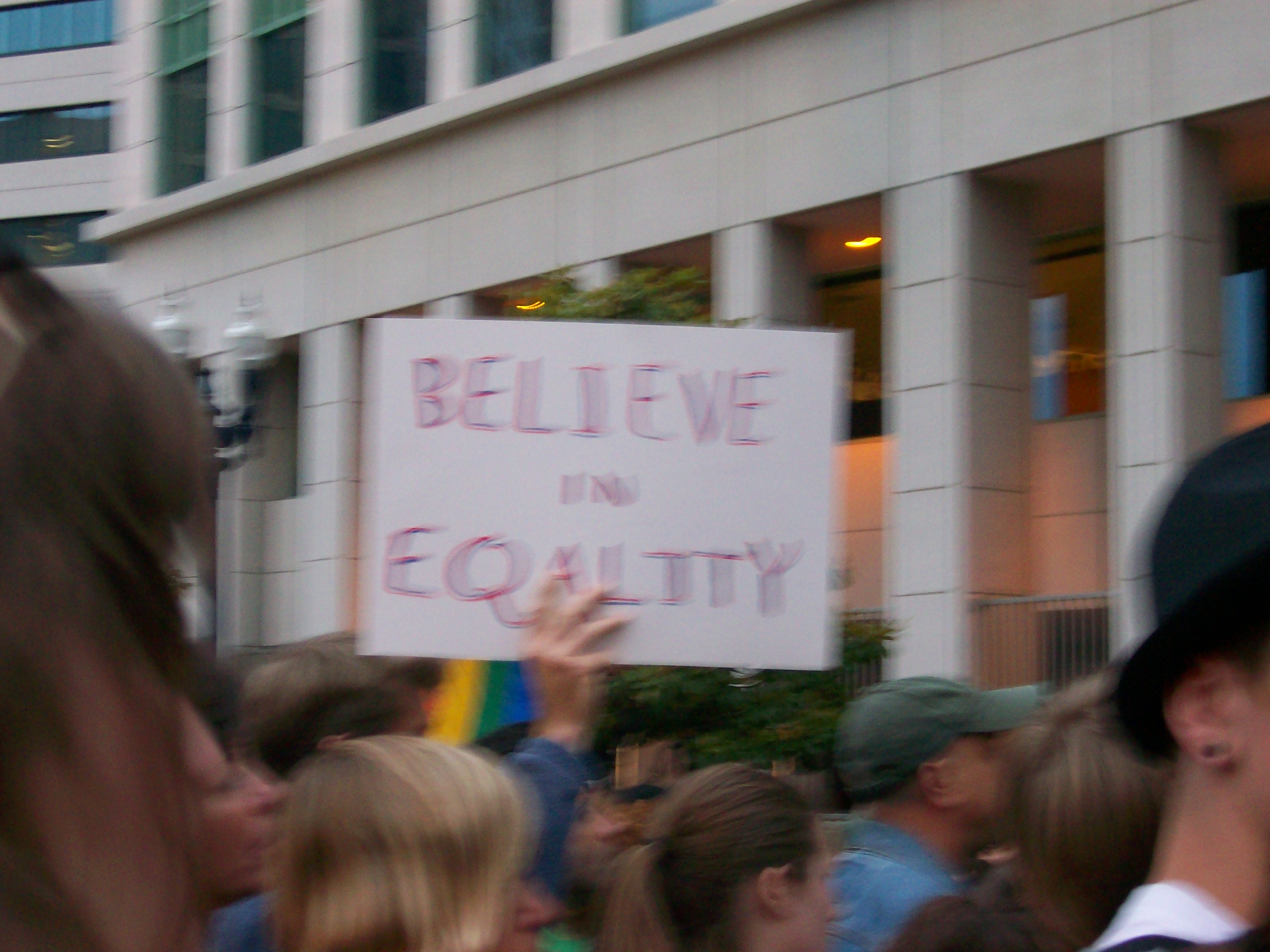
When I get home, I’ll post a picture of our “Even Princeton” sign, out in the streets of Washington.

Sometimes You Just Have to March

So I went for publicity over dignity and pitched an op-ed to the Daily Princetonian. To my pleasant surprise, they liked my pitch, the editing process was actually quite congenial, and I’m reasonably proud of the result. The article is about why the National Equality March happening in Washington on October 11 is a good thing for LGBT rights and a good thing for college students specifically:

Thanks to civil rights activists working long before any current Princeton undergraduate was born, it is possible for queer youth to live out and proud lives to an extent that it wasn’t 30 years ago. But as long as being LGBT means second-class citizenship, more progress must be made. Some change can be enacted through laws and policy proposals, but broader societal support for those laws and policy proposals is essential if they’re to be effective. And sometimes getting that support really does necessitate marching in the streets.

On Oct. 11, thousands of people who believe in civil rights for all will converge on Washington, D.C. They’re participants in a National Equality March, which will wind its way through downtown Washington and culminate in a rally at the Capitol. The march has one demand — “Equal protection in all matters governed by civil law in all 50 states, now” — with which it aims to transcend disagreements about which particular aspect of LGBT equality should be the first priority.

Read the rest here.

And then come to the march! There’s a group of us at Princeton getting together a bus to go down to DC, and if you’re a member of the university community who’d like a spot on that bus you should let us know.

In 1965, a group of Princeton students under the auspices of a campus SDS chapter participated in the national anti-Vietnam March on Washington. They carried a banner that read “Even Princeton.” I love this story, because it reminds me that however frustrating this campus climate may seem at times, there’s nothing to stop you from marching for justice and equality and freedom and civil liberties in the name of its students and in the name of students—and all people—everywhere. I’m going to make a sign to carry at the National Equality March that says “Even Princeton,” and I’m going to be proud to represent my community in DC.

(cross-posted)

In Which I Get Defensive About Princeton, Again; or, Ivy League Admissions from Across the Rubicon

I usually think Kevin Carey is really smart and spot-on when it comes to analyzing higher ed policy. And given the poor decisions Harvard has made recently in doing damage control on its endowment losses, I thought I would really appreciate his most recent piece in the Chronicle of Higher Education (you might need to have a subscription/be on a university network to access that link):

Harvard spent the money on many things. But not a dollar went to increasing the number of undergraduates it chose to bless with a Harvard education. In 1990 the university welcomed slightly more than 1,600 students to its freshman class. In 2008, $32-billion later, it enrolled slightly more than 1,600 freshmen.

That is remarkable stinginess. Harvard undergraduate degrees are immensely valuable, conferring a lifetime of social capital and prestige. The university receives many more highly qualified applicants than it chooses to admit. Because the existing class includes underqualified children of legacies, rich people, politicians, celebrities, and others who benefit from the questionable Ivy League admissions process, Harvard could presumably increase the size of its entering class by, say, 50 percent while improving the overall academic quality of the students it admits.

I have my issues with the first paragraph, but I find the second one far more problematic. Carey states as fact that “the existing class includes underqualified children of legacies, rich people, politicians, celebrities, and others who benefit from the questionable Ivy League admissions process.” I know, I know, there’s been bestseller after bestseller that has attempted to demonstrate the extent to which Ivy League admissions are unfair to the earnest but non-connected student who just can’t get into Harvard because s/he doesn’t know people in power. I’m sorry, but that’s just not the case. You have to meet a basic standard of academic competence to be admitted to Harvard. Or Princeton. Or any of their peer institutions. I know, I know, George W. Bush, but since about the late ’80s family connections have begun to be far less of a point on which college admissions turn. If you’re worried about nepotism, you should be taking your concerns to politics or journalism and publishing, not colleges.

One phrase of Carey’s stands out to me—maybe, if you’ve been reading this blog for a while, you’ve already figured out which phrase I’m referring to: yes, it’s “underqualified children of legacies.” First of all, that’s not the right phrasing: “legacies” are the children of alumni, so unless Carey’s referring to third-generation admits (and yes, they exist, but are no more dangerous than second-generation ones), he’s at least a little confused. But to make an actual point, alumni children are not de facto less qualified than other admits. In fact, if anything, they are likely to be a very academically well-qualified constituency: their parents received a very high-quality education. They probably went on to become middle-class, if they weren’t already. The children were probably raised with encouragement to academic pursuits. They probably had a certain number of environmental advantages.

You probably know that I’m the child of a Princeton alum. And I find the insinuation that I am less entitled to be here because my mother spent 10 years on this campus pretty insulting, frankly. I wouldn’t have lasted very long here if I couldn’t engage with my professors and my peers on a higher level, and I worked very hard both throughout high school and in the admissions process to get here. I find it very hard to believe that all this places me at some greater advantage, or suggests I’m less qualified to be here, than the kid whose parents also both have graduate degrees, but got them from different universities than mine did. If there’s anything that places me at a disadvantage here at Princeton, it’s the fact that I went to a crappy California public high school with no funding, while some of my peers went to excellent public or private schools. My friends who went to Andover or Exeter or Deerfield, or Stuyvesant or Bronx Science or Boston Latin, or even Princeton High School itself, had a better secondary education than I did. That’s a pretty big leg up. And so we all have our advantages and disadvantages, and we all come here with different skills and weaknesses. But to say that the fact that my mother was here 30 years ago gives me less right to be here today? That’s just plain unfair.

I don’t hide the fact that I’m the child of an alum partly because I don’t believe it’s something of which I should have to be ashamed, but also partly because I think that, now that I’m here—however I got here—it gives me an interesting perspective. Because I know a great deal about my mother’s experience here, I can see the contrast between my Princeton and my mother’s Princeton. I see how, in the intervening 30 years, my Princeton has become much more in-line with modern progressive America. And I see how my mother was a part, however small, in making that the case. If I didn’t want to further that legacy—if I didn’t want to do all I can to make Princeton the best possible social/cultural and academic environment—I wouldn’t think very highly of myself. There’s a way to say “legacy” without ritually spitting over your shoulder. Someone ought to tell Kevin Carey.

In Which I Lose My Patience; or, The Princeton Social Scene, Continued

Yes, I (very clearly) enjoy two-clause post titles. At this point, I think you’ll just have to cope.

The Princeton University Press Club is a long-standing institution that has made the names of more than a few professional journalists. They have a slightly less long-standing blog which occasionally picks up an interesting story not covered by the Prince, but which more often than not is really quite fatuous. I’m sure all the writers are solid reporters for the local, state, and national papers where they string/intern, but on the blog, quite a lot of them are frequently guilty of either not understanding snark or of assuming that everyone on campus comes from a privileged background and thus fits totally seamlessly into a dominant culture that further privileges privilege. The most recent offender, wherein the author argues that Princeton’s twice-yearly bacchanalic prepfest isn’t alienating at all:

Lawnparties was never really about the band. It’s a wonderfully weird celebration of Princeton, honoring both what it is and what it could be.

Yes, Lawnparties is an anthem to the Princeton stereotype – loud music, louder pants, drinking before 10 a.m., and preppy bacchanalia. But it’s not just day drinking that makes Lawnparties a special day.

For all its elitist trappings, Lawnparties is Princeton’s egalitarian party. For one day, it doesn’t matter who you know, or what club you’re in. For one day, the bouncers don’t care if you’re on the list, or have two salmon passes. If you go to Princeton, for one day the eating club lawns are your lawns. Seniors and freshman stand shoulder to shoulder in the sun, drinking warm champagne and rocking out to Journey.

The writer of this post, of course, misses the key point that letting anyone listen to a band in the backyard of a usually-exclusive bicker club is only an act of egalitarianism if someone who is usually barred admission from said bicker club fits well enough into the culture to feel welcome there once admitted. Thinking this while reading, I got frustrated enough to comment on the post:

Egalitarian? Since when? Lawnparties elides the stratification between bicker and sign-in, between the haves and have-mores, the populars and the more-populars. But it doesn’t do anything to include people who don’t own a single pastel Lacoste polo or sundress, who don’t like to get shitfaced, or who for a variety of other reasons are just disgusted, not entertained, by the preppy Ivy League stereotype. Believe it or not, 30% of this university’s juniors and seniors aren’t in an eating club. And for many of them, all the clubs could be on PUID and they’d still feel like losers and outcasts. For some of them, Lawnparties is an excuse to go out of town for the weekend, or else an insufferably hot weekend spent indoors with all the windows shut, trying to drown out the sounds of someone else’s party to which, supposed “egalitarian” nature aside, it’s still perfectly clear that those who don’t conform aren’t invited.

Last spring, I went and sat in the basement of the library to work during Lawnparties afternoon, knowing that I would feel awkward and miserable and outcast if I dressed up and went down to Prospect Avenue to stand in a yard getting drunk, but also knowing that if I could hear the strains of Lawnparties music from my room, I would be so tortured by my outcast status that I’d be unable to work. This past weekend, a trip I’d planned happily coincided with Lawnparties weekend, so that I didn’t have to watch debauchery going on all around me to which I am implicitly not invited. Instead, two friends and I high-tailed it to Rhode Island to visit another friend, and I had perhaps one of the best weekends of my life. (While I am given to hyperbole, this is not hyperbole. At all.)

If it hadn’t been for Princeton, I wouldn’t have met the friend I was going to visit, nor the friends I made the trip with. If it hadn’t been for Princeton, I wouldn’t have managed to parachute into a subculture that isn’t interested in what the rest of Princeton is doing Lawnparties weekend. This school has a lot screwed up with its culture, but it also gives you the tools to subvert that culture, the resources to make your own choices, and of course some of the best academics in the world that you can take solace in whenever (if you’re like me) your essential state as a loner can get just a little too depressing. And that’s why I’m a Princeton evangelist, and why I care enough about Princeton to invest my time and efforts in making it a place where I and people like me are as much at home as the people who feel like Lawnparties is the great equalizer.

But for all that to work, the people who feel like Lawnparties is the great equalizer need to realize that although they are the dominant force in Princeton social life, they are not the only force. They need to realize whom they’re alienating and whose insecurities they’re reinforcing. They need to recognize that they speak for a world of privilege and social posturing that is inaccessible, undesirable, or flat-out disgusting to a lot of people with whom they share a campus.

And with that, it’s back to work: I have to read Rousseau’s Discourse Concerning Inequality for tomorrow.

QOTD (2009-09-04)

I bet former UChicago dean of admissions Ted O’Neill thinks the culture of college rankings is stupid:

[Colleges] are all different: We all have our own strengths and our own cultures. Test scores tell us next to nothing about who a student is, how he/she thinks, what they care about…. We want to know how a student will behave around a seminar table at the University of Chicago.

I don’t know whether there’s any truth to the rumor that O’Neill resigned in protest at UChicago moving to the Common Application, but I do know that, when I applied in O’Neill’s last admissions season, the UChic application was my favorite one to complete. I also felt the most certain that the folks there weren’t judging me on the basis of my SAT scores or some artificial resume or my family history—they were assessing whether I would actually flourish at their school.

I’ve since had conversations with a number of people at Princeton that have convinced me that Princeton admissions cares about more than just test scores, too. But it certainly wasn’t something I believed at the time, and I wish other admissions deans who do follow the whole student approach could be as blatant as Ted O’Neill in breaking away from the rankings culture.

In Which I Get Defensive About Princeton

The higher ed blogosphere has said most of what needs to be said about the latest take on the college-rankings phenomenon, GQ‘s “America’s Douchiest Colleges” list. But something I think hasn’t been mentioned is that this list, like most of the other rankings out there, probably wouldn’t exist if it weren’t for pre-existing stereotypes that get reinforced year-in, year-out about America’s most name-recognizable colleges.

While I’m aware that going where I’m about to go may only serve to undermine my entire argument, the only way I know how to discuss this is by speaking to my experience. So.

Take, for example, my college. I go to Princeton, which has a high level of name recognition. It’s been around for a while, and it’s got a reputation among most constituencies you ask about it. Among people who write college rankings, and people who pay attention to them, Princeton is hard to get into (you have to be smart, and have high test scores, among other things), and its alumni get access to high-paying careers on the basis of that aforementioned name recognition. These are things some college applicants want out of a university (the prestige of selectivity, a financial return on the tuition investment), and this popular perception influences why Princeton continues to score highly on metrics like those used by US News and Forbes, and why other universities will rate Princeton well in the all-important US News peer surveys.

Many other people who perceive this exclusivity and elitism see it as a bad thing. They criticize Princeton for being “preppy,” for privileging further the already privileged, and for reinforcing a culture that’s desperately out of sync with “real” America. Some of these people who are critical do have an accurate picture of things that could be improved upon to further diversify Princeton, or to change the ways its admissions and financial aid policies operate to make things more equitable. There are huge improvements to be made in this regard: for example, one recent survey of students’ backgrounds and attitudes showed that those who come from financially well-off backgrounds are much more likely to join eating clubs, which are a central aspect of mainstream Princeton social life. That’s a problem—and, it should be noted, the university administration is working to fix it by offering financial aid that makes it no more costly to join an eating club than to opt for a university dining contract. (For the record, though I disapprove of the eating clubs that choose their members by a selective, competitive process, I don’t see a problem with the ones that use a nonselective process. However, I don’t plan to join one—nothing on them, they’re just not my scene.)

But some of those who are critical of Princeton’s privileged reputation aren’t citing statistics. Some of them, like GQ, are making lame jokes about Princeton’s supposed “douchiness.” I have no idea if I spelled that word right, but it’s an accusation that tends to put me on the defensive, because that perception is not in keeping with the Princeton I know. The Princeton I know—the Princeton I chose to attend only after I realized what it’s really like—is led by the mind-bogglingly progressive administration of Shirley Tilghman, the university’s first woman president, who has done more to take Princeton away from its 1940s and ’50s-era reputation as a Southern gentlemen’s club than anyone else in Princeton’s history. Since women were first admitted in 1969 (40 years this fall!) Princeton has been steadily changing for the better and the more progressive, and now in particular its official positions certainly cannot be said to be problematic. If there are “douchey” elements of the Princeton student culture (and there are), they are no more representative of the student body than birthers, deathers, and tenthers are of the American political spectrum. Certainly, Princeton’s douche factor is no more extreme than are those of other well-regarded private research universities like Harvard, Yale, Stanford, or the University of Chicago.

There is no reason that I should feel more embarrassed by the name of my university than my friends who go to other famous universities should. And there is no reason that I should be stopped (as I have been time and time again) after I tell someone where I go to school so that they can say to me, “You don’t seem like the Princeton type.” My own nerdy intellectual bent and investment in my coursework above all else, my passion for writing and verbal expression, my commitment to causes outside the university walls, and my investment in making Princeton a better and more progressive place are reflected in the policy decisions of the Tilghman administration and in my classmates, friends, and professors. I have to conclude that I am someone who belongs at Princeton. And by acknowledging that, I’m not implying a negative assessment of my character, either.

“Conventional wisdom” is a popular trap for this country’s discourse to slip into, particularly in the mainstream media, which perpetuate quite successfully a lot of myths that, when they don’t involve stupid things Republicans have done recently, do occasionally involve colleges with well-known names. It’s hard for me to counter these myths, when saying the name of my college and speaking from my personal experience automatically renders me an unreliable witness. People prefer narratives that criticize these institutions, so that they may be validated in their previously-held opinions that these institutions aren’t worth the hype. But I’m holding out hope that, as Princeton continues to lead its peer institutions in setting policies that make an unrivaled undergraduate education accessible to anyone who’s qualified, the university name will cease to be a source of shame, or an indication that its bearer is somehow undeserving.

Gay-Friendly Campuses–and the Princeton Review

From Inside Higher Ed:

The Princeton Review regularly is criticized for its ranking system, which is based on surveys of students — a system that critics find unscientific even by the standards of college rankings. At the same time, the Princeton Review is popular with students in part for providing analyses of many unofficial issues, such as which institution is the top “party school.” On Thursday, the Princeton Review was attacked by a gay rights group, Campus Pride, for using its regular surveys (which on many campuses may be filled out largely by straight people) to rate colleges on how gay-friendly they are. “This list is an erroneous, misleading indicator of acceptance for LGBT youth and their safety on campus,” said Shane Windmeyer, founder and executive director of Campus Pride (which does its own “index” on colleges for gay students, based more on policies or programs than a broad student survey). Robert Franek, senior vice president and publisher of the Princeton Review, noted in an interview that many gay groups have praised his publication for making gay inclusiveness a measure of college quality. Franek also said that his publication believes students “are the experts” and so he sees no reason to change the methodology.

I was particularly interested to see this because I wasn’t impressed to begin with by Princeton Review’s treatment of LGBT students’ college experience—the fact that they used the phrase “gay-friendly” instead of “LGBT-friendly” and titled the list of the least welcoming schools with the phrase “alternative lifestyles” says a lot about how much they sought to get a sense of the LGBT communities on the campuses they surveyed (the survey question, “Is there very little discrimination against homosexuals?” sounds as if it hasn’t been revised since the 1960s). And as Campus Pride (an awesome organization, by the way) said in a press release:

Their rankings were based off one single question asked to 122,000 students at the 371 top colleges — whether they agreed or disagreed with the following statement: “Students, faculty, and administrators treat all persons equally regardless of their sexual orientation and gender identity/expression.”

“This list is an erroneous, misleading indicator of acceptance for LGBT youth and their safety on campus,” said Shane Windmeyer, founder and executive director of Campus Pride and the author of The Advocate College Guide for LGBT Students, the first-ever guide profiling the 100 Best LGBT-Friendly Colleges, released in 2006 by Alyson Books. “The majority of students responding to such a question – irrespective of response – will be straight. Their perceptions of equality are likely quite different from those of LGBT students.”

To me, this makes perfect sense.

Campus Pride uses its own methodology to rate—instead of rank—colleges on a variety of criteria including availability of gender-neutral housing/restrooms, LGBT-related course offerings, student organizations, staff diversity training, and that sort of thing (interestingly enough, Princeton gets five stars out of five—which makes sense, as its institutional community really is one of the very best—it’s the organic, noninstitutional community that could use some work). Looking at Campus Pride’s list is an interesting counterpart to some of the weirdness of the Princeton Review list—such as the suggestion that Stanford is more LGBT-friendly than Reed or Simon’s Rock—or indeed Berkeley, which doesn’t appear at all on Princeton Review’s list, but which offered the first undergraduate queer studies course in the country, as early as 1970.

Rankings are so pointless that it’s pointless to discuss how pointless they are, and so it seems worthwhile, I think, to draw a contrast between using criteria to grade an entity on how well it accomplishes something and trying to put the entity in a list that compares apples and oranges—Princeton Review puts liberal arts colleges and research universities, religious schools and military academies, all together, and that’s just not sensible.

Oh yeah, and I have one final question for Princeton Review. Why, in their “Alternative Lifestyles Not an Alternative” list, are the five military academies (which actively discriminate against LGBT students under Don’t Ask Don’t Tell) not at the very top? That alone should be enough to call Princeton Review’s rankings into question.

Sense of Place, Again

Warning: tedious introspection and I-statements to follow.

I wrote a couple weeks ago about sense of place (if we absolutely must quote John McPhee, “a sense of where you are”), and the regional allegiance I feel both to my relatively new home in New Jersey and to the places where my dad’s family is from in suburban and semi-rural British Columbia. It seems a very North American thing to cultivate regional identities like this; I see it in other continents and countries too, but not to quite this extent, and I’m sure it has something to do with the size and geographic diversity of Canada and the United States.

That said, I’m presently in Princeton for the weekend, in order to see some friends I missed very much and just to get a change of scene. Some of my friends were surprised I voluntarily came up here; they thought it was rather silly that I would take a mini-vacation to Princeton of all places. In the groups of people who don’t fit into the mainstream undergraduate culture, I think it is something of a ritual, or a fashion, or a way of establishing community, to disparage and complain about this campus and this town. It’s something I do often enough when I’m here during the semester—bitching about the eating clubs, about loud drunken groups of students, about anti-intellectualism, about the quality of the dining hall food and of the school paper.

But in reality, this place has so absolutely become my home that it’s where I immediately thought to come when I decided to hatch a plot to get out of D.C. for a few days. Maybe I feel so much affection for it because I don’t fit in, or maybe because it enables me to create a fantasy in which I do, irrespective of what’s actually going on. I think that in many respects, the collegiate gothic architecture, the old books in the library, the perfectly manicured quads, allow me to cultivate this quasi-Oxbridgensian fantasy of what I have always imagined and desired university/academe to be.

I am sitting now in a room in the basement of the library (most of the library is in the basement), across from a good friend. He and I have faced each other across this table several times, he no doubt doing far more substantial things than I am, if his status as a grad student, his mountain of books, and their impenetrable titles is any indication. It’s an emotionally warmer room than most of the rest of the library, with older furniture and filled with books and even with a little natural light. It’s a much more congenial place to work or study than, for example, Georgetown’s cinder-block monstrosity. And it’s a room that’s been popular among a similar set of students for multiple generations—I know people who worked in this room long before I was here, and I feel a sort of emotional connection to that tradition of sitting somewhere and reading and thinking that stretches across time at a university like this one (even if, in keeping with America’s sense of “old,” it has only been around for 260 years).

I think that because of this sense of continuous production of ideas or writing or scholarship, when I’m on campus I feel rooted to something. I don’t feel that in the neighborhood where my family lives in southern California, which has only existed for about fifty years, and where very few people are interested in or do the things I am interested in and do. I also don’t feel that in my apartment on the first floor of a row house in Georgetown, where there is a distinct sense of impermanence and a culture of “summer in DC” that is already beginning to evaporate and, by the end of August, will be gone entirely. Both San Diego and Washington seem also to be driven by a sense of fast-developing modernity and immediacy: DC quite literally runs on the 24-hour news cycle; people’s careers and lives develop based on what happens each day in politics. And my experience of San Diego is of a culture that thrives on being materialistically up-to-date, that prizes instantaneous communication, that drives everywhere and gets its coffee at Starbucks to go.

It is quite strange to say this in the context of any 21st-century college experience, but it is being at Princeton, I believe, that drove me to want to take my greatest pleasure from an anachronistic sense of learning how to be a scholar and specifically a historian. A year at Princeton made me want to send actual handwritten letters and postcards to my friends this summer. It vastly diminished my interest in experimenting with drugs and alcohol. It instilled in me what almost seems like a nerdy hedonism: where fulfilling my desires entails a reasonable degree of disconnection from peer pressure, from trends and fashions, and from the minute day-to-day changes in the state of the world. I could maybe feel that somewhere equally old and Europhilic, like Harvard or Yale, but I doubt I could feel it anywhere where I do not sense a connection to past decades and centuries. I would less want to sit here in this room in the library basement if I didn’t feel that I know people of previous generations who have sat here before me, and that their predecessors sat here before them, and that the developments of the decades have made it possible for a woman, and specifically a woman like me, to join that tradition.

So how surprising can it be that when I tire of my heart beating in time to the rhythms of the 24-hour news cycle, I come to sleepy, boring, summertime Princeton to sit in the library with my friends? This is my home, and I don’t see how it could possibly be otherwise.