The Politics of Celebration; or, Terrace Drag Ball and Me

I am the first to admit that I have a tendency to overanalyze things. Take, for example, last Friday’s iteration of the annual Terrace Club Drag Ball, which I overanalyzed for days. I’d been feeling down and antisocial and stressed, and above all guilty about every moment of time not spent doing something productive. I’d been working myself up into a frenzy for weeks about the need to be always doing something. And so, of course, as the possibility of going to a huge party on a Friday night at an eating club loomed, I started concocting arguments and excuses. My antisociality battled it out with my desire to be popular as I weighed alternatives. I could flip out about how to do “drag” (an open question, since I wear men’s clothes normally), or I could flip out about whether I would feel like a loser if I didn’t go, the guilt only piling up further as I spent Thursday and Friday procrastinating on the work to be done this past weekend while my friends talked about the impending drag ball.

Well, to make a long story short, I am happy to say that my sensible side won out: deciding that I wouldn’t get any work done after 11pm anyway, and pointing out to myself that it’s November and I hadn’t yet gone out once this year, I resolved to just deal with my gender-performativity identity crisis by reading Sontag’s “Notes on Camp” (which I highly recommend regardless of whether you’re planning on attending a drag ball) and getting an appropriately academic handle on my emotions. I put on a tie as a vague concession to dressing up, and at the appointed hour trudged across campus to 62 Washington Road.

Dear reader, you would think I would know that after nearly twenty years of pulling this sort of melodrama, things are never as problematic as I make them out to be. Of course I had fun at the drag ball, and of course it was a welcome relief to socialize and dance and cheer on my friends in the traditional runway show/contest/thing. But more than that, I was able to remember that such a social event is by no means a waste of time, or a detraction from either my academic or my political work. Not only is socializing rejuvenating (since Friday night, I’ve been more productive than I’ve been in weeks), it’s just as much a political statement as a march or a rally or an election campaign.

Sometime around 1am, when I was jumping up and down in time to a RuPaul song, getting beer spilled on the nice trousers I stupidly decided to wear, as three good Princeton boys faced off in the final round of the drag queen competition, I realized something that should have been glaringly obvious: this is precisely what I am fighting for. The right to be different, to my mind, is as gloriously essential as marriage rights or parenting rights or immigration rights or non-discrimination rights; de facto equality is as important, if not more important than, de jure equality. Celebration is tied right up in queer history with the fight for equal rights. You don’t have gay liberation without the Firehouse dances; you don’t have ’70s and ’80s New York without disco; you don’t have modern queer culture without Pride. And it is not irrelevant, either, that the first major event the brand-new Gay Alliance of Princeton sponsored in 1973 was a dance—on the top floor of New South, out of the way of a largely hostile institutional culture, close to Spelman and far from the Street. These dances were an annual occurrence for years, but it is no small thing that, 26 years since that first dance, a decidedly queer party can take place in an eating club. It doesn’t matter in the least that the club in question is Terrace—that drag can penetrate the Street at all is perfectly extraordinary, and evidence of how rapidly Princeton culture has changed since the early ’70s.

And so as I walked home Friday, after staying at drag ball far later than I’d told myself I would, after seeing most of my friends there, after laughing and dancing and having fun in a large group as I haven’t in some time, I told myself that there is no point in fighting if I cannot also celebrate what I am fighting for. What, then, am I fighting for? Well, I hope Congress passes the bills before it, and I hope state legislatures do as well. But more than that, I hope that every young person in America who wants to has the opportunity to go to a drag ball, or a queer dance, and to laugh and dance and shout the lyrics to RuPaul songs and be free. And I hope that every young person in America who already has the freedom to go to these events remembers that this freedom—like all others in the history of social justice and equality—has not been easily won.
QOTD (2009-11-18)

From Paul Venable Turner, Campus: An American Planning Tradition:

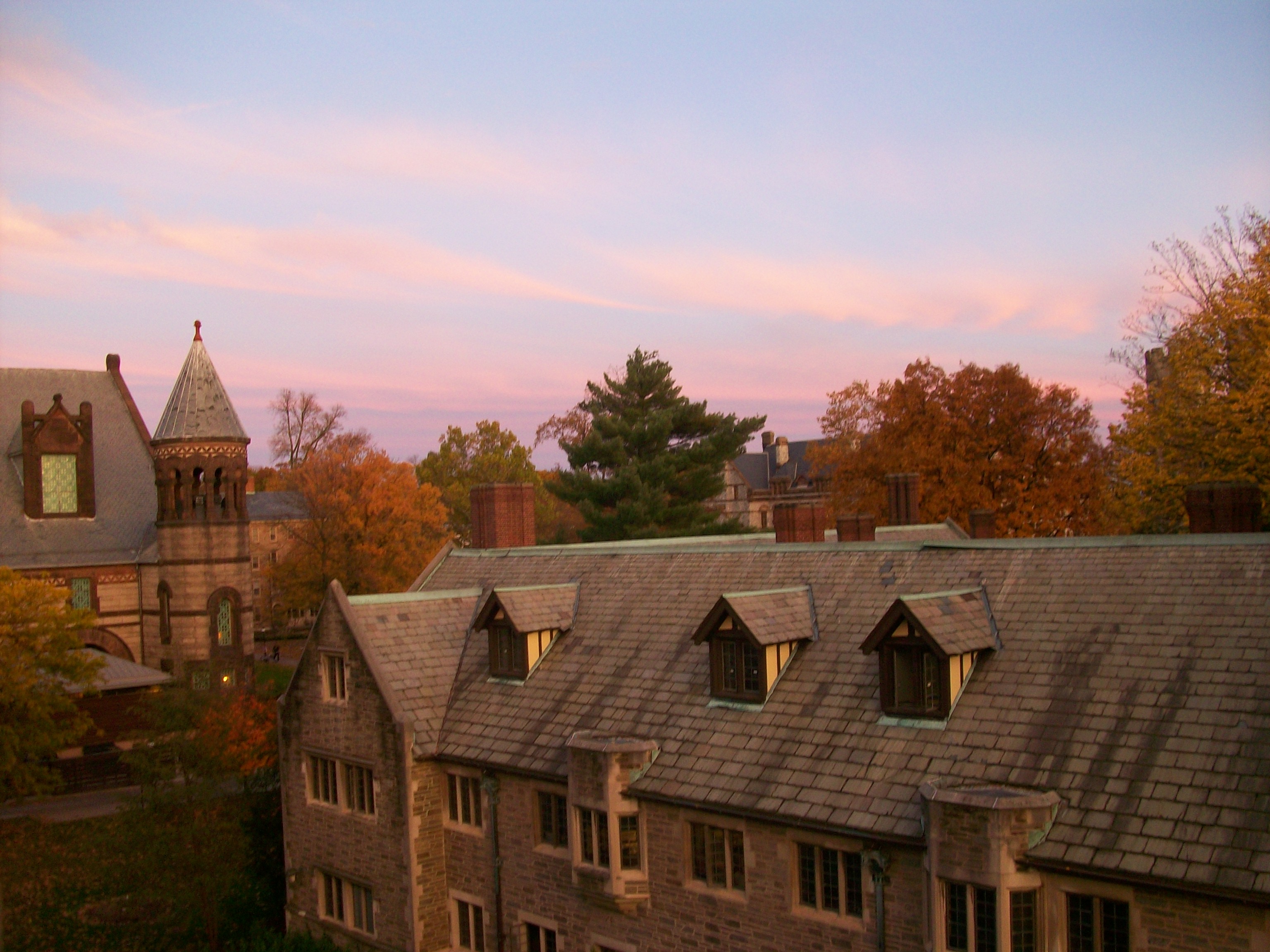
Upon assuming the presidency of Princeton in 1902, Woodrow Wilson praised the new buildings by Cope [Blair and Little Halls and Dillon Gym], saying that they were the first stage in the formation of “a sort of circle and quadrangle,… girt about with buildings in the style that is historic,” and creating “a little town” unto itself. The specific style of Cope’s buildings, a picturesque interpretation of Tudor or Jacobean collegiate architecture, appealed for several reasons. It was consummately English, and thus, according to Ralph Adams Cram, it evoked “racial memories.” And it had aristocratic connotations, which were emphasized by the carving of heraldic shields on the facades of the new structures, in line with Princeton’s adoption of a coat of arms in 1896. Wilson praised this Tudor architecture with the observation that

by the very simple device of building our new buildings in the Tudor Gothic Style we seem to have added to Princeton the age of Oxford and Cambridge; we have added a thousand years to the history of Princeton by merely putting those lines in our buildings which point every man’s imagination to the historic traditions of learning in the English-speaking race.

So yeah, the reason why I am sitting in one of Princeton’s fin-de-siècle neo-Gothic dormitories writing about Princeton’s fin-de-siècle neo-Gothic dormitories is because Woodrow Wilson was a racist Anglophile. Great.

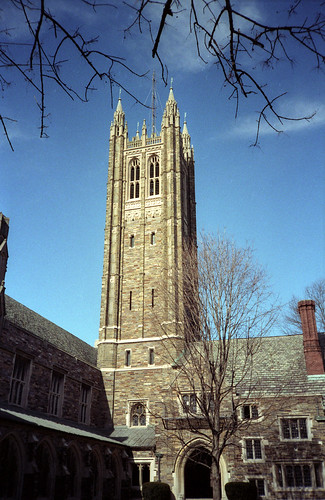
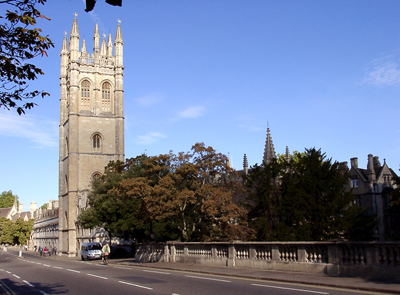
I read in another one of these Princeton architecture books that the Holder tower is meant to be a copy of the Magdalen College, Oxford tower. The two don’t actually look like each other at all (the Princeton Grad College tower is probably a bit closer), but it does sort of explain why I was looking at pictures of Oxford the other day and thinking there was something familiar about the Magdalen tower.

I have to confess, though, that while I’ve always known about how American Ivy League colleges like to imitate Oxbridge (there’s this museum in the British Cambridge somewhere that has a whole display on John Harvard and how he wanted to bring Cambridge to America—which, obviously, he quite literally did), I hadn’t really considered the racialized element of this situation. It makes me feel kind of uncomfortable, suddenly, about my enthusiasm for the Princeton-Oxford exchange-student program, and for American gothic architecture, and other aspects of the distinctly American brand of Anglophilia. I like to think that my own Anglophilia is a lot more realistic than many Americans’; I know that Britain is much more than Monty Python and the Royal Family and I try to keep abreast of the realities of modern Britain. But is it possible to achieve that “realism” when you’re still, at the end of the day, an American Anglophile? Can you be an American Anglophile without in some way associating yourself with this horrible Wilsonian version of academic Anglophilia?

Contentment; or, Writing Life As It Happens

Tonight, while talking to my mother online, I said, “I don’t know, sometimes it’s more that I’m just bowled over by how much has changed [since I came to college] than anything else. Sometimes it’s overwhelming. Sometimes I just look at myself and I’m like, holy shit, really, for the first time in my life I’m not continuously depressed. I can get through a school day without bursting into tears.”

And while I’m the first to admit that I may have been being a bit melodramatic (by the end of my secondary education, I was only sobbing maybe once or twice a week!), it is true that it is only in college that I’ve found a place where I actually belong. I know I tend to go on about this perhaps a bit too much, but I assure you, dear reader, that I only do so out of sheer astonishment that the years and years of sitting alone on the outside are over, and that I can be the person I want to be and have friends and something resembling a social life in spite of it. It’s only as I piece together memories of school and that other teenage life that I realize how different things are now—and how horrible they were. I realize how much I’ve changed. I realize how much more I’m in control. I realize that, objectively, school really did suck, and it wasn’t just my overactive imagination making up the sexism and the hatred of independent thinking. I am the first to proclaim that Princeton has its faults, but I no longer live in a world where, as a girl, “smart” meant “smart-assed,” and where refusing to stand for the Pledge of Allegiance or criticizing the Vietnam War made me a traitor. If my life is circumscribed by what people think of me, it’s only because I want the people I care about—friends, and professors, and, once again, my family—to see me as intellectually curious and genuine and entertaining and interesting and worth the investment of their time. I don’t care about “cool”; “cool” will come as the rest does too. I want to spend the rest of my life in the academy, because it is here that “smart” and “cool” are, after years of self-loathing that began when I entered elementary school, finally equivalent.

My mother came to visit me this weekend, the first time that anyone in my family has come out here since I made this place my home. I have been so proud and excited these past few days to show off my life: my fourth-floor bedroom over the archway, my long meals filled with friends, my world whose compass points are library and coffeeshop and dining hall. Finally, I am living my life on my own terms. Finally, I got to show my mother who I can be, given the chance.

My mother, as you may know, went to this university too, many years ago. We’ve sat three meals now in the college dining hall—the center of my world—and talked steadily about how this place has changed since then. My mother and I have looked at each other across the long wooden (sticky) table, and across generations. She was an outsider; I, though not so very different, belong. At times it is almost impossible to describe how or why this is, but I need only look at my diaries from three or four or five or eight or ten years ago to know exactly what she means. I can relate a potted history of how this place has changed, and how people like us have gone from the margins to belonging, how we have been transplanted from the institutional rubbish-bin to the institutional center, but you’ve heard it all before—if not from me or my mother, surely from some class or lecture or book on how the world has been made easier for all sorts of people in the past thirty years. Princeton is no exception to that rule—or, on the other hand, perhaps it is. For in those thirty years, the culture I came from has not changed so much as this one; maybe this is something particular to the ivory tower, where not just women, and not just queerfolk, and not just people of color, but all the differentfolk (I am all for making a Germanic compound word out of that) can find their place.

I am working on a project for a course on life-writing (biography, autobiography, memoir, that sort of thing), which is going to be in some way about my childhood imagination. I haven’t necessarily worked out yet how it’s going to proceed thematically, but I’m trying very hard to stay away from the temptation to write my life teleologically, as something that is suddenly wonderful somewhere around February 2009. Instead I am trying to root myself in the past, in the mind of a six-year-old, in a world that was very different—one where, simply put, instead of being taller than my mother, I was short enough to cling to her metaphorical skirts (they must be metaphorical, because my mother only sometimes wears skirts). But I’m not sure whether this is going to work: all my childhood fantasies, you see, invariably led to a place like this—where nerdiness isn’t just a social curse, it’s an all-around blessing.

And so I’m sitting here just before I go to bed on another Sunday night at the end of another week, thinking this is not as tight a little essay as I’d hoped it would be, and replaying in my head not the fairies at the bottom of the garden that I’d hoped very much would make life more interesting, but my own interesting life and its two-hour dinners in the dining hall I love more than most every place I’ve spent that much time. It’s a strange thing, this caricature I’ve become of my own fantasy of student life, somehow juggling balls labeled “writer” and “historian” and “activist” and “professional gay,” yet all in that same self-important and self-serious manner my mother tells me I had when I was two. I know I’m ridiculous, of course, and I can tell that other people sometimes think so too—from the way they look at me when I say I have a thesis topic, or the bemused way in which they tell me either that I work too hard or that I spend too much time on Facebook. But ridiculousness is such a relief to revel in when you know years of every day making a conscious decision between being yourself and not feeling lonely are over. Finally I am proud, proud that I can tell my mom everything I do, and introduce her to my friends, and have us all sit down and gossip in my dining hall as if we have known each other forever.

In Which I Flaunt That Whole Ivy-League Thing Some More; or, Thoughts on the Eating Club System

So you might have heard that Princeton has some eating clubs (which, for clarity’s sake, are ten private dining-cum-social organizations for juniors and seniors, five of which use a competitive selection process sort of like fraternities do, and five of which don’t). If you follow Princeton news as obsessively as I do, you also might have heard that the university has established another in its series of task forces, which intends to “examine whether there are steps that can and should be taken to strengthen those relationships for the mutual benefit of the clubs and the University, and for the benefit of Princeton students and the undergraduate experience.” Of course, I’m skeptical, but the task force actually appears to be off to a very positive start: it’s launched a flashy website, which includes an eight-page document about the history of the clubs (a tad teleological in my opinion [though that may only be because “teleological” is my new favorite word to overuse], but a good primer if you don’t know much about the clubs). And on that website is a set of survey questions that the task force has asked all and sundry to answer. It’s a commendable gesture toward transparency and cross-community involvement, and I’d encourage everyone affiliated in any capacity with Princeton to fill in the form and offer your thoughts, whatever you happen to think about the clubs.

I spent some time composing my answers to the task force’s questions, and so in the interests of continuing to develop a cogent set of talking points regarding my feelings about the clubs, I thought I’d post those answers here:

How have you engaged with the eating clubs and what is your opinion of them?

I very rarely go to the Street at all, but occasionally will go to Terrace on a Thursday or Saturday night, particularly if there is a good band playing. I went much more frequently at the beginning of my time here, but never much enjoyed the atmosphere—even at a laid-back place like Terrace—and am glad that I’ve since discovered other social spaces where I feel as if I fit in better.

I don’t feel as if I fit in at the clubs; the atmosphere of “going out” (entailing dressing up, pregaming, putting on a different and false “self” for the night) is not one that suits me. Presently, I don’t feel as if I’m a dweeb or a nerd or a social failure or missing out on something really important by doing other things with my weekends, but I wish I’d known that as a freshman. It would have saved me a lot of depression and self-loathing. I don’t object to the clubs’ existence (though I certainly do to the bicker process! more on that in the next question), and I know that many people derive a large amount of enjoyment from them, but they remind me a little too much of high school and the notion that being popular and socially graceful are all-important.

If you think the eating club experience could be improved, what are your suggestions?

As a sophomore who does not plan on joining a club, I couldn’t comment on how the process could be improved for me, but as an outsider I would say that bicker is a particularly insidious institution. The notion that a set of entities so rooted in campus history and culture should continue, in 2009, to pride itself on its selectivity and exclusion is to me incredibly problematic. If we are going to have private upperclass dining and social organizations in which a great deal of student energy and emotion is invested, I think that the least we can do as a campus community is to ensure that those organizations are self-selecting (as the sign-in clubs are), not reigned over by a process in which many are inevitably—and, to them, tragically—left out. There’s enough stress at Princeton without sophomores crying every spring because they weren’t considered pretty enough or poised enough or athletic enough or accomplished enough or aristocratic enough for their club of choice.

What is your opinion of the relationships between the eating clubs and the University? If you think the relationships could be improved, what are your suggestions?

It is obvious to just about anyone at this campus that the clubs and the university enjoy a particularly strained relationship, as they have now for some decades. That’s no cause for alarm in itself—in some sense, a university administration and student organizations shouldn’t be on the same side, or be too closely connected. But I have perceived some antagonism in the student body that does seem ill-founded—i.e., this notion that the administration is trying to “dismantle” or “shut down” or “silence” the clubs through initiatives like the four-year residential colleges, Campus Club, etc. From my perspective, the university is picking up a sizable number of students—like myself—who were previously falling through the cracks of the club system and didn’t have the time, the culinary skills, or the social skills (necessary for a co-op or Spelman) to cook for themselves. If the clubs and the university are going to work together at all, they would do well to ensure that every student has a social “home” on-campus, that no one feels as if they “have” to join a club, and that no one feels like a loser for not doing so.

What topic(s) do you think the task force should focus on?

One of the things the task force is in a good position to do is to collect data, and I’d like to see two kinds of information come out of this initiative. Firstly, I’d like to know how the alternative social spaces on or near the Street that the university has established in recent years (e.g. the Fields Center, Campus Club, Frist, the CJL, etc.) are being used: are they acting as substitutes for the Street, as the first alternative social spaces in the ’60s and ’70s were; or, now that the clubs are accessible to more varied sectors of the university community, do these alternative social spaces serve more as supplements to Street culture? Are they places someone would stop at on the way to the Street, or places where someone would go instead of the Street? Secondly, I’d like to see some more detailed data on why students who don’t join clubs choose not to do so, particularly in the form of open-ended questions encouraging longer and more detailed answers. No matter how inclusive, the clubs cannot possibly serve every undergraduate’s social needs, and so at some point reform is going to hit a dead end—it would be useful to know if the four-year colleges and the independent/co-op communities are really filling that void, or if there are still populations of students who don’t feel as if there’s currently an upperclass dining option that suits their needs.

Agree? Disagree? Tell me, but also tell the task force! I would love it if they actually got some good feedback out of that web form.

QOTD (2009-10-28)

For my QOTD feature, I usually post words which I like, which resonate with me. Today, I am posting words that I hate, because I think that everyone needs to know what a certain tenured professor with an endowed chair at my university thinks about my community and the rights we’re fighting for. An interviewer is asking Prof. George what the fight for same-sex marriage is about, and he responds:

It’s about sex. Those seeking to redefine marriage began by insisting that what they were fundamentally interested in was gaining needed benefits for same-sex domestic partners. Legal recognition of same-sex partnerships was necessary, they said, so that partners could visit each other in hospitals, extend employer-provided health insurance and other benefits to each other, and so forth. Some people who said this were, I’m sure, being sincere. Most, however, were not telling the truth. Their goal was to win official approbation for sodomy and other forms of sexual conduct that historically have been condemned as immoral and discouraged or even banned as a matter of law and public policy. The clear evidence for this is the refusal of most same-sex “marriage” activists to accept civil unions and domestic partnership programs under which the benefits of marriage are extended, but which do not use the label “marriage” or (and this is very important) predicate these benefits on the existence or presumption of a sexual relationship between the partners. So, it is not really about benefits. It is about sex. The idea that is antithetical to those who are seeking to redefine marriage is that there is something uniquely good and morally upright about the chaste sexual union of husband and wife—something that is absent in sodomitical acts and in other forms sexual behavior that have been traditionally—and in my view correctly—regarded as intrinsically non-marital and, as such, immoral.

I’m sure I don’t need to tell you, dear reader, about the many, many LGBT Americans who have died alone in hospital because their partners were not admitted to see them. Dear reader, if marriage rights are about anything, they’re not sex. They’re about parenting and immigration and being able to be with the person you love in his or her last moments.

Prof. George says this about the generational shift in support for marriage equality:

The support of so many young people for regarding same-sex partnerships as marriages isn’t surprising, given the cultural power of the movement for sexual liberalism; but I seriously doubt that it makes the redefinition of marriage inevitable. Young people grow up. Most will marry and have children. They will perceive the ways in which moms and dads complement each other, especially (though not exclusively) in child rearing, and the ways their children benefit from paternal and maternal complementarity. Their vision of marriage and sexuality as having everything to do with feelings and romance will fade. They will learn something about love as an act of the will, and not merely a species of affection; and their understanding of what marriage actually is and why it exists will, in many cases, be deeply enriched. I do not claim that the experience of growing up, marrying, and bringing up children will lead all young people or even most who today say they favor the redefinition of marriage to change their minds; obviously, lots of married grown-ups with children today hold liberal views about sex. But I suspect that it will have a significant impact.

Dear reader, I’m sure I don’t need to tell you about the large quantities of adults who are fighting for marriage equality, especially those who would like very much to get married themselves. Every time I go to Pride or a protest, I see people my age, but also people of all generations. Just look at Frank Kameny: the folks who built this movement may have gotten older, but they haven’t stopped fighting for the causes they believe in.

Finally, Prof. George says this about the aftermath of Prop. 8:

Anyone who contributed money to the Prop 8 effort or played any identifiable role in supporting it was targeted for intimidation. They were depicted as agents of intolerance and enemies of equality. Pressure was put on their employers to fire or discipline them. (I speak from personal experience here: the president of Princeton University, where I am a member of the faculty, was deluged with letters demanding action against me.)

Regular readers may recall that I helped to organize a dance party outside the erstwhile headquarters of the largest single donor to Yes on 8—and that while I have sent President Tilghman many emails, I have never sent her one expressing my objection to Prof. George’s political advocacy. I believe that the solution to speech I find hateful and prejudicial is to speak up in turn in favor of equality and justice, and to do so louder and stronger and in a manner which attracts good media attention.

But if I were a Californian whose state citizenship had just been reduced once more to second-class, and I’d heard that one of the individuals directly implicated in this was a tenured professor with an endowed chair at one of the best undergraduate universities in the country, then yes, I might write to the office of its president to express my disapproval. It is very hard to look at these words, written so starkly on the page, and think that they come from the mouth of someone who is a part of my university, someone whom I have seen in the library or in the dining hall or at public lectures. It is very difficult to acknowledge that there is someone who holds a profession which I particularly exalt (who, indeed, professes) who holds some of the views which I consider to be the most vile and morally indefensible of all views.

Over the years, I have tried very hard to understand Prof. George, and ardent stalwarts of the conservative movement like him. The amount of potted psychoanalysis to which I’ve mentally subjected my political theory professor’s colleague could probably fill a rather large book, possibly even in a multivolume edition. But sometimes, like now, all the objective distancing and black humor falls down around my ears, and I am simply overcome with hatred for this man.

On Centers for Abstinence and Chastity; or, In Which I Have a Lifestyle Choice

If you’d been paying attention to Princeton politics over the past couple weeks, you’d really think there was some serious repression going on. First, a small group of people started flipping out, rather loudly and ostentatiously, because we have gender-neutral housing now, which is obviously going to cause sexual activity on this campus to skyrocket (hint: it’s actually not, and whether it would is sort of a moot point anyway). Then, another small group of people who, I’d hazard a guess, probably has some significant overlap with the first group, decided what this school really needs is a Center for Abstinence and Chastity. Their proposal has since been categorically denied by our fabulous university president, but it hasn’t stopped quite a lot of the campus from talking about why or why not we ought to have this center.

I walked into one of these conversations the other night, in which the argument for such a center was largely that students who choose to be abstinent are a discriminated-against minority who therefore need the support of institutional resources. The argument against such a center was twofold: a) being in a minority is not the same thing as being discriminated against; b) choosing not to have sex is not precisely equivalent to being, say, African-American, or gay, two groups of people conventionally defined by a particular immutable characteristic who have a long history of being and still are discriminated against in this country (no, I’m not equating the two histories. I’m just saying that both involve discrimination). Basically, I think, the majority of students I’ve spoken with agree that students who aren’t having sex are probably not nearly as small a population as they may think, and the university resources are more than adequate to address their needs.

But I’ve been thinking, over the past few days. I’ve been saying through this entire abstinence-center episode that what we need is a test case to lean on the Anscombe crowd’s assertion that this center wouldn’t itself discriminate. What would they say if a gay student who was comfortable with being gay, but also felt pressure to have sex and wanted support for remaining abstinent, came to this center? And then it hit me: who needs a test case? I’m talking about myself here.

I’m not saying that the hookup culture agenda is recruiting me, because in my experience, if there is a “hookup culture” at all, it’s an opt-in scenario. My social scene isn’t one that features a lot of hooking up, or any expectation that it’s something people will do on a given Saturday night—but nor does it put any stain of moral disapproval on doing so. As long as folks are using protection, I personally don’t care what they do on their own time and in the privacy of their own homes (or eating club cloakrooms), because it really has no effect on my life.

But there’s something far more insidious that does directly impact my life, and about which I do experience a lot of untoward pressure, and that’s serial monogamy. People in our culture—men, women; straight, queer—are expected to date. They are expected to identify people whom they are interested in dating, and pursue them. They are expected to court, and to receive courtship, and eventually to form partnerships. They are expected to end those partnerships at some point, unless they become permanent, in which case marriage or its moral equivalent tends to result. And reader, I wish this didn’t happen. Because I don’t want to “date” anyone. I don’t want to be set up by my friends with eligible types. I don’t want to be asked if I’ve met any cute, bright young things. I am not interested in playing this game. And then, frankly, I tire of hearing the trite stories of the people who do, the young people who live in cities and go to bars and be someone else for a night in order to attract the nicest and nicest-looking people there. And who expect this encounter in a bar not, in fact, to turn into a hookup, but into a monogamous episode. (I know it sounds like a sitcom, but I heard a lot of this during my summer in DC.) It’s overpoweringly absurd—and yet it’s overpowering. And no, for the umpteenth time, I have not met any cute girls (or boys depending on who’s doing the asking), and even if I had, I wouldn’t be trying to pursue them and enter monogamous relationships with them (serially, obviously; if I entered relationships with them all at once that wouldn’t be very monogamous).

Of course, I suppose the chastity center would tell me, after they finished lecturing me on how my lifestyle leads to disunitive sex, and therefore our civilization will perish, that you can date someone without having sex with them. That’s sort of the whole point of the chastity thing. I get it. But I really haven’t talked to anyone (particularly any men) who aren’t part of a conservative group like Anscombe and still don’t believe that there’s going to be sex at the end of the line. The payoff for all this pursuing is sex, it’s just that our culture would prefer that you work harder for it than getting drunk and coming on to someone you dance with at an eating club (hmm, I guess that could be “coming on to” or “coming onto,” when you think about it. Errr… sorry).

If the chastity center crew is feeling pressured to have anonymous quick sex, well then, I’m feeling pressured to have sex with the same person for months on end after playing a delicate dating game. Dude, it really sucks being in the cultural minority here. Can I please have a center too? Or at least get to use your center? No?

Oh well. Guess I’ll just have to go get wasted and hit on a lot of people at Terrace instead.

Okay. Time for Me to Weigh In on the Kevin Jennings Saga.

Those of you who are tuned into either the queer press or the right-wing press might be aware of the right wing’s smear campaign against Obama’s nominee to be head of the Office of Safe and Drug-Free Schools, Kevin Jennings. To summarize briefly: Jennings is gay, he used to be head of GLSEN (which is a pro-safe schools, pro-GSA organization), and he’s written various things about the need to make public education more friendly to queer kids and to kids with queer parents—most famously, by now, the foreword to a book called Queering Elementary Education.

You know what this means, right? Yep, I bet you’re smart enough to put two and two together in right-wing-land: you can’t have the words “gay” and “school” in the same paragraph without invoking the specter of pedophilia. In their attacks against Jennings, the right-wing media have drawn absurdly untrue connections between Jennings and NAMBLA. They have criticized him for listening supportively to a closeted student who told Jennings that he’d had sex with a man he picked up in a bus station bathroom (the student was over the age of consent). Now, apparently, they’re criticizing him because he was involved in ACT-UP. And reader, that’s the last straw.

I know we’re not supposed to feed right-wing nonsense by reporting on it, and I know that I don’t need to tell you folks that Kevin Jennings is far better qualified to make our schools safer than any Bush administration appointee. I don’t need to tell you how nice it would have been to have an out gay teacher in high school, or the importance of students being able to confide in teachers, even if it’s about hooking up in bus stations. But when the right-wing press thinks they can get away with distorting the history I study so that they can erase queerfolk from public education, I’m sorry: I have to rant about it.

The Washington Times ran an editorial on Thursday (I’m not giving them the privilege of a link) which says, in the first paragraph, that Kevin Jennings is an inappropriate person to nominate to public office because he was a member of “the extremist homosexual organization ACT-UP.” It suggests that Jennings is too radical for the gay mainstream because he was in ACT-UP (which, as Alex at Bilerico points out, is just really stupid. ACT-UP was a dominant part of the gay community in the ’80s and early ’90s, and how could it not be? People were dying, and no one was paying attention). The editorial also draws a bizarre association between ACT-UP and NAMBLA, that surefire way to convince folks that all gay men are pedophiles. But this particular excerpt jumped out at me:

ACT UP fanatics invaded the MacNeil/Lehrer NewsHour studio in 1991 and chained themselves to Robert MacNeil’s desk during a live broadcast. Protesters carried signs declaring, “The AIDS Crisis is Not Over.”

Well, yeah. Because that’s true. It wasn’t over in 1991 and it’s not over now. And every time folks like the Washington Times pull something like this, it increases the burden on the rest of us to bear witness to the thousands of gay men who have died in the face of politicians and media figures trying desperately to use AIDS as proof of the immorality of homosexuality, getting some sort of high of self-righteousness out of human suffering. I want to say that I can’t believe that something which calls itself a news organization would have the temerity to criticize a political appointee for his work in the ’80s to stop people from dying, but frankly I’m not surprised. I’ve read enough about the ’80s themselves, and the reasons that ACT-UP formed in the first place, to know better.

The right-wing commentators have a habit of doing this, of distorting the righteous into something evil. It makes me so angry, and I find it very frustrating, because it draws attention away from what I should be doing as someone active in LGBT communities. It’s easy and satisfying to write a blog post like this one, or to bitch about Anscombe, or to get angry about the latest stupid thing Prof. George has said in the national political discourse (with regard to Kevin Jennings, he said, “Children don’t need to be learning about homosexual practices in elementary school.” And they gave this man tenure WHY? Evidence of reasoned thought this is not). But in the meantime, kids are still killing themselves because their school and home environments are so hostile and unsafe. In the meantime, you can be fired for being gay in thirty states; for being trans, in thirty-nine.

And, in the meantime, the Washington Times still think that pointing out that an Obama nominee was involved with ACT-UP is enough to scuttle the nomination. So let’s change hearts and minds, folks. Let’s educate and be here and queer so that America says to itself, “You know what? I’m proud of my president that he nominated someone who was involved with ACT-UP. I hope that, and the rest of Jennings’ past, means that he’ll be an unwavering advocate for queer children and the children of queer parents.” I mean, in a broad sense, that’s what ACT-UP was fighting for, right? The right to recognition and to legitimacy and to care.

I’m not sure how related this is, but this week, the president of the Anscombe Society was quoted in the Princeton alumni magazine as saying, rather hysterically, that advocates for gender-neutral housing want “to eliminate any gender-based considerations whatsoever, and legal embracing of all sexual lifestyles. It’s a piecemeal process, taking each bite out of traditional gender norms.”

Well, yeah. That’s the idea. Call me a radical, but I say, act up! Fight back! Civil rights—and recognition—now!

Should We Be Surprised About Princeton’s GNH News?

At risk of flogging a dead horse, I was interested by the fact that my erstwhile editor Jesse flagged an article in today’s Yale Daily News about gender-neutral housing with the headline “Surprising.” I had a conversation this morning about how I’m becoming slowly convinced that it’s only popular conception that perpetuates the stereotype that Yale is more sociosexually progressive than other Ivies, and how it’s very unclear to me whether that stereotype has considerable basis in fact. Institutionally, Princeton since the Goheen era has been equally progressive as Yale, if not considerably more so. Anyway, this is the comment I left on Jesse’s post:

I mean, it is surprising and it isn’t. As I said when I first saw that article, it definitely bucks convention to think that Yale would be behind the trend on something sociosexual, and that Princeton would have gotten there first. But there are totally ways to rationalize this, and it’s especially easy to make the point that Princeton is not institutionally more conservative than Yale (undergraduate student culture is a different matter).

Princeton and Yale began coeducation in the same year. Princeton followed Yale by only three years in establishing a gay student organization (still both in the heyday of the gay liberation period). Yale has never had a woman president. It was five years behind Princeton in establishing an administration-run LGBT resource center. The institutional support for these types of reforms linked to a more developed understanding of gender and sexuality and a larger acknowledgment of the heterosocial real world in which we live has developed at relatively the same pace at both institutions.

As I think the YDN article indicated, what distinguishes Yale here is a logistical challenge provided by its all-encompassing residential college system. This is certainly a common hurdle: Harvard, which also has a developed residential college system, has a very limited GNH policy. Princeton, whose residential colleges serve only freshmen and sophomores, had little difficulty in extending GNH to upperclass students, but I can tell you from firsthand knowledge that giving underclass students the option (because of the residential colleges) is going to be a nearly insurmountable hurdle.

I’ve been thinking about this all day, and it’s starting to make more and more sense why things have panned out the way they have. Princeton’s eating clubs have entrenched a certain type of conservatism on campus, but it’s certainly not one reflected in the administration–our president is one of the most progressive of any university. And I’m not precisely sure how Yale got the “gay Ivy” designation (though George Chauncey has some ideas) but I’m very dubious about the extent to which that’s supported in fact.

I have to go back and re-read the Chauncey article, in particular light of the work I’m starting to do in learning about the history of gay Princeton. I’m very interested to learn more about where there are parallels and where there are divergences, and how valid this construction of Yale as “liberal” and Princeton as “conservative” is. Certainly the GNH developments complicate that construction—though it’s important to remember this may all be down to logistical factors and not ideological ones at all.

The Practice of Doing Journalism

Readers may know that I occasionally “do” journalism, and have received a certain amount of education and job experience about how to be a writer, reporter, journalist, thing. I’m used to being the interviewer, and so it’s been awfully interesting to find myself in the middle of the media coverage of Princeton’s new gender-neutral housing option and be the one answering student reporters’ questions.

Yesterday I spoke to a reporter who, among other things, asked me about the tenor of other students’ reactions. Had I heard any negative feedback? I explained that I hadn’t from individuals, just read anonymous Daily Princetonian comments, which are about as reliable a source as YouTube comments. The reporter confessed to difficulty finding anyone with a negative reaction, and really kept pushing that. I cautioned her against the old Prince trick of just getting a statement from the Anscombe Society, who is against everything cultural-values-related that the majority of the campus is for, and then hinted that maybe, if she couldn’t find reliable negative reactions, maybe that’s just because there aren’t any.

A number of people have pointed out both in person and on the Internet that they can’t really see what all the fuss is about—for them, gender-neutral housing is a total non-issue, and they can’t imagine why the fact that Princeton has taken this long to implement it should be getting any attention. And as much as I’m pretty proud of the fact that we did this, I can’t blame them: I’ve said from the beginning that what Princeton would be doing by implementing gender-neutral housing would only be bringing the university into sync with the heterosociality of the real world, and that preserving gender-segregated living is totally artificial and totally outdated.

But when you write a story, you need a quote from the opposition. At least, that’s common wisdom, something ingrained into every journalism student’s head at some point. Of course, though, what that means is that you give the opposition the same weight as the majority view, even if that’s very far from being the case. When the Prince does it, they render the views of the two dozen members of Anscombe equally important as those of the 4,500-odd undergraduates not in Anscombe. And when the national media do it, they render the views of the minority who believe that health care reform would institute “death panels” equally important as those of the majority of Americans who don’t believe that, and who would actually rather like some health care reform, now, if at all possible. It’s tricky, dangerous territory.

To all those folks who wondered “What’s the point?”, I’d say that this story is still a story, even if it’s not controversial. The story is, in fact, that gender-neutral housing at Princeton is not controversial—that four decades after there was a serious and fully two-sided debate around whether to admit women to this university, it has finally become in touch with reality. As far as I’m concerned, that’s really exciting.

(cross-posted)