The Productivity of Exhaustion; or, Doing Good Work

We are always tired, here at Princeton. Whether I run into a professor in the street or a friend in the dining hall, and ask “How’s it going?” the answer is inevitably “Tired.” I have some friends who are so unremittingly tired that I can complete their complaints of exhaustion for them. Even the Dining Services employee who swipes my ID card when I enter the dining hall tells me every day that she’s tired. And I always respond in kind: I am downing cup after cup of coffee, taking off my glasses and rubbing my eyes in precept, writing this blog post, even, because after a succession of long days I am still trying to find the energy to engage with this essay I have to write about the Arabs and Turks in the early modern period. It’s a punishing world, this place, full of overscheduled 20-year-olds with bags under their eyes, all trying frantically to turn out the pages and pages of work that we’re expected to produce. I was talking to a friend last week about how little time two years is in which to turn out three pieces of original scholarship in our disciplines, and how difficult it is to write original scholarship under the constant pressure of exhaustion. At times, it seems as if Princeton is setting us up for failure: particularly as I look down the two years ahead of me and worry that even getting a year’s head start on my thesis will not permit me to turn in work of which I can be proud. It is difficult to enjoy college, or to enjoy being young, under these circumstances. Every day I find myself more becoming the monastic scholar whom I thought I wouldn’t resemble until I had a couple more degrees behind me—because here I am, reading and writing as best as I’m able under the circumstances, and always putting that first. You can’t have fun until your work is done—but at Princeton, your work is never done.

I write this not to complain, per se (yes, I am full aware of how overprivileged my life is), but in order to encourage myself to sublimate the constant pressure and constant rushing from place to place and constant high expectations into something intellectually useful. Were it, I think, not for the problem that you can’t think when you haven’t slept, I’d be fine: I have long sworn, if someone sardonically, by the intellectual benefits of a sort of masochistic impulse towards guilt and self-loathing, and this has been my route to self-satisfying output for nearly two years now. And yet I’m realizing that this can’t continue to be enough: the work is getting harder and the stakes are getting higher, and I wonder if I can continue to do good work when doing good work is such a balancing act. Like so many other students, all of us at our desks or in our carrels thinking the same thing, I feel as if I work so much harder than anyone else I know, and that it will never be enough to earn the professors’ accolades or my own self-respect, or—increasingly urgently—the professional success I crave. Because now, when I last-minute a paper, I have begun to tell myself that doing this won’t fly in graduate school, and now I have begun to sweat with terror. (Though mind you, graduate students of my acquaintance tend for whatever reason to be some of the least exhausted people I know.)

I am sure this conversation has been had many times on this campus in the intervening years since 1746, but I’d welcome a dialogue about the degree to which Princeton sets its students up, if not for failure, then for mediocrity. We all know that no one who turns in a thesis receives a failing grade, and that in fact 55% of seniors receive As on their independent work, but are we also providing circumstances in which students can healthily do good work? Or are we as a community rather asking them to sacrifice their friends and their free time for the sake of the original research we so touted as a reason these self-same students should study here instead of Harvard? As I hear about seniors turning in their theses these next couple weeks, I wonder about the degree to which an 80-page paper is a formality, and what the point is of requiring an 80-page paper as a formality. It seems a little ridiculous for writers and readers alike, and indeed the same logic can be applied to junior independent work, or to the shorter essays I write without the time for care and attention every week, or even down to the Blackboard posts we all last-minute or the reading we don’t do for precept. Is this the cruelty of our academic institution, the cherry on top of our own high standard? Or is there just something I’m missing? Is there a way to do it all and well, and still find time and energy and verve to embrace time languidly wasted in the onset of spring?

I know this is all on some level training for the rest of my life, when—if I hope to succeed in my profession—I must write many more pieces of scholarship and read many more pages and keep myself to a more punishing schedule of output than the one to which I am held now. But my mind still comes back to the same question, the question which I ask myself several times a day: in what time-bending universe is it possible to do well in six classes and write 80 good pages of original research in a single year?

Time for another cup of coffee. I haven’t prepped for class tomorrow.

Admissions (Out)reach; or, Policy Which Lends Itself to Ridiculous Puns

My interests in LGBT issues and higher ed policy dovetailed recently (and yielded what I think is a great pun in the title of this post!) with the announcement that Penn will use applicants’ references to LGBT-related causes, activities, and identification to do outreach to queer students, much as college and university admissions frequently do for other minority groups, from students of color to women in science to scholar-athletes. And the awkward and silly thing about being involved in however small a capacity in institutional policy at an Ivy League school is that when you read about one Ivy League school changing a policy, you immediately wonder whether it’s something you could and should implement at your own school. (Well, I feel this way, anyway.) And so I feel moved to pose a question, dear reader: should Princeton follow Penn’s lead in tracking and doing outreach to LGBT applicants, and how should it do this?

Now, I’d argue that in my anecdotal experience Princeton is already helping LGBT applicants along with the other populations of “non-traditional” applicants which it helps. Half the reason I am now wondering what Princeton should be doing in this regard is because in April 2008, when I was a prospective student visiting Princeton for the weekend, my host brought me to an event at the LGBT Center. I may not have identified as gay then, or been as explicitly and consistently involved in LGBT community as I am now, but knowing that there was an LGBT Center at Princeton and that my host (who is not gay herself) wasn’t shy about going there or inviting me to come made me feel like I could be comfortable here. It was the entire reason I made my decision to come here—and I feel like there might have been some intent behind the hosting program pairing me with the host that they did. Similarly, now that I’m on the other side of the hosting process, I write in to tell the program that I’m interested in hosting LGBT students or anyone else apprehensive of coming to Princeton for social-politics-related reasons. Sometimes they go to Yale (not that I blame them), but sometimes they come here—and I think the fact that I’m the one who hosts them is far from coincidental, given the willingness that I express to host those kids.

And so when there are preferences expressed, the administration tends to heed them—because it’s in their best interests, and in accordance with their stated institutional policy to diversify undergraduate culture, to do so. And maybe this could be done to a greater extent—I don’t know to what extent undergrad admissions does specific outreach to members of other minority groups during the admissions office, so it would be hard for me to say whether they should adjust their policies to include LGBT students too. However, Negative Nancy that I am, I am more concerned about who will be left out by such a policy than who will be brought into the fold by it.

As most of my readers are probably aware, more and more teenagers are coming out in high school—or when they’re even younger! Some of my readers, I believe, are out high schoolers themselves, or were; some of my readers are straight allies involved in their schools’ GSAs or LGBT community life in the cities and towns where they live. LGBT youth culture is now a constituent part of LGBT culture as a whole, a recent and exciting development in the variegated experience of being queer in America. And yet for all that many teenagers are out, I’d go so far as to suggest that most aren’t. Most of the kids I know from high school who are now out in college didn’t go to GSA meetings or go to citywide queer-community events—hell, I certainly didn’t! Back in high school, I thought your sexual orientation wasn’t something you put on a college application. I thought it was something you talked about in furtive late-night AIM conversations, or knew in the back of your mind when you saw how uncannily you could relate to the characters in books you read. I’m not sure, when I was applying to colleges, if I would have answered an optional sexual orientation identification question, and if I had I probably would have hovered over the radio buttons such a question would no doubt require you to choose between. When I came to college, I starting identifying myself to others as “gay” instead of as “bisexual,” with intermittent spurts of asexuality in between. When I was 17, would I have been able to choose a radio button? Or would I have declined to, unsure which letter in “LGBT” best described me? Would I have declined to, unsure whether selecting any of them would have made me seem too “unprofessional” for a college application?

And this is me we’re talking about! Two years later, I’m the gayest of the gay at this college where I wound up, making a life out of nonchalantly throwing around the word “sodomy” at the dinner table. What about the others? How does the admissions office reach out to a kid who hasn’t come out to him- or her- or hirself, a kid who after two years in college still lives in fear of being found out? How does the admissions office reach out to the queer kids who are out, but who are so desperate not to make their outness a defining point of their identity that they would run away from such overtures of community? It’s a tricky line to navigate, that’s for sure—as tricky as are any of the lines we deal with when we create or don’t create queer community at Princeton.

I am reminded, once again, of the big gulf between knowing you’re different and knowing you’re queer, particularly when you’re sixteen or seventeen and being different is such an all-consuming torture that it’s hard to understand it as anything else or anything more sharply-defined. I am reminded, once again, of the time Before, the time when I was still trying to get a seat at the popular kids’ table—I hadn’t yet realized that it was possible to go start a table of my own. And I truly am not sure what I would have done, then, if Princeton had asked me to select a sexual orientation.

Well. With that, I’m off to talk about Mary Wollstonecraft’s attitude towards homoeroticism. High school, after all, was a full universe ago.

Memory, Time, and Woeful Insecurities; or, Blogging for Dummies

Those of you who are Princeton students are no doubt aware of a certain Master of Rockefeller College given to holding forth to a large Facebook audience on life and literature and a combination of the two. A fan of his notes since I first became a member of his college 18 months ago, I’ve had particular reason in the past several weeks to slowly wade my way through his backlog. I’m just getting now to the ones he was writing my first few weeks here, and it’s quite strange to be reading these again in quite a different frame of mind. I remember, then, not understanding why I couldn’t understand what he was writing, why its meaning wasn’t immediately apparent to me. I remember feeling lost, as lost as I felt in my French class, when I didn’t understand the teacher; in meetings for the student publication I briefly wrote for, when I wasn’t as charismatic or articulate as the other writers; and out at Terrace on Saturday nights, when I sat alone in a corner and played with my iPod. I loathed myself: for being so stupid, for failing to integrate seamlessly into a foreign culture so far removed from my California public high school. I phoned my parents in tears and begged to come home for fall break.

But now it’s the second time around, the second read. I quit the publication; I stopped going to Terrace. I never stopped feeling stupider than all my classmates, and sometimes it still drives me to tears—but it’s all redeemed when I get good feedback from a professor, as occasionally I do. I have friends, good ones. And far from sitting in a corner in a well of shyness and discomfort and fear, I’ve discovered that what I do best is talk. I talk in precept, I talk on this blog and on Facebook, I talk in committee meetings, I talk at parties and study breaks, I talk when I’m at home—in the Rocky dining hall, that is. I talk about eating clubs, about how it seems like everyone at this university is in the closet, about Walt Whitman and Oscar Wilde, about why the American political system is going to hell in a handbasket. And I’ve found out that when you talk enough, people expect you to do things. I’ve been asked to help start organizations and publications, to make things happen, to change the world.

When I talk on this blog, more often than not, it comes back to haunt me. I am not democratically (little-d!) impartial; I do not withhold my political views about my community or about the United States. I get pushback for being one of them legacies, for example, and a post I wrote back in September about dominant Princeton culture has gotten a disconcertingly large amount of mileage. I have tried, as a result, to write less about my life, to bitch a little less, to engage more intellectually with my world. I have tried to make myself think and to make other people think—and if I am going to bitch, I try to bring a method to my bitchiness. As I have learned to write about history, I have blogged about history. As I have learned to write about literature, I have blogged about literature. And as I have learned to engage with the world as an adult, I have blogged about that process too.

Sometimes I think that to an outside reader, my posts must seem as impenetrable as a certain college master’s did to me 18 months ago—except that mine are not impenetrable in a way that makes the reader want to learn how to read them properly! And sometimes I wonder whether the ethics of my blogging are appropriate, whether I do the right thing to mix the academic so inextricably with the personal, whether I do the right thing to be so forthcoming about the private angst that dogs my days. Does the world need to know that I am still, after 18 months, resolutely tortured by insecurity and guilt and shame at my failure to perform to academic heights? Does the world care how terrified I am that it seems as if my entire life hangs in the balance of one single professional goal which has become near-impossible to achieve?

Reader, I think all this angst must serve some instrumental purpose. It has to. It has to because writing is the road through angst, and has always been—but it also is a declaration that the rhythm of weekends (Thursday night drinking, Friday morning hangover, Saturday night drinking, Sunday morning hangover, Sunday night spent catching up on the weekend’s work) is meaningless to those who have spent their whole weekends in the library. It is a reminder that if seeking validation and self-worth in a dominant social culture that alienates you isn’t working out, you can after all these years of insecurity and self-loathing find a reason for being in books and in words, in writing and in talking. Of course, there are perils in this approach, the foremost being that now if you feel as if you’ve turned in sub-par written work, or if you gave a strange professor a first impression of stupidity and inanity, you’re disconsolate for days. Now you risk being formed only by what you have done, and thus it is imperative that you do Enough, and it is never possible to do Enough. And no matter how well the life of the mind works out, that much time spent tracing the same path between bedroom, dining hall, library, and coffeeshop, and pacing back and forth across 120 square feet of life above an early-20th-century Gothic-revival archway, can get just a little claustrophobic.

But do you know why it’s okay? It’s because you’re just twenty years old and you know that you’ve already discovered your reason for being. You read and read and talk and talk and slowly the secrets of great texts are unlocked; slowly you permeate the surface of those once impermeable Facebook notes. You read. And you talk. And most days you go to bed exhausted, depressed, dissatisfied with yourself. But some days, when the sun shines just right through the windows of your mostly-subterranean library refuge, and you’re listening to Tchaikovsky and drinking your coffee and suddenly the blank verse you’re reading makes so much sense that you have to scramble for pen and paper to note it down—then you remember why you’re doing this, why the greatest and lasting joy is to be found in what you do, what you were—in some sense—fated to do. What you’ve known since you were thirteen that you would do. It’s then, in those single, singular moments, that you know beyond any reasonable doubt that you’ve sold your soul to the ivory tower—and that you never, ever want to leave.

Anglo-Catholicism, Reason, and the Artificiality of Natural Law; or, Andrew Sullivan Comes to Princeton

When I decided to shirk my duty as a Professional Gay(TM) and to back out of attending IvyQ, a pan-Ivy League undergraduate queer issues/politics conference, I was mostly just worried about getting my schoolwork done this weekend—but I then was met with the unexpected pleasure of being able to go see Andrew Sullivan speak instead. Sullivan, who was Princeton’s guest as part of its public lecture series, was without question the perfect person to speak to the political climate which characterizes and divides Princeton’s discourse around LGBT issues. Much as the current national political discourse coalesces around a radical fringe right and everyone else—liberal or conservative—who disagrees with them (and must therefore do so in a moderately conservative sense), Princeton’s LGBT-politics climate consists of a radical fringe right, as represented in the Anscombe Society and its allies in the faculty; and of Everyone Else. All these people, whatever disparate political and policy-oriented outcomes they may desire for the status of LGBT people at Princeton and for the status of LGBT people in America, find themselves united in the fight to dismiss Anscombe on principle. And it took Sullivan to stand on the stage in McCosh 50 and start on the new natural lawyers’ own turf before unravelling their arguments, to come from an intensely Catholic perspective before repudiating rhetorical opponents who come from an equally intensely Catholic perspective, to cite Gerard Manley Hopkins and Cardinal Newman, Aquinas and Aristotle and Foucault, and infuse a coldly pro forma debate with intellectualism and emotion.

Now: don’t get me wrong. I disagree with wide swathes of what Andrew Sullivan believes, about queer politics in particular (though also no less importantly about certain generalizations and assertions which could read as racist and sexist, though those, while no less reprehensible, are perhaps less interesting to pick apart). He spent a good portion of his talk critiquing the “queer liberationist” position, one with which I to a certain extent identify (emotionally, if not pragmatically in 2010). I disagree very sharply first with Sullivan’s reading of Foucault to support the idea that queer liberationists do not believe there is something immutable about sexual orientation—why can there not be immutability at some biological level, but also the constructed and created structures of society which imbue that immutability with very different significances over time, and why can we not distinguish biological sexual orientation from the social constructs of gay or queer culture? Sullivan’s argument overall, as no doubt many of you, dear readers, know, is essentially an assimilationist one (I put no negative connotation on “assimilationist”) and mine is, while not entirely separatist, certainly an argument which critiques assimilationism from the left. That said, however, thank any god or none for someone standing on a Princeton stage and presenting a viewpoint with which I can disagree rationally, which is not motivated at its core by homophobia! What a breath of fresh air!

Someday, I am going to puzzle out the complex sociality of Princeton LGBT culture enough to understand truly what the significance was of Sullivan’s talk to Princeton; someday, too, I will have read enough 19th-century intellectual history to be able to do more than just vaguely nod at allusions to the homoeroticism of Anglo-Catholicism, a sort of cultural-history principle that could be said to have underlain much of what Sullivan had to say. Both these things are certainly on my agenda for the months and years ahead.

But far from my expectation that I would be irritated by a position with which I, as a liberal and a queer liberal at that, fundamentally disagree, I was both intrigued and thankful. Princeton, no matter what policies its administration may or may not espouse, is at its heart a conservative institution, much like any other old Anglo or Anglo-inspired university very much rooted in a notion of tradition or nostalgia. An English conservative who nevertheless prizes intellect and reason is just who it needs to access the still-closed minds who hamper a more productive dialogue on this campus. And now, as I go back to reading history, to writing history, and to having the conversations and writing the essays, articles, and blog posts I need to in order to change hearts and minds on this campus, I only hope that the rest of tonight’s audience was as intrigued by what Andrew Sullivan had to say as I was.

Status Update

What’s on your mind?

Emily Rutherford…
needs to read Mrs. Dalloway again.
Needs to read George Eliot, anything.
Needs to read Nabokov, more than Lolita.
Needs to read Foucault.
Needs to read Blake, seriously, and Auden and Eliot—T.S.—more than desultorily.
Needs to read Jane Eyre.
Needs to read more Kant, more Nietzsche, more Rousseau.
Needs to read Sedgwick, Butler. The whole catalogue.
Needs to read Wilde, everything; Milton, everything but Paradise Lost, because twice is probably enough to get by on.
Needs to read Freud.
Needs to read Plato. And Aristotle. And Cicero.
Needs to read Elizabeth Bishop, more; Trollope, more; Dickens, more.
Needs to read Shaw, Symonds, Pater… and Plath.
Needs to read Melville, especially Bartleby; needs to read Emily Dickinson.
Needs to read needs to read needs to read.
Needs to read Mary Wollstonecraft for tomorrow.

——-
Addendum: Henry James. How could Emily Rutherford have forgotten him?

Shameless Self-Promotion

Since it’s now been posted on Point (though I think you might have to be a Princeton student to see that link), I may as well mention that I’m giving a talk on gender-neutral housing at the Fields Center on Feb. 26:

As one of the Fields Center’s signature events, the Social Issues Roundtable is a lunchtime discussion series featuring scholars and community activists engaging with students in specified topics that intersect issues of diversity and social justice.

The Carl A. Fields Center welcomes undergraduate Emily Rutherford to the Social Issues Roundtable on February 26 at noon. Rutherford will discuss the historical and political nuances of the University’s new Gender Neutral Housing option. Please join us in seminar room 205 for a catered lunch and stimulating conversation.

I’m going to be talking for 20-25 minutes about the historical context of GNH, and where it fits into the narratives of coeducation, alternative dining options, LGBT life, and a host of other developments in the world of non-normative Princeton in the past 40 or so years. Given that this school year is the 40th since women first arrived on campus in significant numbers, it’s a particularly good time to be evaluating our social progress as a community. And since I wrote a paper last semester on the history of the Fields Center and its role in this progress, I’m excited to be doing the gig in the new Fields Center building. Anyway, the gig is a “roundtable,” not really a “talk,” so I hope that if you’re Princeton-based you’ll come by on Feb. 26 and join the conversation!

Being a Dispatch from Your Friendly Neighborhood LGBT Task Force

With the help of other members of the Princeton LGBT Task Force (a faculty-staff-student committee which addresses LGBT policy on campus), I wrote an op-ed that appears in today’s Daily Princetonian. It argues that we don’t need marriage equality to lessen homophobia and transphobia here in our own community:

You may wonder why members of the Princeton community have to worry. Don’t lesbian, gay, bisexual and transgender people on campus have community resources, such as an LGBT Center? Aren’t many students, faculty and staff out of the closet? Yes — but to mistake this for evidence of a safe, fulfilling and welcoming environment is to mistake tolerance for acceptance. Those of us who are LGBT at Princeton have the benefit of some institutional support; threats of physical violence against our community are no longer the predictable routine they were 30 years ago. But Princeton is far from an accepting climate in which to be queer, and many members of the University community remain closeted. Marriage would help matters. It would give same-sex relationships the legal and symbolic status of opposite-sex ones, and, practically speaking, it would make less complicated the lives of Princeton employees who live in New York, which recognizes same-sex marriages (but not civil unions). With that option now off the table, however, it’s time for us at Princeton to look inward. There’s much that we can do in our own community to change policies and attitudes, make it easier for students, faculty and staff to come out of the closet and move from relative tolerance to full acceptance of LGBT members of our community.

Go and read the whole thing, please, and for once I’m not just saying that because I wrote it. I don’t know what they did with my bio—did they confuse me with the editors of Equal Writes?—but that doesn’t diminish the value of the column.

Housekeeping

Updated my about page, again. Trying to find the right inscrutability-to-information ratio.

And for stalking and documentary purposes, here’s my schedule for the new semester, which starts next Monday:

There’s just one precept missing, which I’ll try to squeeze in… somewhere.
Key:
ENG 301 – Old English
ENG 335 – Children’s Literature
FRE 207 – Studies in French Language and Style
HIS 280 – Approaches to American History
NES/HIS 245 – The Islamic World from Emergence to the Beginning of Westernization

Untold Stories; or, You’re Probably Sick of Hearing Me Talk About Gay Men By Now

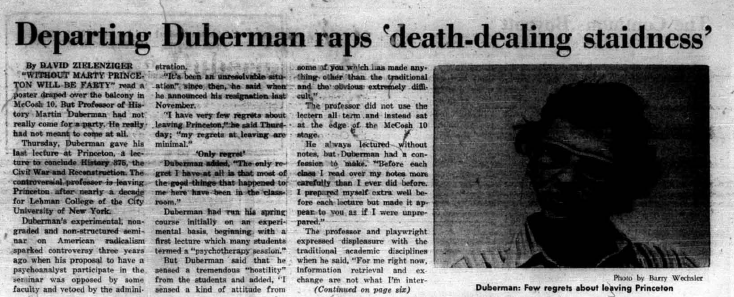
I’m doing a project for a class about Princeton and race and campus planning and things, and it’s involved a lot of archival research. This is great, because I actually really love archives—particularly when, by chance, they lead me to totally unrelated gems like this Daily Princetonian article from May 1971:

“Departing Duberman” is Martin Duberman, founder of the CUNY Graduate School Lesbian and Gay Studies Center and one of the seminal figures in queer scholarship. But you wouldn’t know that from reading the Prince article, which frames Duberman as a fairly classic child of the Sixties, whose “experimental, non-graded and non-structured seminar on American radicalism” befuddled the Princeton establishment, and whose students “had criticized him for his informality and call for spontaneity.” The article quotes Duberman, too, who appears to make no mystery of his departure to CUNY, saying, “Staidness is the best summary word for my experience at Princeton and it symbolizes what Princeton has always stood for.”

“Staidness,” however, is a pretty nonspecific word, and a glance at Duberman’s 1991 memoir Cures (the title refers to alleged cures for homosexuality) fills in some of what he might have meant when he used it. (I would like to note at this juncture that if I have any useful knowledge, knowing the queer shelves in Firestone well enough to find Duberman’s books without a call number appears to be one of them.) The prologue to Cures refers to Duberman’s time at Princeton in the ’60s, expressing his frustration at outdated attitudes to women and African-Americans, and a hostility towards radicalism or really anything different or threatening. But, gesturing towards the subsequent material in the book, this is how the prologue ends:

My private world was not nearly so comfortable [as my students’]. I lived in faculty housing—a small pseudocolonial unit built to sit “picturesquely” next to an artificial pond—and my personal life was a neat match for the antiseptic surroundings. Except for one local pub where ambivalent glances were rumored to have been exchanged by men awaiting their turn at the dart board, and the town of New Hope, about an hour’s drive from Princeton, where a gay bar was actually known to exist (though subject to police raids), the only other hope for contact was in the bushes and the men’s room at the Princeton railroad station, dim prospects in every sense. Even if Princeton had offered more opportunities, I would have been ambivalent about taking advantage of them. In these pre-Stonewall liberation years, a few brave souls had publicly declared themselves and even banded together for limited political purposes, but the vast majority of gay people were locked away in painful isolation and fear, doing everything possible not to declare themselves. Many of us cursed our fate, longing to be straight. And some of us had actively been seeking a “cure.” In my case, for a long time.

Of course, the Prince would hardly report this, because Duberman would hardly have said any of this in 1971. It’s a useful reminder of the apparent insurmountability of piecing together the history of a community that is not a community, and how much goes unmentioned when there’s not an accompanying memoir against which to fact-check.

QOTD (2009-12-16): Missed Connections and Poignancy

I never got into reading the “missed connections” sections on Craigslist or anywhere else—but as of a few days ago, Princeton acquired its own, and now I’m transfixed. There’s something about knowing the locations and the events and the culture driving, to a certain extent, all the postings that makes them that much more engrossing. Of course, I’m particularly struck by the postings listed as male seeking male or female seeking female—postings like this:

Frist
male seeking male – posted about 1 hour ago
I always see you walking around Frist. Tall, handsome, nice glasses, very well-dressed, you even had a purple scarf on once. Are you…different? Let me know.

Reader, what a flashback to another era. “Are you… different?” What a strange question to ask in 2009, when the word “gay” and the acronym “LGBT” grace the front pages of our newspapers and the internet has educated the overwhelming majority of all of us. What a seemingly unnecessary anachronism.

But the fact it was asked, of course, suggests to me that maybe the euphemism is not an anachronism, and maybe in this particular place and time and culture it’s still necessary. Of course, that’s in some ways problematic, and in some ways speaks to the ghettoization and marginalization of the Princeton queer community; it speaks to how many people here are still in the closet. But as you might know, I have a passion for the language of secret codes, of double meanings, of hidden significances, that once characterized a largely underground culture. And although I am sure there are few people reading Princeton missed connections who won’t draw the same conclusions from “different” that I did, this anonymous posting into the void is so weirdly reminiscent of so many others of years past, long before there was an internet on which to post such things, back when there were only word of mouth and nonvocal signals and maybe if you were lucky a gay paper or magazine.

I am reminded, once again, that just when you think times have changed… they haven’t.