Okay. Time for Me to Weigh In on the Kevin Jennings Saga.

Those of you who are tuned into either the queer press or the right-wing press might be aware of the right wing’s smear campaign against Obama’s nominee to be head of the Office of Safe and Drug-Free Schools, Kevin Jennings. To summarize briefly: Jennings is gay, he used to be head of GLSEN (which is a pro-safe schools, pro-GSA organization), and he’s written various things about the need to make public education more friendly to queer kids and to kids with queer parents—most famously, by now, the foreword to a book called Queering Elementary Education.

You know what this means, right? Yep, I bet you’re smart enough to put two and two together in right-wing-land: you can’t have the words “gay” and “school” in the same paragraph without invoking the specter of pedophilia. In their attacks against Jennings, the right-wing media have drawn absurdly untrue connections between Jennings and NAMBLA. They have criticized him for listening supportively to a closeted student who told Jennings that he’d had sex with a man he picked up in a bus station bathroom (the student was over the age of consent). Now, apparently, they’re criticizing him because he was involved in ACT-UP. And reader, that’s the last straw.

I know we’re not supposed to feed right-wing nonsense by reporting on it, and I know that I don’t need to tell you folks that Kevin Jennings is far better qualified to make our schools safer than any Bush administration appointee. I don’t need to tell you how nice it would have been to have an out gay teacher in high school, or the importance of students being able to confide in teachers, even if it’s about hooking up in bus stations. But when the right-wing press thinks they can get away with distorting the history I study so that they can erase queerfolk from public education, I’m sorry: I have to rant about it.

The Washington Times ran an editorial on Thursday (I’m not giving them the privilege of a link) which says, in the first paragraph, that Kevin Jennings is an inappropriate person to nominate to public office because he was a member of “the extremist homosexual organization ACT-UP.” It suggests that Jennings is too radical for the gay mainstream because he was in ACT-UP (which, as Alex at Bilerico points out, is just really stupid. ACT-UP was a dominant part of the gay community in the ’80s and early ’90s, and how could it not be? People were dying, and no one was paying attention). The editorial also draws a bizarre association between ACT-UP and NAMBLA, that surefire way to convince folks that all gay men are pedophiles. But this particular excerpt jumped out at me:

ACT UP fanatics invaded the MacNeil/Lehrer NewsHour studio in 1991 and chained themselves to Robert MacNeil’s desk during a live broadcast. Protesters carried signs declaring, “The AIDS Crisis is Not Over.”

Well, yeah. Because that’s true. It wasn’t over in 1991 and it’s not over now. And every time folks like the Washington Times pull something like this, it increases the burden on the rest of us to bear witness to the thousands of gay men who have died in the face of politicians and media figures trying desperately to use AIDS as proof of the immorality of homosexuality, getting some sort of high of self-righteousness out of human suffering. I want to say that I can’t believe that something which calls itself a news organization would have the temerity to criticize a political appointee for his work in the ’80s to stop people from dying, but frankly I’m not surprised. I’ve read enough about the ’80s themselves, and the reasons that ACT-UP formed in the first place, to know better.

The right-wing commentators have a habit of doing this, of distorting the righteous into something evil. It makes me so angry, and I find it very frustrating, because it draws attention away from what I should be doing as someone active in LGBT communities. It’s easy and satisfying to write a blog post like this one, or to bitch about Anscombe, or to get angry about the latest stupid thing Prof. George has said in the national political discourse (with regard to Kevin Jennings, he said, “Children don’t need to be learning about homosexual practices in elementary school.” And they gave this man tenure WHY? Evidence of reasoned thought this is not). But in the meantime, kids are still killing themselves because their school and home environments are so hostile and unsafe. In the meantime, you can be fired for being gay in thirty states; for being trans, in thirty-nine.

And, in the meantime, the Washington Times still think that pointing out that an Obama nominee was involved with ACT-UP is enough to scuttle the nomination. So let’s change hearts and minds, folks. Let’s educate and be here and queer so that America says to itself, “You know what? I’m proud of my president that he nominated someone who was involved with ACT-UP. I hope that, and the rest of Jennings’ past, means that he’ll be an unwavering advocate for queer children and the children of queer parents.” I mean, in a broad sense, that’s what ACT-UP was fighting for, right? The right to recognition and to legitimacy and to care.

I’m not sure how related this is, but this week, the president of the Anscombe Society was quoted in the Princeton alumni magazine as saying, rather hysterically, that advocates for gender-neutral housing want “to eliminate any gender-based considerations whatsoever, and legal embracing of all sexual lifestyles. It’s a piecemeal process, taking each bite out of traditional gender norms.”

Well, yeah. That’s the idea. Call me a radical, but I say, act up! Fight back! Civil rights—and recognition—now!

The Practice of Doing Journalism

Readers may know that I occasionally “do” journalism, and have received a certain amount of education and job experience about how to be a writer, reporter, journalist, thing. I’m used to being the interviewer, and so it’s been awfully interesting to find myself in the middle of the media coverage of Princeton’s new gender-neutral housing option and be the one answering student reporters’ questions.

Yesterday I spoke to a reporter who, among other things, asked me about the tenor of other students’ reactions. Had I heard any negative feedback? I explained that I hadn’t from individuals, just read anonymous Daily Princetonian comments, which are about as reliable a source as YouTube comments. The reporter confessed to difficulty finding anyone with a negative reaction, and really kept pushing that. I cautioned her against the old Prince trick of just getting a statement from the Anscombe Society, who is against everything cultural-values-related that the majority of the campus is for, and then hinted that maybe, if she couldn’t find reliable negative reactions, maybe that’s just because there aren’t any.

A number of people have pointed out both in person and on the Internet that they can’t really see what all the fuss is about—for them, gender-neutral housing is a total non-issue, and they can’t imagine why the fact that Princeton has taken this long to implement it should be getting any attention. And as much as I’m pretty proud of the fact that we did this, I can’t blame them: I’ve said from the beginning that what Princeton would be doing by implementing gender-neutral housing would only be bringing the university into sync with the heterosociality of the real world, and that preserving gender-segregated living is totally artificial and totally outdated.

But when you write a story, you need a quote from the opposition. At least, that’s common wisdom, something ingrained into every journalism student’s head at some point. Of course, though, what that means is that you give the opposition the same weight as the majority view, even if that’s very far from being the case. When the Prince does it, they render the views of the two dozen members of Anscombe equally important as those of the 4,500-odd undergraduates not in Anscombe. And when the national media do it, they render the views of the minority who believe that health care reform would institute “death panels” equally important as those of the majority of Americans who don’t believe that, and who would actually rather like some health care reform, now, if at all possible. It’s tricky, dangerous territory.

To all those folks who wondered “What’s the point?”, I’d say that this story is still a story, even if it’s not controversial. The story is, in fact, that gender-neutral housing at Princeton is not controversial—that four decades after there was a serious and fully two-sided debate around whether to admit women to this university, it has finally become in touch with reality. As far as I’m concerned, that’s really exciting.

(cross-posted)

QOTD (2009-10-14)

Edmund White, in an interview with Salon, says one of my favorite things ever about same-sex marriage:

In the past, when gays were very flamboyant as drag queens or as leather queens or whatever, that just amused people. And most of the people that come and watch the gay Halloween parade, where all those excesses are on display, those are straight families, and they think it’s funny. But what people don’t think is so funny is when two middle-aged lawyers who are married to each other move in next door to you and your wife and they have adopted a Korean girl and they want to send her to school with your children and they want to socialize with you and share a drink over the backyard fence. That creeps people out, especially Christians. So, I don’t think gay marriage is a conservative issue. I think it’s a radical issue.

I adore White’s books for so many reasons, and I think the fact that I read five of them this summer has influenced a lot of my thoughts about the history of gay men these past few months. He’s got some wonderful prose, and he writes candidly about gay culture and being gay—that’s a strikingly rare combination, and a risky undertaking in a literary world that tends to ghettoize gay writers. The last few pages of The Beautiful Room Is Empty, in which he has this sort of dadaesque description of Stonewall, are some of the best writing I can think of, for example—not only is the prose just glittering in its surreality (I find it really difficult to describe why good prose is good; you’ll just have to take my word for it), it’s a great way of turning the conventional riotous watershed OMG-Judy-Garland-died-and-now-we-have-a-revolution-on-our-hands kind of narrative on its head.

The NYT reviews of White’s two memoirs, My Lives and now City Boy (I’m still waiting for my copy of City Boy to arrive from Amazon; I’ll report back when I read it) seem profoundly on edge about the frank discussion of sex that pervades them. I mean, this is the Times we’re talking about, so it’s not too surprising; the paper hasn’t always been the most with-it on gay stuff. But even I, who am utterly unshockable, remember looking awkwardly around to see if anyone on the bus was looking over my shoulder while I read what the Times facetiously calls “that S-and-M chapter” in My Lives. Even I was glad that, unlike a lot of other books I’ve read with a lot of sex in them, this one’s cover was discreet.

But I think we have to be profoundly thankful to White for writing literary books in which the narrator acknowledges his sexuality with at least the mannerisms of honesty (even if he’s applying creative license to what actually goes/went on in his head and his life). It’s an increasingly common thing, but it still takes a high degree of courage and literary acumen.

Oh yeah, and he teaches fiction at Princeton. What could be better?

Even Princeton; or, This Is What Democracy Looks Like!

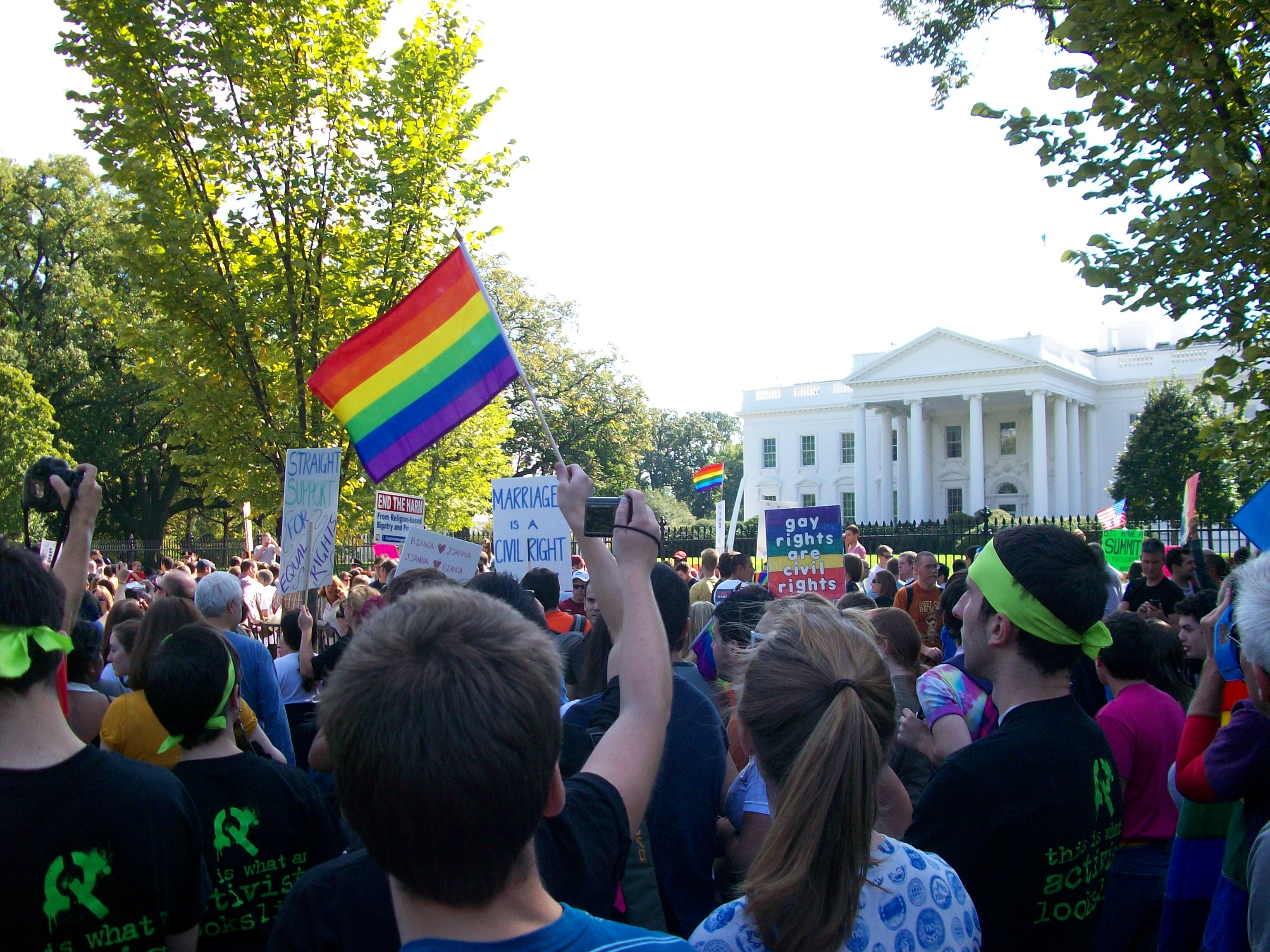
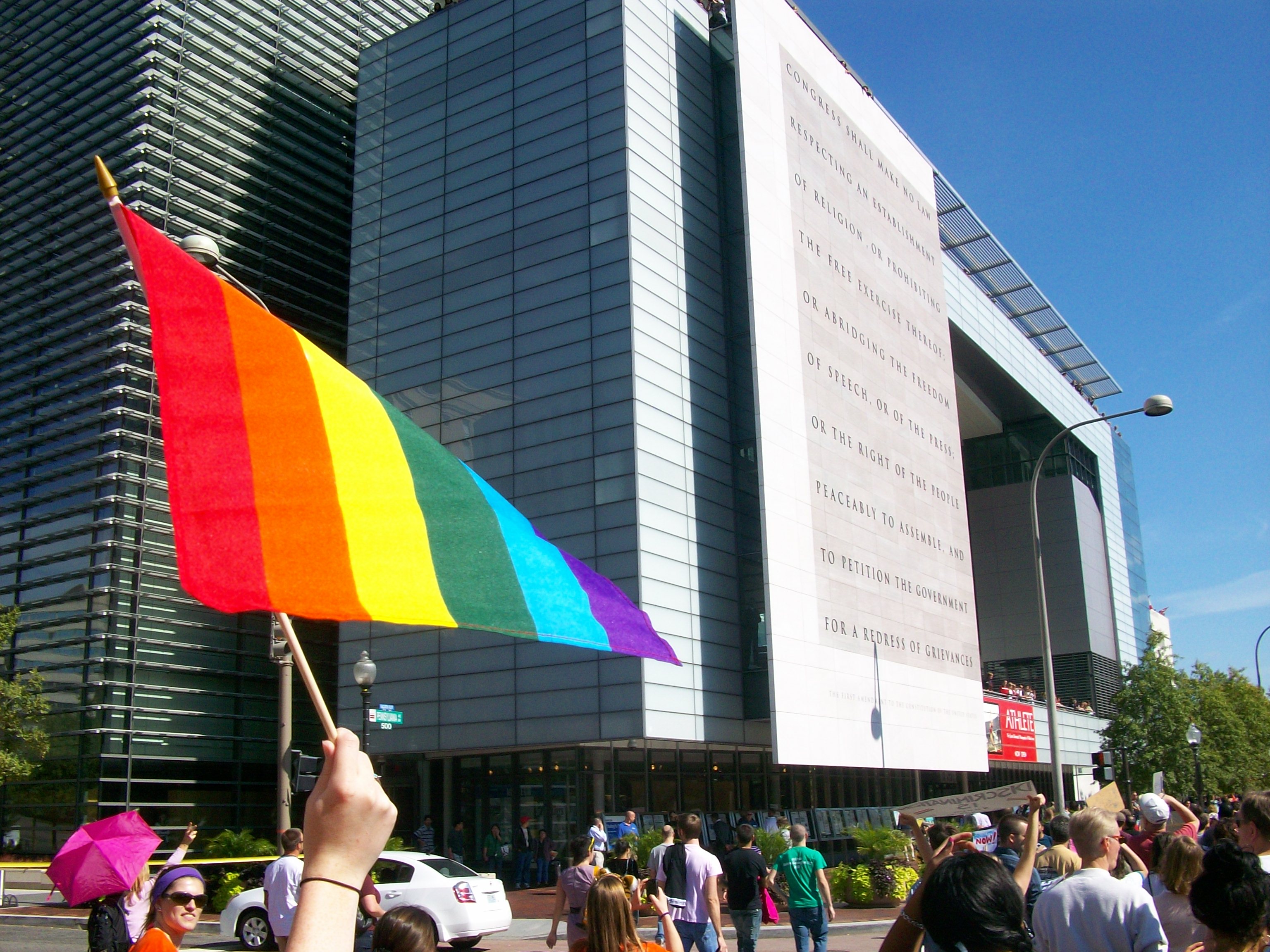
I have marched on the San Diego Hall of Justice and City Hall in Manhattan. I’ve protested in Princeton and at Scripps Ranch High School. Today, I marched on Washington. Today, like my mother before me and in the footsteps of a proud tradition of activists and organizers, I got in a van at 6:30am and drove down to Washington.

100_1212

I marched. I chanted and shouted and cheered (I lost my voice). I cried, especially at the rally when Dan Choi spoke, when Staceyann Chin performed, and when Cleve Jones spoke. I cried most of all when the cast of Hair, who canceled a show to come to the march, sang “Let the Sunshine In.” Readers will perhaps be aware that no song is dearer to my heart than “Let the Sunshine In.” It represents all that is wonderful and all that is left unfulfilled with regard to the American promise. There was no way I could have heard it sung live on the steps of the US Capitol with rainbow flags flying everywhere and not have started to sob. I caught a couple minutes of video of the song, but all you can hear is my tired voice cracking as I try not to cry.

100_1234

There is nothing so incredible when it comes to exercising your freedom of speech as marching past the White House, past federal buildings of all kinds, right up to the steps of the Capitol. There is nothing so incredible as marching in solidarity with your friends and your classmates, but also all the marchers around you. There is nothing so incredible as being able to get 70 people—many of them first-time marchers—from Point A to Point B, and realize that they, too, have loved every minute of it (thanks to EVERYONE, particularly the first-timers, for coming with us today!). There is nothing so incredible as someone coming up to your Princeton contingent to say “I graduated in ’05, and we would never have gotten together a group like this then.” Even in four years, things change. Just think where we’ll be only a few years from now.

100_1253

Some of the speakers at the rally referred to the activist legacy that brought us to the steps of the Capitol today. They referenced the civil rights March on Washington in 1963, and countless gay/LGBT rights marches. The invocation which began the rally called out not to God, but to the spirits of activists like Phyllis Lyon and Del Martin, Harry Hay, Frank Kameny, Harvey Milk, and many others. None of those people, in the time that they began their activism, could have brought 100,000 people to the steps of the Capitol to fight for LGBT civil rights. And yet without their struggles, that couldn’t have happened today.

100_1265

I came home tonight to two things: a tweet from a colleague-friend who proposed different means to the same or similar ends (in other words, Maine before marching), and a flyer from Princeton’s Anscombe Society, advertising their proposal for an Abstinence and Chastity Center on campus. In utterly different ways, both things questioned how I chose to spend my Sunday (and the past few weeks in planning for this Sunday). To my colleague-friend, I say that the fight for equality is not a zero-sum game; I’ve donated my time and my money to Maine even as I remain focused on making sure a contentious election in my own state works out. But doing so did not preclude me from marching today. As they say whenever we do these kind of things, we march for those who can’t—and so I marched today for second-class citizens not just in Maine, but all over America and all over the world. I marched for the people who are unable to come out or unable to travel; I marched—as one speaker at the rally said—for all the people who would have marched today had they not been lost to AIDS or to anti-LGBT brutality. As to Anscombe: I laughed when I saw the flyer that had fallen under my door; I wished I’d been able to tell the kid who dropped it so that I could tell him what a waste of a flyer it was. I wished I’d been able to make sure he knew how 70 kids at his university spent their Sunday.

100_1276

Tomorrow is National Coming Out Day, and my name will appear along with 600 others in an ad in the day’s honor in the Daily Princetonian. There is actually probably nothing more important in this struggle than coming out, and being brave enough to sign your name to something like this. But the old chant does go “Out of the closet and into the streets!” and I think the second clause is nearly as important as the first.

100_1275

(cross-posted)

The Winds of Change; or, What Do We Want? Equality! When Do We Want It? Now!

This is where our world stood 50 years ago:

homophiles

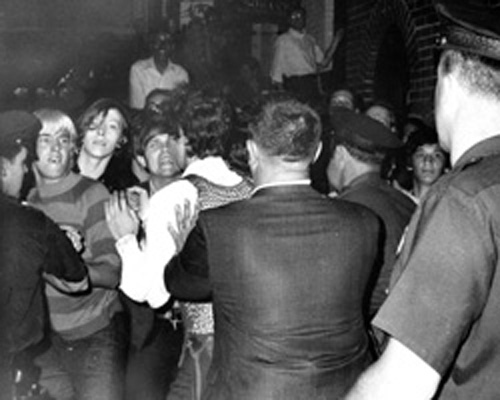
This is where our world stood 40 years ago:

stonewall_riots

30 years ago:

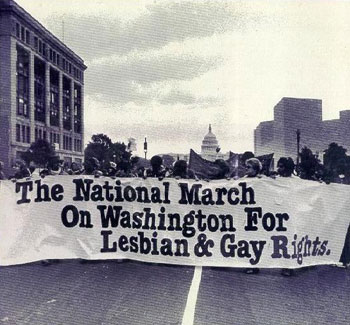
1979_march

And, today, though circumstances may have changed drastically since then, we’re going to do it again. The arc of history bends towards justice, but sometimes you just have to march.

What do we want? Equality! When do we want it? NOW!

100_0501

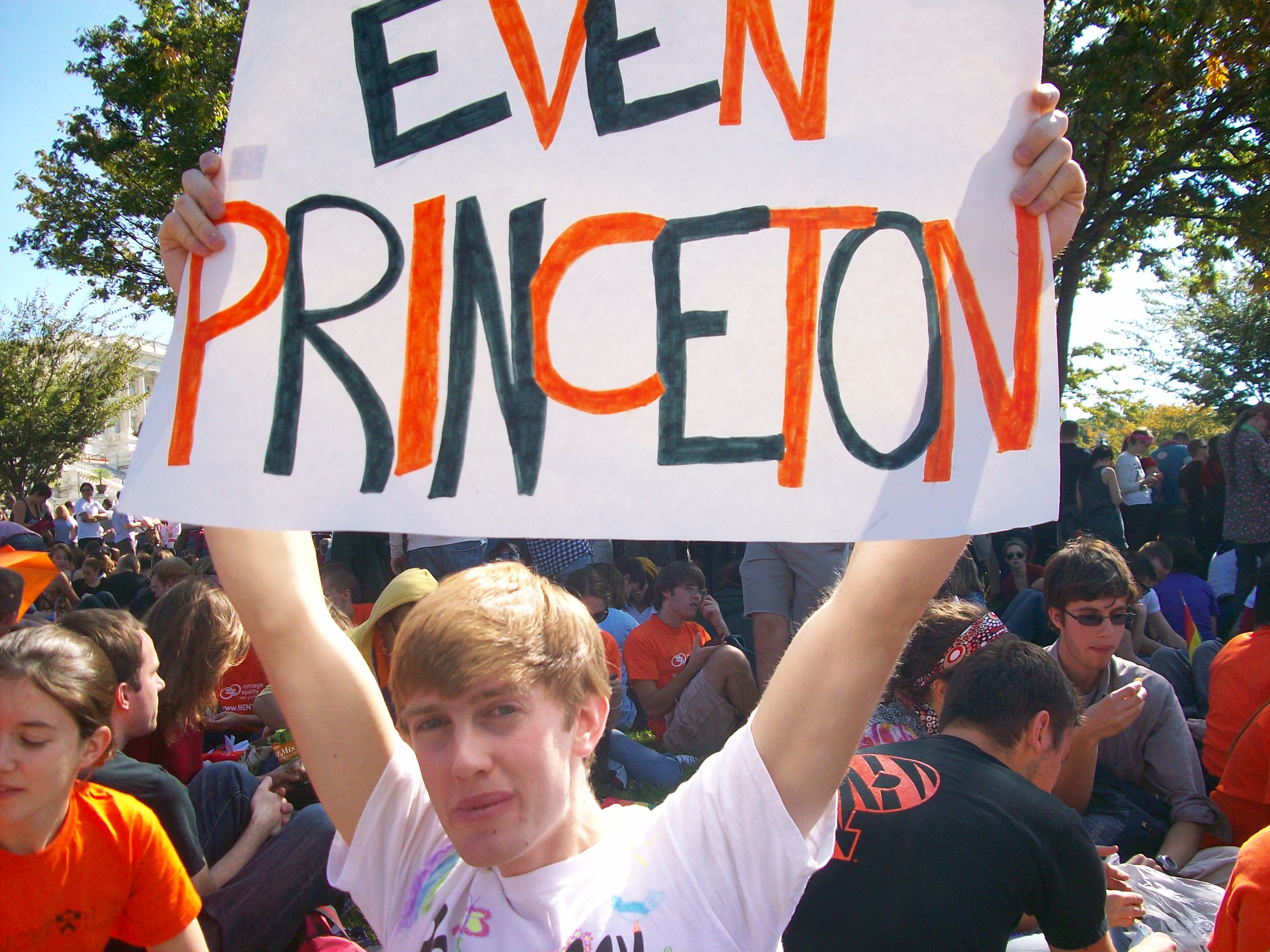
When I get home, I’ll post a picture of our “Even Princeton” sign, out in the streets of Washington.

Sometimes You Just Have to March

So I went for publicity over dignity and pitched an op-ed to the Daily Princetonian. To my pleasant surprise, they liked my pitch, the editing process was actually quite congenial, and I’m reasonably proud of the result. The article is about why the National Equality March happening in Washington on October 11 is a good thing for LGBT rights and a good thing for college students specifically:

Thanks to civil rights activists working long before any current Princeton undergraduate was born, it is possible for queer youth to live out and proud lives to an extent that it wasn’t 30 years ago. But as long as being LGBT means second-class citizenship, more progress must be made. Some change can be enacted through laws and policy proposals, but broader societal support for those laws and policy proposals is essential if they’re to be effective. And sometimes getting that support really does necessitate marching in the streets.

On Oct. 11, thousands of people who believe in civil rights for all will converge on Washington, D.C. They’re participants in a National Equality March, which will wind its way through downtown Washington and culminate in a rally at the Capitol. The march has one demand — “Equal protection in all matters governed by civil law in all 50 states, now” — with which it aims to transcend disagreements about which particular aspect of LGBT equality should be the first priority.

Read the rest here.

And then come to the march! There’s a group of us at Princeton getting together a bus to go down to DC, and if you’re a member of the university community who’d like a spot on that bus you should let us know.

In 1965, a group of Princeton students under the auspices of a campus SDS chapter participated in the national anti-Vietnam March on Washington. They carried a banner that read “Even Princeton.” I love this story, because it reminds me that however frustrating this campus climate may seem at times, there’s nothing to stop you from marching for justice and equality and freedom and civil liberties in the name of its students and in the name of students—and all people—everywhere. I’m going to make a sign to carry at the National Equality March that says “Even Princeton,” and I’m going to be proud to represent my community in DC.

(cross-posted)

On Knowing; or, the NYT Lends Itself to Yet Another Personal Rant

In a sentiment that is hardly unusual, some New York Times readers express surprise that their children and other teenagers they know could possibly have any knowledge of their sexual orientation at such a young age:

My question is about the Q (Questioning) subgroup of L.G.B.T.Q. Youth.

Surely most teens will be in this group at least until they experience a “full” sexual relationship with another person?

[…]

Teen years are so full of doubt and confusion about self and identity. Teens are suggestible, peer pull is strong as is the desire to forge an interesting and individual social identity for themselves.

My concern is for all those teenagers experiencing doubt and sometimes a lot of hidden angst and silent but very real suffering in a world which is incredibly difficult to navigate at their age.

“Don’t worry, they will know if they are gay” is a standard answer. This may be true for adults who have had some experience, but is it really true for many teenagers? It seems too simplistic and inadequate. Any guidance and thoughts would be much appreciated.

I’ve heard this before, of course—I came out for the first time at 14, and over the past few years I’ve heard this many times. I mean, now I’m old enough and enough of a professional queer that folks don’t question the labels I assign myself or allow to be assigned to myself perhaps even as much as they should. But back in early high school, I heard things like this a lot. “You’re too young to know.” “Most teenagers go through a phase of same-sex attraction.” “You’ve never had a relationship.” Well, yes, the last two things were true. But facts B and C do not imply fact A. I don’t see, given the structure of our society, how you can possibly be too young to know.

Our society is very, very clear on what constitutes a normal or normative sexuality. I’m not too long out of high school, and I have friends and a sibling who are still there. I know that when teenagers ask each other “So… who do you like?” they expect you to answer with an opposite-sex name. I know that it is not easy to ask, and then take, a same-sex date to the school dance. I know that there is pressure after pressure, be they from students or parents or teachers or general cultural forces, to define heterosexuality as normal and all other sexualities as abnormal.

And so when you’re different, you know. Believe me. You see it if there is something powerfully and fundamentally (if amorphously) different about the way you interact with people both of the gender to whom you’re supposed to be interacted and the one to whom you’re not. You see it if there is something different about the way you understand and express your own gender. To teenagers, that line is very clear. You know if you’re not like your peers, just like you know when you don’t have the same stuff they do or talk the same way they do or have the same cultural values they do. The lines of difference are very strong in adolescent culture, as are the undercurrents of sexuality. If anything, it is more obvious that your understanding of sexuality is different from your peers, than any other contrast.

Literature shows us this, of course. I’ve read many memoirs—from men, mostly, because that’s what I read, but also because of how adolescent male sexuality is less repressed than and also homoerotic in a different way from female sexuality—in which the writers all say that they knew their queerness from the instant puberty set in. And even if they didn’t know any gay people, or if they were growing up before “gay” became a thing that you could be, they knew there was something different, something strange that made them not like their peers. It’s an undeniable fact of this entire genre, that you start in adolescence with this vague sense of not-belonging and go from there.

I’ve tried on many labels in the past five years. I’ve gone through bisexual and gay and queer and asexual and I don’t know what else. But it’s always been “different” and “other.” And sure, I envy anyone who can make it through adolescence without squirming in desperate confusion when yet another crowd at a lunch table or a birthday party asks, “So… who do you like?” But when you don’t know how to answer that question, or you fear to answer it honestly, you at least know, as I did. And you begin to construct an identity based on that knowledge, however old you are and however much sexual experience you’ve had.

(cross-posted)

In Which Rachel Maddow and I Have Something in Common

Jason Mattera (of kicking your faithful correspondent out of the Young America’s Foundation conference fame) didn’t limit his comments about his political opponents’ physical appearance to the Campus Progress editorial intern with a relative lack of power or social capital who wanted to cover his conference this past summer. He also thinks he’s going to win back conservatism’s power by making remarks about the appearance of one of the most popular news hosts on TV, as Sarah Posner reported on Monday:

But targeting Millennials through pro-life appeals mixes sexuality with chastity. During the panel, Mattera took the David and Goliath metaphor another perverse step: If conservatives (David) smite liberals (Goliath), they will be rewarded with the hot conservative women, just like King Saul promised his daughter to the warrior who slew the evil giant. “You know his daughter must have been beautiful because there’s no guy whose gonna die for an ugly girl,” Mattera chortled. “Our women are hot. We have Michelle Malkin. Who does the left have, Rachel Maddow? Sorry, I prefer that my women not look like dudes.”

Mattera, who doesn’t seem to see the inherent problem with criticizing women’s appearances instead of their ideas, responded on his blog:

Okay, okay. I’ll admit it: Not all lib women look like dudes. I’m sure there are some who don’t. Maybe. But folks, can we at least agree on Rachel Maddow? Some bipartisanship, people?

Posner refers to the college activism panel that I participated in at Family Research Council’s conference over the weekend. What did hot women have to do with my talk? Not much, actually, despite Posner making it the basis of her piece. It was just a casual reference—me noting that even if I weren’t an activist, I’d probably still wander to the conservative camp because our women don’t look like the picture [of Maddow] above.

Rachel Maddow is an extraordinarily talented and successful woman, and it’s not too often that I get to be in the same category as her, so I’m sort of perversely excited that Mattera thinks I’m as worth calling a guy as Maddow. Seriously guys, I’m milking this for all it’s worth.

But what I find interesting and puzzling about folks’ reaction as I’ve told them about this is how eager they’ve been to assure me that Ms. Maddow is incredibly attractive, or that conservative women aren’t attractive, or to insinuate that the fact that Mattera put me in the same category as Maddow says something good about my physical appearance. I’m interested and puzzled because I would have thought the answer to this would be to challenge Mattera’s (and the conservative movement’s) sexism. This conversation shouldn’t be about which side of the aisle has the nicer-looking women. This has nothing to do with “Newsflash! Dykes can be hot too!” This has to do with the fact that we all—Maddow, Mattera, myself, Michelle Malkin, and everyone—should be judged on the basis of our ideas, not our appearances.

I think there are plenty of interesting things to be said about how confused the conservative movement (as represented by Mattera) seems to be about engaging with women on an intellectual level. Mattera seems rather challenged by the notion that women could contribute more than their appearances to the political sphere, and doesn’t even address the ideas of the women on his own side. It’s as if we’re mascots in his universe, and that speaks volumes about what his universe consists of and how he interacts with it. That’s a social phenomenon we could analyze at great length if we wanted to.

But I really have too many other papers to write to bother with unpacking that one, and I think maybe our time could be better served in the long run by not letting Mattera make this a discussion about physical attributes. Yes, it can sometimes be challenging to sit there and watch someone make sexist and implicitly homophobic comments about you, without challenging him on his premise. But if we don’t void the premise entirely, we’re not going to get anywhere. I think I’m going to focus on hoping that one day Rachel Maddow and I will have something in common that isn’t the length of our haircuts.

UPDATE: Ironically, Maddow has one of the best summing-ups of this whole “conservative movement” thing.

(cross-posted)

Calling Ourselves Things; or, In Which I Turn a Statistic Into Wishy-Washy Po-Mo Identity Politics

In the theme I appear to have been developing recently of “Let’s take something I read on the intertubes and use it as an excuse to have an entirely different conversation,” Bilerico pointed out a statistic that, sadly, does not surprise me at all: “While women make up 14 percent of Army personnel, 46% of those discharged under DADT in 2007 were women.”

The saga of Caster Semenya tells us that women who do not behave in “womanly” ways—e.g. by displaying leadership, athletic prowess, skill in combat, fearlessness, or being good at things—wind up having their femininity and their sexuality questioned. In a world that frequently equates gender identity and expression with sex and/or sexual orientation, that questioning could take the form of suspicion about sexual orientation (and subsequently being fired for it), or suspicion about sex and gender (and subsequently having your name, reputation, and career dragged through the mud for it).

I don’t know whether our society will ever come to adopt a model of gender that doesn’t depend on two essentialist categories that have associated with them not only additional expectations with regard to sexual orientation and behavior, but also the notion that one essentialist category represents a higher moral good than the other. It seems impossible that Western society (and many of the societies by which it’s been more recently influenced), which has operated on this model for so long, should change now. But until and unless it does, our headlines will be wracked with these kinds of accusations. Caster Semenya is not really a woman! That Army officer is not really a woman!—but for entirely different reasons that have more to do with how our culture views sexual orientation than with how it views sex. The problem, though, is that over the past few decades it’s proven remarkably difficult to unravel the public’s perceptions of gender and sexuality and all these other forms of identification from one very muddled-up ball of yarn.

For the sake of being able to say “I told you so,” I predicted that Semenya’s battery of tests would result in an intersex diagnosis from the start. But whatever that may mean for Semenya and her sense of identity, identifying as a “girl” or a “woman” is her sole right, something completely apart from whichever internal organs she may or may not have. So is it anyone’s right to identify themselves with whatever sexual orientation labels they wish—only you know who you are. No one else should be able to make that decision for you.

That decision becomes a non-decision when it means being faced with exile from a community of international athletics predicated on a rigid gender binary. And as readers of this blog should well know, it becomes a non-decision when, particularly if you serve in the U.S. armed forces, your career and family life may depend on what you say or what you allow other people to say about you.

Can we force our culture to grant us the right to call ourselves what we please—or, more radical yet, to call ourselves nothing at all?

(cross-posted)