Methods of Mourning; or, Tying Together the Disparate Strands of a School Day

Today at lunch, a friend continued with me a conversation we had started to have online last night. To paraphrase, he was telling me about what he finds inspiring in the worldview of the Old-Testament prophets: these people, my friend said, believed that the smallest injustice was worthy of our attentions, and as valid a point of concern and moral attention as a large-scale conflict, or one to which society imparts greater weight and importance. Without having enough exposure to the Bible to know much about this school of thought, I told my friend I thought this was a morally valuable attitude, but a risky one. If we focus on every injustice, I told my friend, we risk self-annihilation. We risk becoming swallowed by a world of things to fix, and losing our identities and our senses of self in an avalanche of problems and traumas and tragedies. We risk not being able to function as productive members of society, because we can do nothing but be overwhelmed by how many of the reasons that the world is going to hell in a handbasket—and many of the problems which individual members of a society face on a daily basis—are outside of our control.

I didn’t explain this in the context of the conversation, but when I responded that way to my friend, I was of course coming from an intensely personal perspective. The past few months for me have been a struggle at balancing negatives and positives, at knowing when to celebrate and when to fight and when to mourn, at coming to terms with my decision that, in fact, it is important to be a cohesive individual with a set of ideals and principles and morals and desires and reasons for being—and that, what’s more, a person’s state of being is more than a collection of these things. I believe I have some experience with the dangers of being consumed by problems. At risk of being melodramatic, I’d argue that I grapple daily with whether it is as worth my time to better myself or to fulfill my own desires as it is to fight for some external cause. Now, I don’t believe in any sort of “virtue of selfishness.” That’s the farthest thing possible from my mind. But I do believe there is some value in self-preservation, in identity-preservation, in soul-preservation. I have to. I have to believe that I, as an individual, matter; that my rights to life, liberty, and the pursuit of happiness matter in the same way as those of someone who is beset by far greater inequalities and injustices than I am. Ego humana sum, to make an emphatic point by butchering Latin—maybe this is just the voice of the latent conservative in me whom I always suspect is lying in wait, but altruism (and I mean “altruism” in a positive sense) is not always my direct route to pleasure and fulfillment. Isn’t it morally defensible to balance self-fulfillment and other-fulfillment? I would argue that it is, and I would further argue that it is impossible to do so without compartmentalizing. Compartmentalizing is an ugly thing, but it is a survival tactic. It’s a way to get through the day and a way to sleep at night, a way to survive until the next day so that you can continue to develop your own self and continue to take on projects and perform actions that will further the elimination of inequality and injustice. If that makes any sense, it was the subtext of how I responded to my friend at lunch today.

Today was an appropriate day on which to raise this issue, subtext included. In my English class this morning, we discussed Sylvia Plath’s poetry, and if there is any art which is awash in the presentation and examination of particularized personal trauma, well, it’s Sylvia Plath’s poetry. I am not by any means qualified to discuss poetry; I feel in over my head in most of this class’s lectures and discussions. But I was enormously fascinated by my professor’s argument that Plath fundamentally altered the way we understand the genre of elegy—in fact, said my professor, she wreaked havoc upon it, smashed it, and turned it inside-out. By Plath’s later poetry, her elegies are not reverential, they are furious. She made it acceptable, said my professor, for successive poets—particularly women poets—to write elegiac poems that incorporated not the classical, reverential emotions of lamentation, praise, and consolation; but an anger and a frustration and even scarier actions like (to use my professor’s terminology again) desecration and annihilation.

My thought, in the context of developing my own juvenile philosophy, is that Plath’s smashing of the elegy, her pulverization of the memory of her father through that elegy-smashing, and, in the end, her own tragic self-annihilation, are some of the risks of being so fully consumed by mourning. My professor said that Plath characterized her reactions to her father’s death as a primary source of her poetic inspiration: what happens when your whole life revolves around mourning, revolves around confrontations with tragedy, trauma, and injustice? Again, I’m a rank amateur, but it seems to me as if Plath’s example suggests that you may be consumed—and destroyed—by the mourning.

Because of one of my chosen subfields of study, I find myself running up against elegies with some reasonable frequency. I am fascinated by how queer individuals have, over time, constructed community and culture, and how the values of community and culture interact in this historically marginalized group. There is perhaps no better example of these patterns than the outpouring of artistic expression that occurred at the onset of the AIDS crisis, as the decade turned from the 1970s to the 1980s—and continuing well into the 1990s. As far as I can understand it, for some gay writers and artists and musicians and theorists and other producers of cultural material, making art and culture that grappled with AIDS was a way of forming community around—collectivizing—uniting—a series of individual traumas and tragedies each important as the next, which, when taken together, became a grave human crisis. I look at this cultural outpouring and coming-together—represented in forms as diverse as Larry Kramer’s plays, Nelson Sullivan’s films, and dozens upon dozens of memoirs and indeed elegies—and I see an instantiation of the ideal which my friend raised. In this art (at least, when I read it), every death, every individual struggle, becomes both important in and of itself, and important as a constituent part of a historical and cultural moment. Another metaphor is Cleve Jones’ AIDS Memorial Quilt: each constituent part of that quilt is important in and of itself, no more or less important on the basis of why it is included in that quilt. These are all elegies, and they are all particular, though perhaps—it’s hard to say—they avoid the risks of subsumation which the Plath seems to illustrate.

I am fully aware of the fact that I have no right to talk about this kind of elegy. This particular genre of collective mourning is one of which I, who was born in 1990, have no possible conception. Today, of course, is World AIDS Day—and I have struggled for the past week to think about whether I have anything to say concerning a crisis which I tend to historicize and yet is fully contemporary; a crisis whose onset and whose particular tragedies I did not and have not witnessed. And yet I have chosen history as my path towards understanding these moments of crisis, and I believe that I do have a duty to understand them, and to do what I can to further the telling of these stories. If each injustice, each death, each singular struggle is a legitimate subject of our attention—and our elegies—it behooves me as someone who wishes to learn to be a historian (but it also behooves all of us) to try.

After the exchange with my friend about Prophets and particular problems, lunch passed without mention of mourning for the victims of life and death. Lunch passed in lightness and brightness, in the silliness that ensues when good friends share a table and a conversation, and when I finally tore myself away I hurried to class across a quad awash in sunlight. I caught myself suddenly joyful: excited for my class, delighted to be moving from one space I enjoyed to another, across the bright and beautiful and green quad. I slowed my pace for a few minutes (this, it should be noted, made me late to class, and earned a sarcastic comment from my professor), and I wondered: why am I seizing this joy? Why am I brushing aside the weight of undeserved deaths to be made happy by something so ridiculous—and so absurdly self-interested—as walking from point A to point B in nice weather?

Well, reader, I think I know why: it is because the task of elegy is an enormous one, a terrifying one, a profoundly disturbing and troubling one. It is because life is not worth living, and death is thus not worth confronting and mourning, without the promise of truth through beauty. And it is because somehow, in some way, we all have to take the threads of our work days, and the knowledge we have gained in them, and the conversations we have had throughout them, and braid all those threads together into a strand which is somehow strong enough to let us fall asleep tonight, so that we can wake up again tomorrow and go about making the world—and ourselves—worth continuing.
The Politics of Celebration; or, Terrace Drag Ball and Me

I am the first to admit that I have a tendency to overanalyze things. Take, for example, last Friday’s iteration of the annual Terrace Club Drag Ball, which I overanalyzed for days. I’d been feeling down and antisocial and stressed, and above all guilty about every moment of time not spent doing something productive. I’d been working myself up into a frenzy for weeks about the need to be always doing something. And so, of course, as the possibility of going to a huge party on a Friday night at an eating club loomed, I started concocting arguments and excuses. My antisociality battled it out with my desire to be popular as I weighed alternatives. I could flip out about how to do “drag” (an open question, since I wear men’s clothes normally), or I could flip out about whether I would feel like a loser if I didn’t go, the guilt only piling up further as I spent Thursday and Friday procrastinating on the work to be done this past weekend while my friends talked about the impending drag ball.

Well, to make a long story short, I am happy to say that my sensible side won out: deciding that I wouldn’t get any work done after 11pm anyway, and pointing out to myself that it’s November and I hadn’t yet gone out once this year, I resolved to just deal with my gender-performativity identity crisis by reading Sontag’s “Notes on Camp” (which I highly recommend regardless of whether you’re planning on attending a drag ball) and getting an appropriately academic handle on my emotions. I put on a tie as a vague concession to dressing up, and at the appointed hour trudged across campus to 62 Washington Road.

Dear reader, you would think I would know that after nearly twenty years of pulling this sort of melodrama, things are never as problematic as I make them out to be. Of course I had fun at the drag ball, and of course it was a welcome relief to socialize and dance and cheer on my friends in the traditional runway show/contest/thing. But more than that, I was able to remember that such a social event is by no means a waste of time, or a detraction from either my academic or my political work. Not only is socializing rejuvenating (since Friday night, I’ve been more productive than I’ve been in weeks), it’s just as much a political statement as a march or a rally or an election campaign.

Sometime around 1am, when I was jumping up and down in time to a RuPaul song, getting beer spilled on the nice trousers I stupidly decided to wear, as three good Princeton boys faced off in the final round of the drag queen competition, I realized something that should have been glaringly obvious: this is precisely what I am fighting for. The right to be different, to my mind, is as gloriously essential as marriage rights or parenting rights or immigration rights or non-discrimination rights; de facto equality is as important, if not more important than, de jure equality. Celebration is tied right up in queer history with the fight for equal rights. You don’t have gay liberation without the Firehouse dances; you don’t have ’70s and ’80s New York without disco; you don’t have modern queer culture without Pride. And it is not irrelevant, either, that the first major event the brand-new Gay Alliance of Princeton sponsored in 1973 was a dance—on the top floor of New South, out of the way of a largely hostile institutional culture, close to Spelman and far from the Street. These dances were an annual occurrence for years, but it is no small thing that, 26 years since that first dance, a decidedly queer party can take place in an eating club. It doesn’t matter in the least that the club in question is Terrace—that drag can penetrate the Street at all is perfectly extraordinary, and evidence of how rapidly Princeton culture has changed since the early ’70s.

And so as I walked home Friday, after staying at drag ball far later than I’d told myself I would, after seeing most of my friends there, after laughing and dancing and having fun in a large group as I haven’t in some time, I told myself that there is no point in fighting if I cannot also celebrate what I am fighting for. What, then, am I fighting for? Well, I hope Congress passes the bills before it, and I hope state legislatures do as well. But more than that, I hope that every young person in America who wants to has the opportunity to go to a drag ball, or a queer dance, and to laugh and dance and shout the lyrics to RuPaul songs and be free. And I hope that every young person in America who already has the freedom to go to these events remembers that this freedom—like all others in the history of social justice and equality—has not been easily won.

The Washington Blade Shuts Down, and We Lose a Piece of History

I know that there are more important things going on in the world, news-wise, but I have to confess that I was pretty broken-up by yesterday’s news of the abrupt closure of the Washington Blade, among other gay papers owned by the same publishing company. The rest of the gay press has of course been mournfully sympathetic in its eulogies for one of the most important pieces of gay media history, but one of the best write-ups, I was pleasantly surprised to see, came from the Post, whose treatment of LGBT issues over the years has not been precisely sympathetic:

“It’s a shock. I’m almost speechless, really,” said Lou Chibbaro Jr., a Blade reporter who has written for the newspaper since 1976, covering the full arc of the country’s gay-rights movement, from early marches through the rise of AIDS and on to the latest battles over legalizing same-sex marriage.

The Blade, born in an era when most gays lived in the closet, grew in size and stature as Washington’s gay population blossomed and became more politically active and influential. Chibbaro, who wrote his first front-page story for the Blade under a pseudonym at a time when publicly stating one’s sexual orientation could be dangerous, felt the change in dramatic fashion this year, when, while covering a presidential news conference on health-care policy, he was directed to a seat in the front row.

The Blade’s closing comes at a moment of extraordinary optimism for many gays in Washington. The big story Chibbaro and the paper’s other writers have been covering is the bill supported by nearly all of the D.C. Council’s members that would legalize same-sex marriage in the city.

“Here we are, on the verge of having marriage equality, and it would be real shame if the Blade wasn’t there to cover the victory,” said Deacon Maccubbin, owner of Lambda Rising, the gay-oriented Dupont Circle bookstore, which had been advertising in the paper since the shop’s 1974 opening.

[…]

A small troupe of activists founded the Blade in 1969, a few months after New York City police raided the Stonewall Inn, a gay bar in Greenwich Village, igniting riots and launching the gay rights movement. In its infancy, the paper was known as the Gay Blade and consisted of a single, letter-size sheet of paper that its editor, Nancy Tucker, mimeographed and distributed herself, scooting around town in a Volkswagen to drop off stacks at gay-friendly bars. The paper’s mission was to unite an eclectic array of gay groups, including drag queens and government workers, literary buffs and motorcycle enthusiasts; inform readers of gay-related services; and warn them about blackmailers and other scammers.

In the ensuing decades, the Blade’s editors became more ambitious, switching to newsprint and dispatching reporters to write about discrimination against gays in the federal government, hate crimes such as the killing of Matthew Shepard in Wyoming, and political and health issues generated by the AIDS epidemic.

The article even quotes Frank Kameny as saying that the Blade “have become the voice of record for the gay community.”

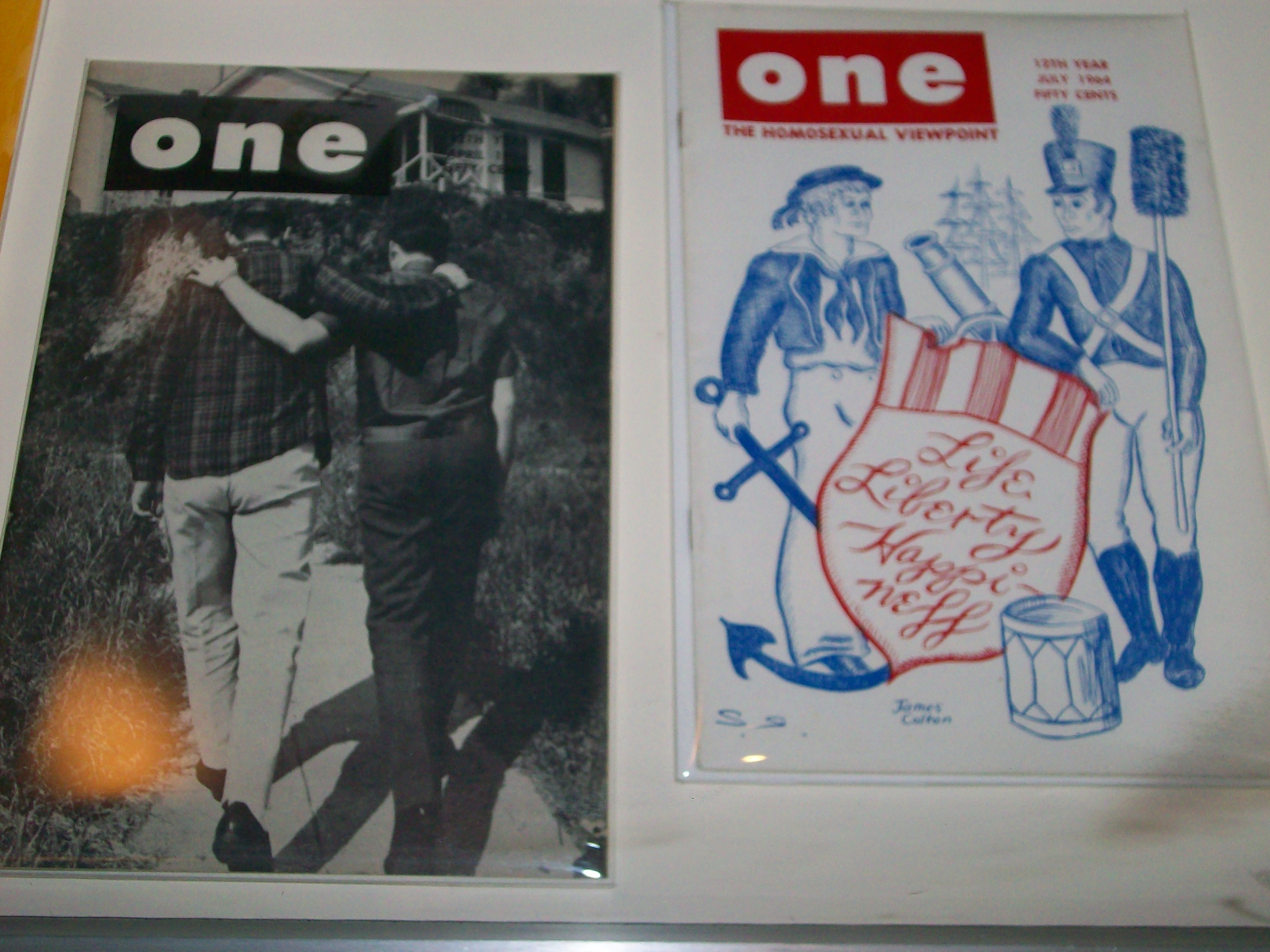
Believe it or not, the Post really gets it right: the gay press is part and parcel of gay history (I’m using the word “gay” intentionally here, for obvious historical reasons). If we are to date the modern gay rights movement back to before Stonewall, we would likely want to begin at the founding of One Magazine in 1952. It was the first gay publication founded by the first gay rights (“homophile”) organization, and it was seminal in establishing the idea that gay identity constituted not some private, internal psychopathology, but a community with a culture. One and its successors helped to spread and coalesce this idea that there was a group of people with shared goals and interests which were worth working to attain. They enabled the parallels between gay struggles and the struggles of other civil rights and social justice movements, and this in turn enabled Stonewall, the first Pride and gay rights parades, and the veritable phalanx of post-Stonewall gay papers. These included, of course, the Blade, but also half a dozen publications in New York and one for just about every other major city. These papers advertised the events of a marginalized and still largely closeted community. They printed the personal ads that couldn’t get printed in other publications. They, of course, reported on the news of hate crimes and police brutality that the mainstream media ignored. Come the 1980s, they were an essential venue of mobilization and organization and dissemination of information surrounding the outbreak of the AIDS crisis. The Blade in particular, by virtue of being based in Washington, was the paper of record of LGBT legislative struggles, reporting on the issues that still impact the community today—from the (eventual) federal response to AIDS through to the recently-passed landmark hate crimes legislation. These papers have recorded LGBT history, and they also are LGBT history.

Probably anyone reading this blog can recite a litany of the reasons the newspaper industry is dying. There are blogs and online editions of papers and myriad ways to access information without paying for it. Instead of paying to put ads and classifieds and personals in papers, people post to Craigslist or dating websites or place ads on websites. Newspapers are losing their revenue—and all these patterns impact what has become the LGBT community doubly. This is a community that is increasingly less ghettoized and more assimilated; what need has it for a particular venue for its ads and its news, when dating websites accept all sorts of advertisements (and dedicated gay dating websites also exist), or when the Post and the Times will cover the issues they once ignored? We no longer live in the era of the NYT’s notoriously poor AIDS coverage. Times have changed. And the Blade, tragically, has locked its offices and fired its staffers.

So maybe Bilerico and Pam’s House Blend and Towleroad—in collaboration, indeed, with the Times and the Post and, heaven help us, the Wall Street Journal—can fill in the hole left by the demise of the Blade and its peers. But how alienating it feels to know that we’re leaving the era when a marginalized community used its print media to band together and organize and share in its solidarity?

(cross-posted)

Armistice Day Art

H.D. (real name Hilda Doolittle) was an Imagist poet, an American transplant to London whose poetry is heavily influenced by Freud and is often inscrutable, but which deals very much with the tumultuous times in which she was writing, during both World Wars. When we talk about war poetry, especially in connection with November 11, we often tend to turn to men such as Wilfred Owen, whose poetry is written from the (male) soldier’s perspective. But we read H.D. in class this week, and I think her writing is as applicable to memorializing the War to End All Wars as any other. I’m particularly interested by how she addresses the theme of Paradise lost through images of Eve and the apple. The passages which follow are from “Tribute to the Angels,” part of her long poem Trilogy. “Tribute to the Angels” was written in 1944, shortly before D-Day (yeah, I know, not WWI, but still relevant, I think).

[30]

We see her hand in her lap,
smoothing the apple-green

or the apple-russet silk;
we see her hand at her throat,

fingering a talisman
brought by a crusader from Jerusalem;

we see her hand unknot a Syrian veil
or lay down a Venetian shawl

on a polished table that reflects
half a miniature broken column;

we see her stare past a mirror
through an open window,

where boat follows slow boat on the lagoon;
there are white flowers on the water.

[35]

Ah (you say), this is Holy Wisdom,
Santa Sophia, the SS of the Sanctus Spiritus,

so by facile reasoning, logically
the incarnate symbol of the Holy Ghost;
your Holy Ghost was an apple-tree
smouldering—or rather now bourgeoning

with flowers; the fruit of the Tree?
this is the new Eve who comes

clearly to return, to retrieve
what she lost the race,

given over to sin, to death;
she brings the Book of Life, obviously.

[37]

This is a symbol of beauty (you continue),
she is Our Lady universally,

I see her as you project her,
not out of lace

flanked by Corinthian capitals,
or in a Coptic nave,

or frozen above the centre door
of a Gothic cathedral;

you have done very well by her
(to repeat your own phrase),

you have carved her tall and unmistakable,
a hieratic figure, the veiled Goddess,

whether of the seven delights,
whether of the seven spear-points.

When reading this, I was reminded of a Pete Seeger song, “Letter to Eve”—much more accessible to the average reader, but equally hauntingly powerful. Listen here, and then remember—as you always should—that the war whose end we observe on November 11 was meant to be a type of action we would never have to repeat.

The Intricacies of Marriage Equality Legislative Politics

Instead of doing work for my anthropology class, I just got distracted by a certain NYT article, which led me to go on an article-long rant about the politics of marriage equality in New York and New Jersey. So much for trying to step back from politics before I have a heart attack or contract diagnosable depression….

You can read the post at my Campus Progress blog, and if you’re interested in staying informed about what’s going to happen in two populous and incredibly important states with regard to LGBT rights in the next couple months, you should really do so.

Rationalizations and Reality Checks

Last night, I was sitting on my window seat, blaring public radio and refreshing half a dozen websites; making phone calls; covering the New Jersey elections—and, to a lesser extent, Maine and NY-23—as if it’s my job. (In fact, it sort of is; I’ll have a piece up at Campus Progress later today about NJ.) I went to bed last night full of depression and malaise, not even fully angry at the voters who elected an incompetent Republican governor in my state, nor at those who voted to take away the rights of LGBT Mainers. No, I was just sad. Sad and frustrated and wondering what the point is of letting my schoolwork suffer while I care about politics. I put on a 50-year-old comedy radio show that had nothing to do with politics, and I fell asleep consumed by guilty that I wasn’t listening to a cable news show instead. It’s so hard. It’s so hard to do enough, because it’s never enough. It seems as if the forces of good and equality and righteousness are up against so much.

This afternoon, after I’d turned in my copy and gotten an H1N1 vaccine (all the while grumbling, “If we had public health care, I wouldn’t have had to pay $15 out-of-pocket for this”), I went to get lunch and wound up chatting with one of the dining hall workers, who is from Haiti. He was telling me that his cousin is running for office in Haiti, and that he was going to go back to Haiti to vote for his cousin. We talked about how we’re both from warm places, and how much colder it is here in New Jersey. We didn’t, of course, talk about the American election.

And that’s because there are people to whom American politics is simply not the center of the universe—not just those who live in privilege and so don’t want to work to get everyone health care and equal rights, but those whose universe is focused differently. I’m going to go out on a limb and guess that Corzine vs. Christie, or marriage in Maine, aren’t questions that make a whole lot of difference to someone whom one of the richest universities in the world can barely manage to pay a living wage. And we all should remember that. Those of us who wake up the next morning election after election, full of elation or remorse and the will to organize and to vote again, should remember that American electoral politics are not the be-all and end-all of reality.

I’m telling that to myself as much as to anyone else, because here I am, now, sitting in Princeton and eating my eggs and drinking my coffee, wondering what to do next. I am left winded by this election, suffering post-2008 disillusionment the way a lot of us are. I feel exhausted by politics, by reading hundreds of blog posts per day, by writing and talking and posting shit on Facebook. I feel lost after phonebanking and campaigning for Corzine, donating to Maine, and being left with the notion that the progressive grassroots is powerless in the face of far more entrenched and well-funded lobbyists.

I would like nothing more than to put politics in a box for the next ten years, and train to be the best historian that I can possibly be. I would like to be able to tell myself that devoting the next two and a half years to telling the story of Princeton’s gay alumni is as worthwhile an endeavor as devoting the next two and a half years to fighting for marriage equality in New Jersey. I would like to believe that going to grad school and fighting for one of those rapidly-disappearing tenure-track jobs is as morally conscionable a career path as getting paid subsistence wages to organize for another pie-in-the-sky progressive cause. I want to believe that telling the untold stories of Americans dead for thirty or forty or fifty or a hundred years is as important as telling the untold stories of Americans suffering today.

I want someone to tell me that it’s okay if I can’t do everything, and that furthermore it’s okay to choose my schoolwork over campaigning. I want someone to tell me that historiography can be a fight for social justice too. But the fact that I want so desperately to hear those glad tidings makes me think that it can’t possibly be true. It makes me believe that this is just rationalization to explain away the fact that I spent the weeks before the election writing my midterm papers and not out in the streets. It makes me believe this is just an attempt to justify my privileged access to elite higher education and a cushy academic job after.

But all the same. All the same I think that ten or fifteen years hence, if I do keep doing this, it will be worth it. The organizers will organize and my god, I wish them well. But how will we know if the arc of history bends towards justice unless there are historians to interpret and understand it?

Oh, Washington Post, Do Please Try Harder

From this morning’s Post:

Questions about the largest contributor [to the anti-marriage equality campaign in Maine] have sparked an investigation by the state ethics commission and a court battle. The National Organization for Marriage, or NOM, has contributed $1.6 million to Stand for Marriage Maine but has declined to reveal its own contributors, despite a federal district court decision last week that it must do so under Maine law.

Some groups for gays say the organization is a stalking horse for the Church of Jesus Christ of Latter-day Saints, or the Mormons, which dominated fundraising in the California campaign. Many of the actors in a nationally televised ad produced by NOM, called “Gathering Storm,” turned out to be Mormon activists.

Weekend calls to the New Jersey-based organization and its attorney were not returned. But Fish said that after the backlash in California against the Mormon Church, its leadership decided not to become directly involved in Maine.

I’m surprised to see the Post pulling this, especially after running that rather silly and much-criticized article about Brian Brown, NOM’s executive director, over the summer. If there is any religious background to which NOM’s leaders subscribe, it’s Catholicism: Brown, President Maggie Gallagher, and Chairman of the Board Robert George all profess devout Catholicism. Indeed, to the best of my knowledge, the only Mormon in a leadership role at NOM is science-fiction writer Orson Scott Card, a recent addition to the Board of Directors who is probably not entirely sane. Making it out to seem as if marriage-equality proponents think NOM is a Mormon conspiracy isn’t entirely fair of the Post, because I think most of us know that’s not true. If we know anything, it’s that NOM is deeply embedded in the Catholic right, and that such is the tradition its leaders come from.

Moreover, I wish some mainstream news organization would get in touch with NOM and determine once and for all where they’re located. First the Post reports that NOM moved out of Princeton, to Philadelphia and then to DC, and now they’re telling us that NOM is still NJ-based. The website still lists a Nassau St. mailing address and a (609) phone number (that’s the Princeton area code), but even during business hours that phone number only ever goes to voicemail. What’s Brian Brown doing in his new H St. offices? How do we contact him there? No one—not even the Post—seems to know.

If the Post has contacts at NOM (and they must do, to have run that profile in August), they have the ability to do much more than make unsourced claims about what “some groups for gays” think. They could actually unravel the tangled web that is the Catholic right and figure out what the hell is going on here. I guess, seeing as this is the Post, that would be too much to ask, but at the very least the paper could stop sowing conspiracy theories about Mormons that I, as an LGBT activist, have never heard espoused by the people I work with.

(cross-posted)

Marriage and Motherhood; Patriotism and Progressivism

I’ll confess I haven’t read the article on the Obamas’ marriage in this week’s NYT Magazine, but Kate Harding’s response at Jezebel resonated very much with me. Harding says:

I voted for Clinton in large part because I regarded her as long-overdue proof that a little girl from the Chicago suburbs could grow up to be president, and it still irritates me to see her held up primarily as a symbol of the establishment, rather than a swift kick in the establishment’s shriveled white nuts. (I think she and Obama are both about 50/50 there.) But it’s also because the false equivalence continues to go unquestioned, just as it did in the campaign — we’re meant to accept that becoming First Lady is basically just as momentous for a woman as becoming president would be. Which… you remember that Hillary Clinton is one of the people in this equation, right? And seriously, every time I heard that shit about a little girl from the South Side growing up to be First Lady, all I could think was, “What little girl dreams of being married to the most powerful person on the planet?” I don’t know, maybe some still do in the twenty-first century, but I certainly didn’t in the late twentieth. I was heartbroken when I learned in elementary school that being born in Canada makes me ineligible for the presidency; it took many more years before it fully sunk in that my vagina does, too. And sadder still is the fact that little African-American girls are faced with even less evidence to suggest they could ever scale those heights. Michelle may have Bill’s charisma, Hillary’s toughness and Barack’s brains, but with racism and sexism both working against her, she couldn’t have made it as far as any of them if she’d wanted to.

I hope things aren’t as bad as all this; I would like to think that an African-American woman would have a viable chance at the presidency in my lifetime. But I find myself sharing Harding’s concern about this sense that being the First Lady is equivalent to being the President. It’s just not. The First Family is an idealization of the modern American nuclear family, a reflection of the conception that’s persisted since the end of World War II that a father who works and a mother who keeps house and takes care of the children are the most American way to envision a family.

I’ve just started watching season 1 of Mad Men this week (I know, I’m a little behind the times), and to me the way we’re applauding en masse the Obama marriage is not entirely different from the way traditional gender roles are made to seem sexy and exciting in Mad Men. I know that the TV show means to critique and expose as flawed those roles, but my sense from having seen half of the first season is that it doesn’t do so nearly as effectively as it could. Mad Men is TV—its depiction of history is going to be inherently romanticized, and not a balanced historical analysis of the way gender and power relationships function(ed) in middle-class, white, urban and suburban America. Likewise, the First Family has its cult (or not-so-cult) following; the Obamas are not only celebrities, but representations of America by virtue of the President’s office as head of state. Even in 2009, being a full-time wife and mother and making it your career to further your husband’s is a patriotic good.

Don’t get me wrong on any count: I believe there is nothing wrong with choosing to make spousehood and motherhood your career. And I admire Michelle Obama deeply; she’s a smart and savvy woman whose history with and views about my university resonate particularly with me. But the way our media and our culture are celebrating her wife-and-motherhood and the moral good of her marriage to her husband just don’t sit right with me. I know this is a contentious statement to make, but I don’t believe that the Obamas’ marriage—as happy and fulfilled as it may make them—represents a higher moral good. I don’t know that we should be celebrating their marriage—and Michelle O.’s wife-and-motherhood—more than the lives and careers of people who do not have spouses and/or children.

When I say “we,” I’m talking about the left, the progressive community. I perceived a tendency over the past year-plus for progressives to valorize the Obamas’ marriage despite professing disagreement with cultural conservatives’ pronouncements about “family values” and gender essentialism. I think that we have a tendency to assume that because the Obamas themselves are progressive, because the implication is that both husband and wife made the choices to assume the roles they did, that it’s okay, and that therefore we can celebrate the degree to which Barack and Michelle reflect a somewhat updated but nevertheless (to my mind) Mad Men-esque hyper-American patriotic ideal of the nuclear family. Reader, this makes me profoundly uncomfortable.

Marriage is for some people and not others. Getting married is a perfectly reasonable thing to do, particularly if you have children, or one of you is from a different country, or for whatever reason you want access to however many thousand benefits it is that marriage gives you. But marriage should be a choice, not a patriotic duty, especially where 21st-century progressivism is concerned.

When I sit down and think about it, I don’t see myself as a particularly radical person—farther to the left than average, certainly, and probably farther to the left than the average Democrat. For instance, I do vote Democratic. I am willing to make concessions to the political mainstream to accomplish things. I believe in the greater good of certain cultural institutions, particularly those enshrined in the Constitution. I am an intensely patriotic person. I kind of want to feel as if my country likes me back, as if the political ideologies with which I ally myself are willing to be inclusive about my life choices. In our cultural moment surrounding the life of the 44th President and his family, I don’t see that happening, and it leaves me profoundly ill-at-ease.

QOTD (2009-10-28)

For my QOTD feature, I usually post words which I like, which resonate with me. Today, I am posting words that I hate, because I think that everyone needs to know what a certain tenured professor with an endowed chair at my university thinks about my community and the rights we’re fighting for. An interviewer is asking Prof. George what the fight for same-sex marriage is about, and he responds:

It’s about sex. Those seeking to redefine marriage began by insisting that what they were fundamentally interested in was gaining needed benefits for same-sex domestic partners. Legal recognition of same-sex partnerships was necessary, they said, so that partners could visit each other in hospitals, extend employer-provided health insurance and other benefits to each other, and so forth. Some people who said this were, I’m sure, being sincere. Most, however, were not telling the truth. Their goal was to win official approbation for sodomy and other forms of sexual conduct that historically have been condemned as immoral and discouraged or even banned as a matter of law and public policy. The clear evidence for this is the refusal of most same-sex “marriage” activists to accept civil unions and domestic partnership programs under which the benefits of marriage are extended, but which do not use the label “marriage” or (and this is very important) predicate these benefits on the existence or presumption of a sexual relationship between the partners. So, it is not really about benefits. It is about sex. The idea that is antithetical to those who are seeking to redefine marriage is that there is something uniquely good and morally upright about the chaste sexual union of husband and wife—something that is absent in sodomitical acts and in other forms sexual behavior that have been traditionally—and in my view correctly—regarded as intrinsically non-marital and, as such, immoral.

I’m sure I don’t need to tell you, dear reader, about the many, many LGBT Americans who have died alone in hospital because their partners were not admitted to see them. Dear reader, if marriage rights are about anything, they’re not sex. They’re about parenting and immigration and being able to be with the person you love in his or her last moments.

Prof. George says this about the generational shift in support for marriage equality:

The support of so many young people for regarding same-sex partnerships as marriages isn’t surprising, given the cultural power of the movement for sexual liberalism; but I seriously doubt that it makes the redefinition of marriage inevitable. Young people grow up. Most will marry and have children. They will perceive the ways in which moms and dads complement each other, especially (though not exclusively) in child rearing, and the ways their children benefit from paternal and maternal complementarity. Their vision of marriage and sexuality as having everything to do with feelings and romance will fade. They will learn something about love as an act of the will, and not merely a species of affection; and their understanding of what marriage actually is and why it exists will, in many cases, be deeply enriched. I do not claim that the experience of growing up, marrying, and bringing up children will lead all young people or even most who today say they favor the redefinition of marriage to change their minds; obviously, lots of married grown-ups with children today hold liberal views about sex. But I suspect that it will have a significant impact.

Dear reader, I’m sure I don’t need to tell you about the large quantities of adults who are fighting for marriage equality, especially those who would like very much to get married themselves. Every time I go to Pride or a protest, I see people my age, but also people of all generations. Just look at Frank Kameny: the folks who built this movement may have gotten older, but they haven’t stopped fighting for the causes they believe in.

Finally, Prof. George says this about the aftermath of Prop. 8:

Anyone who contributed money to the Prop 8 effort or played any identifiable role in supporting it was targeted for intimidation. They were depicted as agents of intolerance and enemies of equality. Pressure was put on their employers to fire or discipline them. (I speak from personal experience here: the president of Princeton University, where I am a member of the faculty, was deluged with letters demanding action against me.)

Regular readers may recall that I helped to organize a dance party outside the erstwhile headquarters of the largest single donor to Yes on 8—and that while I have sent President Tilghman many emails, I have never sent her one expressing my objection to Prof. George’s political advocacy. I believe that the solution to speech I find hateful and prejudicial is to speak up in turn in favor of equality and justice, and to do so louder and stronger and in a manner which attracts good media attention.

But if I were a Californian whose state citizenship had just been reduced once more to second-class, and I’d heard that one of the individuals directly implicated in this was a tenured professor with an endowed chair at one of the best undergraduate universities in the country, then yes, I might write to the office of its president to express my disapproval. It is very hard to look at these words, written so starkly on the page, and think that they come from the mouth of someone who is a part of my university, someone whom I have seen in the library or in the dining hall or at public lectures. It is very difficult to acknowledge that there is someone who holds a profession which I particularly exalt (who, indeed, professes) who holds some of the views which I consider to be the most vile and morally indefensible of all views.

Over the years, I have tried very hard to understand Prof. George, and ardent stalwarts of the conservative movement like him. The amount of potted psychoanalysis to which I’ve mentally subjected my political theory professor’s colleague could probably fill a rather large book, possibly even in a multivolume edition. But sometimes, like now, all the objective distancing and black humor falls down around my ears, and I am simply overcome with hatred for this man.