On “It Gets Better,” Briefly

Yesterday came the news that Dharun Ravi, the roommate who videotaped Rutgers student Tyler Clementi’s hookup last fall immediately before Clementi jumped off the George Washington Bridge, is being charged with a hate crime. Those who grope, when a suicide happens, for someone to blame it on will I suppose have their closure, though as my friend Katherine wrote when I posted the news story on Facebook, “Nobody wins.” Clementi is still dead, and Ravi’s life is probably not going to go too well from now on. For this teenager, unlike (we might assume) the many LGBT teenagers who have been targeted by Dan Savage’s viral campaign in the wake of Clementi’s suicide, it will not “get better.”

Though a woefully poignant note, this seems an appropriate one on which to take a moment to reflect on what “It Gets Better” means. The immense popularity of the campaign, in which thousands of people all over the world—from these sweet older men to President Obama—have posted videos on YouTube, has led to the elevation of teen suicide as one of the causes les plus célèbres of the LGBT rights movement. It is a cause which has demanded the attention of not only the representatives of several departments of the U.S. government and the employees of several major international corporations, but also of pop stars such as Lady Gaga, whose “Born This Way” was written to be marketed as a gay anthem, and to encourage the positive-thinking, neatly-packaged Pride attitude that seems to have worked so well for the “It Gets Better” stories. When the Fox TV show Glee, which has also focused a lot of attention on what it is like to be a white gay male teenager in a school environment, premieres a 90-minute special episode written around “Born This Way” next week, it will become the latest addition to this mega-narrative promising salvation to LGBT teenagers that has responded with such commercial—as well as heartfelt—force to Tyler Clementi’s, and other young people’s, suicides.

Ostensibly, it is a narrative which offers so much hope and promise—stay alive; everything’s gonna be okay—but as the months have ticked by, my feelings about it have gotten ever more complex. My acceptance of it as something which I can both relate to and believe in has faded since I wrote my first response to Clementi’s death, and since I contributed to Princeton’s “It Gets Better” video. As I go to Holy Week services this week and get hung up on the degree to which the words, and the acts of devotion they demand, make no sense since I was raised without a promise of salvation as part of my worldview, so do I hesitate more and more to hurtle headlong for “It Gets Better.” Justification by faith is no more sensible to me whether we’re talking about how God sent his Son to die for us or whether we’re talking about a telos in which anonymous gay (yes, usually gay) kid from flyover country realizes he (yes, usually he) was “Born This Way,” and therefore has the impetus to move to a city and go to Pride and dance to Gaga at the clubs and eventually get gay-married and live happily ever after. I speak facetiously, of course, but this is not to elide the comparison between religious faith and “It Gets Better” faith. I’m getting a sense now that this is what’s been lying behind my hesitation to embrace the IGB narrative over the course of the past several months. I think I’m just not a person who has faith.

But I am not without belief, and not without causes, and not without spirituality, of a certain sort. If I am anything, I am a believer in good works, and in the quasi-Transcendentalist belief in God-as-metaphor, as a divine presence in all things that are good and virtuous that we can experience at the best of times as a shiver of pleasure. And it’s these things I think of when I think of getting better: of developing oneself to be more virtuous, and to be able to feel that shiver when confronted with beauty. My God is not externalized, in the promise of salvation nor the promise of Pride, but is something I may perceive in swift glimpses if I play my cards right, if I do my reading and practice my vocation of being a teacher. And this is something that does not happen without good works—without those of oneself and one’s daily self-fashioning, and most critically without those of the bettering influences around one, the dearest friends and most caring mentors, the families biological and adopted, and even the anonymous donor who means you get paid for doing what you love for the first time. For me, coming into this world without faith, it does nothing to believe that “it gets better” first, and then proceed from there. It is only through the daily Pilgrim’s Progress of psychological labor that I have even so much as come to appreciate the goodness of my life, how fortunate I am, how much better my life is now than it was just three years ago, and how much I now have to give that it is my duty to pass on to those whom I believe need to be told not “It Gets Better,” but how to help themselves—just as my teachers, slowly but surely, brought home to me.

Late last night, a bout of insomnia had me reflecting on what it is to be a 21-year-old Canadian-American academic brat living alone on another continent (or, well, an island in the North Sea), for whom going to work every day means going to the Bodleian Library to write about John Addington Symonds, which work is (or will be, this summer) subsidized in part by a grant because some members of her department thought what this 21-year-old Canadian-American academic brat does with her life is worth paying her for. Three years ago, when I was an 18-year-old gazing rapt at the light at the end of the long, dark, horrible tunnel of high school, and looking ahead to a summer working at the local cinema and who-knows-what to follow in September at a university I was convinced I hadn’t deserved to get into, I could never have imagined living in a room in Broad Street, writing original scholarship by sunlight in the Upper Reading Room. I could never have imagined being the one to discover Symonds’ letters to Roden Noel in the Bodleian’s English literary manuscript collections, or the one to cut the pages on nineteenth-century books no one has ever opened for a hundred years. I could never have imagined having mentees of my own. I could never have imagined having a pint at the pub with friends, or using Facebook to keep in touch with other friends on the continent I came from. I could never have imagined living in a world in which what I do, and what I value, is valued. I no longer hate myself. And if there is any evidence of bettering, surely this is it.

But I did not come to realize that my life is better because someone in a YouTube video told me; I came to realize it through dint of purpose and the gentle guidance of teachers who taught me how to read and how to write, how to love, how to teach; who took seriously what I said to them and responded in kind; and, whether eminent chaired professors or my parents, have given me guidance when I needed it. My teachers have taught me not that I will be their colleague someday, but that I am worth working towards that goal, and moreover that such a specific goal (rather like that of the gay-married coastal-city-living IGB gay, I suppose) need not define who one is or what one can contribute. My teachers have taught me that even if it doesn’t get better, we shouldn’t stop trying. And for me it’s that purpose, not the faith, that is so much worth living for.

One last thing: if things have gotten better for me, and if I remain resolved to continue my Pilgrim’s Progress, it has nothing to do with moving to a city (after all, I have nearly always lived in or near cities) or knowing the words to every song Lady Gaga has ever released (which I probably do). For me, there is no gay marriage on the horizon. And while this is in part because this narrative does not even begin to map onto my life, and its whitewashing of the queer experience strikes me as incredibly problematic, it is also because sexual orientation is not at the center of my struggle, and because my self-loathing of past years was far displaced from a closet. Gaga notwithstanding, I live in a Victorian world, before a certain Symonds set the word “homosexual” to paper, and the competing discourses with which people of all kinds struggled to express inchoate desires didn’t always cohere around sexual object choice and the mechanics of what someone then might have called “voluptuousness.” My discourse is one in which the language of passion speaks as much, if not more, to the cults of truth, of good, and of beauty as it does to the cult of the body.

And so I ask that anyone who speaks a language in common with mine feel free to reclaim the words “it gets better” from the neatly-packaged narrative that those words have been sold as. And as we labor onwards, suspecting that the Celestial City is nowhere to be found, but that we ought to keep on towards it anyway, let us please make sure that we say an atheist’s prayer for the poor lost souls of all those people who take an action like jumping off the George Washington Bridge—regardless of whether their torment was the homophobic taunts of a schoolyard bully.

… to my knowledge, nobody professes to doubt that, so far forth as we possess a power of bettering things, it is our paramount duty to use it and to train all our intellect and energy to this supreme service of our kind. Hence the pressing interest of the question, to what extent modern progress in natural knowledge… is competent to help us in the great work of helping one another?”
—T.H. Huxley
I Don’t Usually Do This Kind of Post, But; or, Problems in IvyGate’s Knowledge of Late-Victorian Intellectual History

There’s been a bit of buzz on the internet (or, well, okay, fine, the Ivy League internet; yes, I know I’m an elitist bastard) recently about an 1899 Harvard admissions exam that the NY Times posted on its website, seemingly largely consisting of dismay at how difficult it must have been to get into Harvard or a school like it in 1899. Here’s IvyGate, whose post caused me to become very irritable:

If you thought getting accepted to an Ivy League school was tough today, you should count your blessings that you weren’t born in the 1880s. In addition to having diphtheria and bad teeth and a pompadour like a mangy cat, you’d also be forced to take a comically rigid entrance exam and speak ancient Greek.

The New York Times recently unearthed a Harvard entrance exam from 1899, and man, is it ugly. The text spans three major disciplines–classical languages, history and math–and requires its victims to jump through flaming hoops in topics like Greek Composition, Random-Ass Geography, and Hard Numbers.

In their usual pained attempts to be sarcastic, IvyGate seem to have forgotten the first rule of history, which I hope they learned before taking their AP U.S. History test to get into their own fancy schools: change over time. No, of course secondary-school students aren’t taught the same things now that they were in 1899. Classical studies are (sadly, some might argue) out of fashion in favor of modern subjects; since we all have TI-83s now, it’s no longer as much a mark of mathematical competency to do complicated arithmetic as it is to differentiate and integrate single-variable equations. And, in reference to the Columbia entrance exam the post also references, obviously before 20th-century literature came along, people read different things—and yet I’ll wager most of us who go to Ivy League schools read at least some of those works of literature in high school, such as Macbeth, “The Rime of the Ancient Mariner,” and House of the Seven Gables, and have covered more of them (such as Milton) since entering college.

As to the Latin and Greek—well, it’s a question of fads, not so much a question of competency. Most people applying to university in America take a modern language; if you go to a fancy school in America today, you might still do Latin, and possibly even Greek (though it’s not particularly likely). I did Latin on my own for three years, and while I couldn’t do well on the Harvard exam if I sat it today, I would certainly have been able to answer all those questions after three years with the language. This is very similar to the sort of stuff I was asked to do as a Latin student, particularly the English-to-Latin translations where they give you a lot of clues as to which words they’d like you to use. I’m sure if those questions were in French or Spanish, most people would be able to conjugate some verbs and do a little translation and composition in the language. It’s not clear to me that this is any more difficult than taking an AP language test—and in fact, it was probably easier. Why, you ask? Well, because the boys who applied to Harvard in 1899 were probably groomed to it in a way few students are today. They attended a much smaller array of elite east-coast schools, which knew what to teach in order to get their students into the universities. Anyone with their sights on Harvard in the late 19th century would probably have been heavily coached to be good at their Greek verse and to know fun facts like the dates of the battles of Philippi and Actium, just as a lot of people applying to university today do SAT prep classes. University students in 19th-century Britain and America were rewarded for pretty foreign-sounding things by our standards (on the other side of the Atlantic, both Symonds and Wilde won prizes at Oxford for their Latin verse stylings!) but hey, we now award prizes for community service and school spirit. Go figure.

Bottom line, it was probably much easier to get into Harvard in 1899, because the number of people who could even enter the admissions pool was so limited. You obviously had to be a white man, and more than that to even have a shot you had to go to a fancy high school, probably in the northeast and even more probably in Massachusetts, where you would be taught ancient subjects ad nauseam. If you even had the opportunity to sit this exam in the first place, you’d probably do well.

As for us, in our age of uber-competitive, 6-8% admission rates for these schools, the insane regimes of prep classes and extracurricular activities to which prospective applicants feel pressured to subject themselves, and the widespread disappointment that spreads across the New York Times readership every year at this time as people realize that 21st-century college admissions isn’t a meritocracy, it’s a madhouse? Yeah, I’d take declining a few Greek nouns, describing the differences between Athens and Sparta, and using a slide rule any day.

But oh wait: it’s a moot point—I’m a woman. No Harvard Greek for me in 1899—and there’s the rub, really.

A Brief Moral Lesson

American Historical Association President Anthony Grafton wrote in last month’s Perspectives on History (only just brought in front of the paywall for non-AHA members) about, among other things, the gap between the work professional historians do and the public’s perception of that work (full, as they say in the biz, disclosure: I am lucky enough to be Grafton’s student and advisee):

Ann Little and Jeremy Young, the bloggers who responded at length, pointed out, in different ways, that my title was imprecise: “it is not history, but historians, who are under attack.” They’re absolutely right. Americans love history. Tens of thousands of them reenact battles, hundreds of thousands visit historical sites and exhibits, and a million a week on average watch the History Channel. Thousands of them buy the works of history that appear on best-seller lists. From Tea Partiers to Ta-Nehisi Coates’s readers debating the Civil War, they’re passionate about the past. What they don’t love, to the same extent, are professional historians.

Many believe that professional historians are no better than, or indeed worse than, amateurs (a traditional American view that often encompasses experts in other fields, from medicine to climate). Some find that professionals are too politically correct to see the past as it really was. Many, especially journalists, insist that professionals just can’t write.

The biggest problem, though, is rooted in the core of our practices. Professional historians, Little argues, “are, by nature, splitters rather than lumpers. We aren’t united by a methodology or single set of disciplinary practices, and our writing and teaching more often than not seeks not to impose order on a given topic but rather to provide nuance and complexity. This is intellectually satisfying, but it sure makes it difficult for us to explain to the general public what we do and why it’s important that professionally trained historians do it rather than Cokie Roberts or Glenn Beck.”

This resounds with me today because yesterday I was reading Tocqueville’s Democracy in America, a work which I have been learning about for much of my school-going life, but never read in its entirety. In eighth-grade US history in Massachusetts, we were taught how special Tocqueville thought this new American kind of democracy was; in eleventh-grade AP US history in California, we likewise learned about de Tocqueville as someone excited and optimistic about this new liberal, democratic project. In a college class at Princeton called “American Society and Politics,” taught out of the sociology department, we read Tocqueville on voluntary organizations, and Americans’ unique predilection for being heavily involved in civil society on their own terms. In the past eight years, the people without Ph.D.s in history who have taught me Tocqueville have never suggested that Tocqueville was in the least bit skeptical about the American experiment—and yet there the skepticism is in the document itself. The first volume of Democracy in America ends with some uncertainty; though Tocqueville believes that “the Anglo-Americans will alone cover the immense space contained between the Polar regions and the Tropics,” he is not so certain that the American political system will endure, or that the rule of the majority will not become tyrannical. He, like his British translator, who introduces the book some twenty years later at the height of the Civil War, is not as taken in by the rhetoric of American exceptionalism as the American teachers who taught Tocqueville to me. (He does, however, accurately predict the Cold War a hundred years early, which is rather impressive.)

My incredulity, as a reasonably-well-educated American who did well in high-school history, on reading Tocqueville yesterday illustrates to me why we need professional historians, and why professional historians need to work harder to bridge the gap between them and the people who teach history to the general public. I would have thought that, by this time in my life, I would have overcome the ability to be surprised by historical fact that differs from what I was taught at school. Clearly those of us thinking about careers as professional historians need to ensure that we can reach and preach not only to our own choir, but also to those who would prefer to attend a gospel of American exceptionalism—or who, as per a QOTD last week, don’t think gender has a role to play as a historical lens.

QOTD (2011-01-25); or, Nostalgia and the Homoerotic Literary Tradition

It’s disconcerting how much I identify with a teenage Terry Castle, as represented in her memoir, The Professor:

In high school I had been almost freakishly solitary and skittish, with no idea how to comport myself in ordinary-teenager fashion…. Bizarre as it sounds, by the time I left for college I had never once called anyone on the telephone or invited a classmate over after school. Nor had I myself been so called or invited…. On the contrary: I’d been reclusive, a regular Secret-Garden-Frances-Hodgson-Burnett-Girl-Hysteric-in-Training. At seventeen, I remained passionately (if uneasily) mother devoted; frighteningly watchful, in school and out; abnormally well read in Dumas novels, G.K. Chesterton’s Father Brown stories, H.P. Lovecraft, and the lives of the poets…. I began devouring certain louche modern authors in secret: Gide, Wilde, Thomas Mann, Hermann Hesse, even Yukio Mishima, then at the height of his celebrity in the West. Sexual deviance, or at least what I conceived it to be, began to exert a certain unhallowed, even gothic allure—a glamorous, decayed, half-Satanic romance…. Not least among the attractions that such literary homosexuality proffered: some drastic psychic deliverance from familial dreariness and the general SoCal strip-mall stupor…. As for “homosexual practices”—and I confess I wasn’t exactly sure, mechanically speaking, what they were—they sounded sterile and demonic but also madly titillating…. Anything could happen, it seemed, in the fascinating world of sexual inverts. Lesbianism didn’t figure much, if at all, in these early reveries: one of the oddest parts of the fantasy, I guess, was that I was male, dandified, and in some sort of filial relationship to various 1890s Decadents. I knew more about green carnations, the Brompton Oratory, The Ballad of Reading Gaol, and the curious charms of Italian gondoliers than I did about Willa Cather or Gertrude Stein—not to mention Garbo or Stanwyck or Dusty Springfield.

I was already feeling nostalgic about high school from earlier this afternoon, when something one of my high-school friends posted on Facebook reminded me of those lonely quiet days of negotiating friendship for the very first time, bumbling step-by-step out of the world of Musketeers into the bright cloudless San Diego shopping-mall sunlight, learning for the first time at the age of 16 or 17 how to socialize. At the very same time as I was learning how to socialize, I was learning how to study sexuality—putting off the terrifying process of having to confront myself and who I was and what I wanted by discoveries no less thrilling and rewarding. I can remember where I was, how I felt, when I read “Reading Gaol” and the Calamus poems and Howl. I remember lugging around school volumes of Krafft-Ebing and Kinsey borrowed from the UCSD library, because I thought it made me cool. I remember sitting up in a dark bedroom at 3 am on a hot summer night in the dead-quiet suburbs, talking to my high-school friend on AIM while we simultaneously watched Shortbus together. I remember being trapped by the walls, by the air, by the cars we all were stuck in all the time when we drove down Interstate 15 into or out of the city. I remember reading Viola in Twelfth Night for one English class. Teaching Whitman and Ginsberg in another. Adapting and staging and deliberately cross-casting The Importance of Being Earnest in another.

Like Symonds, like Terry Castle, like me, so many of us believe in another world, a place where glamor and panache and camp and beauty take the place of gender conformity and Hollister clothing and pink stucco houses. So many of us read our Plato, read our Wilde, lived our pretentious little teenage lives in a performative effort to clap! clap if we believed in fairies! So many of us grew up and didn’t quite ever find that the real world lived up to the hazy, lilac-scented Arcadian visions of the earliest chapters of Brideshead Revisited and The Picture of Dorian Gray. (As a teenager, I was never quite able to read all the way to the ends of those books, and watch the paradise slip away into madness.) But I’d like to think we all cultivate our own gardens, all find our paradises within, happier far. I’d like to think that Symonds’ creation of a homosexual culture and his affair with his gondolier at long-last helped to put some of his demons to rest; I’d like to think that Castle’s wonderfully dry self-deprecating humor bespeaks contentment with the material niceties of her life as a successful academic, far from the barren stucco San Diegan wilderness (mentally, if not physically. But I swear, Palo Alto’s nicer than University City anytime). And I dream that someday someone will pay me to introduce the homoerotic literary tradition to the young people who desperately need a little camp and glamor in their lives. But the thing is, even if plans B through Z fail and no one ever does, I’ll still be the 14-year-old kid who strutted over the hills of a southern-California suburb one September in floral-patterned knee-breeches, black lace-up boots, a frilly shirt and doublet and a broad-brimmed hat with an enormous purple peacock feather pinned to the brim. “Notes on Camp“? Baby, who needs ’em? I’ve got the text memorized!

I’ll end this reverie on the perfect note that Madonna’s “Vogue” serendipitously came up on shuffle.

In Which I Cultivate My Own Garden

Fellow Princetonian-turned-Oxonian-radical-academic Alex began his election-reaction blog post, in which he expresses his anger at last night’s Republican victories, by asking, “What left-leaning blogger isn’t writing one of these?” Well, dear reader. I wasn’t going to, until Alex asked. But now I feel I ought to, to explain why I wasn’t, and why (of all things) the biannual routine of elections which don’t turn out the way you’d like has restored my devotion to my own personal morals and values and motivation to work for what is right in the world.

In November 2009, when Chris Christie won the New Jersey gubernatorial election and I realized for the first time as a voting adult that politics does not tend usually to deliver record landslides for the party for which you voted, I began to articulate my desire to turn away from politics to other ways of making change. On November 4, the day after the election, I wrote, “I would like nothing more than to put politics in a box for the next ten years, and train to be the best historian that I can possibly be.” And later that day, I put into practice the trainee academic/teacher’s approach to keeping faith in the world, in a post about “rededicating ourselves to banishing hate and finding joy.” In that post, I wrote about the stalwarts of my aesthetic compass, like Walt Whitman and James McNeill Whistler, and I promised myself I would concentrate on positive values like love and beauty and not on negative angry things like party politics.

A year later, I stand in more or less the same place. My schoolwork has moved a step further towards real history and literary criticism, I’ve sought out a few more mentors and adopted a few more mentees, and I’ve added a few more writers and artists and musicians to my aesthetic compass and to my dorm-room walls and bookshelves. But a year later I still sit under the window of a gaudily neo-Gothic dormitory in the crisp November afternoon, telling myself and the world that the teacher’s daily labor of changing hearts and minds carries on, regardless of what happens in Washington. And that there is little point getting angry about Washington, because there’s so much to do to institute everything from knowledge to kindness in our lives and communities. I may only live a few hours from Washington—close enough that I’ve taken the early-morning bus down there for a protest myself—but in a day-to-day life of learning and teaching both tangible and intangible things, the wealthy mostly-men who use their personal fortunes and the support of sundry industries to propel themselves to elected office have little bearing on what we do and how we do it. They have the power to affect our material circumstances, but it’s we who must make sure we continue to bring out the best in ourselves and others. Washington has nothing to do with aesthetic appreciation and loving our neighbors. And I happen to believe, because I’m a sappy humanist, that while we need to make sure all our fellow humans are fed and clothed and housed and have healthcare and jobs and educations, we also need fight for the endurance of love and beauty and truth and hope. How can we do that if we believe that humanity’s fate lies in the hands of Congress?

And so today I spent a couple morning hours going over the election returns, but then I set about reading for my first substantial piece of independent historical scholarship. And for the first time in several weeks, I am doing this reading with the conviction that I am doing the right thing, and that I am not a total idiot, and that I deserve my place in Princeton and I deserve to go to grad school, and that what I do amateurishly mucking about with intellectual history matters as much as literary theory I can’t understand. Because what I do will keep me steeped in my vocation of teaching and learning, and that is what will keep us not just alive, but human and humane and doing right by each other.

I leave you with one of the heroes who taught me to believe in what I believe in (whose newest album, to which I’m listening this minute, should be required listening for this particular historical moment) singing a song which always gives me hope:

Come Out, Come Out, Wherever You Are!

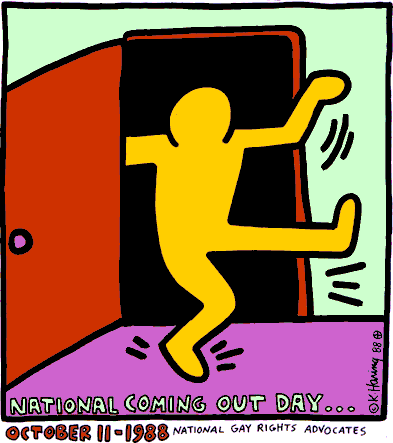
Keith Haring National Coming Out Day
Today, October 11, is National Coming Out Day here in the U.S. As you can see from the Keith Haring poster, National Coming Out Day comes from a time in American queer history when “SILENCE = DEATH” was the watchword, and so it is tempting perhaps to think that it belongs to a time that is no longer, when urgency and militancy overtook the case for same-sex marriage and other, more concrete and legalized understandings of LGBT civil liberties. But in fact, that’s not so: the specter of a particularly large round of young queer people’s suicides means that there are radical political groups holding die-ins again.

But even as we find militant urgency surrounding us in a stark reminder that historical narratives cannot ever be written as entirely teleological marches toward progress, we can also think of National Coming Out Day as a reminder that you needn’t be a militant to save people’s lives; you needn’t pull a Harvey Milk and declare that you will risk assassination in the name of “destroy[ing] every closet door.” All you need do is be here, be yourself, and be alive. You can go about the rest of your life, and the rest of the things you do to make the world a better place, safe in the assurance that if you live an out and unashamed life, you are, in the paraphrased words of another eminent cultural icon of teh gayz, convincing by your presence.

Of course, it doesn’t hurt either if you’re willing to put a little part of your life and yourself into being a mentor to the queer kids and the not-yet-queer kids who happen to look to you for help. Tell them your stories and listen to theirs. I have found, through a life made not just easier and more bearable; but wonderfully entertaining, enriching, and loving, by good queer mentors, that it is easier to say “homophobia” or “transphobia,” to say “girlfriend” or “boyfriend” in the way you want to say them, to talk the language of cruising or of gay-marriage politicking, if you have heard someone else do it first. And it is easier to believe that you can be a queer, gender-nonconforming woman in academia if you have seen a woman stand in front of your classroom or sit with you on a committee who is also wearing a men’s dress shirt and slacks, you know?

Coming out is at times a complicated, a perplexing, and a daunting prospect. But when you do so, whether you have any sort of life as a public figure or not, you do so for the kids who need to see queer adults around them to know that it’s worth growing up to be one too. Something I’ve always admired about gay history is the familial closeness of queer communities, even when faced with incredible adversity. Think of what queer community could do for each other in the time when Keith Haring created that poster, think of today’s queer kids who still need a ton of support, and do the right thing and tell them you’re One of Those People too.

Happy Labor Day To All, And To All A Good Night

(Update: Some related Labor Day reading is here, here, here, and especially here.)

I am not a holiday sort of person, so much. I don’t have a religion, I’m wary of clichés, and my work schedule tends not to take notice of when the banks and post offices are shut. However, if there’s one thing which can move me to celebration or solemn observance, it’s an old-fashioned leftist’s sentimental patriotism. That sentiment has found me the words to observe the Fourth of July in years past, and it always gives me the motivation to pay my respects to the people who have served this country by working for it, and who have fought for the right to do so with dignity. Labor Day is one of my very favorite days in America—and Labour Day one of my very favourites in Canada. You, dear reader, may or may not know that I was raised on the songs of the American labor movement; it was the IWW Little Red Songbook which instilled in me the basic sense of social justice, love and respect for each other, and conviction that we are more than our jobs and our wages, which I am proud to consider my creed. I have made a mixtape or a playlist nearly every first Monday in September of the songs and their history which taught me to adhere to the courage of my convictions—and this Labor Day I shared that playlist with Facebook over about twelve hours. I thought I might as well reproduce it here.

“Solidarity Forever,” written by Ralph Chaplin, is the song which stopped my crying when I was an infant. Here is the Weavers’ version.

The great organizer and songwriter Joe Hill’s “There is Power in a Union,” here performed by the venerable IWW folksinger Utah Phillips.

Joe Hill was executed on a framed murder charge in 1915, following a highly controversial trial which seems largely to have convicted him due to his political affiliations. A martyr to the cause of organized labor, several songs have been written in his honor. This, with words by Alfred Hayes and music by Earl Robinson, in versions sung by Paul Robeson and then by Joan Baez, is the most famous.


My sister and I learned fearless dissidence from the following song. I don’t know its author, and it’s not in my well-worn 1973 edition of the IWW songbook, but here is a version sung at a 1980s IWW convention by Faith Petric and Mark Ross. This is required listening for you, dear reader—and if I had the power to compel every elected Democrat in the United States to listen to this song, it would be required listening for them, too.

My early childhood feminism came from Woody Guthrie’s classic “Union Maid,” here well-updated with solid, modern verses by Woody’s son and granddaughter.

In 1931, the United Mine Workers in Harlan County, Kentucky were engaged in a bitter, violent, scary, and courageous strike. Florence Reece was the wife of a UMW leader, and the mine bosses broke into her home and terrorized her and her children in an attempt to intimidate her husband and the UMW into capitulating. It didn’t work, and Reece wrote this beautiful, haunting song. Here is Pete Seeger singing “Which Side Are You On?”


The Republican candidate for the Senate in Kentucky, Rand Paul, professed not to know why Harlan County is famous. Someone should tell him that “They say in Harlan County, there are no neutrals there/You’ll either be a union man, or a thug for J.H. Blair,” the sheriff who attempted to intimidate Florence Reece.

We conclude with the poignant “We Have Fed You All for a Thousand Years,” by an anonymous author, first printed in 1908. Here’s Utah Phillips, and here are the lyrics, which are worth typing up in full out of the IWW songbook.

We have fed you all for a thousand years
And you hail us still unfed,
Though there’s never a dollar of all your wealth
But marks the workers dead.
We have yielded our best to give you rest
And you lie on a crimson wool,
Then if blood be the price of all your wealth,
Good God! We have paid it in full!

There’s never a mine blown skyward now
But we’re buried alive for you.
And there’s never a wreck drifts shoreward now
But we are its ghastly crew.
Go reckon our dead by the forges red
And the factories where we spin.
If blood be the price of your cursed wealth,
Good God! We have paid it in!

We have fed you all for a thousand years—
For that was our doom, you know,
From the days when you chained us in your fields
To the strike a week ago.
You have taken our lives, and our husbands and wives,
And we’re told it’s your legal share,
But if blood be the price of your lawful wealth,
Good God! We have bought it fair!

I’m not a praying woman, but let us all send thoughts of some kind today to the workers who have fought for the right to organize and who have fed their families and served their countries with honor and dignity, no matter how much the bosses try to keep them down and out. As “Solidarity Forever” says, “It is we who plowed the prairies, built the cities where they trade/Dug the mines and built the workshops, endless miles of railroad laid.” It is working folk—whatever “working” means—who have built this country, and they deserve the thanks of its government and its people for all they have done and how hard they have fought to do it on fair and humane terms.

When we talk about Labor Day, and labor unions, we must necessarily talk about the right to organize, and the actions of the people who do organize unions, who do come together to work cooperatively in the fight for fair treatment, a living wage, safe working conditions, and the right not to be treated like shit. Now, “organizing” means many things, but above all it means working together and caring for each other, and no rhetoric about “efficiency” or “accountability,” no smearing of the good name of socialism, will change that. What makes us human is that we care for each other, but what we don’t often consider is that caring for each other does not just mean loving our families and being friendly enough to attend our neighbors’ cookouts on the National Day Off. It also means—and perhaps even more so than those other things—that we spend some time on Labor Day being grateful to the people who don’t have the day off, or the people who have made great personal sacrifices in the course of their efforts to build a world in which it is possible for some to have the day off. We have organizing to thank for that. We have organizing to thank for the fact that These States are still, after all, One Big Union Strong. I wonder if perhaps it might make sense for someone to tell the bosses who run this country—elected officials or simply the powerful—that organizing is more, so much more, than an industrial inconvenience.

Every morning before I have a shower or have a cup of coffee or start to read books about 19th-century intellectual history, I read the newspapers. Sometimes I am so demoralized by what I see, so convinced that we live in an insane and deranged simulacrum of the world as it should be, so certain that the world is going to hell in a handbasket, that it is hard, so terribly hard, to have a shower or have a cup of coffee or start to read books about 19th-century intellectual history or do any of the many small tasks we all set about to make daily life better for ourselves, for the people around us, and for the people who will come after us. But: though the story is apocryphal, it is still said (and worth saying) that Joe Hill’s bold last words before the firing squad were “Don’t mourn: organize!”

Happy Labor Day (and, we should not forget, Labour Day) to all, and to all a good night. May you all wake up tomorrow ready not to mourn, but to organize—whatever form of cooperation and comradeship that word may mean to you.

QOTD (2010-08-17), Continuity and Change Edition

In A Problem in Modern Ethics, Symonds, in his detailed discussion of German sexologist Ulrichs’ arguments for homosexual tolerance, reminds us just how little has changed in 120-odd years:

As the result of these considerations, Ulrichs concludes that there is no real ground for the persecution of Urnings [his word for men-loving men] except as may be found in the repugnance by the vast numerical majority for an insignificant minority. The majority encourages matrimony, condones seduction, sanctions prostitution, legalises divorce in the interests of its own sexual proclivities. It makes temporary or permanent unions illegal for the minority whose inversion of instinct it abhors. And this persecution, in the popular mind at any rate, is justified, like many other inequitable acts of prejudice or ignorance, by theological assumptions and the so-called mandates of revelation.

This fin-de-siècle argument is, other than some stylistic markers, barely distinguishable from federal judge Vaughn Walker’s decision in Perry v. Schwarzenegger—whose unveiling the other week reignited a conversation about equality, tolerance, and the nature and role of religion and morals in a society which includes men who love men and women who love women. Since there has been a thing called “homosexuality” (or “sexual inversion,” or “Greek love,” or “Urningliebe,” or other terms more recognizable to a Symonds or an Ulrichs), those who make a life out of thinking and writing about it have tried to puzzle through what its relationship is to the rest of our society. And it is remarkably striking that, just as surely as a discussion of men’s love for men will before long come back to Plato (even if by a circuitous, modern, post-classics route), it seems it will come back to marriage and divorce as well.

I remember how surprised I was, a year ago at the Smithsonian, to see a 1963 issue of One magazine with the cover text “Let’s Push Homophile Marriage,” a political rallying cry which, though advanced six years before the advent of gay liberation, though using the vocabulary of a pre-“gay” era, sounded disconcertingly familiar to 21st-century ears. I am even more surprised to see marriage rear its head in the equal-rights discussions of the 19th century: has the movement really, in 120 years, not come so far as all that? Is marriage equality as a 2010 cultural touchstone really so close to the cultural touchstones of 1890 as to make the lasting accomplishments of gay liberation seem like an illusion?

Obviously the past 120 years have brought decriminalization and the eradication of sodomy laws, a product of 1980s Britain and 2000s America largely unthinkable in Symonds’ and Ulrichs’ day, as standard as it already was in some European countries by the end of the 19th century. And yet despite shifts in public opinion and in the law, we seem to be having the same conversations, still unable to make up our collective cultural mind as to whether male homosexuality is a crime against nature or a psychological problem or just the way some people are; whether it’s fundamentally the same as or fundamentally different to heterosexuality; how the law should respect these categories and whether it should notice them at all; how we define male homosexuality as a cultural as well as a psychological category; and why, indeed, the hell it is that we get so exercised about male homosexuality while female homosexuality fades into the background! To the proverbial Martian anthropologist, our microbiological searches for the “gay gene” and endless academic psychological studies would likely seem as strange as Ulrichs’ obsessive taxonomizing of sexual behavior or Krafft-Ebing’s psychological-physiological quackery and a touch of the Freud about all their contemporaries’ early-childhood theories. We have come no closer than Symonds and his contemporaries to understanding why people are gay, and yet we seem just as wedded to an idea of the characteristic’s biological immutability as most homosexual-sympathetic sexologists of the late 19th century were. I suppose a good question to ask would be, why do we keep going around in circles? Why is it so difficult to construct a narrative of the history of homosexuality in which the arc of history bends as unremittingly towards progress as it’s supposed to?

And Christ, reader, have I really signed up to write a thesis about all this?

QOTD (2010-08-12), Thesis Research and Queer Theory Edition

We normally think of J.A. Symonds as one of the pioneers of a modern theory of male homosexuality, and my thesis presently (that is, until I change my mind again next week) hopes to discuss how Symonds’ work and life prefigured the gay identities of the 20th and 21st centuries. He was in many ways an extraordinary pioneer, and I don’t believe the importance of his work to modern queer scholarship has been fully realized. Sometimes, however, he says things which mark him as far away indeed from the mainstream of modern queer thought. For example, from Chapter 4 of his short 1896 book A Problem in Modern Ethics:

… as is always the case in the analysis of hitherto neglected phenomena, [German doctor and sexologist Casper’s] classification [of “congenital” and “acquired” sexual inversion] falls far short of the necessities of the problem. While treating of acquired sexual inversion, he only thinks of debauchees. He does not seem to have considered a deeper question—deeper in its bearing upon the way in which society will have to deal with the whole problem—the question of how far these instincts are capable of being communicated by contagion to persons in their fullest exercise of sexual vigour. Taste, fashion, preference, as factors in the dissemination of anomalous passions, he has left out of his account. It is also, but this is a minor matter, singular that he should have restricted his observations on the freemasonry among pæderasts to those in whom the instinct is acquired. That exists quite as much or even more among those in whom it is congenital.

By “freemasonry,” Symonds means the tactics “pæderasts” use to recognize each other (dress, ways of looking at each other, linguistic cues, etc.), which so happen to be a major interest of mine, so that’s cool. But I’m actually far more intrigued here by Symonds’ endorsement of Casper’s inclination to break the population of men-loving men into those in whom the trait is inborn or developed in early childhood, and those in whom it is “acquired” and to a certain extent voluntary. To endorse such a taxonomy flies in the face of most of what we think of as standard in modern homosexuality, and it would be natural to dismiss it out-of-hand as late-Victorian wackiness. There are three reasons, however, why I think we actually ought to give Symonds’ raising of a “deeper question” more thought.

The first is a fairly straightforward historical-context point: it was commonly understood in 19th- and early-20th-century American and European culture that men not generally disposed to have sex with other men might do so in extraordinary circumstances when there were no women available—the best examples being sailors on long voyages, boys and young men at single-sex boarding schools and universities, and the still-common trope of the men’s prison. Hence the sense Casper and Symonds have that some men’s sex with men does not necessarily stem from any deep-seated physiological or psychological characteristic, even though–as Symonds says at the end of this chapter–“‘the majority of persons who are subject’ to sexual inversion come into the world, or issue from the cradle, with their inclination clearly marked.”

The second is a point of semantics and close-reading: at first glance the kookiest of Symonds’ suggestions in this paragraph is that “these instincts are capable of being communicated by contagion to persons in their fullest exercise of sexual vigour.” It’s a strange sentence, one which seems to embody all the worst quackery of Victorian medical “knowledge” and to bear a disconcerting resemblance to modern warnings about the “homosexual agenda.” But putting Symonds’ suggestion in a slightly different context changes its meaning: how many stories do we continue to hear day by day about adults who come out reasonably late in life? For every modern teenage boy who grows up watching Logo, attending Pride parades, and looking for porn on the Internet, there is a middle-aged man who takes half a lifetime to realize or to determine that he is gay–and sometimes, I would imagine, this is because he has a sexual experience which spurs him to connect feelings he’s had all his life to the larger concept of “homosexuality.” It seems this could be a modern way of phrasing the problem which Symonds raises: how will society taxonomize the man who, though heretofore “normal” (in 19th-century parlance), has sex with a man and determines himself an invert? How would someone’s identity and sense of self be reshaped by having a homosexual sexual experience? It does not strike me as surprising that Symonds, who is fundamentally concerned with ideas of identity and the parts of history, culture, medicine, language, etc. which compose an identity for the sexual invert, would find this question important.

The third point is larger in scope, involving broader implications to Symonds’ observations which I don’t have the queer theory to attack properly, but which I think enormously important to understanding homosexuality both in its natal decade and today. By invoking “Taste, fashion, preference, as factors in the dissemination of anomalous passions,” I like to think of Symonds as raising the point I am fond of making that there is an extricable division between physiological/psychological, immutable homosexual sexual orientation and the much more mutable entity commonly known as “gay culture.” I am fond of pointing out that not all (male) homosexuals are participants in “gay (male) culture” (we can quibble about what that means, but regardless of what “gay culture” is, I think the point stands), while not all participants in “gay (male) culture” are (male) homosexuals themselves–I count myself in this group. And I am tempted to think of a man from Los Angeles I met in a gay bar in Paris who seemed to be enjoying the efforts of a couple guys to hit on him before confessing that he wasn’t gay himself. I think Symonds is right to point to “taste” and “fashion” as elements which make up an identity and a culture as much as something immutable does, and I think this is something which all of us who consider ourselves interested in the matter of queer identities could do a little more thinking about.

I think I’ll end on the note that I personally would like to do a lot more thinking about this word “taste,” because it could represent the simple uncontrollable desire of sexual orientation, but also quite obviously seems to connote a desire colored by preference. After all, homosexuality may not be a choice, but how many people are given to couching their sexual preferences for partners of a specific race, partners who prefer to engage in specific sexual acts, etc. in this same language of non-choice? Sometimes orientational models of these things surface–the orientational model of dominance and submission is beginning to catch on in many circles, while we nearly always speak both historically and contemporarily of pedophilic desire as something uncontrollable, only condemning in criminal terms the acting-out of that desire. But I think the language of “taste” colors many discussions of sexuality beyond LGBT activists’ “being gay is not a choice” mantra, and considering it a factor “in the dissemination of anomalous passions” could help us develop still further our understandings of how queer identities are shaped. I would think that “taste” would be incredibly important to men like Symonds who came to construct a theory of homosexual identity out of an intellectual trajectory heavily influenced by the British aesthetic movement, who joined Wilde and Pater in the study of Greats and the Renaissance, and who had much to say about art and its criticism. That Symonds’ origins in and study of this tradition related directly to his theory of homosexuality is something I hope to weigh in on in my thesis, and I hope that doing so can help us to consider what bearing “taste” has on homosexuality today, removed as it seems from ancient philosophy or Renaissance art.

My Fellow Americans; or, What I Did On My Summer Vacation

Every few days, Steve Benen, of whose Washington-politics blog I am an avid reader, writes a post summarizing the achievements of the 111th Congress and of the Obama administration’s first two years. It can become tiresome, representing as it does the endless partisanship of Washington politics, the defensiveness with which those who find themselves supporting the Democrats must react to the new normal of Republican nihilism. Tired cynic that I am, I find myself just barely satisfied with a set of accomplishments meant to advertise the promise of progressivism and the suggestion that these days will—we are certain of it!—go down in history along with the New Deal and the Great Society. I possess not just a cynicism but a conservatism which hesitates to consign the new progressivism to the historical narrative of the old progressivism quite so very soon, and I resent being dragged into a reelection campaign against my will.

And yet there is something nevertheless comforting about listing your accomplishments and thinking that, after all, you’ve been more productive than you’d supposed. I had occasion to reflect on this point this morning, as I sat morosely staring into my first cup of coffee and letting my father quote Aristotle on the inachievability of perfection at me. My father is exceptionally talented at making sensible points about the nature of academic life (frequently with the aid of ancient philosophy) which I know, rationally, to be quite true. Listening to him make these points tends to cause me to alternate between frustration that I couldn’t have figured these things out for myself and resolve to reapply myself, after all, to achieving the elusive nine-hour day of sitting at a desk reading and writing. And so this morning, of course, I sat and read 75 pages of a novel and the new issue of The American Scholar, and this afternoon I made a cup of tea and am now at least sitting at the desk, albeit thinking that in order to find the motivation for nine-hour days, I need to first congratulate myself—à la reelection campaign, reelection to the post of academic apprentice for another academic year—on the accomplishments of a summer which started two-and-a-half months ago and which now has three weeks to go. Campaign season is in full swing, and there’s no more time to waste on staying up late watching BBC documentaries on the history of British art, or on reassembling Ikea furniture that I’d screwed up the first time, or on walking to the neighbors’ house to download practically gigabytes of Facebook updates and book-review RSS feeds. And so: instead of lapsing into schizophrenic GOP-style sabotage, outlining my failure to the American people (who are also, obviously, me), we might as well catalogue two-and-a-half months’ worth of stimulus, health care and financial reform, and so on. I should be able to concoct a checked-off checklist of which to be proud: after all, I don’t have to contend with the U.S. Senate.

****

This summer began what seems like a long time ago, with the proper vacation bit, the part where it was okay that I wasn’t putting in nine-hour days, and was actually in its way the most productive of all. Not only did I get a valuable lesson in having fun, and travel north to lend a brief hand to one of the most welcoming communities and best local causes I know, my world got much bigger and brighter in the wake of my first trip to France, my first trip out of North America as an adult. In the process, somehow, I experienced the biggest surge of productivity I’ve had all summer: writing two good articles (one my valediction to Campus Progress, the other as yet homeless), and beginning to research grad schools and become a bit more knowledgeable about the real world of professional history. Of course, I spent hours sitting in front of the computer, but not entirely steeped in book reviews and academic blogs—also wading through bibliographies and archival finding aids and Amazon and Google Books and Powells, looking for titles to add to what is now my “to read” list and will someday become the bibliography of my first substantive research project. As June stretched on, I told myself every day that when July rolled around, and I was sitting at a desk in the suburbs without the delights of Paris to distract me, I would marshal all the intellectual and physical reserves of a Princeton semester and read for my thesis.

But wow, that perfection is so damnably impossible, isn’t it? Like a member of Congress who can’t quite look the American people in the eye, it seems as if I’ve read anything but thesis books, found any number of things to fill my day other than the desk and the notebook. Even when bureaucratic incompetency caused my volunteer job to vanish into the ether, leaving me with great washes of unmanaged time, I found myself inefficiently lingering over too-detailed notes, reorganizing instead of writing, and every day updating my thesislog with a new lens through which to focus my study of the intellectual history of homosexuality, unable to settle down and research just one. My fellow Americans, it is hard to begin a substantial research project with only the two-week, fifteen-page paper as guidance in how to do so—not quite as hard as generating support for a public option, perhaps; not quite as hard as withdrawing gracefully from land wars in central Asia; but hard all the same. I’ve spent six weeks dithering, skirting the edges, reading only a third of the books I’d excitedly checked out of the UCSD library in my first week of self-imposed summer term, and realizing last week that it had stupidly taken me over a month to notice that Eve Kosofsky Sedgwick had in about three sentences of a book she wrote in 1985 rendered the act of writing the thesis I’d thought I’d begun to research rather pointless. And so here we are: hence the dithering, hence the Ikea furniture and the book-club novel, hence my father’s Aristotelian pep-talk over the morning coffee. Hence this afternoon’s decision to turn the academic life which I sometimes believe I am not qualified to undertake into a reelection campaign.

Because, you see, that was the opposition’s attack ad (“Rutherford is no historian! She hasn’t the capability for original thinking! She has never done more than naïvely parrot Sedgwick!”), and here is Rutherford Junior Year PAC’s response: By assuming that this summer was about the thesis of my thesis, my opponent misses the point. By assuming that this summer was a failure because I haven’t been gainfully employed, my opponent misses the point. My opponent has turned a blind eye to the accomplishments of this administration: from essays, articles, and memoirs written, to restoring and life-changing travel foreign and domestic, to the real work of the academic amidst all this.

You see, my fellow Americans, one of the most rewarding parts of my life this summer has become what I can do to transmute my innate academic geekiness into something useful to other people’s lives—particularly in the links I post and the discussions which I moderate and in which I take part on Facebook. There are those in my life who have schooled me well in the possibility of taking Facebook seriously: it is where the audience is, the audience to which I hope to impart the values of civil discussion of current events and a respect for the liberal arts which the countries in which any of us live would like to funding-cut into oblivion. My days this summer have been made not by the slow inching progress on my thesis, but by the friends who have written to me all summer to tell me that they read what I post on Facebook, and that it is worth reading. My gratitude for these words of gratitude is immense, because it suggests to me—as I have suspected—that we are all starved for opportunities to read real things and to talk about real things. And it suggests to me that after too many years of being outcast for choosing a lonely life of the mind, and failing at too many social situations to ever dream of building communities based in friendship first and the sharing of ideas second, I can actually put my talents and my predilections to use. It suggests to me that when I seek to tune out of politics so that I can spend more time making my own life into a metaphoric midterm election, I do not do so needlessly or even entirely selfishly: I do so because I like having people to whom to talk, people with whom to talk, and people from whom I can feel needed. It is these interactions, electronic as often as not, which provide for me the real proof that the life of the mind is no waste of time.

But they are not always electronic. In San Diego, I found myself becoming part of a new social circle of kids with whom I went to high school: some of its members I’ve known for a long time, but some of them I just barely knew, or had never met at all. I grew closer to all of them, though, in a few weeks of cultural excursions and late nights in coffeeshops of which I could never have dreamed when we were all still in high school, when I was a little less sure of myself and a little more apprehensive of social settings than I am now. Twice or three times, in those languid summertime caffeine-fueled conversations, when I drank espresso and we made our Paris café right there in the cultural backwater of southern California, I caught myself, without realizing it, lapsing into my academic mode. Suddenly conscious that I was lecturing my friends about the history of gay identity politics, or had become the TA-like moderator of a political discussion, I would become embarrassed and step back—but not without first experiencing a little frisson of delight. Because I am never so much myself, and never so content with being so, as when I feel that I am teaching, and that my audience doesn’t object too much to being taught. And it is because of this that, despite the constant failure to achieve a nine-hour work day (I have now spent over an hour writing this post) I do not feel as if I have failed in my campaign promises of trainee scholarship.

****

When we make our cases for ourselves, we cannot admit to the world that we are—as is surely a philosophical truth—imperfect. Politicians do not schedule rallies only to tell their constituents that they will not be able to deliver on the promises they make; I think there was a part of me which belived when I left Princeton in June that I would write a book-length research project this summer. But in making the case for reelection—in calling upon all our physical and moral energy to take on the new academic year, and to make the case for fitness to do this for a lifetime—we must recast the debate. Determination of a candidate’s fitness should not be based in the partisan binary of what she has or hasn’t done, what she does or doesn’t believe, but rather in the presence of moral seriousness: the belief that she is acting not in the interests of lobbyists or in response to fleeting scholarly trends, but in pursuit of American ideals, in pursuit of knowledge, in a manner which demonstrates her caring for the next generation.

My fellow Americans, I have not written my senior thesis in the summer before my junior year. I have not, really, even started. But I have made great headway in understanding how to read the masters of my discipline and how to convey what I’ve read to those who haven’t; I have practiced in my own stumbling adolescent way the craft of public intellectualism, and I have begun to believe that research—as much as it will determine my career in the years to come—is absolutely the least important part of how my electorate (okay, fine, I) ought to judge my candidacy.

The 111th Congress passed the Affordable Care Act. I read a few books, and wrote a few essays. But the pollsters are asking the wrong questions. I would sooner they asked: are we good people striving to be better, committed to making the world a better place?

I leave it to the American people to decide.