I found it rather silly that this ad came up on my Facebook yesterday:
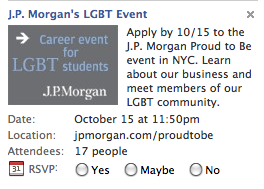
I found it rather silly that this ad came up on my Facebook yesterday:
Jason Mattera (of kicking your faithful correspondent out of the Young America’s Foundation conference fame) didn’t limit his comments about his political opponents’ physical appearance to the Campus Progress editorial intern with a relative lack of power or social capital who wanted to cover his conference this past summer. He also thinks he’s going to win back conservatism’s power by making remarks about the appearance of one of the most popular news hosts on TV, as Sarah Posner reported on Monday:
But targeting Millennials through pro-life appeals mixes sexuality with chastity. During the panel, Mattera took the David and Goliath metaphor another perverse step: If conservatives (David) smite liberals (Goliath), they will be rewarded with the hot conservative women, just like King Saul promised his daughter to the warrior who slew the evil giant. “You know his daughter must have been beautiful because there’s no guy whose gonna die for an ugly girl,” Mattera chortled. “Our women are hot. We have Michelle Malkin. Who does the left have, Rachel Maddow? Sorry, I prefer that my women not look like dudes.”
Mattera, who doesn’t seem to see the inherent problem with criticizing women’s appearances instead of their ideas, responded on his blog:
Okay, okay. I’ll admit it: Not all lib women look like dudes. I’m sure there are some who don’t. Maybe. But folks, can we at least agree on Rachel Maddow? Some bipartisanship, people?
Posner refers to the college activism panel that I participated in at Family Research Council’s conference over the weekend. What did hot women have to do with my talk? Not much, actually, despite Posner making it the basis of her piece. It was just a casual reference—me noting that even if I weren’t an activist, I’d probably still wander to the conservative camp because our women don’t look like the picture [of Maddow] above.
Rachel Maddow is an extraordinarily talented and successful woman, and it’s not too often that I get to be in the same category as her, so I’m sort of perversely excited that Mattera thinks I’m as worth calling a guy as Maddow. Seriously guys, I’m milking this for all it’s worth.
But what I find interesting and puzzling about folks’ reaction as I’ve told them about this is how eager they’ve been to assure me that Ms. Maddow is incredibly attractive, or that conservative women aren’t attractive, or to insinuate that the fact that Mattera put me in the same category as Maddow says something good about my physical appearance. I’m interested and puzzled because I would have thought the answer to this would be to challenge Mattera’s (and the conservative movement’s) sexism. This conversation shouldn’t be about which side of the aisle has the nicer-looking women. This has nothing to do with “Newsflash! Dykes can be hot too!” This has to do with the fact that we all—Maddow, Mattera, myself, Michelle Malkin, and everyone—should be judged on the basis of our ideas, not our appearances.
I think there are plenty of interesting things to be said about how confused the conservative movement (as represented by Mattera) seems to be about engaging with women on an intellectual level. Mattera seems rather challenged by the notion that women could contribute more than their appearances to the political sphere, and doesn’t even address the ideas of the women on his own side. It’s as if we’re mascots in his universe, and that speaks volumes about what his universe consists of and how he interacts with it. That’s a social phenomenon we could analyze at great length if we wanted to.
But I really have too many other papers to write to bother with unpacking that one, and I think maybe our time could be better served in the long run by not letting Mattera make this a discussion about physical attributes. Yes, it can sometimes be challenging to sit there and watch someone make sexist and implicitly homophobic comments about you, without challenging him on his premise. But if we don’t void the premise entirely, we’re not going to get anywhere. I think I’m going to focus on hoping that one day Rachel Maddow and I will have something in common that isn’t the length of our haircuts.
UPDATE: Ironically, Maddow has one of the best summing-ups of this whole “conservative movement” thing.
In the theme I appear to have been developing recently of “Let’s take something I read on the intertubes and use it as an excuse to have an entirely different conversation,” Bilerico pointed out a statistic that, sadly, does not surprise me at all: “While women make up 14 percent of Army personnel, 46% of those discharged under DADT in 2007 were women.”
The saga of Caster Semenya tells us that women who do not behave in “womanly” ways—e.g. by displaying leadership, athletic prowess, skill in combat, fearlessness, or being good at things—wind up having their femininity and their sexuality questioned. In a world that frequently equates gender identity and expression with sex and/or sexual orientation, that questioning could take the form of suspicion about sexual orientation (and subsequently being fired for it), or suspicion about sex and gender (and subsequently having your name, reputation, and career dragged through the mud for it).
I don’t know whether our society will ever come to adopt a model of gender that doesn’t depend on two essentialist categories that have associated with them not only additional expectations with regard to sexual orientation and behavior, but also the notion that one essentialist category represents a higher moral good than the other. It seems impossible that Western society (and many of the societies by which it’s been more recently influenced), which has operated on this model for so long, should change now. But until and unless it does, our headlines will be wracked with these kinds of accusations. Caster Semenya is not really a woman! That Army officer is not really a woman!—but for entirely different reasons that have more to do with how our culture views sexual orientation than with how it views sex. The problem, though, is that over the past few decades it’s proven remarkably difficult to unravel the public’s perceptions of gender and sexuality and all these other forms of identification from one very muddled-up ball of yarn.
For the sake of being able to say “I told you so,” I predicted that Semenya’s battery of tests would result in an intersex diagnosis from the start. But whatever that may mean for Semenya and her sense of identity, identifying as a “girl” or a “woman” is her sole right, something completely apart from whichever internal organs she may or may not have. So is it anyone’s right to identify themselves with whatever sexual orientation labels they wish—only you know who you are. No one else should be able to make that decision for you.
That decision becomes a non-decision when it means being faced with exile from a community of international athletics predicated on a rigid gender binary. And as readers of this blog should well know, it becomes a non-decision when, particularly if you serve in the U.S. armed forces, your career and family life may depend on what you say or what you allow other people to say about you.
Can we force our culture to grant us the right to call ourselves what we please—or, more radical yet, to call ourselves nothing at all?
As I read more and more about what it meant to be a gay man in any decade of the 20th century, I become immersed in a language. Sometimes that means just picking up enough in context, or inferring enough from the slang of our own era, to know what someone means when he talks to another man in a bar, using words the undercover cops wouldn’t know. Sometimes I see someone give me a funny look in conversation, and I realize I’ve used a turn of phrase natural in the 1950s but completely anachronistic—and perhaps offensive—in our time. And sometimes—as happened just yesterday—it’s not so much basic comprehension that I gain, but a sense of what greater significance simple words had to someone living in a different time and place and social context.
I’ve read, or listened to a recording of, Ginsberg’s “Howl” more times than I can count. My iTunes says I’ve listened to my favorite recording of Ginsberg reading “Howl” (yes, I have more than one) 19 times, but I’m sure that’s not accurate. It doesn’t count the number of times I’ve listened to just Part I, my favorite part, and stopped before I reached the end of the track. It doesn’t count the times I listened to one of the other versions instead, for a change (though I find the other versions jarring, because I’m so used to Ginsberg’s cadences in the first version). And it doesn’t count the times that I’ve opened one edition or another and stared at the pages, passing my eyes over words obscene and sublime, or perhaps sublimely obscene; the times I’ve typed those words out on an electric typewriter, or quoted them in conversation, or added them as epigrams at the start or finish of my essays as they happen to take on temporarily a significance that informs what I’m trying to get across.
Last night I was listening to Part I of “Howl” again, trying to fall asleep, as I do at least a few nights a week. I tune out a bit, usually, when I do this—sometimes I murmur along with my favorite parts, but usually I just let Ginsberg’s voice lull me. I tuned back in for this part:
who bit detectives in the neck and shrieked with delight in policecars for committing no crime but their own wild cooking pederasty and intoxication,
who howled on their knees in the subway and were dragged off the roof waving genitals and manuscripts,
who let themselves be fucked in the ass by saintly motorcyclists and screamed with joy,
who blew and were blown by those human seraphim, the sailors, caresses of Atlantic and Caribbean love,
who balled in the morning and the evenings in rosegardens and the grass of public parks and cemeteries scattering their semen freely to whomever come who may,
who hiccupped endlessly trying to giggle but wound up with a sob behind a partition in a Turkish Bath when the blonde & naked angel came to pierce them with a sword,
who lost their loveboys to the three old shrews of fate the one eyed shrew of the heterosexual dollar the one eyed shrew that winks out of the womb and the one eyed shrew that does nothing but sit on her ass and snip the intellectual golden threads of the craftsman’s loom,
This passage is preceded by a section about young political radicals, and alludes to their naïveté without condemning it; it is followed by a hymn to the heterosexual essence of Neal Cassady, Ginsberg’s great unrequited love. And in looking for details about the political movements or characters that made up the Beat Generation, I’ve never really paid much attention to that above passage. Despite its prurient nature, it never struck me as particularly interesting.
But all it takes is some conversance in stereotypes of gay culture (not to put a negative connotation on “stereotype”; it’s just what they are), and you realize how exciting it is that Ginsberg is including all these things. He puts a humorous, light-hearted, camp spin on being arrested in a police raid. He applies the same sense of joie de vivre to bikers and sailors, and to sex in parks and bathhouses—marred only by that sob in the “Turkish Bath.” And then, of course, the poem turns to the essentially pathetic (in the sense of pathos, though maybe I’m not using that word correctly) underbelly of this whole situation; it invokes loss and traitorousness and all that other stuff Ginsberg must be feeling as he goes on to sing to “N. C., secret hero of these poems.” This was 1956. Ginsberg hadn’t yet morphed into the Great Icon of Homosexuality he would become. His journals from both the period in which he was writing and the period he was writing about reek of that tortured self-psychoanalysis that characterizes how a lot of gay men in the ’40s and ’50s tried to make sense of their lives. But still. Still there is this sense of what fun, what larks, what silliness can be had if you giggle your way through the maneuverings of your tortured soul. And still he was not afraid—even in 1956—to share that bubbling of joy.
On the live recording I have, there’s a ripple of laughter in the background when Ginsberg, then in his mid-60s, solemnly intones lines like “scattering their semen freely to whomever come who may,” and in the past when I heard that laughter I thought they were giggling because he said “semen.” I thought they were behaving the way most people do when a prurient subject is raised. But knowing what I know now, being conversant in some tropes, I’m not so sure of that. This time the laughter sounded entirely different: it sounded relieved, this outburst of held-in breath that is thrilled this sagacious, bearded man proposes to “scream with joy” when engaging in a bout of anal sex; that in 1975 (whence the recording dates), it is finally possible to publicly agree on delight in bikers and sailors. It’s almost as if they’re screaming with joy with him.
I read books where anonymous interviewees talk about holding papers over their faces in police raids of New York bars. I read accounts of gay life at mid-century written in the 1990s, where the participants are still afraid to reveal themselves. I watch old movies filled with references so coded they got through the Hollywood censors; I read the letters and diaries of famous figures, some of whom were closeted until they died and those letters and diaries were revealed. And I follow the news religiously and sometimes despair that America will ever change, that gay public figures will ever have any civil rights, much less be able to admit that they have sex lives like straight public figures do.
But 52 years ago, when he published “Howl,” Allen Ginsberg launched himself onto the national scene with an obscenity trial about what continued for the rest of his life, and long after, to be his most famous work. He stood in a witness box and defended his right to “scream with joy.” He read “Howl” again and again, and in my recording he reads for a group of students, decades before homosexuality was decriminalized in this country. And yet he asserted his right to “scream with joy” and the students laughed—not at him, as I’d once thought, but perhaps with him.
That, to this cynical blogger and proto-historian, is incredible. It’s been nearly three years now, my relationship with Ginsberg and with “Howl,” and I’m so glad that after all that time the tools that I gather, and the codes that I learn, continue to dig up more things inside the head and the life of that wonderful man.
I did very little conventional work on the California No on 8 campaign last year. It was partly that I was in New Jersey for most of the campaign season and so it was difficult to do any volunteer work that involved a physical presence, but I was also, I must confess, lazy and complacent. I didn’t think it was worth donating to the campaign, I thought Prop. 8 would probably fail, and I also didn’t (and still don’t) believe marriage to be the most important LGBT issue worth fighting for. But when Prop. 8 passed, I felt pretty damn guilty. There’s no question I should have done more, that outreach to my Facebook friends wasn’t enough. The one-on-one conversations are a great tactic (if you haven’t talked to your friends and family about LGBT rights, get the hell on that!), but they still need to be coupled with traditional methods of political action for political campaigns to succeed.
And so I won’t be making that mistake again. I’ve decided to make a small donation—what I can afford—to the Maine No on 1 campaign, which is in a similar position to that of California’s No on 8 a year ago. I doubt that what I can afford to give will make a great deal of difference to what Stand for Marriage Maine is able to achieve, but it’s a symbolic gesture, and a wedge I can use when I encourage other people to take action, to volunteer or to donate what time or money they have.
But I also don’t want to get too sidetracked by distant battles: in New Jersey sometime between November (the gubernatorial election) and January (when the winner will be sworn in), marriage equality is going to come to a vote in the state legislature. Gov. Corzine has said that he will sign a bill—now the legislature needs to pass it. And you can bet I’ll be calling and writing my representatives; you can bet I’ll be doing what I can from my position on campus to support getting that vote through the legislature—and if it involves fighting NOM, so much the better! I know we can win.
I still have a lot of regret that marriage became the flashpoint issue for LGBT equality in this country, and that the culture war battle has come to center on assimilation, not something more radical. If there was going to be a fight anyway, I wish my predecessors had decided to go for broke. But they didn’t, and we have these state-by-state marriage battles now. That means we’ve got to work with what we’ve got. We’ve got to engage this issue head-on. We’ve got to use marriage as a jumping-off point to teach acceptance of all people, all relationships, all families, all children, all kinds of love. We’ve got to take advantage of this conversation, and from there move on to safe schools, hate crimes, employment discrimination, tax code, immigration, Don’t Ask Don’t Tell, and oh my god so many other things. When we let measures like Prop. 8 or Maine’s Measure 1 pass, we’re robbing ourselves of the ability to control those conversations about everything else. Even if some of us are not so crazy about the whole marriage thing, it’s a symbol to a large percentage of this country of something very meaningful. And if it will help get things done, I’m okay with rolling with that.
I’m so totally primed for battle. Let’s do this shit.
The LGBT blogosphere is so used to calling out homophobia and transphobia that it can often seem a bit knee-jerk and hysterical, but to my mind, last Friday’s outburst over a Washington Post profile of National Organization for Marriage executive director Brian Brown was entirely justified. As I said in a response at Campus Progress:
What is most disappointing—and disturbing—about the Post’s profile of Brown is the degree to which the writer, Monica Hesse, fell hook, line, and sinker for NOM’s marketing in its entirety. Hesse positively fawns over Brown, saying that in contrast to “the people who specialize in whipping crowds into frothy frenzies, who say things like ‘Katrina was caused by the gays,’” Brown speaks to a “country [that] is not made up of people in the far wings, right or left, [but] is made up of a movable middle, reasonable people looking for reasonable arguments to assure them that their feelings have a rational basis.” Hesse seems to have missed that fighting against same-sex marriage becomes a more and more unreasonable position as the public warms to it. The idea that Brown’s cause is rational is just a tactic: it’s exactly what he and other social conservatives want the public to think.[…]
Brown believes that because Western civilization has historically not recognized same-sex marriages, they shouldn’t have a place in our modern legal system. (As Stephanie Coontz writes, what’s actually most common in Western civilization’s history of marriage is polygyny, not monogamous heterosexual marriages.) The comparison means little when you factor in differences among regions, time periods, and cultures. But Hesse rolls with this flawed understanding of the glorified tax status that is marriage in the 21st-century United States, developing in its modern form fairly recently.
The Post’s profile does not hide the fact that Brown is a devout Catholic (like many of the crusading conservatives, he converted as a young man while studying at Oxford). In doing so, it gives away the tried-and-true tactic Brown is using—placing a dummy wall between his Catholicism and his “family values,” which he tries to defend on other-than-religious grounds. The modern social conservative movement uses supposed “logic” and “reason” to advance arguments which have traditionally been presented on religious grounds. Princeton Professor Robert George, chair of NOM’s board of directors, does the same thing with his arguments, using his distinguished academic pedigree and his debate skills to distance his social conservatism from his ardent Catholic faith.
Read the rest—and I mean it; I don’t usually self-promote unless I actually like what I’ve written.
A lot of stuff was going through my head as I sorted out why I actually do feel outraged by the way the Post treated this profile of a man who is far from moderate or reasonable. It wasn’t just that Brown, who dropped out of a UCLA history PhD program, was claiming that this background gave him license to pronounce authoritatively upon the legacy of Western civilization, and I felt offended on behalf of proto-historians everywhere. It wasn’t just that I felt offended on behalf of queerfolk everywhere. It wasn’t just that I continue to feel that the existence of NOM besmirches the name of Princeton, NJ.
I read, and watched the Granada television adaptation of, Brideshead Revisited this summer, and liked it so much that I’ve had it on the brain since. I find myself coming back to it when I think about the ways in which Brown and the other NOMites either call attention to or try not to call attention to their religion—often, specifically, their Catholicism. In Brideshead, Catholicism is for the Flytes (the aristocratic family central to the plot) at times a piece of social positioning, a networking tool that means being friends with monseigneurs and curates and other English Catholics; and at times it is an intensely private and deeply-held conviction that seems irrational to those who don’t subscribe to it, but is the natural order of things for the believers. And I can’t resist reading the novel as suggesting that, whatever homosexuality meant in the English 1920s and ’30s, it’s part of what Sebastian Flyte is struggling with within his tortured guilty Catholic conscience, part of what drives him away from his family and which propels his uneasy relationship with his religion.
In Brideshead, the family’s religious beliefs are the plot wedge, but it could conceivably be something else—and in 2000s America for people like Brian Brown, being Catholic is not the same as it would have been in inter-World Wars England. For one thing, being Catholic is just not as markedly incredible here and now as it was there and then. But I am struck in both cases by how dogged trust in a faith doctrine persists, even in the face of what seems to those who don’t have that faith as the most unassailable evidence that, for example, prejudice just isn’t in anymore, whatever Leviticus or your own personal brand of non-Biblical logic may have to say about it.
Okay, yeah, the Brideshead thing was a totally tenuous connection, and I’m not quite sure why I drew it in—except to say that this kind of fervor (whether it’s religiously driven or not) remains to me, as it does to the non-Catholic characters in Brideshead, a deeply incomprehensible thing. I find myself continuing to wonder in all these cases to what extent it’s actual devotion, and to what extent it’s a cultivated social pose.
Regular readers may be aware that one of my favorite pastimes is making fun of the National Organization for Marriage—their national headquarters is across the street from the building where I eat two meals a day during the school year, and so I consider them and the hate they spread a particularly ridiculous affront to my day-to-day existence.
Maybe I should be more careful about bullying people who can’t defend themselves, though, because they just make it so easy. Take, for example, the latest: a post by Maggie Gallagher, NOM’s president, at the National Review‘s blog. Gallagher lists “Five Predictions about Gay Marriage”:
1. In gay-marriage states, a large minority people committed to traditional notions of marriage will feel afraid to speak up for their views, lest they be punished in some way.
2. Public schools will teach about gay marriage.
3. Parents in public schools who object to gay marriage being taught to their children will be told with increasing public firmness that they don’t belong in public schools and their views will not be accomodated [sic] in any way.
4. Religous [sic] institutions will face new legal threats (especially soft litigation threats) that will cause some to close, or modify their missions, to avoid clashing with the government’s official views of marriage (which will include the view that opponents are akin to racists for failing to see same-sex couples as married).
5. Support for the idea “the ideal for a child is a married mother and father” will decline.
I am struck by two issues here, which I think actually typify fairly accurately the discourse of the fringe right: in the first place, some of Gallagher’s points are just wrong, or at least predictions that will almost certainly not come to pass. In the second place, some of her predictions are likely to come to pass, but if they did, it would be a great thing for all concerned. I strongly doubt that points 1 and 3 will ever happen, because no one—and I mean no one treats social conservatives that way. Our society and our political framework positively bend over backwards to accommodate them and their views, no matter how much in the minority they may be or how outlandish their views. This has been the case since Reagan-Moral Majority days, and it should be pretty apparent by now that the whole persecution complex thing is nothing more than a tactic to garner sympathy. Point 4 won’t happen, because we have freedom of religion in this country, and that’s not going anywhere. I know it may come as a surprise to some radical conservatives, but believing that the Constitution is a living document does not mean disregarding it entirely. And finally, my god, I wish public schools would include acceptance of LGBT people and their families in their life skills curricula! It would have made my own public school experience just a little bit less lonely and miserable, and might have cut down on the dozens of times per day I heard someone say “That’s so gay.” I wish that our society could collectively acknowledge that children raised in all different kinds of family configurations turn out okay, and that we could encourage all kids to take pride in their parents or guardians and their families. But heaven forbid kids should feel happy or safe or included! Maggie Gallagher doesn’t want them to!
As I sit and stare at my computer every day, only to read about radical right-wingers who think health care reform is akin to the Holocaust (even I, who so rarely identify with mainstream Jewish culture, am starting to get personally offended by that one), or that it is unconstitutional, or even something as comparatively minor as to compare the proposed House bill to the British or the Canadian systems, I find myself increasingly frustrated by the radical right’s propensity for simply making things up. I watch in open-mouthed shock as some senator or governor or talk-show host just says something that anyone with the barest rudiments of political awareness knows isn’t true—and yet it works! People believe it! They go and repeat it at town hall meetings! And Gallagher is doing the same thing here, just not with health care—with another issue that has a lot of emotional resonance and which it’s easy to scare people about. People are easily scared by threats that their Medicare will be taken away or that they’ll be brought before a “death panel,” because health care reform is a type of legislation that actually affects individual ordinary Americans. And so are people easily scared by threats that their straight marriages will be somehow less valid or that their religious beliefs will be challenged, because marriage and the family are personal things pertinent to individual ordinary Americans—despite what’s actually true. And it’s a frightening thing for a would-be academic to think that, in the democratic process, reason doesn’t always win out. The truth doesn’t always win out. The louder people attract more attention, regardless of whether they have the facts on their side. People keep on listening to the Maggie Gallaghers of the world, no matter how ridiculous they sound or what a moral stain their organizations’ offices are on perfectly lovely towns like Princeton, New Jersey.
(As a postscript: I am careful how I deal with the radical right now, because I don’t want to sink to the level that the radical right has sunk to when dealing with me. (By the way, YAF redesigned their website, and so the comments on that post got lost. They’re on a cached version of the page here.) However, I think my comments here have been more than fair-minded, and have focused on ideas and politics, not anyone’s appearance or age or gender. Making fun is fine, but it should be done in a way that focuses on the substantiated actions of people and the organizations they represent. But then, what standard of conduct should I expect from a movement that invokes genocide to describe a perfectly reasonable domestic policy proposal?)
UPDATE: More Maggie Gallagher being silly on national television here.
From Human Rights’ Watch’s report on the horrible crimes committed against gay men in Iraq:
All the survivors of militia violence Human Rights Watch interviewed for this report identified themselves as “gay.” Some reflection on terminology and identity is necessary here. The use of “gay” in English to describe men who have emotional or sexual relationships with other men is relatively recent, emerging out of a North American subculture in the twentieth century. (“Homosexual” does not much predate it in European languages; the term was coined by an Austro-Hungarian doctor in 1869.)
All the survivors we interviewed told us they first heard “gay” with that purport after the US invasion in 2003. Most said it had come to Iraq through the Internet or Western media, particularly TV and films. Its use cuts across classes: a doctor and a high-school dropout each employed it in talking to us about themselves. The men integrated the English word seamlessly into Arabic speech. [emphasis mine] The recent deployment in Arabic of mithli (plural mithliyeen) as a neutral, non-condemnatory equivalent of “homosexual” in English has not taken strong root in Iraq. Most of the men, if they were familiar with it at all, said it was rare. “All of us use ‘gay’ among ourselves, never mithli,” a gay hospital employee told us. “Even doctors in speaking to each other won’t use the Arabic word for it—they’ll sometimes say ‘homosexual’ in English.”
It is vital to stress two points. First, the fact that the word comes from beyond Iraq’s borders does not point to anything imported or foreign about the phenomenon people use it to describe. To the contrary: the conduct called “homosexual”—desires, erotic acts, or emotional relationships between people of the same sex— has always existed in Iraqi society, as in all societies. A new name for it is, by itself, only a shift in vocabulary, not in values or behavior.
Yet at the same time, no one should assume that the word bears exactly the same connotations in Iraq as it does elsewhere. That homosexual conduct has happened everywhere does not mean people interpret it in the same way, or give it the same individual or collective meanings. […] Many gay Iraqis we interviewed implied that, for them, having a “gay” identity is at least as much about how “masculine” or “feminine” they see themselves as about the object of their desire. Gender—the accumulated distinctions that societies and cultures impose, to demarcate what is “proper” to men and to women—is an important axis along which they situate their self-understanding.
I posted here a passage about the construction of gay identity, because I found it interesting, and it relates directly to what I write about on this blog. However, I consider the true substance of the report, which describes the cruelty of those who have kidnapped, tortured and murdered men based on allegations and appearances, far more important than the above triviality. This report, with its graphic depictions of violence and torture and unchecked hate, is terrifying, and it gives me a sick feeling in my stomach and I am trying not to cry while I read it. I’m working on a related article for Campus Progress, so expect that later this week.
It’s important to note that this kind of violence skyrocketed after the US invasion. We as a country have so much in the past six years to answer for.
I feel like Natania Barron must have been looking over my shoulder all throughout Montessori school, mainstream private elementary school, and mainstream public elementary, middle, and high school. In her article for Wired.com, “5 Tips for Raising Your Girl Geek,” she tells it like it is for us girls who never fit in:
Geek girls don’t watch the right shows. They don’t go to the right movies. They don’t listen to the right music. And unfortunately, pop culture provides the clues by which kids sort each other out; it’s almost as obvious as the clothes they wear. When I was younger, I loved “The X-Files”, Westerns and They Might Be Giants. I quoted Monty Python and the Holy Grail with my handful of guy friends, but certainly didn’t win points in the cool crowd. Often girl geeks fall into this odd no-man’s land. We are passionate about the things we like, but share them with very few. Especially in a high school or junior high-school setting. That can lead to teasing, isolation, and ultimately, depression. […]
Many young geeklets tend to be smart. Whether it’s math, science, English or art (or all of the above), young girl geeks will excel in something. And coupled with the geeky tendencies and often bookish nature, this doesn’t exactly contribute to popularity (not that they want to be popular, but you know what I mean). […]
There wasn’t always a culture of geek girls. We didn’t always have pride, solidarity and ironic 16-bit graphic t-shirts. And even some girls don’t realize they’re geeks at all. As such, they feel like they never fit in. Even though they assert they don’t want to be the crowd, they can’t help but feel on the outskirts. This can lead to a poor self-image, which is never a good thing. While popularity isn’t important, self-worth always is.
It’s refreshing to see honest discussion about what a hard time smart, outspoken, and different girls have in school, even to an audience as sympathetic as Wired‘s undoubtedly is. However, I felt a little unsure about one paragraph. I’ve been mulling over how to talk about my complicated relationship to gender identity in this space, because I think it’s an important thing to introduce to audiences not used to thinking about gender. Weirdly enough, a problematic-seeming graf in a Wired article gives me the jumping-off point:
There are more boy geeks than girl geeks. At least, that was my experience. And many geek girls discover more friends among guys than girls. This can lead to feeling of self-consciousness and a lack of connection with other girls. While this isn’t always a bad thing, I definitely had trouble making gal friends as I got older, and assumed there were so few geek girls that it wasn’t worth the trouble. Good, enduring relationships between girls are important, not just for your daughter’s social growth, but emotionally as well. Not to mention, having tons of guy friends can be an issue when dating starts…
Oh my god, is this ever the story of my life, but perhaps in a different way than Barron intends. I remember when I was in 8th grade, and begged my mom to take me to Target so I could buy my first pair of cargo shorts. I wanted to shed my outlandish Society for Creative Anachronism-style costumes so that I could fit in better with my boy-geek friends who were having difficulty processing the fact that a girl wanted to be “one of the guys.” In many respects, that desire has driven how I’ve related to my identity as a girl and eventually as a woman for the past eight years. But I do object to Barron’s assumption of her hypothetical girl-geek’s heterosexuality—particularly when most of the girl-geeks I know, I think, identify as gay or bisexual or amorphously queer, even if they have only ever dated men. And I don’t think that’s just a reflection of my little “rainbow bubble”: they have a relationship to their sexuality that they know is non-normative, because, as Barron’s article suggests, they feel so estranged from standard and accepted models of female sexuality and appearance.
In my sophomore and junior years of high school, I went through a period of really hating womanness and femininity. I pissed off a lot of my female friends and some of my feminist male friends as well, and it’s not a period of my intellectual development that I’m proud of. When one friend told me that he didn’t see me as a feminist, it was a wake-up call, and I started to adjust how I thought about gender, and to distinguish positive femininity from negative femininity, if that makes sense. Nevertheless, I have this lingering estrangement from being a woman, and this sense that perhaps it’s not particularly important to make friends who are girls just for the sake of making friends who are girls, or that it really doesn’t matter whether you have lots of friends who are boys when you’re old enough to be dating. At least, it’s no more important than having friends who are of different races or nationalities or socioeconomic backgrounds. After all, in my experience, my male friends are more likely to date men than I am.
But (and here comes the TMI part that I do nevertheless think it’s important to have a conversation about, because maybe others can relate, and this doesn’t really get talked about ever) I don’t really date women either. I may call myself a dyke, but amorphously queer and androgynous asexuality is more my style. My social skills with regard to patterns of gendered interaction have been knocked pretty well out of balance from many of years of trying to seek acceptance from and inclusion in the boy-geeks’ club. Feeling completely alienated from the fact that I am a woman plus the complete desexualization of myself and everyone I ever interact with (necessary to get into the boy-geeks’ club, you see—to not be seen as Woman and therefore foreign/threatening) does not a healthy relationship to sexuality and gender identity make.
I am so thankful that this subject is getting some attention from Wired, and hope that maybe the boy-geeks who read the magazine will realize what a threat they pose to the self-confidence of the girl-geeks who seek entrance into their world. But I’d like to see it addressed, too, in a manner that plays to non-normative sexualities and gender identities—possibly in a way that uses queer theory to explore this relationship to femininity and woman-esque gender identity. Anyone?
From Inside Higher Ed:
The Princeton Review regularly is criticized for its ranking system, which is based on surveys of students — a system that critics find unscientific even by the standards of college rankings. At the same time, the Princeton Review is popular with students in part for providing analyses of many unofficial issues, such as which institution is the top “party school.” On Thursday, the Princeton Review was attacked by a gay rights group, Campus Pride, for using its regular surveys (which on many campuses may be filled out largely by straight people) to rate colleges on how gay-friendly they are. “This list is an erroneous, misleading indicator of acceptance for LGBT youth and their safety on campus,” said Shane Windmeyer, founder and executive director of Campus Pride (which does its own “index” on colleges for gay students, based more on policies or programs than a broad student survey). Robert Franek, senior vice president and publisher of the Princeton Review, noted in an interview that many gay groups have praised his publication for making gay inclusiveness a measure of college quality. Franek also said that his publication believes students “are the experts” and so he sees no reason to change the methodology.
I was particularly interested to see this because I wasn’t impressed to begin with by Princeton Review’s treatment of LGBT students’ college experience—the fact that they used the phrase “gay-friendly” instead of “LGBT-friendly” and titled the list of the least welcoming schools with the phrase “alternative lifestyles” says a lot about how much they sought to get a sense of the LGBT communities on the campuses they surveyed (the survey question, “Is there very little discrimination against homosexuals?” sounds as if it hasn’t been revised since the 1960s). And as Campus Pride (an awesome organization, by the way) said in a press release:
Their rankings were based off one single question asked to 122,000 students at the 371 top colleges — whether they agreed or disagreed with the following statement: “Students, faculty, and administrators treat all persons equally regardless of their sexual orientation and gender identity/expression.”
“This list is an erroneous, misleading indicator of acceptance for LGBT youth and their safety on campus,” said Shane Windmeyer, founder and executive director of Campus Pride and the author of The Advocate College Guide for LGBT Students, the first-ever guide profiling the 100 Best LGBT-Friendly Colleges, released in 2006 by Alyson Books. “The majority of students responding to such a question – irrespective of response – will be straight. Their perceptions of equality are likely quite different from those of LGBT students.”
To me, this makes perfect sense.
Campus Pride uses its own methodology to rate—instead of rank—colleges on a variety of criteria including availability of gender-neutral housing/restrooms, LGBT-related course offerings, student organizations, staff diversity training, and that sort of thing (interestingly enough, Princeton gets five stars out of five—which makes sense, as its institutional community really is one of the very best—it’s the organic, noninstitutional community that could use some work). Looking at Campus Pride’s list is an interesting counterpart to some of the weirdness of the Princeton Review list—such as the suggestion that Stanford is more LGBT-friendly than Reed or Simon’s Rock—or indeed Berkeley, which doesn’t appear at all on Princeton Review’s list, but which offered the first undergraduate queer studies course in the country, as early as 1970.
Rankings are so pointless that it’s pointless to discuss how pointless they are, and so it seems worthwhile, I think, to draw a contrast between using criteria to grade an entity on how well it accomplishes something and trying to put the entity in a list that compares apples and oranges—Princeton Review puts liberal arts colleges and research universities, religious schools and military academies, all together, and that’s just not sensible.
Oh yeah, and I have one final question for Princeton Review. Why, in their “Alternative Lifestyles Not an Alternative” list, are the five military academies (which actively discriminate against LGBT students under Don’t Ask Don’t Tell) not at the very top? That alone should be enough to call Princeton Review’s rankings into question.
 Samuel Rutherford
You must be logged in to post a comment.