Doing the History of Sexuality: A Post for Pride Month

When I first became fascinated by Symonds, it was in the context of narratives and teleologies, of arcs of progress, of rights-driven activism at whose center was marriage equality. When I was first moved by Michael Robertson’s account of Symonds’ futile correspondence with Walt Whitman in his book about Whitman’s fans, I was the sort of person who organized protests against Proposition 8 and the National Organization for Marriage, who was there with my reporter’s notebook when Barney Frank introduced the 2009 version of the Employment Non-Discrimination Act into the House, who was in the Rayburn Room with my voice recorder to ask Jared Polis what it was like to be the first openly gay member of Congress to have been elected when he was already out, who never missed a Pride parade or a National Coming Out Day. When I first became fascinated by Symonds, it was in the context of a worldview grounded in a rights-based teleology, an understanding of queer history as a concentric layering of closets grounded in the Harvey Milk craze of a few years ago, a particularly identity-political form of convincing by one’s presence. When I decided to be a history major, it was with the assumption that I would do history as if it were politics, telling stories about modern LGBT identity that related closely to the world I was beginning to inhabit as a professional gay.

But as I began to be embedded more deeply in my discipline, things began to change. Learning a bit more about what history is as a discipline caused me to begin to believe that while history may inform and help us to understand the present, it is not the present, nor is it necessarily always a guide to the future. The more I learned about Symonds and his historical context, the more I became aware that the complete foreignness of the way he and others in his time constructed sexual identity was at the root of what I needed to say about him. I was getting suspicious: of historians who say that they are writing “gay” or “LGBT” history when they are talking about the nineteenth century or earlier, before such categories existed; of historians who claim they can “out” figures such as Lincoln, Whitman, or Wilde; of really any form of interpretation that linked the sexual identities of the past too closely to those of the present. I started to conceive of Symonds not so much as a figure of liberation, but rather as a figure who illustrates the distance of nineteenth-century sexual identity from its twenty-first-century counterpart. And I attracted a fair amount of confusion, and at times ire, on the Internet when I stubbornly insisted that Walt Whitman was not a gay poet, that Tchaikovsky was not a gay composer, that thinking of an “uncensored” edition of The Picture of Dorian Gray (based on Wilde’s first draft, without editorial changes) as something that can bring the famous homoerotic novel out of the closet is desperately misguided. And as I did this, I started to get tired of modern LGBT politics, and to unpin my interest in the history of gay culture from marches for marriage equality and Pride parades. I was looking back at some of my old journal entries last night, reliving months of blushing as I read Edmund White on the bus, learning Allen Ginsberg off by heart, and watching my aspirations of professional homosexuality shift from dreaming of having Kerry Eleveld‘s job to understanding myself as someone who steps back and reads, writes, watches, concludes and synthesizes. I proposed and discarded idea after idea for my independent work—and as I look over my journals from that time, a couple years ago, I can see myself becoming less and less certain not only of the veracity of the identity categories I had taken for granted when I was angry about Prop. 8, but also about their importance. In the fall, at Princeton, I became the girl with the dining-hall catchphrase “Remember to always be suspicious of binaries,” and over the course of that semester a couple friends and I painstakingly worked out a theoretical paradigm that allowed us to separate identity politics—and culture—from LGBTQ essentialism, distinguishing sexual orientation and gender identity from culture in a way that allowed us to make sense of politically and culturally conservative gay people, or the straight people in our community who are always welcome at the queer parties. We started to recognize the limits of a construction of identity in which orientation mapped one-to-one onto culture, and in which both putting one’s sexual orientation in a box and seeing it as one of the most integral characteristics of one identity remained central. We started to see that if homosexuality is not a choice, gay culture certainly is. And I started to question my identity as a professional gay in a serious way.

Yesterday, I turned in a junior paper that is as much about what I learned in the archives in the past several months, or in my classes before that, as it is about what I have learned about myself in the past three years of university. My JP makes an argument about Symonds’ intellectual sphere, about his own reading strategies and how his education and cultural milieu prepared him to synthesize material from all kinds of disciplines and outlooks into a cultural discourse within which it was possible to identify as “a homosexual man.” It’s a romp through the Oxford classical curriculum, the Aesthetic movement, Darwinism, scientific sexology and early pre-Freudian psychoanalysis, and the allure of democracy and other questions about the relationship to the individual to society. While I am aware that I am telling a story, like any historian is, I also try to take seriously (as Symonds himself did!) the traditional Rankean exhortation to “discover a sense of the past as it actually was.” I try to consider what it was like to think about homosexuality before you could think about homosexuality, when there literally were not English words to express issues of sexual identity and when, as teleological as nineteenth-century worldviews could be, no one would dream of a grand-scale teleology of “gay liberation” or a small-scale teleology of “coming out” (or, indeed, “it gets better”). And in so doing, I consider the mutability of ways to categorize identity, the importance of culture, the ways in which we can delude ourselves into thinking that a cultural framework signifies something essential when in reality it’s just another narrative we’ve constructed (as Symonds did when he misread Whitman). When I write in my JP that “the time is long past to consider [Symonds] an intellectual just as much as a homosexual,” it is because I have learned in the past three years that there is more than one route to identity politics, and also more than one route to self-bettering; and that to write about homosexuality is not always to adhere to the established expectations of the genre, or to consider one’s sexual orientation the most essential thing about oneself. Sometimes the orientation is the base, and the culture the superstructure. But sometimes—as when Symonds got from ancient Greece and the Renaissance and Whitman to a language of sexual object choice—sometimes it’s the other way round.

But lest I be accused of not being fair to a culture and a community I too claim as my own, or of ignoring what good the coming-out narrative and the essentializing of sexual identity can do for those who are struggling with it, I feel obliged to point out one more thing. As a scholar, a polemicist, and a very astutely introspective person, Symonds was always keen to have everything both ways, to make the impossible possible. Deconstruction hadn’t been invented yet, and rather than having neither one thing or the other, he was keen to have both. It was his relentless faith in dialectic that enabled him to construct an epistemological framework in which “ethical same-sex sexual behavior” was a conceivable idea, and so having it both ways is a strategy that I think is worth trying. If Symonds can be taken as a guide, it is to a strategy that can admit the refashioning of existing cultural elements into new identities—and that’s why I can have the greatest respect for Kerry Eleveld, and for Rachel Maddow, yet no longer want either of their jobs. Instead I am quite content to think that it is my funny old place in the world to read Edmund White on the bus, to memorize Housman like Robbie Ross did for Wilde when he was in Reading Gaol, to listen to the new Lady Gaga album all the way through the day it comes out, to have opinions on Facebook about “It Gets Better,” to go to Paris and make my pilgrimage to Wilde’s grave, to never miss a Pride parade. Symonds repurposed a Platonic understanding of virtue into something which made it possible to assert that, contra his teacher Benjamin Jowett’s belief to the contrary, the love of the Symposium was not “mainly a figure of speech.” I feel that I can repurpose his repurposing not into a coming-out narrative, but into a promise that we can understand our lives and our selves if we read closely enough, that even if we feel right now as if there are no words to describe our innermost longings, if we keep reading widely we will be able to pull some together. I don’t want to erase identity politics—but I want to suggest that, as I myself have discovered, their boundaries may be wider than we might at first imagine.

And so Symonds was an intellectual just as much as a homosexual, and so I do not need to be a professional gay to spend my days in the Bodleian, elbow-deep in the male side of the homoerotic literary tradition. And so it will be June, and like all the Junes since the June before I started university, I will celebrate Pride. But while I have the greatest respect for and sense of comradeship with those who celebrate with the minds on the present or the future, I will celebrate as a historian, with mine on the past: reminding merry-makers that Pride commemorates Stonewall; respecting our elders who were there when AIDS first hit thirty years ago, and remembering those who died in that first horrible wave and since; and asking myself what Symonds would have thought about flatbed trucks covered with the logos of corporations and filled with gyrating young men in very small underwear. Because I am an intellectual far more than I am a homosexual; because when orientation and culture are separate entities, assimilationism and political obligation alike become moot points; and because while the personal may frequently be political, it is often not quite in the ways that you’d expect.
Culture Shock, Class Consciousness, and the Weather Girls

The week after I arrived in Oxford, months ago now (gosh, that’s strange to say!) I attended the first formal dinner of this whole strange experience, and a couple weeks afterward I found myself writing a long post that attempted to puzzle through and come to terms with the culture shock that dinner occasioned. As your average American academic brat, I grew up attending dinner parties and reading the kinds of books and watching the kinds of movies where the etiquettes of attire, successive courses, and too many forks are deployed. When I came to Princeton, I attended the odd awards dinner or some such thing where I put what I’d learned into practice, making small talk, using my forks and knives correctly, and agonizing too much over the ambiguities of gender-specific dress codes. But as much as I thought I knew how to navigate academic dinners, I found myself stupefied by the performance of pretentious formality that gets carried out every Friday night in Trinity’s dining hall, by sparkly dresses and port and being waited on at table by young women my own age who I felt certain loathed the posh-accented people getting drunk around them. As I processed the experience of that first “Guest Night,” as this production is known, I felt ashamed, ashamed of the fact that I had been complicit in the perpetration of the remnants of the English class system.

Time went on—a term passed—and I got to know more people in Trinity who felt the way I did, left-wingers who greeted these productions with an embarrassed ironic distance and yet managed to take them for what they were and have a good time. I went to another formal dinner, for all the history students hosted by the college history fellows; and when my father came to visit I took him to my second Guest Night. I paced myself, feat-of-endurance-like, through four-course meals; I learned to do the same for massive, by my standards, quantities of red and white and port and sherry. And I went several times a week to normal formal halls, wearing my gown and standing for the Latin grace and turning the alienating thing into something I could value, something that put me closer to understanding Symonds’ Oxford and something that got me out of the library and talking to the people sitting near me for at least an hour a day. I’d look at the portrait of John Henry Newman in Trinity hall and think about another time, another Oxford, and wonder where I as a woman academic stand in relation to it—like Guest Night itself, wanting to understand and yet feeling an irreconcilable distance all the same.

Last week, my friend told me she had an extra ticket for the MCR Gala, Trinity’s annual black-tie banquet for the graduate student body, and would I like to go? I leapt at the chance, and in the days leading up to the event, which was yesterday, I could hardly contain my excitement. I’ve been working hard; I was longing for a celebration; and parties with good friends are always fun. I went out and bought a dress, the first dress I have bought since my high-school prom—ready to play the black-tie game properly, to act the role (with appropriate sense of irony, of course) of one of those Bright Young Things in the costume dramas I’ve always salivated over. I bought my “Big Issue” magazine from the homeless man in front of Blackwell’s on Friday afternoon, and on Friday evening I dressed for dinner. The epithet “champagne socialist” couldn’t possibly have been more apt, I realized, as I started the evening by drinking a glass of champagne and spent the third course bonding with my friend over the large-looming role of the socialist musical and cultural tradition in our upbringings. We talked about how it had made us feel a bit nostalgic, a bit homesick, to see a little May Day trade-unions rally in front of the Bodleian last weekend, and we shared in a sense of outrage about how much sexism there still is in academia. But the ugly juxtaposition of this political sentiment with what we were doing while we said it didn’t really strike home until the President of our college made a rambling after-dinner speech that made several bad jokes at the grad students’ expense, but no reference to the idea that what they do is intellectually important and worth doing; and which in an instance of tastelessness that frankly fills me with disgust and I think is absolutely inexcusable in a retired senior British diplomat, made not only a joke about the death of Osama bin Laden, but a joke whose apparent humor rested on said retired senior British diplomat “accidentally” confusing the names “Obama” and “Osama.” I gaped, speechless and outraged, at my friends while the room erupted into laughter around us. A few minutes later, when someone in the room was, honest to God, “sconced” for supposed “offenses” including speaking in a foreign language, the compartments I’d built in my mind to rationalize my enjoyment of the idea of a black-tie dinner came crashing down. I could see, clearly, why events like these are a big part of the access and equality problems Oxford and Cambridge continue to have. I was embarrassed at myself for being complicit in this sort of nonsense, and embarrassed on behalf of a college and to some extent (though less so) a university that should really, in this day and age, know better.

Like so many things I have been part of since coming to Oxford, all this is not really unique to Oxford, Oxbridge, or England. Elite universities are elite universities wherever you go, and there are unquestionably people in Princeton who behave the way some of the people in Trinity did last night. I have often said that it may be better to be served at table rather than having the kitchen staff hidden away behind servery counters and kitchen walls as they are in the halls at Princeton, just as it may be better to have your bins emptied by someone who comes into your room, whom every morning you need to have a conversation with and whose name you need to know—in Princeton, where the bins are emptied at six in the morning, I have never been awake to ask the name of the person who empties mine. And just because at Trinity displays of wealth and privilege are events that anyone can attend does not mean that the ones that occur at Princeton behind the walls of eating clubs or in the rooms of fraternity, sorority, and certain student organization members are any less insidious. I have been fortunate in finding friends at Princeton who don’t buy into this nonsense, just as I have at Trinity, but the absurdities of last night’s dinner, and the culture shock of my first Guest Night, take me back to the inferiority I felt in my first semester at Princeton, when I was acutely aware that I was not as suave or as smooth-talking as my fellow members of certain student organizations who came from money and had been to prep school. Elite universities are elite universities wherever you go, and if on the one hand that means that once you’ve learned the rules of academia you’re set, it also means that you will find these ugly underbellies wherever you go too. The best thing I can say for the rest of the halls of privilege is that I have never in my life heard anyone who holds academic power say anything as tasteless while speaking in an official capacity as what the President of Trinity said last night, nor do I come from a university culture where faculty and administrators are so obviously complicit in and present at their students’ excesses.

But where does that leave us? Well, it leaves me having to make the awful confession that for all this, I still get a kick out of dressing up like a woman and drinking champagne, and that I would do it again, especially if it were in an environment where I could more readily forget about the ugliness of the display of wealth and privilege. And it also leaves me thinking back to a late, humid New Jersey night a year ago, at the end of the weekend of Reunions that is Princeton’s most grandiose display of money and privilege, when I sated the nausea produced by the parade of alumni classes and their mass consumption of the second-largest annual alcohol order in America by dancing to Madonna in a dark basement with my friends. After Reunions, I got my Princeton back by going to the LGBT alumni’s party, the last event of the weekend. And it wasn’t so much that it was teh gayz, as it was people I knew and loved, and songs that a cultural tradition I adore and respect has adopted as anthems of not-belonging, of survival, and of pride. I will never forget the glowing realization on the face of one of my friends, newly come out, as he realized that he was in a room full of people who, like him, knew all the words to “Like a Prayer”—that, for reasons greater than this, he wasn’t alone. Whether I myself ever participate in Reunions as an alumna, the Princeton that can do that is the Princeton I want to remember.

And so it was late last night, after the MCR gala, when my friends and I with a sense of escape betook ourselves to a gay bar and danced until after 3 in the morning. The air humid after the first rainfall in weeks, all of us dancing as if for our lives in a dimly-lit room permeated by flashing colored lights, gave me back my university experience, my sense of what it means to be a young person, my self-constructed, adopted cultural compass. The DJ played “It’s Raining Men” that night, a song that recalls for me the youthful glee of dance-party protests against the National Organization for Marriage, of road trips up and down I-95, of seeing Martha Wash perform it at Pride that fateful summer in Washington, DC. There are no gay bars in Princeton. There is no reason I would ever have to wear black tie there. But turning my face to the ceiling and laughing aloud while shouting the words to my favorite gay anthem, still in my ankle-length dress and my jewelry and my high-heeled pumps, I felt a powerful sense of continuity. We make our own worlds, our own communities, our own senses of ownership and control. We adopt our own anthems—whether the solidarity stems from the sentiments of the Internationale or those of “I Will Survive.” Like drag queens, like the great Harlem ball culture, we can, if we wish, all make opulence and glamor into something we can understand, own, and be part of.

And really, I suppose that’s the point: there is nothing evil in wearing a dress, in having a fancy meal, in playing game-like by the rules of a kind of class culture that shouldn’t properly have a place in modern-day Britain (or America). Because simply by doing and living we can all invert, subvert, and parody these conventions until they are something which we find ourselves capable of delighting and glorying in. I had my stereotypically Oxonian debauched formal evening. I played the game. But it is the sight of half a dozen of my friends, faces glowing, bowties undone and dresses askew, all of them shouting “Hallelujah, it’s raining men!”, that I hope to remember for years to come.

On “It Gets Better,” Briefly

Yesterday came the news that Dharun Ravi, the roommate who videotaped Rutgers student Tyler Clementi’s hookup last fall immediately before Clementi jumped off the George Washington Bridge, is being charged with a hate crime. Those who grope, when a suicide happens, for someone to blame it on will I suppose have their closure, though as my friend Katherine wrote when I posted the news story on Facebook, “Nobody wins.” Clementi is still dead, and Ravi’s life is probably not going to go too well from now on. For this teenager, unlike (we might assume) the many LGBT teenagers who have been targeted by Dan Savage’s viral campaign in the wake of Clementi’s suicide, it will not “get better.”

Though a woefully poignant note, this seems an appropriate one on which to take a moment to reflect on what “It Gets Better” means. The immense popularity of the campaign, in which thousands of people all over the world—from these sweet older men to President Obama—have posted videos on YouTube, has led to the elevation of teen suicide as one of the causes les plus célèbres of the LGBT rights movement. It is a cause which has demanded the attention of not only the representatives of several departments of the U.S. government and the employees of several major international corporations, but also of pop stars such as Lady Gaga, whose “Born This Way” was written to be marketed as a gay anthem, and to encourage the positive-thinking, neatly-packaged Pride attitude that seems to have worked so well for the “It Gets Better” stories. When the Fox TV show Glee, which has also focused a lot of attention on what it is like to be a white gay male teenager in a school environment, premieres a 90-minute special episode written around “Born This Way” next week, it will become the latest addition to this mega-narrative promising salvation to LGBT teenagers that has responded with such commercial—as well as heartfelt—force to Tyler Clementi’s, and other young people’s, suicides.

Ostensibly, it is a narrative which offers so much hope and promise—stay alive; everything’s gonna be okay—but as the months have ticked by, my feelings about it have gotten ever more complex. My acceptance of it as something which I can both relate to and believe in has faded since I wrote my first response to Clementi’s death, and since I contributed to Princeton’s “It Gets Better” video. As I go to Holy Week services this week and get hung up on the degree to which the words, and the acts of devotion they demand, make no sense since I was raised without a promise of salvation as part of my worldview, so do I hesitate more and more to hurtle headlong for “It Gets Better.” Justification by faith is no more sensible to me whether we’re talking about how God sent his Son to die for us or whether we’re talking about a telos in which anonymous gay (yes, usually gay) kid from flyover country realizes he (yes, usually he) was “Born This Way,” and therefore has the impetus to move to a city and go to Pride and dance to Gaga at the clubs and eventually get gay-married and live happily ever after. I speak facetiously, of course, but this is not to elide the comparison between religious faith and “It Gets Better” faith. I’m getting a sense now that this is what’s been lying behind my hesitation to embrace the IGB narrative over the course of the past several months. I think I’m just not a person who has faith.

But I am not without belief, and not without causes, and not without spirituality, of a certain sort. If I am anything, I am a believer in good works, and in the quasi-Transcendentalist belief in God-as-metaphor, as a divine presence in all things that are good and virtuous that we can experience at the best of times as a shiver of pleasure. And it’s these things I think of when I think of getting better: of developing oneself to be more virtuous, and to be able to feel that shiver when confronted with beauty. My God is not externalized, in the promise of salvation nor the promise of Pride, but is something I may perceive in swift glimpses if I play my cards right, if I do my reading and practice my vocation of being a teacher. And this is something that does not happen without good works—without those of oneself and one’s daily self-fashioning, and most critically without those of the bettering influences around one, the dearest friends and most caring mentors, the families biological and adopted, and even the anonymous donor who means you get paid for doing what you love for the first time. For me, coming into this world without faith, it does nothing to believe that “it gets better” first, and then proceed from there. It is only through the daily Pilgrim’s Progress of psychological labor that I have even so much as come to appreciate the goodness of my life, how fortunate I am, how much better my life is now than it was just three years ago, and how much I now have to give that it is my duty to pass on to those whom I believe need to be told not “It Gets Better,” but how to help themselves—just as my teachers, slowly but surely, brought home to me.

Late last night, a bout of insomnia had me reflecting on what it is to be a 21-year-old Canadian-American academic brat living alone on another continent (or, well, an island in the North Sea), for whom going to work every day means going to the Bodleian Library to write about John Addington Symonds, which work is (or will be, this summer) subsidized in part by a grant because some members of her department thought what this 21-year-old Canadian-American academic brat does with her life is worth paying her for. Three years ago, when I was an 18-year-old gazing rapt at the light at the end of the long, dark, horrible tunnel of high school, and looking ahead to a summer working at the local cinema and who-knows-what to follow in September at a university I was convinced I hadn’t deserved to get into, I could never have imagined living in a room in Broad Street, writing original scholarship by sunlight in the Upper Reading Room. I could never have imagined being the one to discover Symonds’ letters to Roden Noel in the Bodleian’s English literary manuscript collections, or the one to cut the pages on nineteenth-century books no one has ever opened for a hundred years. I could never have imagined having mentees of my own. I could never have imagined having a pint at the pub with friends, or using Facebook to keep in touch with other friends on the continent I came from. I could never have imagined living in a world in which what I do, and what I value, is valued. I no longer hate myself. And if there is any evidence of bettering, surely this is it.

But I did not come to realize that my life is better because someone in a YouTube video told me; I came to realize it through dint of purpose and the gentle guidance of teachers who taught me how to read and how to write, how to love, how to teach; who took seriously what I said to them and responded in kind; and, whether eminent chaired professors or my parents, have given me guidance when I needed it. My teachers have taught me not that I will be their colleague someday, but that I am worth working towards that goal, and moreover that such a specific goal (rather like that of the gay-married coastal-city-living IGB gay, I suppose) need not define who one is or what one can contribute. My teachers have taught me that even if it doesn’t get better, we shouldn’t stop trying. And for me it’s that purpose, not the faith, that is so much worth living for.

One last thing: if things have gotten better for me, and if I remain resolved to continue my Pilgrim’s Progress, it has nothing to do with moving to a city (after all, I have nearly always lived in or near cities) or knowing the words to every song Lady Gaga has ever released (which I probably do). For me, there is no gay marriage on the horizon. And while this is in part because this narrative does not even begin to map onto my life, and its whitewashing of the queer experience strikes me as incredibly problematic, it is also because sexual orientation is not at the center of my struggle, and because my self-loathing of past years was far displaced from a closet. Gaga notwithstanding, I live in a Victorian world, before a certain Symonds set the word “homosexual” to paper, and the competing discourses with which people of all kinds struggled to express inchoate desires didn’t always cohere around sexual object choice and the mechanics of what someone then might have called “voluptuousness.” My discourse is one in which the language of passion speaks as much, if not more, to the cults of truth, of good, and of beauty as it does to the cult of the body.

And so I ask that anyone who speaks a language in common with mine feel free to reclaim the words “it gets better” from the neatly-packaged narrative that those words have been sold as. And as we labor onwards, suspecting that the Celestial City is nowhere to be found, but that we ought to keep on towards it anyway, let us please make sure that we say an atheist’s prayer for the poor lost souls of all those people who take an action like jumping off the George Washington Bridge—regardless of whether their torment was the homophobic taunts of a schoolyard bully.

… to my knowledge, nobody professes to doubt that, so far forth as we possess a power of bettering things, it is our paramount duty to use it and to train all our intellect and energy to this supreme service of our kind. Hence the pressing interest of the question, to what extent modern progress in natural knowledge… is competent to help us in the great work of helping one another?”
—T.H. Huxley

QOTD (2011-01-25); or, Nostalgia and the Homoerotic Literary Tradition

It’s disconcerting how much I identify with a teenage Terry Castle, as represented in her memoir, The Professor:

In high school I had been almost freakishly solitary and skittish, with no idea how to comport myself in ordinary-teenager fashion…. Bizarre as it sounds, by the time I left for college I had never once called anyone on the telephone or invited a classmate over after school. Nor had I myself been so called or invited…. On the contrary: I’d been reclusive, a regular Secret-Garden-Frances-Hodgson-Burnett-Girl-Hysteric-in-Training. At seventeen, I remained passionately (if uneasily) mother devoted; frighteningly watchful, in school and out; abnormally well read in Dumas novels, G.K. Chesterton’s Father Brown stories, H.P. Lovecraft, and the lives of the poets…. I began devouring certain louche modern authors in secret: Gide, Wilde, Thomas Mann, Hermann Hesse, even Yukio Mishima, then at the height of his celebrity in the West. Sexual deviance, or at least what I conceived it to be, began to exert a certain unhallowed, even gothic allure—a glamorous, decayed, half-Satanic romance…. Not least among the attractions that such literary homosexuality proffered: some drastic psychic deliverance from familial dreariness and the general SoCal strip-mall stupor…. As for “homosexual practices”—and I confess I wasn’t exactly sure, mechanically speaking, what they were—they sounded sterile and demonic but also madly titillating…. Anything could happen, it seemed, in the fascinating world of sexual inverts. Lesbianism didn’t figure much, if at all, in these early reveries: one of the oddest parts of the fantasy, I guess, was that I was male, dandified, and in some sort of filial relationship to various 1890s Decadents. I knew more about green carnations, the Brompton Oratory, The Ballad of Reading Gaol, and the curious charms of Italian gondoliers than I did about Willa Cather or Gertrude Stein—not to mention Garbo or Stanwyck or Dusty Springfield.

I was already feeling nostalgic about high school from earlier this afternoon, when something one of my high-school friends posted on Facebook reminded me of those lonely quiet days of negotiating friendship for the very first time, bumbling step-by-step out of the world of Musketeers into the bright cloudless San Diego shopping-mall sunlight, learning for the first time at the age of 16 or 17 how to socialize. At the very same time as I was learning how to socialize, I was learning how to study sexuality—putting off the terrifying process of having to confront myself and who I was and what I wanted by discoveries no less thrilling and rewarding. I can remember where I was, how I felt, when I read “Reading Gaol” and the Calamus poems and Howl. I remember lugging around school volumes of Krafft-Ebing and Kinsey borrowed from the UCSD library, because I thought it made me cool. I remember sitting up in a dark bedroom at 3 am on a hot summer night in the dead-quiet suburbs, talking to my high-school friend on AIM while we simultaneously watched Shortbus together. I remember being trapped by the walls, by the air, by the cars we all were stuck in all the time when we drove down Interstate 15 into or out of the city. I remember reading Viola in Twelfth Night for one English class. Teaching Whitman and Ginsberg in another. Adapting and staging and deliberately cross-casting The Importance of Being Earnest in another.

Like Symonds, like Terry Castle, like me, so many of us believe in another world, a place where glamor and panache and camp and beauty take the place of gender conformity and Hollister clothing and pink stucco houses. So many of us read our Plato, read our Wilde, lived our pretentious little teenage lives in a performative effort to clap! clap if we believed in fairies! So many of us grew up and didn’t quite ever find that the real world lived up to the hazy, lilac-scented Arcadian visions of the earliest chapters of Brideshead Revisited and The Picture of Dorian Gray. (As a teenager, I was never quite able to read all the way to the ends of those books, and watch the paradise slip away into madness.) But I’d like to think we all cultivate our own gardens, all find our paradises within, happier far. I’d like to think that Symonds’ creation of a homosexual culture and his affair with his gondolier at long-last helped to put some of his demons to rest; I’d like to think that Castle’s wonderfully dry self-deprecating humor bespeaks contentment with the material niceties of her life as a successful academic, far from the barren stucco San Diegan wilderness (mentally, if not physically. But I swear, Palo Alto’s nicer than University City anytime). And I dream that someday someone will pay me to introduce the homoerotic literary tradition to the young people who desperately need a little camp and glamor in their lives. But the thing is, even if plans B through Z fail and no one ever does, I’ll still be the 14-year-old kid who strutted over the hills of a southern-California suburb one September in floral-patterned knee-breeches, black lace-up boots, a frilly shirt and doublet and a broad-brimmed hat with an enormous purple peacock feather pinned to the brim. “Notes on Camp“? Baby, who needs ’em? I’ve got the text memorized!

I’ll end this reverie on the perfect note that Madonna’s “Vogue” serendipitously came up on shuffle.

Come Out, Come Out, Wherever You Are!

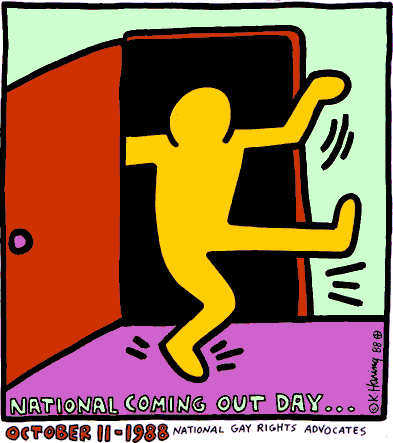
Keith Haring National Coming Out Day
Today, October 11, is National Coming Out Day here in the U.S. As you can see from the Keith Haring poster, National Coming Out Day comes from a time in American queer history when “SILENCE = DEATH” was the watchword, and so it is tempting perhaps to think that it belongs to a time that is no longer, when urgency and militancy overtook the case for same-sex marriage and other, more concrete and legalized understandings of LGBT civil liberties. But in fact, that’s not so: the specter of a particularly large round of young queer people’s suicides means that there are radical political groups holding die-ins again.

But even as we find militant urgency surrounding us in a stark reminder that historical narratives cannot ever be written as entirely teleological marches toward progress, we can also think of National Coming Out Day as a reminder that you needn’t be a militant to save people’s lives; you needn’t pull a Harvey Milk and declare that you will risk assassination in the name of “destroy[ing] every closet door.” All you need do is be here, be yourself, and be alive. You can go about the rest of your life, and the rest of the things you do to make the world a better place, safe in the assurance that if you live an out and unashamed life, you are, in the paraphrased words of another eminent cultural icon of teh gayz, convincing by your presence.

Of course, it doesn’t hurt either if you’re willing to put a little part of your life and yourself into being a mentor to the queer kids and the not-yet-queer kids who happen to look to you for help. Tell them your stories and listen to theirs. I have found, through a life made not just easier and more bearable; but wonderfully entertaining, enriching, and loving, by good queer mentors, that it is easier to say “homophobia” or “transphobia,” to say “girlfriend” or “boyfriend” in the way you want to say them, to talk the language of cruising or of gay-marriage politicking, if you have heard someone else do it first. And it is easier to believe that you can be a queer, gender-nonconforming woman in academia if you have seen a woman stand in front of your classroom or sit with you on a committee who is also wearing a men’s dress shirt and slacks, you know?

Coming out is at times a complicated, a perplexing, and a daunting prospect. But when you do so, whether you have any sort of life as a public figure or not, you do so for the kids who need to see queer adults around them to know that it’s worth growing up to be one too. Something I’ve always admired about gay history is the familial closeness of queer communities, even when faced with incredible adversity. Think of what queer community could do for each other in the time when Keith Haring created that poster, think of today’s queer kids who still need a ton of support, and do the right thing and tell them you’re One of Those People too.

QOTD (2010-08-17), Continuity and Change Edition

In A Problem in Modern Ethics, Symonds, in his detailed discussion of German sexologist Ulrichs’ arguments for homosexual tolerance, reminds us just how little has changed in 120-odd years:

As the result of these considerations, Ulrichs concludes that there is no real ground for the persecution of Urnings [his word for men-loving men] except as may be found in the repugnance by the vast numerical majority for an insignificant minority. The majority encourages matrimony, condones seduction, sanctions prostitution, legalises divorce in the interests of its own sexual proclivities. It makes temporary or permanent unions illegal for the minority whose inversion of instinct it abhors. And this persecution, in the popular mind at any rate, is justified, like many other inequitable acts of prejudice or ignorance, by theological assumptions and the so-called mandates of revelation.

This fin-de-siècle argument is, other than some stylistic markers, barely distinguishable from federal judge Vaughn Walker’s decision in Perry v. Schwarzenegger—whose unveiling the other week reignited a conversation about equality, tolerance, and the nature and role of religion and morals in a society which includes men who love men and women who love women. Since there has been a thing called “homosexuality” (or “sexual inversion,” or “Greek love,” or “Urningliebe,” or other terms more recognizable to a Symonds or an Ulrichs), those who make a life out of thinking and writing about it have tried to puzzle through what its relationship is to the rest of our society. And it is remarkably striking that, just as surely as a discussion of men’s love for men will before long come back to Plato (even if by a circuitous, modern, post-classics route), it seems it will come back to marriage and divorce as well.

I remember how surprised I was, a year ago at the Smithsonian, to see a 1963 issue of One magazine with the cover text “Let’s Push Homophile Marriage,” a political rallying cry which, though advanced six years before the advent of gay liberation, though using the vocabulary of a pre-“gay” era, sounded disconcertingly familiar to 21st-century ears. I am even more surprised to see marriage rear its head in the equal-rights discussions of the 19th century: has the movement really, in 120 years, not come so far as all that? Is marriage equality as a 2010 cultural touchstone really so close to the cultural touchstones of 1890 as to make the lasting accomplishments of gay liberation seem like an illusion?

Obviously the past 120 years have brought decriminalization and the eradication of sodomy laws, a product of 1980s Britain and 2000s America largely unthinkable in Symonds’ and Ulrichs’ day, as standard as it already was in some European countries by the end of the 19th century. And yet despite shifts in public opinion and in the law, we seem to be having the same conversations, still unable to make up our collective cultural mind as to whether male homosexuality is a crime against nature or a psychological problem or just the way some people are; whether it’s fundamentally the same as or fundamentally different to heterosexuality; how the law should respect these categories and whether it should notice them at all; how we define male homosexuality as a cultural as well as a psychological category; and why, indeed, the hell it is that we get so exercised about male homosexuality while female homosexuality fades into the background! To the proverbial Martian anthropologist, our microbiological searches for the “gay gene” and endless academic psychological studies would likely seem as strange as Ulrichs’ obsessive taxonomizing of sexual behavior or Krafft-Ebing’s psychological-physiological quackery and a touch of the Freud about all their contemporaries’ early-childhood theories. We have come no closer than Symonds and his contemporaries to understanding why people are gay, and yet we seem just as wedded to an idea of the characteristic’s biological immutability as most homosexual-sympathetic sexologists of the late 19th century were. I suppose a good question to ask would be, why do we keep going around in circles? Why is it so difficult to construct a narrative of the history of homosexuality in which the arc of history bends as unremittingly towards progress as it’s supposed to?

And Christ, reader, have I really signed up to write a thesis about all this?

QOTD (2010-08-12), Thesis Research and Queer Theory Edition

We normally think of J.A. Symonds as one of the pioneers of a modern theory of male homosexuality, and my thesis presently (that is, until I change my mind again next week) hopes to discuss how Symonds’ work and life prefigured the gay identities of the 20th and 21st centuries. He was in many ways an extraordinary pioneer, and I don’t believe the importance of his work to modern queer scholarship has been fully realized. Sometimes, however, he says things which mark him as far away indeed from the mainstream of modern queer thought. For example, from Chapter 4 of his short 1896 book A Problem in Modern Ethics:

… as is always the case in the analysis of hitherto neglected phenomena, [German doctor and sexologist Casper’s] classification [of “congenital” and “acquired” sexual inversion] falls far short of the necessities of the problem. While treating of acquired sexual inversion, he only thinks of debauchees. He does not seem to have considered a deeper question—deeper in its bearing upon the way in which society will have to deal with the whole problem—the question of how far these instincts are capable of being communicated by contagion to persons in their fullest exercise of sexual vigour. Taste, fashion, preference, as factors in the dissemination of anomalous passions, he has left out of his account. It is also, but this is a minor matter, singular that he should have restricted his observations on the freemasonry among pæderasts to those in whom the instinct is acquired. That exists quite as much or even more among those in whom it is congenital.

By “freemasonry,” Symonds means the tactics “pæderasts” use to recognize each other (dress, ways of looking at each other, linguistic cues, etc.), which so happen to be a major interest of mine, so that’s cool. But I’m actually far more intrigued here by Symonds’ endorsement of Casper’s inclination to break the population of men-loving men into those in whom the trait is inborn or developed in early childhood, and those in whom it is “acquired” and to a certain extent voluntary. To endorse such a taxonomy flies in the face of most of what we think of as standard in modern homosexuality, and it would be natural to dismiss it out-of-hand as late-Victorian wackiness. There are three reasons, however, why I think we actually ought to give Symonds’ raising of a “deeper question” more thought.

The first is a fairly straightforward historical-context point: it was commonly understood in 19th- and early-20th-century American and European culture that men not generally disposed to have sex with other men might do so in extraordinary circumstances when there were no women available—the best examples being sailors on long voyages, boys and young men at single-sex boarding schools and universities, and the still-common trope of the men’s prison. Hence the sense Casper and Symonds have that some men’s sex with men does not necessarily stem from any deep-seated physiological or psychological characteristic, even though–as Symonds says at the end of this chapter–“‘the majority of persons who are subject’ to sexual inversion come into the world, or issue from the cradle, with their inclination clearly marked.”

The second is a point of semantics and close-reading: at first glance the kookiest of Symonds’ suggestions in this paragraph is that “these instincts are capable of being communicated by contagion to persons in their fullest exercise of sexual vigour.” It’s a strange sentence, one which seems to embody all the worst quackery of Victorian medical “knowledge” and to bear a disconcerting resemblance to modern warnings about the “homosexual agenda.” But putting Symonds’ suggestion in a slightly different context changes its meaning: how many stories do we continue to hear day by day about adults who come out reasonably late in life? For every modern teenage boy who grows up watching Logo, attending Pride parades, and looking for porn on the Internet, there is a middle-aged man who takes half a lifetime to realize or to determine that he is gay–and sometimes, I would imagine, this is because he has a sexual experience which spurs him to connect feelings he’s had all his life to the larger concept of “homosexuality.” It seems this could be a modern way of phrasing the problem which Symonds raises: how will society taxonomize the man who, though heretofore “normal” (in 19th-century parlance), has sex with a man and determines himself an invert? How would someone’s identity and sense of self be reshaped by having a homosexual sexual experience? It does not strike me as surprising that Symonds, who is fundamentally concerned with ideas of identity and the parts of history, culture, medicine, language, etc. which compose an identity for the sexual invert, would find this question important.

The third point is larger in scope, involving broader implications to Symonds’ observations which I don’t have the queer theory to attack properly, but which I think enormously important to understanding homosexuality both in its natal decade and today. By invoking “Taste, fashion, preference, as factors in the dissemination of anomalous passions,” I like to think of Symonds as raising the point I am fond of making that there is an extricable division between physiological/psychological, immutable homosexual sexual orientation and the much more mutable entity commonly known as “gay culture.” I am fond of pointing out that not all (male) homosexuals are participants in “gay (male) culture” (we can quibble about what that means, but regardless of what “gay culture” is, I think the point stands), while not all participants in “gay (male) culture” are (male) homosexuals themselves–I count myself in this group. And I am tempted to think of a man from Los Angeles I met in a gay bar in Paris who seemed to be enjoying the efforts of a couple guys to hit on him before confessing that he wasn’t gay himself. I think Symonds is right to point to “taste” and “fashion” as elements which make up an identity and a culture as much as something immutable does, and I think this is something which all of us who consider ourselves interested in the matter of queer identities could do a little more thinking about.

I think I’ll end on the note that I personally would like to do a lot more thinking about this word “taste,” because it could represent the simple uncontrollable desire of sexual orientation, but also quite obviously seems to connote a desire colored by preference. After all, homosexuality may not be a choice, but how many people are given to couching their sexual preferences for partners of a specific race, partners who prefer to engage in specific sexual acts, etc. in this same language of non-choice? Sometimes orientational models of these things surface–the orientational model of dominance and submission is beginning to catch on in many circles, while we nearly always speak both historically and contemporarily of pedophilic desire as something uncontrollable, only condemning in criminal terms the acting-out of that desire. But I think the language of “taste” colors many discussions of sexuality beyond LGBT activists’ “being gay is not a choice” mantra, and considering it a factor “in the dissemination of anomalous passions” could help us develop still further our understandings of how queer identities are shaped. I would think that “taste” would be incredibly important to men like Symonds who came to construct a theory of homosexual identity out of an intellectual trajectory heavily influenced by the British aesthetic movement, who joined Wilde and Pater in the study of Greats and the Renaissance, and who had much to say about art and its criticism. That Symonds’ origins in and study of this tradition related directly to his theory of homosexuality is something I hope to weigh in on in my thesis, and I hope that doing so can help us to consider what bearing “taste” has on homosexuality today, removed as it seems from ancient philosophy or Renaissance art.

We Must Cultivate Our Own Dancefloor; or, Thoughts While Listening to “Like a Prayer”

Look around: everywhere you turn it’s heartache
It’s everywhere that you go
You try everything you can to escape
The pain of life that you know
If all else fails and you long to be
Something better than you are today
I know a place where you can get away:
It’s called the dancefloor, and here’s what it’s for…!

—Madonna, “Vogue”

I am sitting in a darkened bedroom in a big, empty house on a rural island in the Strait of Georgia, listening to Madonna’s “Like a Prayer.” I am enraptured by this song whenever I listen to it, and I have listened to it many times this summer: on a train to Rhode Island, on a plane to Paris, speeding down the highway from the San Diego suburbs. Each time I have the same response, which is that a great gush of emotion wells up inside me, and I can do nothing but raise my head to the sky, shout the lyrics (silently, if need be, as now), and form a fist which pumps in time to the beat. It’s strange how much I love this song and how few pieces of music move me more—I’ve come a long way from the civil rights anthems of the elementary-school car ride, or the Scottish folk ballads of the middle-school bus, or the Pink Floyd that got me through high school. Weirdly (I think), I’ve wound up through all of this at Madonna, despite my actual political, feminist objections to the Madonna phenomenon itself. Weirdly, there are only a few Pete Seeger songs, a few finales from Russian ballets and symphonies, which can command this much attention and passion from my soul.

It must have something to do with the single memory I associate with this song, which (unlike most of the memories I associate with songs) is not related to the first time I heard it, or the person who introduced me to it. That’s a fairly uninteresting, and fairly embarrassing story: I’d never heard Madonna before this spring, when the Glee Madonna episode prompted me to download a “Best of” album from iTunes. I had the songs in that collection on in the background through a few months of walking across campus and doing laundry and surfing the web. I learned the lyrics, and I got them stuck in my head, and then I was playing the songs again and again as, finally, I packed my things up in boxes and got ready to leave Princeton for another summer.

One of the components of leaving Princeton for the summer was attending the three-day bacchanal my university throws for its alumni, an event of which I’m far more ashamed than I was of my sudden descent into pop culture and the slippery slope in that direction which Glee seems to have set in motion. I spent three days getting no sleep, hating the 70-year-old rich white men and 20-year-old rich white football players who made my beloved quad smell like stale beer and vomit, and letting my shame at actually enjoying myself at the alumni parties subside into the retributive self-righteousness I felt at abusing their free food. And after three days of all this, of the longest and most exhausting and most emotionally up-and-down party I’ve ever paid $45 to attend (or, indeed, attended for free), I went to the last dance, a Saturday night affair sponsored by the LGBT alumni organization, a high-school-prom of the very drunk queer kids set who spent a few hours grinding with their friends in a too-large multipurpose room with a DJ and a disco ball. It was cheesy and ridiculous and the most fun I’ve had in the past several months. Because it was a gay dance, the DJ played Lady Gaga and Ke$ha and even the Spice Girls, and of course various disco standards, and of course everyone knew all the songs. It was a collective experience of dancing to collectively popular music of the sort which I don’t get to experience very often, and for me it culminated with “Like a Prayer,” a song to which I remember shouting the words with one of my friends, all the energy I’d built up in months of secretly listening to Madonna in my room all coming out in the realization which it took that cheesy fag-and-dyke-prom of an alumni reunions event to bring home: I love the dancefloor. And I love it because it represents unbridled joy.

In the past twelve months, I’ve been absorbed neck-deep in the personal struggles of young adulthood: sorting out desires from obligations, trying to figure out my purpose in life, striving to identify what a good person is and what she does to be good and to be better. This time a year ago, I was about to return to my family after a summer of depression, disillusionment, and cynicism in the District of Columbia, and I spent my sophomore year of college salvaging my faith in humanity by coming to love art galleries, classical music, literary criticism, and other trappings of highbrow culture; by investing my emotions in friendships instead of in elections; by making a difference through the person-to-person contact of the dining hall or the LGBT Center; and by investing myself in my scholarship and in the notion that studying now so that I can be an academic in a decade or so is as worthy a use of my time as working for a political cause. In the intervening moments, between applying all my mental will towards figuring out what a good person is and then trying to become one, I have snatched slices of transcendent happiness: on my first and then successive road trips; having madcap ideas and making them happen; basking in the company of the brilliant people I idolize who let me tag along in their far-more-interesting lives; watching the sun set from that beautiful little room with its window seat over the archway in the college quad I call home. Occasionally, going to a party. Dancing. Laughing. Going back to my room too late, still grinning, still with pop songs and their unrelenting beats running through my head.

Last October, when I put aside my political and personal prevarications and went to the annual Terrace Drag Ball, I had fun. I danced with friends and strangers, all delighting in the party and in the dancing. I came home realizing that it was wrong to deny myself simple pleasures like this, because what is the LGBT political movement fighting for, exactly, if not the right to hold drag balls? The right to ownership of a dancefloor has presented itself to me, slowly, over the course of the past year, as a fundamental right surely on par with a few others which top the front pages of the news. As I’ve read more books by Edmund White, taken an American studies class which talked (among other things) about the birth of the downtown music scene, and more importantly stepped away from gay history once or twice and gone out for myself and danced till hours I never see otherwise, I’ve realized what a powerful sense of collective identity, and collective pride, and collective joy, dancing together provides. I’ve come to understand it as a tool to banish ugliness and despair, to create resolve and strength, to assert defiance and freedom from fear. Granted, I’ve only been to a few parties, and a few dances, in the past twelve months: work always takes priority, and more often than not I recreate the magic of the dancefloor for myself, with my eyes closed in a darkened bedroom and more than enough happiness and energy to swallow up a whole nightclub (granted, being a shy young thing of twenty, I’ve also never been to an actual nightclub). For “dancing” is as much a metaphor as it is a reality, and for me it functions easily as a symbol of the process of using joy to banish ugliness, using beauty (once sought) as a peaceful weapon, a route to strengthening moral resolve to fight the next battle of the human condition. In the past year, in the process of learning to have fun, learning to do good by being good, and learning to accept and to appreciate myself in the meantime, “dancing” as symbol has helped me to keep myself whole, to keep me going through my days, and to create, hovering in the back of my mind, a vision of what the Platonic ideal of happiness can be. Yes, that’s what it is, an ideal: an ideal I have experienced only elusively, but an ideal to keep in mind when working to build a world in which the right to the dancefloor is inalienable—consider it the universal Stonewall, the Stonewall of the mind. Everyone deserves a liberation led by a drag-queen kickline, a hedonistic music-and-club-and-drug-and-sex scene born in the bowels of Manhattan, and a resilient spirit which can rebirth that scene into one which can confront death and impoverishment and come out fighting. Everyone—even those of us for whom the gender politics of the female divas so beloved by the gay male stereotype create problems—deserves their Madonna, whatever their actual gender or sexual orientation or personal struggles or routes to community and acceptance.

The other afternoon (back on the quiet, far-flung, isolated island) I was reading the newspaper stories and blog posts I’d downloaded from the neighbors’ internet connection (we don’t have one of our own), my headphones in and my body bouncing a bit to Donna Summers, another of my recent discoveries from the canon. As I flipped through stories about the dysfunction of our government; about the peril in which the environment finds itself; about soldiers and civilians killed in countries so far away I can’t imagine them; about economic crises or hate crimes the world over; I felt a sharp stab of guilt for dancing to disco while reading of such hurt and sorrow. But—as I steeled myself to move onto the stories about funding cuts to universities, a lack of investment in the humanities, and the end of tenure—I resolved that there is nothing shameful about seeking a slice of the dancefloor where you can find it, about trying to recreate for yourself where and how you can the rapture of “Like a Prayer.” I am tempted to think, as I rationalized myself into submission by thinking on that occasion, of the forces of disco and pop (allied with the forces of 19th-century portraiture and Elizabeth Bishop’s “One Art” and the Tchaikovsky symphonies and the Declaration of Independence and Oscar Wilde’s statements in the witness box and oh, at least five dozen other things) ranged in a great cosmic battle against the forces of hate and evil and ugliness; all doing their best, whether in earnest or in camp (though those aren’t too different!), to help us to cultivate our own dancefloor.

And, well: if this is what gets us through the days and nights and helps us to keep our shit together, I am all too happy to be “putting my queer shoulder to the wheel” on this one.

QOTD (2010-07-07); or, Another Problem in Greek Ethics

From the second chapter of Jonathan Ned Katz’s Love Stories: Sex Between Men Before Homosexuality:

In December 1837 at Yale, Dodd composed or transcribed a revealing, rhymed ditty, “The Disgrace of Hebe & Preferment of Ganymede,” about a dinner for the gods given by Jove, at which the beautiful serving girl, Hebe, tripped over “Mercury’s wand,” exhibiting, as she fell, that part “which by modesty’s laws is prohibited.” Men’s and women’s privates were on Dodd’s mind—eros was now closer to consciousness. Angry at Hebe’s “breach of decorum,” Jove sent her away, and called Ganymede “to serve in her place. / Which station forever he afterward had, / Though to cut Hebe out… was too bad.”

Considering Dodd’s cutting out Julia Beers [his girlfriend] for John Heath, Anthony Halsey, and Jabez Smith [fellow college students for whom he professed love or intense friendship], his poem shows him employing ancient Greek myth, and the iconic, man-loving Ganymede to help him comprehend his own shifting, ambivalent attractions. At Yale, Dodd read the Greek Anthology and other classic texts and began to use his knowledge of ancient affectionate and sexual life to come to terms with his own—a common strategy of this age’s upper-class college-educated white men.

This passage leads to the sort of thesis-related observations I usually try to keep off this blog, but given the relationship of the work Katz does to the questions of close-reading I contemplated yesterday, and the broader implications of his thesis about the historical contextualization of identity categories, it’s worth discussing here. Briefly, Katz has written this book to talk about men who loved and desired other men in America, but before such a thing as homosexuality existed. Through detailed case studies and work with both literary and more traditionally historical sources, he makes a case for a 19th century in which men’s sexual identities and relationships to sexual identity were very different from those of men in our own time. He fights against an essentialist reading of homosexuality across generations, and focuses instead on how 19th-century American men perceived their own relationships with each other, not what modern Americans might read into them. He finds (well, so far; I’m only on Chapter 4) that men often lacked the appropriate vocabulary to define their love for each other, but that they certainly did not see it as part of a distinct identity, evidence of pathology, or indeed reason not to love, desire sex with, and marry women—and that goes for both Abraham Lincoln and Walt Whitman!

And so I’ve been getting myself in this “men before homosexuality were nothing like men after homosexuality” mindset, which is productive in that it allows me both to find Katz’s book very persuasive and to further my own thinking about what changed, theoretically and culturally, when homosexuality did emerge as an identity. But I found that easy suspension-of-my-own-sense-of-identity-categories challenged by the passage I quote above, simply because it does not sound like the experience of a man from before-homosexuality. It sounds like the experiences of young men from across the history of homosexuality (though particularly in its early history) who came to understand their sexualities as sexualities through the frame of classical literature and art. I titled this post the way I did because one of those men was John Addington Symonds, whose 1901 tract A Problem in Greek Ethics is about Athenian pederasty, and implicitly makes the argument that because Athenian sexual mores were different from late-Victorian Britain’s, there was no reason why Britain and its legal system shouldn’t change to accept himself and his fellow “Uranians” into the fabric of society (this was an argument Symonds certainly expressed in so many words in private, if not so explicitly in print). The secondary “Problem in Greek Ethics,” however, would seem to lie in Symonds’ adoption of ancient Greek sexual practices which do not map precisely onto modern homosexuality and would not have been considered “homosexual” then to seek cultural and artistic validation for a modern form of sexual deviance. This sort of essentializing is, it seems to me, in some sense endemic to being homosexual in the modern western world—and it is this sort of essentializing which Katz’s book fights against in part precisely because it is so endemic. (You know how academics are.)

And so to read about Albert Dodd’s bawdy Ganymede poem, and Katz’s observations about Dodd’s interest in Greek matters in 1837, far before the word “homosexual” enters the language or before the sundry proto-homosexual scandals of late-19th-century Britain get going, and to read them occurring out in the provinces, in New Haven, far away from the theoretical and academic and cultural work done to create homosexuality in London and Paris and Berlin, is to me to profoundly trouble the neat homosexuality-didn’t-exist-and-then-it-did narrative. It is to question what is homosexual and what isn’t, to challenge my coding of problems in Greek ethics as homosexual, and indeed to question Katz’s thesis (with which I otherwise agree strongly) about the mutability and historical contingency of identity categories. Is a search to understand one’s erotic impulses through ancient Greek literature something enduring across time, no matter what words exist in the language to describe it?

Blogger Historiann wrote yesterday about the importance of using “sideways” methodologies in building the narratives of people(s) and events (such as women, or people of color, or working-class people) whom written sources sometimes leave out. Sometimes these methodologies come with their own problems in ethics: Historiann gives the example of using the recorded lives of men in order to make inferences about the lives of women, but what does it do for women’s history if it’s still only told through the eyes of men? It seems as if the kind of work that Katz does moves similarly sideways, getting around the obvious lack of forthright records of 19th-century men’s sexualities by inferring and reading between the lines; I’m hoping to learn from his books how to employ similar strategies when writing my own thesis. But it seems to me as if there is always a tension between too much inference and too little (something else I learned from literary studies!), and that playing the inference game carries with it problems in ethics, Greek or otherwise. Am I undoing Katz’s work by assuming homosexuality on the basis of Hellenism? Or could he possibly be the one who is reticent to make a necessary logical leap. (What is truth, anyway?!)

This is a tricky business in which to get involved—and we should never lose sight of the concrete social and political ramifications our quirks of interpretation can have, when they make their ways beyond the ivory tower.

What Do the Scissor Sisters, Grindr, and My Local Barnes and Noble Have in Common? or; Presumption and Gay History; or, A Rant Which Is a Little More Sarcastic Than Usual

Starting to overcome the jetlag and culture shock that greeted me upon my arrival back home in southern California, I ventured out of the house for the first time today. My mother drove me to the mall near our house and dropped me in front of Barnes&Noble, and before too long I was standing in front of the two shelves in a back corner labeled “gay and lesbian studies,” wondering what, in my first mainstream chain media emporium in a while (it’s been all independents, academics, and useds lately), those two shelves would hold. It turned out to be largely lesbian erotica (for reasons unbeknownst to me, only one volume for gay men amidst a sea of lesbian titles), but mixed in among every volume of “Best Lesbian Erotica” published in the past 15 years were—to my shock and awe—books and books about Stonewall. There was Martin Duberman’s classic text, and a new one by a local historian who lives on Christopher Street, and one specifically aimed at young adults, and a couple others too which I’ve now forgotten. And though the books I need which was half-hoping I might find on those shelves, like David Halperin and Jonathan Ned Katz, were absent, I did see a few classic texts of the work I do in Literary Gay Men Studies standing out amongst the erotica: Randy Shilts. Edmund White. It was strange, in a conservative suburban world which I imagine is everything that my academic world is not, to think that the Mira Mesa Barnes&Noble’s usual customers might care about gay history too, enough to buy one of five different books about Stonewall. I suppose it should have come as no surprise, really—I knew kids in high school energized into activism by the legend of Harvey Milk—but the incongruity was still jarring. I was so startled that I almost bought And the Band Played On—I mean, who knows whether anyone else would?

I think perhaps that I was attuned today to the extra-ivory tower understanding of gay history (and I use “gay” intentionally; I’m sorry to say I’m not going to be talking about LBT folks too much here) because I had a couple reasons in popular culture to believe that there isn’t much of that going around these days. Sure, everyone’s excited about Pride and stuff, but the Harvey Milk craze has more or less died out, the Frank Kameny craze was more or less confined to Washington, and none of the elders of the gay community are getting any younger when it comes to getting their stories out into the wider community. The increasing normalcy of same-sex marriage has supplanted the urgency of gay liberation; on a far more nerve-wracking note, HIV infection rates among men who have sex with men are sharply on the rise because men my age, born around 1990, don’t remember how awful the 1980s were. I worry that gay men and the LGBT community at large do not only take their history for granted, but are at serious risk of losing memory of it altogether—particularly as my generation, with its oh-so-very-different outlook on being gay in America, reaches maturity.

One event which has got me worried about this is the release of the new album from the very gay dance/pop/disco/thing band Scissor Sisters, Night Work. I saw the promotional posters all over Paris, and couldn’t wait to download the album; it turns out I love it, and have been listening to it a lot the past few days. And perhaps I am attuned to love it because it is an album steeped in gay history, from its Robert Mapplethorpe cover photo to its ’80s-style promotional video to band frontman Jake Shears’ bold declaration that the album’s concept is to carve out an alternative history for the past 25 years: “like AIDS never happened.”

And yet as much as I myself am at times consumed by a profound sense of loss from reading about a time and a virus I didn’t live through; and as much as I devour the history of the era just before, Shears’ explanation of his album makes me uncomfortable enough to sour me on the music. It is irresponsible history—verging on the point of moral wrong—to pretend that AIDS never happened. It (and I do not think strong language is out of place here) desecrates the memories of those who have died from it. I do not know that we owe it to our community to become steeped in the sadness and depression of the so-called “plague” to the exclusion of happier moments in gay history, but I think Shears—and all of us who listen to and love his band’s album—owe it to thousands of people, right down to the man whose ass graces Night Work‘s cover, to remember a history that does not sweep AIDS under the rug simply because it is as depressing as all hell. Rather, we can aim for a more cautious, forward-looking revival of musical genres and cultural aesthetics, which I think is something Night Work does. 2010 so far has been a year fatigued by marriage-equality battles and soured on gay civil rights heroes; it is a year that is perhaps more willing to embrace disco as it once was. Which is fine; I only ask that we turn ourselves to fashioning a disco of 2010 instead of trying to pretend as if it’s still 1978.

I’m not the only one taking this attitude: it’s saturating Guardian writer Polly Vernon’s article about Grindr, the gay-men-meetup-and-hookup iPhone app. If the Scissor Sisters are stuck in some sort of irresponsible time warp before 1983, Vernon is all forward-thinking. Positing that we live in a “post-gay world,” and drawing attention to the apolitical nature of Grindr, Vernon is very much a part of this 2010 gay world I mentioned which is both non-radical and fatigued by politics. Not to mention the fact that Vernon is talking about that most 21st-century of cultural markers, an iPhone app—and one which, she is convinced, is on its way to revolutionizing gay culture and, in this aforementioned “post-gay world,” straight culture too.

But if Vernon does not deliberately erase key swathes of gay history, she certainly seems pretty ignorant of some of them. She thinks Grindr will change the ways that gay men meet each other, hook up, form social connections with each other, date, and understand each other as a mapped-out community. She threatens the downfall of monogamy, raising concerns about monogamous couples where one partner might cheat using Grindr… but Polly, honey, where the hell do you think American male homosexual culture has been for the last, I don’t know, 90 years? Not all gay men are alike, to be sure, or find sex partners in the same ways, but cruising is a long and storied tradition stretching back far before the invention of the iPhone or the GPS or the social networking site. Since homosexuality has existed in America, gay men have had varyingly covert ways of recognizing each other and soliciting each other. Furthermore, as Jake Shears could probably tell Vernon if he hasn’t blocked it out, non-monogamy was the norm in the urban gay culture which Grindr targets until AIDS hit. As Edmund White explains it in The Farewell Symphony (I’m paraphrasing, as the book is in a box in Princeton), the gay community in New York so much understood its identity to be based in non-monogamous values that it had serious difficulty adjusting to a world threatened by infection in which it was recommended that you know the names of your sex partners. And even in our current century, in this AIDS-ridden world, the character Jamie in Shortbus says, “Face it: monogamy’s for straight people.” For all Vernon’s insistence on “post-gay,” there is still a not-insignificant band of the rainbow flag which defines itself in opposition to the “straight” world.

Of course, straight people have never been wholly monogamous, either (ever seen a cheating Senator ‘fess up on TV? or, for a less morally-charged example, ever heard of swingers?), and so I’m not sure what Vernon thinks is so new about Grindr’s potential in the straight market. History and my academic knowledge of these things leads me to believe that a disproportionate number of users would still be gay men, but I see no reason to believe that Grindr will dramatically change how straight men and women conduct their business. Those who hook up will continue to hook up; those who might once have attracted each other’s attention by glances across a bar or perhaps by their own version of the handkerchief code (yes, I’ve seen heterosexual-geared color keys) will just be adding another tool to their repertoire. Despite the wide expert knowledge Vernon claims due to her many pseudonymous gay friends, I don’t see any reason to be as excited as she is about Grindr. Yes, I’m sure it’s a shiny toy. Yes, I think it would be hilarious to watch my friends try it out in a bar. And yes, I’m sure it’s helped a lot of men have a good time. But it seems to me as precisely much of an upgrade to old-fashioned cruising as email was to the penny post: faster and flashier, but not fundamentally altering how we use the English language. Or pick up boys. Or something.

I wish Vernon would not be so quick to assume that, just because she has some gay friends, she knows what it is like to be a gay man and to belong to the gay male community. And I wish Shears would not be so quick to assume that, just because he is gay, he can rewrite the history of his elders. But perhaps I should not either be so presumptuous as to tell a musician and a journalist what I think of what they do on the basis of having read a few books and (yes, I admit it) knowing a few gay men. For just as Vernon will never really understand what it is like to be on the gay cruising scene, and just as Shears will never really know what it was like to live in the Village in the ’80s, I will never have the full understanding of this community that my gay male friends can—and it would be wrong of me to pretend that I can too.

However, I believe that, given the particular mission I’ve carved out for myself, it would also be wrong of me to stop trying. By reading more history, and being judicious about how best to apply it, I can hopefully bring my own outsider’s perspective to the recording of this community’s life before we all forget too much of it. Perhaps, after all, I should have plucked And the Band Played On out of the sea of lesbian erotica and done my best to pay my respects, even all the way out here in the California suburbs.