Status Update

Well, I’m off! To the land of socialized medicine, same-sex marriage, multiculturalism, bilingualism, and a sane right wing. By the time you read this, I’ll be on one of my epic 12-hour journeys from Princeton to British Columbia, hanging out on a rural island in a house that now has a kitchen and flooring (!) for what will hopefully be the best Christmas EVAR and maybe even writing about 30 pages. Blogging will be sporadic, as will internet access—and thus procrastination will hopefully not ensue.

Best of the season to everyone. See you in the new year!

QOTD (2009-12-10)

From Marx, Capital:

In a higher phase of communist society, after the enslaving subordination of the individual to the division of labour, and thereby also the antithesis between mental and physical labour, has vanished; after labour has become not only a means of life but life’s prime want; after the productive forces have also increased with the all-round development of the individual, and all the springs of common wealth flow more abundantly—only then can the narrow horizon of bourgeois right be crossed in tis entirety and society inscribe on its banners: From each according to his abilities, to each according to his needs!

I’ve been hearing “From each according to his abilities, to each according to his needs” all my life, but it is one thing to be familiar with the maxim and quite another to read it in context. I’ve got to confess that I haven’t always been the most enthusiastic about the political philosophy class in which I read this—the whole discipline isn’t really my cup of tea—but Marx is just one of those key thinkers I feel like a college student ought to read and care about. He’s a compelling writer, too, and his words come alive for me in a way that, say, Kant’s don’t. I found myself smiling in class, getting excited, wishing it really were possible to build a society along these lines. And when I realized I was doing this, I was proud of myself for not just dismissing this as absurdly foolish, not just letting myself fall into the Ivy-League trap of dismissing utopia as not sufficiently, well, realistic. It’s a long tradition of college students that has read Marx and seen in his theories a way towards a better world, and I do find myself wanting to be part of that tradition. Utopia like Marx’s is a powerful force for optimism, for staying sane, for going to bed and waking up and continuing to work, because he’s laid out a possible future (“From each according to his ability to each according to his needs) that many people believe is worth striving for.

Yes, I must also try to be a historian. I must also look to where and when communism has been woefully unsuccessful, and where and when an ideal has perished in the hands of human nature. And I must acknowledge the reality of my life and my possessions and my bourgeois attitudes and my class privilege and be honest with myself: if I am going to believe in this ideal, I’ve got to walk the walk—but finally reading the primary text certainly makes me want to try.

Anyone want to start a commune?

Methods of Mourning; or, Tying Together the Disparate Strands of a School Day

Today at lunch, a friend continued with me a conversation we had started to have online last night. To paraphrase, he was telling me about what he finds inspiring in the worldview of the Old-Testament prophets: these people, my friend said, believed that the smallest injustice was worthy of our attentions, and as valid a point of concern and moral attention as a large-scale conflict, or one to which society imparts greater weight and importance. Without having enough exposure to the Bible to know much about this school of thought, I told my friend I thought this was a morally valuable attitude, but a risky one. If we focus on every injustice, I told my friend, we risk self-annihilation. We risk becoming swallowed by a world of things to fix, and losing our identities and our senses of self in an avalanche of problems and traumas and tragedies. We risk not being able to function as productive members of society, because we can do nothing but be overwhelmed by how many of the reasons that the world is going to hell in a handbasket—and many of the problems which individual members of a society face on a daily basis—are outside of our control.

I didn’t explain this in the context of the conversation, but when I responded that way to my friend, I was of course coming from an intensely personal perspective. The past few months for me have been a struggle at balancing negatives and positives, at knowing when to celebrate and when to fight and when to mourn, at coming to terms with my decision that, in fact, it is important to be a cohesive individual with a set of ideals and principles and morals and desires and reasons for being—and that, what’s more, a person’s state of being is more than a collection of these things. I believe I have some experience with the dangers of being consumed by problems. At risk of being melodramatic, I’d argue that I grapple daily with whether it is as worth my time to better myself or to fulfill my own desires as it is to fight for some external cause. Now, I don’t believe in any sort of “virtue of selfishness.” That’s the farthest thing possible from my mind. But I do believe there is some value in self-preservation, in identity-preservation, in soul-preservation. I have to. I have to believe that I, as an individual, matter; that my rights to life, liberty, and the pursuit of happiness matter in the same way as those of someone who is beset by far greater inequalities and injustices than I am. Ego humana sum, to make an emphatic point by butchering Latin—maybe this is just the voice of the latent conservative in me whom I always suspect is lying in wait, but altruism (and I mean “altruism” in a positive sense) is not always my direct route to pleasure and fulfillment. Isn’t it morally defensible to balance self-fulfillment and other-fulfillment? I would argue that it is, and I would further argue that it is impossible to do so without compartmentalizing. Compartmentalizing is an ugly thing, but it is a survival tactic. It’s a way to get through the day and a way to sleep at night, a way to survive until the next day so that you can continue to develop your own self and continue to take on projects and perform actions that will further the elimination of inequality and injustice. If that makes any sense, it was the subtext of how I responded to my friend at lunch today.

Today was an appropriate day on which to raise this issue, subtext included. In my English class this morning, we discussed Sylvia Plath’s poetry, and if there is any art which is awash in the presentation and examination of particularized personal trauma, well, it’s Sylvia Plath’s poetry. I am not by any means qualified to discuss poetry; I feel in over my head in most of this class’s lectures and discussions. But I was enormously fascinated by my professor’s argument that Plath fundamentally altered the way we understand the genre of elegy—in fact, said my professor, she wreaked havoc upon it, smashed it, and turned it inside-out. By Plath’s later poetry, her elegies are not reverential, they are furious. She made it acceptable, said my professor, for successive poets—particularly women poets—to write elegiac poems that incorporated not the classical, reverential emotions of lamentation, praise, and consolation; but an anger and a frustration and even scarier actions like (to use my professor’s terminology again) desecration and annihilation.

My thought, in the context of developing my own juvenile philosophy, is that Plath’s smashing of the elegy, her pulverization of the memory of her father through that elegy-smashing, and, in the end, her own tragic self-annihilation, are some of the risks of being so fully consumed by mourning. My professor said that Plath characterized her reactions to her father’s death as a primary source of her poetic inspiration: what happens when your whole life revolves around mourning, revolves around confrontations with tragedy, trauma, and injustice? Again, I’m a rank amateur, but it seems to me as if Plath’s example suggests that you may be consumed—and destroyed—by the mourning.

Because of one of my chosen subfields of study, I find myself running up against elegies with some reasonable frequency. I am fascinated by how queer individuals have, over time, constructed community and culture, and how the values of community and culture interact in this historically marginalized group. There is perhaps no better example of these patterns than the outpouring of artistic expression that occurred at the onset of the AIDS crisis, as the decade turned from the 1970s to the 1980s—and continuing well into the 1990s. As far as I can understand it, for some gay writers and artists and musicians and theorists and other producers of cultural material, making art and culture that grappled with AIDS was a way of forming community around—collectivizing—uniting—a series of individual traumas and tragedies each important as the next, which, when taken together, became a grave human crisis. I look at this cultural outpouring and coming-together—represented in forms as diverse as Larry Kramer’s plays, Nelson Sullivan’s films, and dozens upon dozens of memoirs and indeed elegies—and I see an instantiation of the ideal which my friend raised. In this art (at least, when I read it), every death, every individual struggle, becomes both important in and of itself, and important as a constituent part of a historical and cultural moment. Another metaphor is Cleve Jones’ AIDS Memorial Quilt: each constituent part of that quilt is important in and of itself, no more or less important on the basis of why it is included in that quilt. These are all elegies, and they are all particular, though perhaps—it’s hard to say—they avoid the risks of subsumation which the Plath seems to illustrate.

I am fully aware of the fact that I have no right to talk about this kind of elegy. This particular genre of collective mourning is one of which I, who was born in 1990, have no possible conception. Today, of course, is World AIDS Day—and I have struggled for the past week to think about whether I have anything to say concerning a crisis which I tend to historicize and yet is fully contemporary; a crisis whose onset and whose particular tragedies I did not and have not witnessed. And yet I have chosen history as my path towards understanding these moments of crisis, and I believe that I do have a duty to understand them, and to do what I can to further the telling of these stories. If each injustice, each death, each singular struggle is a legitimate subject of our attention—and our elegies—it behooves me as someone who wishes to learn to be a historian (but it also behooves all of us) to try.

After the exchange with my friend about Prophets and particular problems, lunch passed without mention of mourning for the victims of life and death. Lunch passed in lightness and brightness, in the silliness that ensues when good friends share a table and a conversation, and when I finally tore myself away I hurried to class across a quad awash in sunlight. I caught myself suddenly joyful: excited for my class, delighted to be moving from one space I enjoyed to another, across the bright and beautiful and green quad. I slowed my pace for a few minutes (this, it should be noted, made me late to class, and earned a sarcastic comment from my professor), and I wondered: why am I seizing this joy? Why am I brushing aside the weight of undeserved deaths to be made happy by something so ridiculous—and so absurdly self-interested—as walking from point A to point B in nice weather?

Well, reader, I think I know why: it is because the task of elegy is an enormous one, a terrifying one, a profoundly disturbing and troubling one. It is because life is not worth living, and death is thus not worth confronting and mourning, without the promise of truth through beauty. And it is because somehow, in some way, we all have to take the threads of our work days, and the knowledge we have gained in them, and the conversations we have had throughout them, and braid all those threads together into a strand which is somehow strong enough to let us fall asleep tonight, so that we can wake up again tomorrow and go about making the world—and ourselves—worth continuing.

Being Thankful; or, The Sentimental Thanksgiving Post

I am large, I contain multitudes.

If there is any tradition that I have observed throughout the past five years of my blogging life, it is that of hyperserious posts on annual momentous occasions (such as New Year’s, my birthday, and of course Thanksgiving). It is, therefore, in this attitude of annual sentimental retrospective that we turn ourselves to the task of being thankful.

I contemplated not observing Thanksgiving this year (partly because I was in a bitter mood about not being able to join my family for this the most “family” of all family holidays) on the basis of the excuse that it’s just so politically incorrect to observe a holiday that glorifies imperialism and the infantilizing of native peoples. But hey, I can’t get away from it: the world has fled campus, the only shop open in this entire town is Starbucks, I actually got a Thanksgiving dinner invitation at 2am last night, and in any case there is something alluring somewhere in that Low-Church Protestant “giving thanks” mentality. I’m not of the praying persuasion, but there is something to be said for counting the simplest of blessings and being grateful.

And so, which blessings shall I enumerate? I could do the obvious ones; I could rattle them off. I am thankful for my family and my friends, for never contracting swine flu, for the academic and financial resources of the best university in America (suck it, Harvard!). I am thankful for food and shelter, and in turn the Rocky dining hall and my 120 square feet over this archway. I am thankful for knowledge and books and thus being literate; for academia and my professors and my parents, who are professors. I am thankful for nighttime walks by Lake Carnegie and pre-Raphaelite portraitists, for October in New England and August in British Columbia, for road trips and train trips and feeling as if at the end of them I have a home, or any number of places to call home, to which it is worth returning. I am thankful that I am getting older and wiser, and learning more and seeing my world grow larger; I am thankful that someday I will not only be able to drink legally in this benighted country, but will be able to regard my professors as my equals. And yes, I am grateful that I had the chance at this life, that I was born into a middle-class family in the developed world with the chance at health and safety and women’s rights and the choice to leave my community and set out on my own.

But what I really wanted to talk about was something a bit more fundamental: I am grateful for life, for living, for being alive. And I know that sounds corny, and trite, and just something one says to try to be clever when everyone at your Thanksgiving table goes around and has to say what they’re thankful for. But I do not ever think that it’s corny to thank some deity whom you actually never think about except in circumstances like this for the fact that you have survived thus far, and that you continue to believe that it is worth doing so.

The day I graduated high school, I fought my last battle with its administration, threatening to sic the ACLU on my principal if she didn’t allow me to wear trousers instead of a dress under my regalia. When I walked, finally, into the San Diego State gymnasium, sweltering in my shirt and trousers and cap and gown and cords and tassels in the 85-degree weather of San Diego in June, I found myself, against all odds, trying desperately not to cry. I couldn’t believe I was there, finally. I couldn’t believe that I would in a few short minutes have that piece of paper proving I’d made it through, which no one could take away from me. I couldn’t believe I’d survived and come out the other end alive.

I mean that in its literal sense, of course—I have known those whom high school claimed as victims, whether through the much-publicized and much-martyred drunk-driving accident, or through the reprehensibly shushed-up suicide. But I also mean it more figuratively, because not everyone who walked that June day did so with soul intact. To venture once more into religious language, high school is a market where souls are bought and sold, where one loses oneself in popularity contests and rat races and blows to one’s self-esteem and the whole world’s desperate attempts to sand down every last piece of individuality sticking out from your soul. I fell prey to this; sure I did. I made choices for popularity’s and acceptance’s sake; I made choices for survival’s sake. I shut down thinking; I sometimes despaired, but I waited it out. To abuse the above metaphor, I wasn’t sanded: I just taped down the bits sticking out; I bound my individuality as I sometimes thought about binding my breasts. And I waited.

After I walked onto a stage—legs showing khaki, not flesh-colored stockings—and shook hands with my principal and had my picture taken in front of a garish American flag, I went home again and I put on a uniform and I worked eight-hour shifts serving popcorn and cleaning up vomit, having the quintessential suburban teenager experience you’re glad you had but you hope with all your heart and soul you will never have to endure again. And we can fast-forward, now, through a first semester of college insecurity, and a second semester of college flowering, and 13 weeks in our nation’s capital growing older and wiser and simultaneously discovering highbrow culture and cutthroat DC politics games, and another few months and here we are. Here we are, living, rediscovering, remembering the things I loved before I decided it wasn’t safe to love them. Books, and folk music, and swords, ships, and Scotland. Discovering, through hours spent in classrooms and reading more than I have since I was 12, my access to language that can describe my world and my thoughts and my desires, words with which to read and to react to the artists and the ordinary bystanders who have reacted to this world before me. Self-confidence and self-esteem are still so desperately hard to maintain; moving from one day to another and one week to another still does not come easily. But now I am setting the terms. Now I am making the rules. Now I have the power and the control. Now I am challenged by my classes, and I respond in kind with work worth doing. Now I sit at dining tables for hours talking about everything; now I take off on madcap road trips north or south. Now I walk into conference rooms and sit around tables and try to change this university. Now I sit in reading rooms in libraries and archives and study its history. Now I spend a lot of time learning, and reading, and following my intellectual passions—and I learn about people killed by AIDS and people killed by bigots and people killed by themselves in the face of an unresponsive state and civil society. Now I devote so much time and energy to stopping that dying, and to keeping a culture alive and a history alive and going out and celebrating being alive. Being healthy, being whole, being me and and all of us being us.

It is powerfully easy to feel insignificant and inadequate in this world. Now, instead of being frustrated and depressed by oppression, I am frustrated and depressed because I do not or cannot assert myself loudly enough or eloquently enough. If I care no longer for being “cool enough,” I now must care for being “smart enough.” The need to be taken seriously by my professors and friends has replaced the need to be seen as badass by my teenage peers, and yet it is if anything a more tortuous insecurity. I feel ignorant after every precept and seminar, after every dinner-table conversation. But I come home and I read more, I write more, I learn more. I go out into the world and I discover what it is like to be an independent person, on the verge of adulthood. I sense more of the world open to me than I ever thought possible when I was part of a newly-diploma’d mass of 500 white-and-blue mortarboards. And even if at times I feel undeserving of my grades and my good fortune, I feel as if I have the power to own the world, to change the things I want to change, to be of it and in it.

That is not a feeling easily won; it is not a feeling which can be bought or sold. It is the feeling of a soul which is living and which is thankful—so thankful!—to be alive. Oh, youth of America: leave your hometown. Take risks. Have adventures. Be of your world. No matter how challenging, no matter how exhausting or self-doubting or terrifying, I promise that you will be thankful for every minute of it.

The Politics of Celebration; or, Terrace Drag Ball and Me

I am the first to admit that I have a tendency to overanalyze things. Take, for example, last Friday’s iteration of the annual Terrace Club Drag Ball, which I overanalyzed for days. I’d been feeling down and antisocial and stressed, and above all guilty about every moment of time not spent doing something productive. I’d been working myself up into a frenzy for weeks about the need to be always doing something. And so, of course, as the possibility of going to a huge party on a Friday night at an eating club loomed, I started concocting arguments and excuses. My antisociality battled it out with my desire to be popular as I weighed alternatives. I could flip out about how to do “drag” (an open question, since I wear men’s clothes normally), or I could flip out about whether I would feel like a loser if I didn’t go, the guilt only piling up further as I spent Thursday and Friday procrastinating on the work to be done this past weekend while my friends talked about the impending drag ball.

Well, to make a long story short, I am happy to say that my sensible side won out: deciding that I wouldn’t get any work done after 11pm anyway, and pointing out to myself that it’s November and I hadn’t yet gone out once this year, I resolved to just deal with my gender-performativity identity crisis by reading Sontag’s “Notes on Camp” (which I highly recommend regardless of whether you’re planning on attending a drag ball) and getting an appropriately academic handle on my emotions. I put on a tie as a vague concession to dressing up, and at the appointed hour trudged across campus to 62 Washington Road.

Dear reader, you would think I would know that after nearly twenty years of pulling this sort of melodrama, things are never as problematic as I make them out to be. Of course I had fun at the drag ball, and of course it was a welcome relief to socialize and dance and cheer on my friends in the traditional runway show/contest/thing. But more than that, I was able to remember that such a social event is by no means a waste of time, or a detraction from either my academic or my political work. Not only is socializing rejuvenating (since Friday night, I’ve been more productive than I’ve been in weeks), it’s just as much a political statement as a march or a rally or an election campaign.

Sometime around 1am, when I was jumping up and down in time to a RuPaul song, getting beer spilled on the nice trousers I stupidly decided to wear, as three good Princeton boys faced off in the final round of the drag queen competition, I realized something that should have been glaringly obvious: this is precisely what I am fighting for. The right to be different, to my mind, is as gloriously essential as marriage rights or parenting rights or immigration rights or non-discrimination rights; de facto equality is as important, if not more important than, de jure equality. Celebration is tied right up in queer history with the fight for equal rights. You don’t have gay liberation without the Firehouse dances; you don’t have ’70s and ’80s New York without disco; you don’t have modern queer culture without Pride. And it is not irrelevant, either, that the first major event the brand-new Gay Alliance of Princeton sponsored in 1973 was a dance—on the top floor of New South, out of the way of a largely hostile institutional culture, close to Spelman and far from the Street. These dances were an annual occurrence for years, but it is no small thing that, 26 years since that first dance, a decidedly queer party can take place in an eating club. It doesn’t matter in the least that the club in question is Terrace—that drag can penetrate the Street at all is perfectly extraordinary, and evidence of how rapidly Princeton culture has changed since the early ’70s.

And so as I walked home Friday, after staying at drag ball far later than I’d told myself I would, after seeing most of my friends there, after laughing and dancing and having fun in a large group as I haven’t in some time, I told myself that there is no point in fighting if I cannot also celebrate what I am fighting for. What, then, am I fighting for? Well, I hope Congress passes the bills before it, and I hope state legislatures do as well. But more than that, I hope that every young person in America who wants to has the opportunity to go to a drag ball, or a queer dance, and to laugh and dance and shout the lyrics to RuPaul songs and be free. And I hope that every young person in America who already has the freedom to go to these events remembers that this freedom—like all others in the history of social justice and equality—has not been easily won.

QOTD (2009-09-20), and a Rant

From Lytton Strachey’s Eminent Victorians, in the section on Florence Nightingale:

As the years passed, a restlessness began to grow upon her. She was unhappy, and at last she knew it. Mrs. Nightingale, too, began to notice that there was something wrong. It was very odd; what could be the matter
with dear Flo? Mr. Nightingale suggested that a husband might be advisable; but the curious thing was that she seemed to take no interest in husbands. And with her attractions, and her accomplishments, too! There was nothing in the world to prevent her making a really brilliant match. But no! She would think of nothing but how to satisfy that singular craving of hers to be doing something.

Reader, I can relate. So much of my life recently has been a struggle not to feel guilt for not doing enough, for not putting the greater good ahead of my emotional (and intellectual!) needs as much as I feel that I ought to. Maybe the “general will” and “duty” and “freedom of the fully rational will” in the Rousseau and Kant and Hegel I’m reading in my political theory class is getting to me; maybe it’s just that I’ve made my activist bed, and now I have to lie in it. I have to actually comply with my own exhortations to action; I’ve adopted a community, and now I have to work for it. In the space of a year, I’ve gone from sitting around a lunch table bitching about the place to actually changing it for the better.

But at the end of the day, I don’t want to spend the rest of my life lobbying and writing emails and sitting through committee meetings and talking to people and doing the logistical organizing for events. Those things are really, really important, and I’m glad that people want to do them, and I’m glad that people continue. But I want to spend the rest of my life in the classroom and the library, and honestly, I don’t think that’s too much to ask. You can satisfy your long-term emotional needs, and still be doing something too.

In his Elements of the Philosophy of Right, Hegel outlines three forms of freedom (yeah, I know this is getting a little bizarre, for one of my posts. Bear with me). The first and most basic of these is the freedom of the immediate will, which is a sort of “life, liberty, property,” human-rights idea—the right to do what you want in your own home. The second is the freedom of the reflective will, which means making choices for yourself in accordance with a long-term vision of your personal happiness (e.g. if I judge that becoming a professor will bring me the greatest happiness, I should make choices that will result in my excelling at undergrad and grad school). The third, and according to Hegel, the highest form of freedom is that of the fully rational will, which holds that our freedom is embodied in the institutions of “ethical life”—the family, the state, and the civil society—and that to ensure our freedom we have to invest ourselves in and uphold those institutions, in so far as we judge them to be rational and moral (e.g. we might not have to live in accordance with a state that allows slavery, or a family structure that condones domestic abuse). However, each of these three forms of freedom builds on the others—they’re all necessary when it comes to being and acting as a free individual.

Now, this may seem like a total tangent and just a rehashing of my professor’s lecture last Thursday, and you’re probably wondering, “How does this connect back to Florence Nightingale, and what the fuck is Emily going on about?” But I’m inclined to read the Hegel like this: there is a side to living as a fully realized individual which involves acting in accordance with what will further the greater good of society and its institutions, and there is a side which involves acting in the way that will best further your own personal happiness. These are both constituent parts of Hegel’s freedom; they’re both necessary.

And so if, like Florence Nightingale, you’re going to assign a moral value to “doing something,” the best way to go about this is to ensure that “doing something” will result both in furthering your own personal happiness and the greater good. I haven’t finished the Strachey, and his take on Nightingale is obviously different from the folklore we get in school, but we learn about her today in terms of the greater good she served—not in terms of who she was as a person, and what her idea of happiness might have been. I’m not entirely sure it’s a good thing that we care so much about how selfless she was; selflessness (very obviously) implies that there is no “self.” No identity. No personhood. And if that’s what doing something entails, well frankly, I’m not too sure I want to be identifying with Nightingale and her desire to be constructive.

I went to talk with someone today about some administrative issues, and I wound up sitting in her office for over an hour ranting at her about all this stuff. (Well, I didn’t bore her with tales of Florence Nightingale and Lytton Strachey and Hegel, but the gist was the same.) It was then, taking up the poor woman’s time with my still-so-teenlike angst, that I realized I really need to get a grip. But you can babble about 19th-century intellectuals all you like, and still go to bed wondering what you’ve done all day that’s made the world a better place. My desire to become more culturally literate (as I sit in precept or at meals every day so very aware of the enormous gaps in my knowledge) is having it out in my head with my desire to become just a shell inhabited by a desire to fix the world, and it’s enough to make me want to move to Canada permanently before I explode. (In Canada, after all, we have marriage equality and much less sexism in politics and government health care and multiculturalism and French and beautiful scenery and a Conservative party that isn’t convinced that Armageddon is nigh.)

I don’t think I can keep going on like this. I feel as if one side is going to win out sooner or later—but I dread the guilt I will be consumed by when this happens, and the lingering fear that I won’t have made the right choice.

Contentment; or, Writing Life As It Happens

Tonight, while talking to my mother online, I said, “I don’t know, sometimes it’s more that I’m just bowled over by how much has changed [since I came to college] than anything else. Sometimes it’s overwhelming. Sometimes I just look at myself and I’m like, holy shit, really, for the first time in my life I’m not continuously depressed. I can get through a school day without bursting into tears.”

And while I’m the first to admit that I may have been being a bit melodramatic (by the end of my secondary education, I was only sobbing maybe once or twice a week!), it is true that it is only in college that I’ve found a place where I actually belong. I know I tend to go on about this perhaps a bit too much, but I assure you, dear reader, that I only do so out of sheer astonishment that the years and years of sitting alone on the outside are over, and that I can be the person I want to be and have friends and something resembling a social life in spite of it. It’s only as I piece together memories of school and that other teenage life that I realize how different things are now—and how horrible they were. I realize how much I’ve changed. I realize how much more I’m in control. I realize that, objectively, school really did suck, and it wasn’t just my overactive imagination making up the sexism and the hatred of independent thinking. I am the first to proclaim that Princeton has its faults, but I no longer live in a world where, as a girl, “smart” meant “smart-assed,” and where refusing to stand for the Pledge of Allegiance or criticizing the Vietnam War made me a traitor. If my life is circumscribed by what people think of me, it’s only because I want the people I care about—friends, and professors, and, once again, my family—to see me as intellectually curious and genuine and entertaining and interesting and worth the investment of their time. I don’t care about “cool”; “cool” will come as the rest does too. I want to spend the rest of my life in the academy, because it is here that “smart” and “cool” are, after years of self-loathing that began when I entered elementary school, finally equivalent.

My mother came to visit me this weekend, the first time that anyone in my family has come out here since I made this place my home. I have been so proud and excited these past few days to show off my life: my fourth-floor bedroom over the archway, my long meals filled with friends, my world whose compass points are library and coffeeshop and dining hall. Finally, I am living my life on my own terms. Finally, I got to show my mother who I can be, given the chance.

My mother, as you may know, went to this university too, many years ago. We’ve sat three meals now in the college dining hall—the center of my world—and talked steadily about how this place has changed since then. My mother and I have looked at each other across the long wooden (sticky) table, and across generations. She was an outsider; I, though not so very different, belong. At times it is almost impossible to describe how or why this is, but I need only look at my diaries from three or four or five or eight or ten years ago to know exactly what she means. I can relate a potted history of how this place has changed, and how people like us have gone from the margins to belonging, how we have been transplanted from the institutional rubbish-bin to the institutional center, but you’ve heard it all before—if not from me or my mother, surely from some class or lecture or book on how the world has been made easier for all sorts of people in the past thirty years. Princeton is no exception to that rule—or, on the other hand, perhaps it is. For in those thirty years, the culture I came from has not changed so much as this one; maybe this is something particular to the ivory tower, where not just women, and not just queerfolk, and not just people of color, but all the differentfolk (I am all for making a Germanic compound word out of that) can find their place.

I am working on a project for a course on life-writing (biography, autobiography, memoir, that sort of thing), which is going to be in some way about my childhood imagination. I haven’t necessarily worked out yet how it’s going to proceed thematically, but I’m trying very hard to stay away from the temptation to write my life teleologically, as something that is suddenly wonderful somewhere around February 2009. Instead I am trying to root myself in the past, in the mind of a six-year-old, in a world that was very different—one where, simply put, instead of being taller than my mother, I was short enough to cling to her metaphorical skirts (they must be metaphorical, because my mother only sometimes wears skirts). But I’m not sure whether this is going to work: all my childhood fantasies, you see, invariably led to a place like this—where nerdiness isn’t just a social curse, it’s an all-around blessing.

And so I’m sitting here just before I go to bed on another Sunday night at the end of another week, thinking this is not as tight a little essay as I’d hoped it would be, and replaying in my head not the fairies at the bottom of the garden that I’d hoped very much would make life more interesting, but my own interesting life and its two-hour dinners in the dining hall I love more than most every place I’ve spent that much time. It’s a strange thing, this caricature I’ve become of my own fantasy of student life, somehow juggling balls labeled “writer” and “historian” and “activist” and “professional gay,” yet all in that same self-important and self-serious manner my mother tells me I had when I was two. I know I’m ridiculous, of course, and I can tell that other people sometimes think so too—from the way they look at me when I say I have a thesis topic, or the bemused way in which they tell me either that I work too hard or that I spend too much time on Facebook. But ridiculousness is such a relief to revel in when you know years of every day making a conscious decision between being yourself and not feeling lonely are over. Finally I am proud, proud that I can tell my mom everything I do, and introduce her to my friends, and have us all sit down and gossip in my dining hall as if we have known each other forever.

QOTD (2009-10-09), and Theme of the Week

From Edmund White’s City Boy, on his first teaching gig, at Yale:

Once a week I took a train up to New Haven (a two-and-a-half-hour trip each way) to teach my twelve undergrads. I kept imagining that the students would be much better educated than I and would unmask me as a sham; after all, I thought, I’ve never read The Faerie Queene!

Of course few nineteen-year-olds, even at an Ivy League university, have read widely and deeply. They simply haven’t had enough time, especially when the admissions departments at such schools insist they be “well-rounded.” In high school they have to do some sort of community outreach, sing in the glee club, play lacrosse, work as a volunteer for their state senator in the summer, hold down a part-time job to learn the value of a dollar—and study with a tutor the rudiments of Mandarin Chinese twice a week after school. When would they find time to read Spenser or Flannery O’Connor?

This is of course so very true. I certainly didn’t read Spenser or O’Connor until university, and folks who don’t take English classes could easily get through without reading either. But in high school, I don’t think I would have had the desire to read Spenser or O’Connor; I wouldn’t have realized why it’s important to. University is good for many things, such as the mechanical process that is getting a bachelor of arts degree, and (in my case) giving one the intellectual tools one needs to be prepared for grad school. But I’ve found that the greatest thing university has done for me is to realize that there are people out there who will care if you have read Spenser or O’Connor, and people with whom you can have conversations about them. University reminded me that it is not shameful to delight in knowledge and in art.

This is something of the Theme of the Week, as you may realize. Ever since I spent Wednesday being more depressed than I’ve been in a while, I’ve been buoying my spirits by thinking of art instead of politics. Today I went to the Met for the first time in about 10 years, to look at art and appreciate the fact that there are things more profound than petty arguments (which is, really, all Washington politics is).

Without university, I might have intuited this, but I certainly wouldn’t have known it. When the only people agreeing with what you believe are related to you, you tend not to believe it. University has given me the power to get through my days not just with teeth-gritting attitudes of survival, but with rapturous delight.

I made a new sign for my wall. It says, “Seek Beauty.”

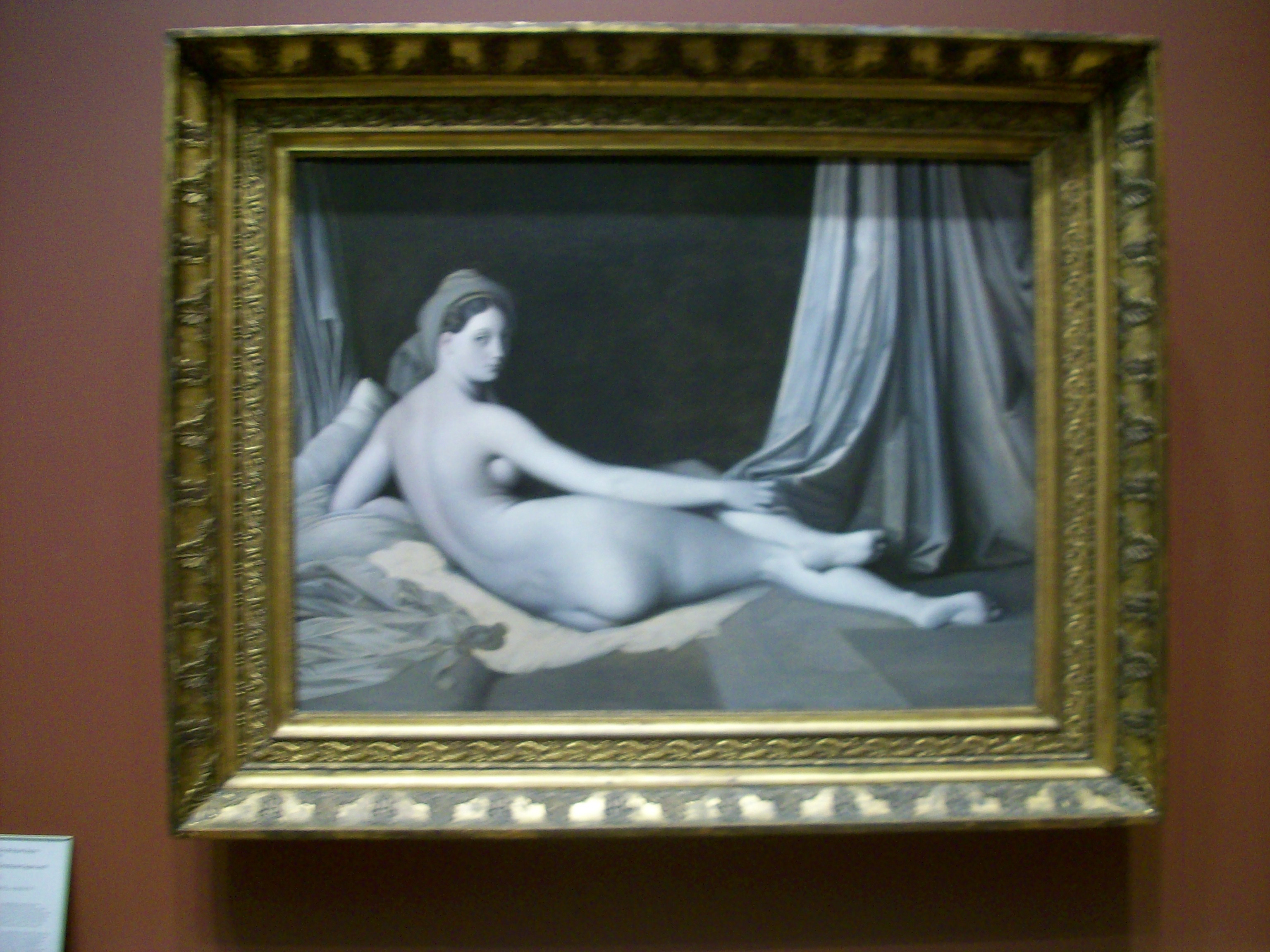
odalisque

On Whitman and Wilde, Homosexuality and History… and some Meta Questions as well

I think that the first thing I ever read in which I recognized gay themes was Wilde’s “Ballad of Reading Gaol.” We read it in my Grade 10 English class, along with The Picture of Dorian Gray and The Importance of Being Earnest (one of the best pieces of amateur dramatics I was ever involved in, if I do say so myself), but very little attention was paid in our class to the double-life themes in the novel and the play that I would later regard as common sense. As far as I can recall, I learned the story of the trial and two years’ hard labor, and used the 10th-grade version of biographical criticism to discover the tragedy of “Reading Gaol” for myself, particularly in its final stanza:

Yet each man kills the thing he loves
By each let this be heard.
Some do it with a bitter look,
Some with a flattering word.
The coward does it with a kiss,
The brave man with a sword!

We had to do a final, capstone project at the end of the year, and my friend and I put on a skit making fun of everything we’d read. The only texts I couldn’t find it in myself to write jokes for were Elie Wiesel’s Night, and “Reading Gaol.” I don’t think I could have expressed then in so many words what I found particularly awful about Wilde’s two years’ hard labor, and how the relentless meter of the poem represents to me how jail stripped the life out of Wilde. In 10th grade, I certainly didn’t know that there is a school of thought which understands Wilde as a watershed figure in gay literary history; I don’t think I knew that the trial of Oscar Wilde brought homosexuality—or something like it—into the public consciousness. If I did know it then, I certainly wouldn’t have thought it as important or as relevant as I do now. But three years ago (it seems like a lifetime ago, now), I figured (though I probably wouldn’t have said it in this way, either) that the three dozen cucumber sandwiches I made for our staging of Importance of Being Earnest were some sort of Edenic precursor to the fallen world of post-trial Reading Gaol.

I know, I know, there are dangers in telling the Wilde story this way. And I’d be the first person to argue that things are always more complex than the Wilde-is-a-martyr-for-the-gay-cause reading. I guess you could even say that, as I have learned more and more about gay culture and the history of gay culture and the history of the history of gay culture, I have proceeded from not understanding Wilde at all to memorizing a famous story to being able to complicate that famous story. That’s something, I think, to be proud of; in this world we have so little opportunity to learn queer literature and queer history that it’s an accomplishment to have any understanding of the genre even at the most basic level. Now, however, I’m reading Richard Ellman’s landmark biography of Wilde, and finding it tempting to fall back upon that romanticized narrative of decline and fall. Ellman makes it easy, I think (though maybe I just know the old story too well by now, and am superimposing it upon Ellman’s rendering); his Bosie captures the giant Oscar and enthralls him and pulls him down; the prose, moreover, is as ebullient in the chapters telling of Wilde’s travels in America as it is dull during the prison sentence. It’s really quite an incredible piece of scholarship, all the same; I can see why it has been so successful. (Incidentally, I wonder why the person who created the Wikipedia entry on Ellman copy-pasted only the first half of the Oxford Dictionary of National Biography entry. Seems an odd choice.) But I can see how the 1997 Wilde film (with Stephen Fry, who must have gotten such a kick out of getting to play Wilde) was based so heavily on Ellman’s work—both portray unquestionably gay Wildes. This is what, I suppose, I’m finding unexpected, coming back to Wilde after months or even years of reading about gay stuff and drumming into my head that it’s dangerous to impose modern notions of sexual orientation upon historical figures. Ellman’s portrait of Wilde is all aestheticism, but also all rentboys and also all petulant Oscar-Bosie quarrels. The interesting thing that is actually quite surprising me is that if Ellman is to be believed, this “aesthetic” version of homosexuality wasn’t all Platonic pederasty; in fact, the London life which eventually resulted in Wilde’s downfall as he became blackmailable by Queensberry and others seems to me to adhere pretty damn closely to modern patterns of sexual and romantic behavior, casual sex interspersed with long-term relationships, Robbie Ross and rentboys and back and forth to Bosie (yes, the alliteration was intentional).

Ellman devotes a great section to the famous meeting between Wilde and Whitman in the course of Wilde’s grand tour of America. Wilde paid a visit to Camden (I said to my friend a little while ago, “Could you imagine Oscar Wilde paying a visit to Camden today?), where Whitman was living with his brother and sister-in-law; the two men drank elderberry wine and uttered many now-famous lines, Wilde questioning Whitman as to his views on all manner of poetics and aesthetics. Ellman concludes the passage about Whitman with these lines:

Wilde would later tell George Ives, a proselytizer for sexual deviation in the nineties, that Whitman had made no effort to conceal his homosexuality from him, as he would do with John Addington Symonds. ‘The kiss of Walt Whitman,’ Wilde said, ‘is still on my lips.’ He would expand upon this theme a little later when signing John Boyle O’Reilly’s autograph book in Boston. Under an inscription by Whitman, Wilde wrote of him, ‘The spirit who living blamelessly but dared to kiss the smitten mouth of his own century.’

See, I’ll confess I did something of a double-take on reading the word “homosexuality” there. I have spent a reasonable amout of time in my life advancing my belief that it’s erroneous to call Whitman a gay or even a homosexual poet, since I’m not persuaded that’s how Whitman would have understood his own sexuality, nor how his poetry suggests that he understood it. I’m of the opinion that it’s unwise to attribute labels to people posthumously that they wouldn’t have used or understood themselves, and moreover I think it’s important to recognize that Whitman really does extol the virtues of all humanity in his writing. People who read this post will know better than I do, certainly, but I’m disinclined to think that the countless times Whitman writes about the beauty and sexual allure of women are just a front to distract readers from the times he writes about the beauty and sexual allure of men. That seems a bit too contrived, and while apparently I lack the vocabulary to write about this issue properly, it just doesn’t seem right to talk about Whitman in terms of sexual object choice.

But what, I suppose, Ellman’s biography is making me question is whether maybe we can talk about Wilde in terms of sexual object choice. He certainly seems to want to. Is that a product of 1895 (the year of Wilde’s trial) versus 1882 (the year of Wilde’s trip to America)? Is it a product of the 19th century versus the 20th, and of 1987 (the year Ellman’s biography was published) in particular? 1987 seems like a not-unexpected year, zeitgeist-wise, to talk up the homosexuality of famous people. Or is it a reading which we can ever resolve as objectively accurate, whatever the historical context?

I have to confess that this idea that things might not be objective is really quite alarming to me. I’m used to being able to trust things that authors say when I’m not in possession of all the facts, and the idea (as obvious as it may seem) that even different people who have quite a lot of facts could arrive at different interpretations of historical events and characters is sort of earth-shattering. I’m still trying to figure out what that means—and, at the bottom line, whether I should trust what Ellman is saying. He cites an impressive array of sources, to be sure, but can I and should I take that as an indication that it is reasonable to think of Wilde as homosexual in modern sexual-object-choice terms? And then what about Whitman? If Ellman is right about Wilde, is he right about Whitman too? Or can anyone ever be right? What is objectivity, anyway?

Okay, okay, so I’m working myself up into a frenzy, and I know perfectly well that there are no answers to these questions. I also know that to a certain extent it is pointless to reconstruct the lives and motivations and desires of people whose social contexts could not have given us a clear picture of what those might have been (i.e. if we can’t prove homosexuality in Whitman’s case, we can’t rule it out, either). These are things you don’t get answers to, no matter how much more learned in Literary Gay Men Studies you become, no matter how many years of school you have. I suppose all I can really say is that I’ve known Wilde’s writing for years, but that—as with so many other cultural stalwarts I’ve rediscovered more recently—interpretations change so much with knowledge (for example, instead of writing 1,800 words ranting about Wilde and Whitman, I should really be writing 1,800 words analyzing Alice in Wonderland and Through the Looking-Glass for a paper which has caused me to learn more about Victorian intellectuals than I’d thought possible).

I know, at some level, I should be able to accept the enormity of my new world after the provincialism of high school. I know that, just as I swallow and accept the bizarre-seeming premises on which Kant bases his metaphysics of morals, or just as I skim over the names of Victorian intellectuals with whom I know I’m supposed to be familiar (if only my secondary education hadn’t been a bit thin on Victorian intellectuals) and wait for context to make all clear, I should be able to accept the premise that knowledge and the universe which it touches upon are infinite, and wait for the context to slowly illuminate the ever-widening edges of the sphere of enlightenment. (That may have been a mixed metaphor.) But more often than not I find myself standing back, agape, dumbstruck, unable to believe how far the mental journey from high school has taken me, back from that first reading of “Reading Gaol” a lifetime ago.