The Trauma of Theory: A Cautionary Tale

I had my first run-in with literary theory in the spring of my freshman year. I was halfway through my first college English class and thought I knew everything; I figured that because I’d read Paradise Lost and was increasingly able to follow along when I heard graduate students talk about their work, I’d be able to listen to a faculty member I knew give a paper on a panel concerning a topic in which I was interested, and know when to smile and nod. I let some people talk me into attending this panel, and I knocked off my work-study job to stand in the back of an overflowing auditorium, full of optimism and full of myself.

And boy, was I sure mistaken. Not only did I not understand the poem the speaker was discussing when she passed around photocopies of it; I didn’t understand a single word she said about it. I don’t remember, today, what the title of the talk was, or what argument she might have said she was intending to make; I only remember blank incomprehension, and confusion, and shame. I remember becoming increasingly worried and upset as I failed to grasp anything, failed to understand why what the speaker was saying was important to an understanding of the poem, failed to nod or chuckle with the rest of the audience. I ducked out before the end of the panel, too ashamed of my lack of understanding to drink the coffee, pick over the fruit tray, and say hi to the people in the audience whom I knew. I went home and cried. Though surely no one in the audience even noticed me, much less knew how confused I was, I felt as if I’d been exposed as a pretentious fool, and I realized how ridiculous I’d been to think that half a semester of intro lit could have prepared me for the rigors of professional literary criticism, or indeed the realities of the professional academic world. A few English classes and theory talks later, I have learned enough to watch the people in the audience whom I think are clever and nod when they nod; I have learned to stay for the fruit tray and let myself be introduced to people no doubt wondering what this awkward undergrad was doing at their talk; every so often I can grab hold of a sentence out of the paper which relates to something I’ve read or learned from a class, something which reminds me that the speaker isn’t talking in a foreign language after all. And I have come to accept that, as an undergrad, as not even an English major, as someone of merely average intellect who hasn’t read the theorists the academics make use of in their talks, there is no reason why I should understand the strange language they speak, their inscrutable methods of making sense out of a text which to the uninitiated sound quite all Greek (or perhaps all French, given the context, except that I actually do understand French, and what they say doesn’t sound like any of the French I know). Even if I can cope, now, with this incomprehension—enough to keep masochistically putting myself through the routine, in the hopes that someday I will understand—that afternoon at that first panel remains one of the most frightening and embarrassing moments of the first half of my undergraduate career. For someone such as me whose sense of self-worth is rooted nearly entirely in the degree to which she’s taken seriously by professional academics, there is nothing quite so awful as it being so matter-of-factly demonstrated to you what an outsider you are.

I was reminded of this episode today not only because, with twelve days to go until I’m back on campus, I can think of nothing other than the academic world; but because I read Adam Kirsch’s brief obit of Frank Kermode in Slate. Kermode is one of the people whose name has entered my sphere of awareness through the academic conversations on which I habitually eavesdrop; like so many such names, I’ve never actually read his work, a fact which, like it does with so many other such names, never fails to produce a distinct feeling of shame. The point, however, is that I can’t comment on Kermode’s views of the state of literary criticism today except through Kirsch’s interpretation of them, which will no doubt expose me as a charlatan far more obviously than my failure to understand theory talks does; however, what Kirsch says does have some bearing on that very problem of failure to understand theory talks. According to Kirsch, Kermode expressed considerable concern about the inaccessibility and hyperspecialization of literary theory, and the modern habit of scholars of literature of keeping the public (like me) unable to understand what it is they do—due, I suppose, to their reliance on a particularly inscrutable and difficult set of secondary literature. Kirsch pays tribute to Kermode’s status as a consummate generalist and a popular critic in the London Review of Books (which he helped to found) and other publications, labeling this manner of practicing lit crit a dying breed in favorable contrast to the theorists.

And, well, it’s difficult not to sympathize with this perspective. As cognizant as I am that my failure to understand theory is probably due either to my own stupidity or my lack of initiative at studying on my own the fundamental theory texts which would help my understanding of that world, I must to some extent think that the sense of alienation I feel isn’t entirely my fault. I’ve taken a number of English classes for someone who isn’t a major, have dabbled in theory, have done my best to understand what it is my friends and my colleagues in my sister department do. And I have come to believe in the relevance of theory to understanding our world: when it’s explained in a simplistic way for undergrads to understand, I’ve gotten excited by it; I’ve seen firsthand the transformative power of, for example, queer theory on a queer person’s understanding of hirself and the world, and that’s a good thing. But I do find myself agreeing with Kirsch (and perhaps Kermode, though as I said, I don’t have a good sense of how much Kirsch is quoting Kermode, and how much he’s offering his own take) that what the academic practice of literary criticism and theory so insulates itself from the world of people who don’t have advanced degrees in the subject, we have a serious cultural problem which matters a great deal.

But why does it matter so much? After all, one Ivy-League-brat-with-self-esteem-issues’ self-absorbed feelings of alienation are probably not that important in the scheme of things. Recasting the language of literary criticism such that someone who hasn’t read a single post-structuralist could still engage with the process of thinking about literature won’t help to eliminate world poverty and hunger or stop global warming or bring relief to the flood victims in Pakistan. But a citizenry which sees the practice of humanistic inquiry as part of its time could restore reason and civility to the political sphere. It could find in itself a desire to reinvest in education and the arts in the name of the next generation. It could, regardless of whether there is such a thing as narrative or such a thing as reality or such a thing as authorial intent, become interested in scrutinizing the claims of politicians and pundits who take even more fast-and-furious approaches to Truth than do literary critics. Because, see, the fact is that we need the humanities. The practice of the close study of texts makes us better citizens, better thinkers, perhaps even better people. But if that study is not just hidden in an ivory tower, but hidden behind a wall of words, it’s going to be very difficult indeed to make the case for its survival to a public which cannot understand what it is that humanists do.

Of course, it would be lovely if we lived in a world in which people said, “I do not have the knowledge or cultural capital to understand your work or the culture in which it exists, and yet I will take your word for its importance.” But, as we all know by reading daily news which attests to the systematic defunding and vocationalizing of higher education, this is not the world in which we live. We live in a world in which intellectual culture must be rigorously defended as a good in itself, and in which a discourse which can bridge the gap between the closed circle of the academic conference panel and the larger western culture of anti-intellectualism is yet to be outlined. In order to do this, it seems to me as if it is necessary to rethink academic culture into something which is not dedicated to separating insiders from outsiders, and to rethink literary studies in particular into something which does not reward mere inscrutability and punish and induce shame in those who are not members of the club. This is not to say that theory has no place in the practice of understanding the world and its texts (or films, or music, or art, or culture), but rather simply to point out how difficult it will be to make a case for the humanities going forward, if the Frank Kermodes of this world really are such a dying breed. We have our work cut out for us—and I especially. Not only do I feel as if I need to begin to consider what it means to belong to the next generation of humanists still in the process of learning what it means to be engaged in this project of understanding the world through its texts; I need also, I feel, to do the reading and listening necessary such that I can loiter unseen in the back of an auditorium, listen to a scholar speak, and not feel quite so hopelessly, shamefully left out of a culture in which I want so desperately to be taken seriously and to belong. Once I feel I have moved beyond the stage of twenty-year-old charlatan, perhaps I can start to articulate a humanism I can call my own—but is it too much to ask that the theorists should meet me halfway?
My Fellow Americans; or, What I Did On My Summer Vacation

Every few days, Steve Benen, of whose Washington-politics blog I am an avid reader, writes a post summarizing the achievements of the 111th Congress and of the Obama administration’s first two years. It can become tiresome, representing as it does the endless partisanship of Washington politics, the defensiveness with which those who find themselves supporting the Democrats must react to the new normal of Republican nihilism. Tired cynic that I am, I find myself just barely satisfied with a set of accomplishments meant to advertise the promise of progressivism and the suggestion that these days will—we are certain of it!—go down in history along with the New Deal and the Great Society. I possess not just a cynicism but a conservatism which hesitates to consign the new progressivism to the historical narrative of the old progressivism quite so very soon, and I resent being dragged into a reelection campaign against my will.

And yet there is something nevertheless comforting about listing your accomplishments and thinking that, after all, you’ve been more productive than you’d supposed. I had occasion to reflect on this point this morning, as I sat morosely staring into my first cup of coffee and letting my father quote Aristotle on the inachievability of perfection at me. My father is exceptionally talented at making sensible points about the nature of academic life (frequently with the aid of ancient philosophy) which I know, rationally, to be quite true. Listening to him make these points tends to cause me to alternate between frustration that I couldn’t have figured these things out for myself and resolve to reapply myself, after all, to achieving the elusive nine-hour day of sitting at a desk reading and writing. And so this morning, of course, I sat and read 75 pages of a novel and the new issue of The American Scholar, and this afternoon I made a cup of tea and am now at least sitting at the desk, albeit thinking that in order to find the motivation for nine-hour days, I need to first congratulate myself—à la reelection campaign, reelection to the post of academic apprentice for another academic year—on the accomplishments of a summer which started two-and-a-half months ago and which now has three weeks to go. Campaign season is in full swing, and there’s no more time to waste on staying up late watching BBC documentaries on the history of British art, or on reassembling Ikea furniture that I’d screwed up the first time, or on walking to the neighbors’ house to download practically gigabytes of Facebook updates and book-review RSS feeds. And so: instead of lapsing into schizophrenic GOP-style sabotage, outlining my failure to the American people (who are also, obviously, me), we might as well catalogue two-and-a-half months’ worth of stimulus, health care and financial reform, and so on. I should be able to concoct a checked-off checklist of which to be proud: after all, I don’t have to contend with the U.S. Senate.

****

This summer began what seems like a long time ago, with the proper vacation bit, the part where it was okay that I wasn’t putting in nine-hour days, and was actually in its way the most productive of all. Not only did I get a valuable lesson in having fun, and travel north to lend a brief hand to one of the most welcoming communities and best local causes I know, my world got much bigger and brighter in the wake of my first trip to France, my first trip out of North America as an adult. In the process, somehow, I experienced the biggest surge of productivity I’ve had all summer: writing two good articles (one my valediction to Campus Progress, the other as yet homeless), and beginning to research grad schools and become a bit more knowledgeable about the real world of professional history. Of course, I spent hours sitting in front of the computer, but not entirely steeped in book reviews and academic blogs—also wading through bibliographies and archival finding aids and Amazon and Google Books and Powells, looking for titles to add to what is now my “to read” list and will someday become the bibliography of my first substantive research project. As June stretched on, I told myself every day that when July rolled around, and I was sitting at a desk in the suburbs without the delights of Paris to distract me, I would marshal all the intellectual and physical reserves of a Princeton semester and read for my thesis.

But wow, that perfection is so damnably impossible, isn’t it? Like a member of Congress who can’t quite look the American people in the eye, it seems as if I’ve read anything but thesis books, found any number of things to fill my day other than the desk and the notebook. Even when bureaucratic incompetency caused my volunteer job to vanish into the ether, leaving me with great washes of unmanaged time, I found myself inefficiently lingering over too-detailed notes, reorganizing instead of writing, and every day updating my thesislog with a new lens through which to focus my study of the intellectual history of homosexuality, unable to settle down and research just one. My fellow Americans, it is hard to begin a substantial research project with only the two-week, fifteen-page paper as guidance in how to do so—not quite as hard as generating support for a public option, perhaps; not quite as hard as withdrawing gracefully from land wars in central Asia; but hard all the same. I’ve spent six weeks dithering, skirting the edges, reading only a third of the books I’d excitedly checked out of the UCSD library in my first week of self-imposed summer term, and realizing last week that it had stupidly taken me over a month to notice that Eve Kosofsky Sedgwick had in about three sentences of a book she wrote in 1985 rendered the act of writing the thesis I’d thought I’d begun to research rather pointless. And so here we are: hence the dithering, hence the Ikea furniture and the book-club novel, hence my father’s Aristotelian pep-talk over the morning coffee. Hence this afternoon’s decision to turn the academic life which I sometimes believe I am not qualified to undertake into a reelection campaign.

Because, you see, that was the opposition’s attack ad (“Rutherford is no historian! She hasn’t the capability for original thinking! She has never done more than naïvely parrot Sedgwick!”), and here is Rutherford Junior Year PAC’s response: By assuming that this summer was about the thesis of my thesis, my opponent misses the point. By assuming that this summer was a failure because I haven’t been gainfully employed, my opponent misses the point. My opponent has turned a blind eye to the accomplishments of this administration: from essays, articles, and memoirs written, to restoring and life-changing travel foreign and domestic, to the real work of the academic amidst all this.

You see, my fellow Americans, one of the most rewarding parts of my life this summer has become what I can do to transmute my innate academic geekiness into something useful to other people’s lives—particularly in the links I post and the discussions which I moderate and in which I take part on Facebook. There are those in my life who have schooled me well in the possibility of taking Facebook seriously: it is where the audience is, the audience to which I hope to impart the values of civil discussion of current events and a respect for the liberal arts which the countries in which any of us live would like to funding-cut into oblivion. My days this summer have been made not by the slow inching progress on my thesis, but by the friends who have written to me all summer to tell me that they read what I post on Facebook, and that it is worth reading. My gratitude for these words of gratitude is immense, because it suggests to me—as I have suspected—that we are all starved for opportunities to read real things and to talk about real things. And it suggests to me that after too many years of being outcast for choosing a lonely life of the mind, and failing at too many social situations to ever dream of building communities based in friendship first and the sharing of ideas second, I can actually put my talents and my predilections to use. It suggests to me that when I seek to tune out of politics so that I can spend more time making my own life into a metaphoric midterm election, I do not do so needlessly or even entirely selfishly: I do so because I like having people to whom to talk, people with whom to talk, and people from whom I can feel needed. It is these interactions, electronic as often as not, which provide for me the real proof that the life of the mind is no waste of time.

But they are not always electronic. In San Diego, I found myself becoming part of a new social circle of kids with whom I went to high school: some of its members I’ve known for a long time, but some of them I just barely knew, or had never met at all. I grew closer to all of them, though, in a few weeks of cultural excursions and late nights in coffeeshops of which I could never have dreamed when we were all still in high school, when I was a little less sure of myself and a little more apprehensive of social settings than I am now. Twice or three times, in those languid summertime caffeine-fueled conversations, when I drank espresso and we made our Paris café right there in the cultural backwater of southern California, I caught myself, without realizing it, lapsing into my academic mode. Suddenly conscious that I was lecturing my friends about the history of gay identity politics, or had become the TA-like moderator of a political discussion, I would become embarrassed and step back—but not without first experiencing a little frisson of delight. Because I am never so much myself, and never so content with being so, as when I feel that I am teaching, and that my audience doesn’t object too much to being taught. And it is because of this that, despite the constant failure to achieve a nine-hour work day (I have now spent over an hour writing this post) I do not feel as if I have failed in my campaign promises of trainee scholarship.

****

When we make our cases for ourselves, we cannot admit to the world that we are—as is surely a philosophical truth—imperfect. Politicians do not schedule rallies only to tell their constituents that they will not be able to deliver on the promises they make; I think there was a part of me which belived when I left Princeton in June that I would write a book-length research project this summer. But in making the case for reelection—in calling upon all our physical and moral energy to take on the new academic year, and to make the case for fitness to do this for a lifetime—we must recast the debate. Determination of a candidate’s fitness should not be based in the partisan binary of what she has or hasn’t done, what she does or doesn’t believe, but rather in the presence of moral seriousness: the belief that she is acting not in the interests of lobbyists or in response to fleeting scholarly trends, but in pursuit of American ideals, in pursuit of knowledge, in a manner which demonstrates her caring for the next generation.

My fellow Americans, I have not written my senior thesis in the summer before my junior year. I have not, really, even started. But I have made great headway in understanding how to read the masters of my discipline and how to convey what I’ve read to those who haven’t; I have practiced in my own stumbling adolescent way the craft of public intellectualism, and I have begun to believe that research—as much as it will determine my career in the years to come—is absolutely the least important part of how my electorate (okay, fine, I) ought to judge my candidacy.

The 111th Congress passed the Affordable Care Act. I read a few books, and wrote a few essays. But the pollsters are asking the wrong questions. I would sooner they asked: are we good people striving to be better, committed to making the world a better place?

I leave it to the American people to decide.

We Must Cultivate Our Own Dancefloor; or, Thoughts While Listening to “Like a Prayer”

Look around: everywhere you turn it’s heartache
It’s everywhere that you go
You try everything you can to escape
The pain of life that you know
If all else fails and you long to be
Something better than you are today
I know a place where you can get away:
It’s called the dancefloor, and here’s what it’s for…!

—Madonna, “Vogue”

I am sitting in a darkened bedroom in a big, empty house on a rural island in the Strait of Georgia, listening to Madonna’s “Like a Prayer.” I am enraptured by this song whenever I listen to it, and I have listened to it many times this summer: on a train to Rhode Island, on a plane to Paris, speeding down the highway from the San Diego suburbs. Each time I have the same response, which is that a great gush of emotion wells up inside me, and I can do nothing but raise my head to the sky, shout the lyrics (silently, if need be, as now), and form a fist which pumps in time to the beat. It’s strange how much I love this song and how few pieces of music move me more—I’ve come a long way from the civil rights anthems of the elementary-school car ride, or the Scottish folk ballads of the middle-school bus, or the Pink Floyd that got me through high school. Weirdly (I think), I’ve wound up through all of this at Madonna, despite my actual political, feminist objections to the Madonna phenomenon itself. Weirdly, there are only a few Pete Seeger songs, a few finales from Russian ballets and symphonies, which can command this much attention and passion from my soul.

It must have something to do with the single memory I associate with this song, which (unlike most of the memories I associate with songs) is not related to the first time I heard it, or the person who introduced me to it. That’s a fairly uninteresting, and fairly embarrassing story: I’d never heard Madonna before this spring, when the Glee Madonna episode prompted me to download a “Best of” album from iTunes. I had the songs in that collection on in the background through a few months of walking across campus and doing laundry and surfing the web. I learned the lyrics, and I got them stuck in my head, and then I was playing the songs again and again as, finally, I packed my things up in boxes and got ready to leave Princeton for another summer.

One of the components of leaving Princeton for the summer was attending the three-day bacchanal my university throws for its alumni, an event of which I’m far more ashamed than I was of my sudden descent into pop culture and the slippery slope in that direction which Glee seems to have set in motion. I spent three days getting no sleep, hating the 70-year-old rich white men and 20-year-old rich white football players who made my beloved quad smell like stale beer and vomit, and letting my shame at actually enjoying myself at the alumni parties subside into the retributive self-righteousness I felt at abusing their free food. And after three days of all this, of the longest and most exhausting and most emotionally up-and-down party I’ve ever paid $45 to attend (or, indeed, attended for free), I went to the last dance, a Saturday night affair sponsored by the LGBT alumni organization, a high-school-prom of the very drunk queer kids set who spent a few hours grinding with their friends in a too-large multipurpose room with a DJ and a disco ball. It was cheesy and ridiculous and the most fun I’ve had in the past several months. Because it was a gay dance, the DJ played Lady Gaga and Ke$ha and even the Spice Girls, and of course various disco standards, and of course everyone knew all the songs. It was a collective experience of dancing to collectively popular music of the sort which I don’t get to experience very often, and for me it culminated with “Like a Prayer,” a song to which I remember shouting the words with one of my friends, all the energy I’d built up in months of secretly listening to Madonna in my room all coming out in the realization which it took that cheesy fag-and-dyke-prom of an alumni reunions event to bring home: I love the dancefloor. And I love it because it represents unbridled joy.

In the past twelve months, I’ve been absorbed neck-deep in the personal struggles of young adulthood: sorting out desires from obligations, trying to figure out my purpose in life, striving to identify what a good person is and what she does to be good and to be better. This time a year ago, I was about to return to my family after a summer of depression, disillusionment, and cynicism in the District of Columbia, and I spent my sophomore year of college salvaging my faith in humanity by coming to love art galleries, classical music, literary criticism, and other trappings of highbrow culture; by investing my emotions in friendships instead of in elections; by making a difference through the person-to-person contact of the dining hall or the LGBT Center; and by investing myself in my scholarship and in the notion that studying now so that I can be an academic in a decade or so is as worthy a use of my time as working for a political cause. In the intervening moments, between applying all my mental will towards figuring out what a good person is and then trying to become one, I have snatched slices of transcendent happiness: on my first and then successive road trips; having madcap ideas and making them happen; basking in the company of the brilliant people I idolize who let me tag along in their far-more-interesting lives; watching the sun set from that beautiful little room with its window seat over the archway in the college quad I call home. Occasionally, going to a party. Dancing. Laughing. Going back to my room too late, still grinning, still with pop songs and their unrelenting beats running through my head.

Last October, when I put aside my political and personal prevarications and went to the annual Terrace Drag Ball, I had fun. I danced with friends and strangers, all delighting in the party and in the dancing. I came home realizing that it was wrong to deny myself simple pleasures like this, because what is the LGBT political movement fighting for, exactly, if not the right to hold drag balls? The right to ownership of a dancefloor has presented itself to me, slowly, over the course of the past year, as a fundamental right surely on par with a few others which top the front pages of the news. As I’ve read more books by Edmund White, taken an American studies class which talked (among other things) about the birth of the downtown music scene, and more importantly stepped away from gay history once or twice and gone out for myself and danced till hours I never see otherwise, I’ve realized what a powerful sense of collective identity, and collective pride, and collective joy, dancing together provides. I’ve come to understand it as a tool to banish ugliness and despair, to create resolve and strength, to assert defiance and freedom from fear. Granted, I’ve only been to a few parties, and a few dances, in the past twelve months: work always takes priority, and more often than not I recreate the magic of the dancefloor for myself, with my eyes closed in a darkened bedroom and more than enough happiness and energy to swallow up a whole nightclub (granted, being a shy young thing of twenty, I’ve also never been to an actual nightclub). For “dancing” is as much a metaphor as it is a reality, and for me it functions easily as a symbol of the process of using joy to banish ugliness, using beauty (once sought) as a peaceful weapon, a route to strengthening moral resolve to fight the next battle of the human condition. In the past year, in the process of learning to have fun, learning to do good by being good, and learning to accept and to appreciate myself in the meantime, “dancing” as symbol has helped me to keep myself whole, to keep me going through my days, and to create, hovering in the back of my mind, a vision of what the Platonic ideal of happiness can be. Yes, that’s what it is, an ideal: an ideal I have experienced only elusively, but an ideal to keep in mind when working to build a world in which the right to the dancefloor is inalienable—consider it the universal Stonewall, the Stonewall of the mind. Everyone deserves a liberation led by a drag-queen kickline, a hedonistic music-and-club-and-drug-and-sex scene born in the bowels of Manhattan, and a resilient spirit which can rebirth that scene into one which can confront death and impoverishment and come out fighting. Everyone—even those of us for whom the gender politics of the female divas so beloved by the gay male stereotype create problems—deserves their Madonna, whatever their actual gender or sexual orientation or personal struggles or routes to community and acceptance.

The other afternoon (back on the quiet, far-flung, isolated island) I was reading the newspaper stories and blog posts I’d downloaded from the neighbors’ internet connection (we don’t have one of our own), my headphones in and my body bouncing a bit to Donna Summers, another of my recent discoveries from the canon. As I flipped through stories about the dysfunction of our government; about the peril in which the environment finds itself; about soldiers and civilians killed in countries so far away I can’t imagine them; about economic crises or hate crimes the world over; I felt a sharp stab of guilt for dancing to disco while reading of such hurt and sorrow. But—as I steeled myself to move onto the stories about funding cuts to universities, a lack of investment in the humanities, and the end of tenure—I resolved that there is nothing shameful about seeking a slice of the dancefloor where you can find it, about trying to recreate for yourself where and how you can the rapture of “Like a Prayer.” I am tempted to think, as I rationalized myself into submission by thinking on that occasion, of the forces of disco and pop (allied with the forces of 19th-century portraiture and Elizabeth Bishop’s “One Art” and the Tchaikovsky symphonies and the Declaration of Independence and Oscar Wilde’s statements in the witness box and oh, at least five dozen other things) ranged in a great cosmic battle against the forces of hate and evil and ugliness; all doing their best, whether in earnest or in camp (though those aren’t too different!), to help us to cultivate our own dancefloor.

And, well: if this is what gets us through the days and nights and helps us to keep our shit together, I am all too happy to be “putting my queer shoulder to the wheel” on this one.

Foxes and Hedgehogs; or, An Excess of Guilt and What to Do About It

I have been following avidly blogger-historian Notorious Ph.D.’s series of posts on “The Fox and the Hedgehog,” an Aesopesque woodland-creatures metaphor for two kinds of scholars: foxes, whose expertise emphasizes breadth over depth and could encompass projects on completely different thematic areas; and hedgehogs, who burrow deeply into one subject area and become experts in that subfield. Across the historians’ blogosphere in the past couple weeks, there’s been a lot of discussion about areas of specialization, workload, and the gendered manifestations thereof, and Prof. Notorious neatly synthesizes it all in a question I find critical and salient:

… we all choose whether to be foxes or hedgehogs, but women’s/gender/feminist(/queer/?) historians who want to be foxes may feel that there is a moral obligation to be a hedgehog. If we don’t do this very important work, who will?

[…]

Now, I know that there are plenty of women’s historians (and in other fields too, of course) out there who are joyful hedgehogs by choice; we owe them a great deal as both scholars and feminists. And I also know that women’s history is a subfield big enough that you can be a fox within it. But I’m not talking about them — I’m talking about the feminist fox who feels pressured to be a hedgehog, to continue working in a field that is politically and/or personally important to her, when she’d rather be off writing about municipal institutions or poison or siege techniques of the Hundred-Years’ War.

Prof. Notorious included “queer” with a question mark, not certain whether the politics of queer history are quite identical to the politics of feminist history, but I think there’s some overlap. Since I decided that I was going to write my undergraduate thesis on gay men, and indeed since I became publicly known as something of a professional queer, I’ve been making my way through very related dilemmas without clear ethical answers. For months I have been trying to balance my fears of being ghettoized as someone who writes on queer issues (both in my undergraduate department and when I apply to grad schools) with my conviction that the stories I want to write need to be told; and to balance my belief in the good and necessary work of queer studies with the growing sense that I won’t want to work on queer topics for the rest of my professional life. In recent weeks, too, I’ve found these dilemmas compounded by an additional one: I’ve realized that my thesis project will be more focused and easier to pull off in a year and a hundred pages if it only deals with men-loving men, and not women-loving women during the same period—but what political disservice does that do to the Sapphic sisterhood, of which I’m theoretically a member? Do I have an ethical obligation to tell the stories of lesbians and proto-lesbians? If my thesis will be about queer men, do I need to ensure that one of my pieces of junior independent work is about queer women? Am I really just a sexist pig, like one of my friends told me in eleventh grade when I told her I hated being a girl?

Of course, the answer which Prof. Notorious gives, and the answer which I rationally know is the most sensible, is that we should write what we want to write, we should study what we love, and we shouldn’t feel bound by any sort of artificially-constructed external standard of what we “ought” to study. Prof. Notorious wisely writes that “Just because you can, doesn’t mean you have to,” and I think that she is right that women can write about men, and teh gayz can write about teh strayhtz and maybe everyone will end up more sensitive about each other in the process.

I’d add that in my experience, the most important work of visibility and tolerance is not done through academic study of people-who-aren’t-straight-white-men, but rather through convincing by our presences: being there for our peers (in my case) and our students (in the cases of the professors whose blogs I read and who are my mentors in real life) and making it clear that women or queer people—or people of color, or others who are left out of the straight-white-men version of history—really do have a place in the world. Of course, always being there to be the poster child for minority identity can let you in for the pitfalls which the blogger-historians have been describing of being overwhelmed by a false moral responsibility to spend all your time teaching tolerance, but I am tempted to say that it is the least you can do to spend just a little time being present so that the people around you can take courage from it. I am always the most moved and inspired—and confident—when I spend time in an academic setting (a classroom, a meeting, a departmental function, or even a dining hall meal) with people who look like me. This world does a very good job of tricking me into believing that because I am a woman, or because I make a professional and social identity out of identifying as queer, or because I am not conventionally attractive or feminine, I will not be successful, respected, or taken seriously. Reconstructing how 19th-century men-loving men understood their sexual identities is fun and engaging and illuminating about 19th-century culture, but it has never moved and inspired me the way seeing a woman who looks like me in a position of academic success and power has done. Even if I don’t—as I probably won’t—turn out a hedgehog, writing about the historiography of homosexuality forever, I hope that I can devote the same political energy to being there for my students (when I have some) as my professors have been there for me.

Having It Both Ways; or, In Which I Try to Get an American Liberal Arts Education

or, a rant in which I sound like an entitled Ivy League student (my apologies)

Last weekend, Tenured Radical (of whom I’m quite an enormous fan) posted a review of Louis Menand’s most recent book, The Marketplace of Ideas. Amid criticism of Menand’s views on interdisciplinarity which largely went over my head (when I submitted my application to the Princeton Program in American Studies, I certainly didn’t know this was what it meant to talk about interdisciplinarity!), I was struck by TR’s comments on Menand’s discussion of the general education curricula at liberal arts institutions. TR quotes Menand as saying that “A college’s general education curriculum, what the faculty chooses to require of everyone, is a reflection of its overall educational philosophy, even when the faculty chooses to require nothing”; she then goes on to say that she believes it “intellectually lazy not to have a core curriculum of some kind.” And when I read this I knew I had to write a post of my own in partial response. The thing is that I, in theory, would like to believe this too. I place great store in the values of liberal arts education and in the greater social necessity of cultural literacy across disciplines. I have the greatest fondness for the tradition in American higher education of balancing a higher-level general education with specialized training in a chosen field of concentration. And yet, as someone making my way through this system right now (indeed, I’m between my sophomore and junior years, having just declared my major three months ago: precisely on the cusp between general education and specialization), I want to talk about just how difficult it is to achieve this balance in the four years the American higher-ed system allots us, and how even those of us undergraduates most dedicated to the principles of liberal-arts education can find the system failing us. I find that while discussions like this often feature very productive dialogue between faculty, administrators, and other higher-ed professionals, they rarely involve a student perspective, and so I hope that mine as an undergraduate who genuinely wants to work hard and to see the system helping me out in my efforts to do so can be useful to the adults considering these questions of intellectual development.

I matriculated at Princeton in the fall of 2008, essentially starting my liberal-arts education from zero. Like a fairly significant number of my colleagues, my secondary education was at a large, public California high school: not one of the best in the state, located in an area whose high property taxes provide for smaller class sizes, lots of AP or IB classes, and arts programs; but a good-enough school with a small gifted program which was reasonably safe and sent a lot of its graduates to the local state universities. I’d had enough general education to get me the basics: AP English and history, the “honors” track in lab sciences, community-college calculus, a mishmash of largely self-taught French and Latin, and a few scattered classes here and there in music, theater, and computer programming (I also played the violin and viola outside of school for about ten years). However, while this level of education would have placed me out of nearly all my gen-ed requirements at a University of California campus, Princeton (like most other highly selective colleges and universities) doesn’t take transfer credit, and with good reason: Princeton’s 100-level math sequence is much more difficult than community-college calculus; a passing score on the AP French Language test placed me into the middle of the introductory French sequence. And, most relevantly, you cannot use AP scores or community-college credit to place out of Princeton’s “distribution requirements,” a system which labels nearly every course in the catalog with a subject area like “Literature and the Arts,” “Quantitative Reasoning,” or “Epistemology & Cognition,” and mandates that all undergraduates take one or two classes in each area, preferably in their first two years. In the fall of 2008, full of optimism and faith in liberal-arts education—and, critically, as yet without a major—I happily signed up for a freshman seminar in higher-education policy (Social Analysis), the French course into which I’d been placed (no distribution requirement), an easy computer-science class for non-scientists (Quantitative Reasoning), and the required freshman composition seminar, and I waited patiently for those first college classes to give me the university-level general education I knew that high school hadn’t.

But as I’m sure you’ve already guessed if you know anything about these things, it didn’t quite work that way, and my optimism and faith didn’t last long. Not only had I, heeding advice from my academic advisers to select a non-demanding course schedule, picked a joke of a programming class (known, unfortunately, as “emails for females,” and easier than the programming class I’d taken in high school) instead of something useful like social-science statistics or something challenging and rewarding like multivariable calculus, therefore demonstrating my innate lack of enthusiasm about the value of a rigorous general education, it also didn’t take long before my elective interests took precedence over my belief that the Princeton distribution requirements were for my own good. My first spring, I took courses in American history, British literature, American politics, and creative writing—including the ones which caused me to decide that I wanted to be a professional historian. I checked off my Literature and the Arts and Historical Analysis requirements, and I’ve gone on to fulfill them over and over again in the semesters since, choosing the upper-division seminars in history, English, and American studies that have been and continue to be one of the greatest sources of joy and fulfillment in my life. I’ve befriended my professors and become their research assistants; I’ve grown to love things I never before knew existed, like literary theory and cultural studies; and of course I have become convinced that I could not be happy without being able to stay engaged with texts and primary documents for the rest of my life—but I have never taken a single “real” college math or science class.

“Emails for Females” set the trend for my efforts to fulfill the requirements that come less easily. Last fall, to be honest, I put in just enough effort to pull a B in an anthropology course which satisfies the Science and Technology With Lab requirement; this fall (well into the second half of my college career, the part where I’m supposed to focus wholeheartedly on my major), I’m signed up to take an environmental sciences lab pass/fail—and I chose it, I’m ashamed to admit, because I thought it sounded fun, not because it will be an intellectual challenge. I’ve been scared of physics or math: scared of the appearance of the pass/fail indicator on my transcript, and indeed scared of failing. I am not good at math and science; if these quantitative indicators are worth anything, my math SAT score is far below the Princeton median. I would have to work very hard, putting in more hours than I put in for the classes which teach me the kind of work with which I want to spend the rest of my life, in order to pass physics or higher-level math. And so I’ve become a terrible liberal-arts student, picking and choosing the classes I want and not the classes that will make me a more well-rounded person and a better thinker. I feel as if I am being hypocritical and dishonest, as if I am lying to the high-school senior who thought for months that she would go to the University of Chicago for the Core.

But now I’m going to be a junior at Princeton, taking pass/fail a notoriously easy lab alongside three upper-division seminars in history and English, and can you blame me? One seminar is a requirement for my major, and promises to help me produce my first piece of required departmental independent work, a 30-page piece of original historiographical research; the other two are taught by two of the best professors in Princeton, whose opinions are some of those I value the most highly of anyone who has ever read and evaluated my academic work. Why, pragmatically speaking, would I want to limit the amount of time I can spend learning how to be the best historian I can be by spending hours trying to study for the notoriously difficult intro courses in physics, chemistry, or biology? There is no reason to think that my high-school science and math education (most of which I’ve forgotten by now) was sufficient to understand the conversations that my scientist and engineer friends have about their work; by rights I should be working to step outside my disciplinary box. But Princeton also expects me to write a senior thesis in a year, and so it is difficult to know where to focus my attentions. There are only so many hours in the week, and the system seems to force a choice between doing well across the general-education board and doing well in your discipline (which, naturally, entails a higher standard of mastery than does an introductory general-education curriculum). I’m a serious student, and spend very little time not working; I think I spent about three Saturday nights last academic year not doing homework. If I seem lazy about fulfilling requirements outside my comfort zone, or as if I am exaggerating this choice between my major field of study and my general education, I can’t think that it’s entirely my fault. I can’t think that I am to be blamed, entirely, for leaving my Epistemology & Cognition requirement till my senior year, my thesis year, because I am going abroad next spring. It can’t be just me. It must be the system too.

I am tempted to put the blame on my high-school education. After all, by the standards of the men who created Princeton’s earliest general education curricula, I am woefully undereducated. To be sure, there was much less to learn then, and particularly in the sciences, but it’s certain that in the fall of 2008 I would not have been able to pass the examinations once administered to incoming freshmen in literature, history, philosophy, and the classics. Of course, when those exams were required, a middle-class Jewish girl like me wouldn’t have been able to take them in the first place, and the wealthy young southern gentlemen who did take them tended to have the advantage of a private prep-school education. It was a system that perpetuated elitism in a disgusting and horrible way, and I am glad it no longer exists—but if incoming freshmen today were better read, perhaps we could consider ourselves generally educated and move on to the business of the major field of study. Perhaps wanting to do so wouldn’t make us bad mini-intellectuals.

It occurs to me that the British university system manages to get along just fine without requiring distribution requirements of its students, and perhaps that’s made easier by the GCSE and A-level system, which seems to teach to a higher level of proficiency than the American system does. However, I also understand that if you want to specialize early it is very easy to do so—no doubt if I’d been educated in the British system, the same temptations that have led me to drop serious math and science at Princeton would have led me to drop them at 16 in the UK. In reality, I think it must be as difficult to get a liberal-arts education in the UK as it is in America, if not more so. And while I strongly suspect that I might have come through the British system a better historian, that is only because the system is weighted so heavily towards specialization—I certainly wouldn’t have solved the Princeton problem of taking-the-easy-lab-for-the-requirement, and I certainly wouldn’t have moved beyond my disciplinary box.

To be sure, Princeton distribution requirements have so far pushed me to take one course which I wouldn’t have otherwise taken and for which I’m very grateful. The Ethical Thought & Moral Values requirement led me to continental political theory, and a basic understanding of Kant and Hegel—which I really did need a professor’s help to muddle through—has not only transformed how I engage with the British and American intellectual history I study, it has helped me to engage with my friends (and family members!) who study and talk about philosophy and theory; it has helped me to learn to write clearly about complex philosophical concepts; and it is valuable for its own sake. Educated people, I tell myself, have read Kant and Hegel, not to mention Rousseau, Marx, and Nietzsche. And I think of myself as a more literate and educated person for having struggled through those texts, which I hope I will remember as an experience at least as beneficial as the course I took which cemented my desire to become a historian.

But that was just one course, and pragmatically I could take the time to take political theory seriously in a way I can’t for fields with which I really struggle. In the end, in a system like Princeton’s, there is just not enough time in four years to become culturally literate and to achieve competency in your field. I want to be able to do both well, I really do. Between meeting all Princeton’s requirements and my own high standards, though, I don’t really feel as if either is going to happen. Not quite two years out from my thesis due date, I feel as if I could spend my entire life researching and writing that project and still not be able to turn in a project of sufficient quality or originality come May 2012—and forget my junior independent work, forget my departmental coursework, forget my semester abroad, and forget that one outstanding distribution requirement in Epistemology & Cognition which I’ll have to fulfill my senior year—probably through an easy course I’ll take pass/fail, because do I, grad-school-bound as I am, really want to reduce the amount of time I can spend on my thesis?

I have the sense that educators and administrators sometimes think that those who object to liberal-arts distribution requirements or core curricula just don’t want to do the work. Sometimes I see concerns about distribution requirements held up as evidence of the downfall of intellectual culture, as part of a package with students with entitlement issues who just want to pay for a 3.5 GPA or with students who think college is only important if it serves some sort of immediate and obvious vocational credentialing purpose. I think it’s worth thinking, however, about the fact that distribution requirements can reduce even the most serious students with the highest-minded educational ideals (and the most feminist principles!) to “Emails for Females,” and that a distribution-requirements system may not necessarily be the best way to help these students (who are not always innately skilled at choosing the courses which will challenge and reward them) get the best undergraduate education they possibly can.

Rachel Maddow and the Lands’ End Catalogue; or, In Which a Specter is Haunting Emily Rutherford: The Specter of Womanhood!

This morning, apparently, Sen. David Vitter (R-LA) decided to take a cheap shot at Rachel Maddow by implying that she does not look like a woman. Of course it is absurd to think that Maddow’s short haircut and dark suits (and, implicitly I’m sure, her sexual orientation) make her less of a woman; as we all know if we stop to think about it, there are more and more ways these days to look professional as a woman, ways which run straight across the femininity spectrum, and Maddow’s is just one of many ways (if it weren’t, you can bet she wouldn’t be on television). But if we stop to think for a few seconds longer, we might also consider what message we send to other women who are not conventionally feminine by suggesting that Vitter’s comment is worth being outraged about, therefore validating (however unintentionally) the idea that it is somehow “better” to be more feminine if one is a professional woman in the public eye. The ways in which we who do not approve of what Vitter said respond to it say a great deal about how unusual it seems, still, to be okay with being a non-feminine woman in our society. That we are instinctively inclined to jump to the defense of women in situations like this demonstrates, I think, how fraught issues of gender presentation are, and how sensitive we can be about what “counts” as “looking like a woman” in 21st-century America.

What it means to be a woman and to look like a woman is an issue which has plagued me for the entirety of my life as a woman—since, I suppose I would say, my late teenagerhood. And while I do not want to overshare about my personal life in this space (after all, I deleted my livejournal account years ago), today’s Maddow story, as well as things which have happened in my own life recently, cause me to believe that this is a story worth addressing from a transparently personal angle. Since her television show first went on the air, Rachel Maddow has been a role model to me in negotiating the world as a non-conventionally-feminine woman, and well: if it is writing our stories and making sure they’re out in the open that helps to build a new world for the next generation, then it is worth telling mine with my words the way Maddow, to me, convinces by her presence.

I wrote yesterday about sexuality, its relevance to my life, and my coping mechanisms for dealing with it (and, by the way, thank you for all your kind words about that post. They are much appreciated). I addressed in oblique terms, but still the most explicit terms in which I have spoken about the issue in some time, the ways in which the intellectual pursuit of sexology was a way of confronting the changes going on in my own life. Today I want to talk about another set of coping mechanisms, separate but not too separate from those I built up to confront sexuality. These are the ones I used to confront gender, and my growing sense as I went through puberty that I was inhabiting a narrowly gendered body.

In suburban southern California, where I went to middle school and high school, it was difficult to escape from a culture which entwined “being a woman” with “being a sexual being.” I was scared of being both things: I was a bit later developing than some of my classmates, and I’d watched the eyes which began to watch the girls in my school as I began to fear that those eyes would soon be trained on me. I perceived a fairly limited set of options for what “being a woman” meant, and I didn’t find any of them appealing. Read what you will into my obsession with my female classmates’ changing bodies, and my visceral fear of the remote possibility of my male classmates’ gaze, but at the time I didn’t read into it anything but horror. I cannot emphasize enough how terrifying that environment was, and how perilously inevitable, not to mention suddenly looming, the link between womanhood and sexualization seemed.

I reacted by going into denial, which I did by dressing not like a little girl in skirts, but like a little boy in shorts and t-shirts: loose, baggy clothes that hid my changing body, emphatically purchased from the men’s sides of stores. I cut my hair, choosing for myself styles like those chosen for little boys by their mothers. I grew increasingly uncomfortable in all-girls’ atmospheres from locker rooms to slumber parties. I either tried hard to be accepted by boys’ social groups or just went it alone, so that I didn’t have to account for my resistance to looking like and acting like the almost-women around me. This all became such a big barrier to living a mentally normal life that I actually began to wonder if I was transgender, although I knew that it wasn’t until puberty that I’d truly begun to hate my body. But even if gender dysphoria wasn’t the answer, I certainly didn’t have a better one. Lacking an answer, this visceral hatred has persisted for much of the past several years. By wearing only men’s clothes and by using them to disguise the unavoidable female parts of my body, I have hoped to avoid what that body signifies to me about the social expectations of women in our culture.

But, as have so many things in my post-adolescent life, this, too, has slowly started to change. While one of the best ways to make me feel uncomfortable is still to tell me that I look attractive, the paranoia about evaluating gazes has lessened. I have independence of thought and action that I didn’t have when I was a high-school student and the inability to control what was happening to my body was just another part of the general helplessness I felt. I worked in a D.C. office for nine weeks and realized that, in a culture which prizes dress code, sticking out in Capitol Hill corridors for effectively cross-dressing made me more uncomfortable than wearing clothes bought from the women’s side of the store. And most importantly—particularly in the last academic year—I’ve started to get a sense of who I am as an adult, and to see that as being a very different kind of person from the kind of person I was as a child and an adolescent. I’ve started to think of myself as someone who has my own ideas about the way the world works, someone who has an ability to cultivate my own social and professional relationships, and someone whose life decisions are constrained by little except what I think I am capable of doing. I have started to use phrases like “my work,” “my project,” “my thesis,” and “as a historian….” I have started not just to have professional role models, but to talk like them, and to see my life as one which could be like theirs someday. I have started to see myself as an apprentice to the masters, not as a different (and alien, grotesque) species. I have started to see myself as another professional academic woman.

The hang-ups are still there. The coping mechanisms are still valid. I will not go swimming or change my clothes in front of others, I will not wear tank tops or low-cut blouses, and I certainly have no intention of returning to skirts. But I have grown tired of not owning any clothes that fit me because they were not cut for bodies like mine, and the anxiety that has come to accompany entering gendered spaces like women’s restrooms has long since subsumed any feeling of accomplishment I might have gotten from passing as a boy. What is more, I have found at college, and on the east coast in general, more gray areas in women’s dress and presentation. More of my women friends (and, importantly, more of my women professors) have short hair, so that just a haircut doesn’t gender one masculine; even more of them don’t wear makeup; a few don’t even shave their legs. Dressier, preppy styles suited to cold-weather climates are a non-entity where I’m from, but proliferate on the east coast and even at prices I can afford—opening up a whole new world of women’s clothing which is conservative enough that I feel comfortable wearing it. Between my desire to be taken seriously as a professional in my field, my desire not to have to deal with observers’ confusion about my gender identity, and my desire simply to look stylish, I suddenly find myself more willing to compromise, and less frightened of spooky added implications to shopping on the women’s side of the department store.

Last week, I went and got a shorter, but trendier, haircut; I finally reneged on my principle of never using any sort of cosmetic to change my appearance, letting the hairdresser show me how to use “product” to style my hair so that I don’t look like a fourth-grade boy with a bowl cut. Over the weekend, after having a meltdown in the middle of Sears because I was scared of all the women’s clothes I didn’t feel comfortable trying on, I went online and shopped the bargain section of the Lands’ End website, where they sell the east-coast styles not stocked in San Diego stores. My order arrived today: the first women’s clothes in years that I have picked out for myself, not had given to me by a well-meaning parent or aunt. Despite the heat wave, I tried on the trousers and shirt and sweater and raincoat, and I found myself lingering in the full-length mirror I usually avoid. And why? Because I looked at myself and for once I didn’t look like a 12-year-old boy who’s raided his dad’s closet. I looked like a professor.

Today I decided something which has not ever been the case before in my life: I am okay with being a woman. And this is because “womanhood” (as distinct from “girlhood”) need not be defined by how large your breasts look, how pastel your clothes are, or whether you’re dating and having sex; all those things can be merely incidental in the arc of a thrillingly developing life as someone with an independent professional identity, for whom clothes do not signal sexuality as much as they do readiness to stand behind a lecture-hall lectern or (it occurs to me, thinking ahead not ten years but six months) to attend formal hall at an Oxford college.

I don’t expect to embrace conventional femininity anytime soon, and so I don’t imagine that those who object to or are threatened by me will cease to use my “mannish” appearance as a weapon. But perhaps a bit like Rachel Maddow—whose ease at rising above those sorts of insults has given me a serious lesson in moral fortitude—I think I’ve found a compromise I can accept, a way to balance my competing impulses to fit in and to stick out. I think I’m ready to be a professional academic woman—and I think I’m ready not to let anyone else tell me what that identity has to mean.

Puberty, Perversions, and Allen Ginsberg; or, My Life as a Teenage Sexologist

I was in tenth grade, in my teenage counterculture phase, when I discovered the sexologists. Most teenagers, I think, go through a counterculture phase, when they devour Ginsberg and Kerouac and at least think about drug-taking and free love, even if they’re too dorky to really go through with it. Most teenagers go through a phase of coming to terms with an idea of themselves as sexual beings, as proto-adults, as people newly able to relate to their fellow proto-adults in entirely different ways. Most teenagers today, I think, must see something of themselves in the Beats, because today it is cool to be a misfit and cool to write poetry or songs as an expression of why your misfitedness is how the whole world ought to be. And so did I: Allen Ginsberg has been easily one of the single most influential people in my life. Long before I knew what it meant to be “blown by those human seraphim, the sailors, caresses of Atlantic and Caribbean love,” I imagined myself to be an “angelheaded hipster” in my own suburb. I read Ginsberg under the table in American history class until I’d learned “Howl” off by heart; and when we had to do five-minute individual presentations on poems in my English class, I took up half the period subjecting my poor teacher and classmates to a lecture on how “A Supermarket in California” ripped off Whitman and Lorca.

But the piece of Ginsbergiana of which I’m reminded today is a few paragraphs in Bill Morgan’s very long biography of the poet, which I received for Christmas in 2006 and spent another few months reading under the table in class. The book is in a box in Princeton now, but those paragraphs talk about when Ginsberg was living in New York in the ’50s, at the height of the Beat era, and his drug-dealing dropout friend Herbert Huncke introduced him to a researcher named Alfred Kinsey who was writing a book about Sexual Behavior in the Human Male and looking for interesting case studies. Kinsey and Ginsberg had dinner in a diner near Times Square and Kinsey got plenty of juicy material about the poor poet struggling with his sexuality and always falling uncomfortably in love with his straight male friends. It was fascinating not only to realize that Kinsey’s research involved paying underworld types like Huncke to seek out countercultural men with more colorful stories (hardly a scientific way to do a survey of the population!), but also to realize that such stories existed. Wikipedia research, of course, ensued, and I soon learned that individual anonymous case histories were a staple of the history of sexological research in Europe and America. I read tantalizing snippets on the Internet of archaic-sounding sexual autobiography, and I was hooked. For the rest of high school, whenever I went to the university library, I would sneak guiltily off too the wing on the sixth floor where I knew the “sex books” were. I’d take the English translation of Krafft-Ebing’s Psychopathia Sexualis off the shelf and sit on the linoleum poring over one of the earliest systematic studies of sexuality, shame causing me to slip round the corner into the history of marriage books if anyone came by.

Sexology was my puberty, my coming of age, surely as transformative to me as any teenager’s first girlfriend or boyfriend. I leaped into a world of “deviance” and “perversion,” because to a sheltered and easily-shocked 16-year-old, any sexual behavior was as weird and perverted as any other. As I branched out—to the 18th-century pornography I brought with me on my orchestra’s trip to Europe, or the Olympia Press books I read for my (totally-embarrassing-not-a-real-piece-of-history-writing) European history research paper—I developed easily the most infamous reputation that any late-blooming girl without a first kiss behind her has ever had. Like teenagers “who chained themselves to subways for the ride from Battery to holy Bronx on benzedrine” without having injected or ingested a single real drug, I carried around Kinsey for the caché, and I sat alone at lunch and actually slogged all the way through Leopold Sacher-Masoch’s unbelievably boring novel Venus in Furs so that I could tell people where our word “masochism” (a Krafft-Ebing coinage!) came from. And when I left for college, I guiltily hid my little, growing collection of 18th- and 19th-century sex lit and 20th-century Kinsey-spinoff studies in my backpack; and I slipped away from the bustle of orientation weekend to make my first foray into the university library system, getting lost looking for Havelock Ellis on Firestone B-floor.

Over time, I got used to visiting the stacks shelved under Library of Congress classification HQ, and over time I stopped running away if I saw another person standing there poring over a book about lesbians. As the months went by and I made some friends and found a new home and took a great, great class called “Gender and Sexuality in Modern America,” homosexuality started to separate itself out from all the other strands of perversion. Through the lens of homosexuality, I discovered more memoirs than I’d ever read in my life, by people not too different from me who’d used the primary sources of previous eras to access a subject they didn’t otherwise know how to address. I read more and more, and became conversant in the secret languages of those who lead double lives, and in the not-so-secret languages of those who create new languages in order to bring those lives out into the sunshine. I read about those who discovered Plato the way I’d discovered Krafft-Ebing, and Whitman the way I’d discovered Ginsberg. I grew to care very deeply indeed for the centuries of lonely people who snuck off to libraries as a way to confront shame and fear, and to admire beyond measure those who thought to write about it in the hopes that the next generation might not be so embarrassed by it all. I grew to see it as my 21st-century job—at least for now—to keep their stories alive, and to do the thinking, writing, and talking necessary to bring their work to a new generation living in a new social context. It’s been sexology ever since—and now Ginsberg’s lines about the men “in public parks… scattering their semen freely to whomever come who may” stand out to me more than those about drugs and jazz.

Today “Howl” does not hang over my desk as it once did, and I am not quite so inseparable as I once was from the old City Lights paperback. But Ginsberg is part of the literary lineage through which I have found a sense of purpose, and he is never far away. Today, reading about the 19th-century sexological intellectuals whose story I hope in a few short months to begin to tell, I pieced together the elements of the sexual lineage Ginsberg believed tied him to Whitman: Ginsberg had slept with Neal Cassady, who had slept with a man named Gavin Arthur (incidentally, the grandson of the president), who may or may not have slept with Edward Carpenter, who may or may not have slept with Whitman. These claims get trickier as you get farther back, and it’s harder to figure out what counts as sex at the turn of the 20th century than it was in the Clinton White House. But reading that today, I thought of how Ginsberg used that lineage to make sex a process of literary and spiritual inspiration, and what a tool the intellectualization and academization of human sexuality has been to those who seek to understand themselves, their world, and their place in it.

I am writing this, probably the most particularly sexual blog post I have written in years, as I look out my bedroom window to a suburban street, young voices shouting at each other and skateboards clattering on the pavement as the neighbors’ kids play in their driveways. I have sat here for the past two weeks, too, on a crash course through the intellectual history of 19th-century sexuality, and I plan to do the same until the end of the month when I take off for Canada. I can’t help thinking, as I look out the window, of freshman-year fall break, the week before the 2008 election, when our neighbors with the skateboarding kids had “Yes on Prop. 8” signs in their front yards, when I waited in the living room to give out candy on Halloween and heard parents telling their children to pass by our house because our sign said “No on 8.” As I go back to reading about intellectuals like John Addington Symonds, who seem to have believed that if they wrote enough about homosexuality it would cease to be a crime or a disease, I can’t help reaffirming my belief in the good work that words do, and the good work that scholarship does. And I can’t help but think, as I go to open yet another book about sodomy, and look out the window once more, that maybe I managed to find in me a shred of real countercultural subversion after all.

Moments of Maturity; or, an American in Paris; or, Adventures of an Academic Brat

I was talking to a friend of mine on the internet yesterday. She’s in China, on an internship and seeing family; I’m in Paris, tagging along with the rest of my family because my father is giving a paper at a conference here. My friend asked me how it was being back with my family after not having seen them since January, and I responded that it’s much the same. It’s as if the last six months—or, indeed, the last two years—have never happened. Whenever I see my family after protracted absences, it’s as if I’ve never left, and it’s awfully strange to think of their lives going on as normal when I’m not there for most of the year. We transition so easily back to our routine from when I was in high school.

I’ve felt that in particular these past few days, since we landed in Paris on Sunday morning. As we sightsee, I’m reminded of our London trip, or our eastern Canada trip, or our Boston trip, or any of the other trips we’ve been on as a family, spurred by an academic conference or not. As we walk (and walk, and walk!) to various sites of interest (Notre Dame, famous philosophers’ houses, the falafel shops of the Marais, Shakespeare and Company), we habitually fall into a constantly mutating set of pairs: I walk either with my mother, or my father, or my sister, and the other two family members walk some distance ahead or behind us. We alternate between trying to disguise ourselves as Europeans and shamelessly flaunting our map and guidebook. We wake up and go to bed early, by my college-student standards; our sightseeing agendas are planned. And as we walk, I can’t help but think how different these routines are from the two weeks of vacation I had with friends my own age, who tend far more towards the spontaneous than my family, and who like to stay out later; I can’t help but think that Paris’s annual Fête de la musique, a sort of citywide night at Terrace outside on every street corner, was made awfully odd by being there as a child, not as a college student. It’s not as if I sought to escape my parents, or that I resented them. It was just unexpected, a strange change of register in a life that has not quite figured out whether it’s a child’s or an adult’s, and can just as easily fill both roles—except in these strange instances when it feels drawn to both simultaneously, and can’t quite decide which to choose.

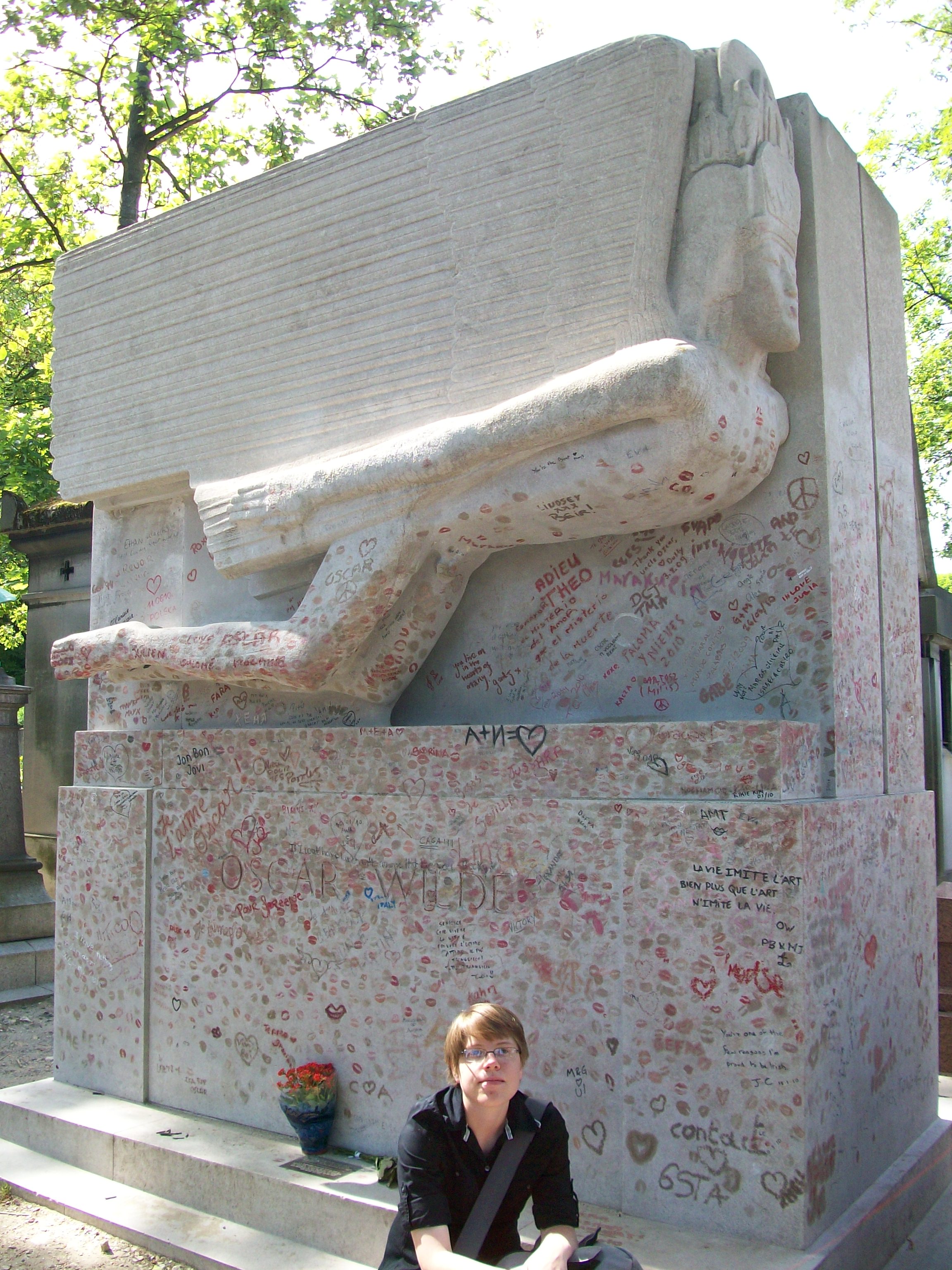
Today’s long sightseeing day, however, changed very much how I saw my role as an academic brat with my parents, across the world in a country whose language I barely speak. Our visit this afternoon was to Père Lachaise, the cemetery in the east of Paris where many famous people, including Oscar Wilde, are buried. Wilde’s tomb was one of the few places in Paris which I knew I had to visit before I knew very much at all about Paris; in the past semester, I have become too immersed in Wilde’s life to have missed the opportunity to make The Pilgrimage. There seems, somehow more point to visiting Wilde’s grave than those of so many other important people who are buried in Paris: the tragic ending to Wilde’s life makes the site of his remains somehow more relevant than that of other celebrities whose life histories do not revolve around martyric downfalls. The monument—whose inscription, on its rear side, stops telling Wilde’s life history after he won the Newdigate Prize—bears witness by omission to the ignominy to which his scandal reduced the bestselling author and playwright; the lipstick marks which now obscure the inscription so much that it’s illegible in my photographs bear omission-witness of a different kind to the importance of this tomb to so many people later. The myth of Wilde is powerful, and it is difficult to maintain a cynical distance from it even when you know a bit more than the average fan about his life and work. Even if you know enough to balance the story, to be aware of how complicit Wilde was in his own downfall, you still cannot help but pay a visit to Père Lachaise. And when I took some time before and after my pilgrimage to wander through the avenues of tombs and pay my respects to the dead anonymous as well as (in)famous, from Holocaust victims to long-forgotten officials in the Paris government, I thought that it is not a child’s job to try harder to remember the denizens of the largest cemetery in Paris. It is rather the historian’s, and I think the Wilde metaphor is apt here: it is not responsible history to gloss over the character flaws of an object of study, but it is responsible history not to forget.

When we were on our way out of the cemetery, my father and I spotted an intriguing-looking monument which we suspected might have its own story to tell. As we joked about co-authoring an article on its subject, it occurred to me that in not too long such a joke might become a genuine possibility. Sitting that evening in a restaurant, drinking the same wine as my parents and participating in their academe-gossip, I was reminded as I so often am by the social barrier which alcohol places between myself and the professors and graduate students whom I idolize—and how excitingly quickly, both literally and metaphorically and European drinking laws notwithstanding, that barrier is fading away. As much as I know that it is imprudent to look too much forward to getting older, as before long I will surely wish to slow time down, I am more excited than it is possible to describe in a few stolen minutes before bed in a Paris professor’s sublet that I am getting ever closer to having an equal place at the metaphorical department-party dinner table.

Bibliographies, Indices, Card Catalogues, oh my!; or, The Well-Organized Life: A Cry for Help

I have always been interested in the meticulous organization of my thoughts and scribblings. Back in my childhood bedroom, my notebooks are shelved in chronological order; my high-school math notes are in a three-ring binder with tabs for “geometry” and “intermediate algebra” and “pre-calculus” and “calculus”; the boxes of schoolwork are indexed by academic year and subject; the hard drives are the same, with nests of folders backed up in three places all cross-indexed by date and subject.

But if my work has always been organized, my thoughts have not. My notebooks may march on, all neatly dated in the top right-hand corner of each page, but if I don’t know when I scribbled down a certain quotation or an idea for a new line of research or the title of an article to read, how am I ever going to find it again? In all my efforts to reorganize—blogs, varying folder trees, the occasional catch-all manila envelope—I never seem to have broken out of a chronological approach. It is all very well to scribble a date on something and consider it filed, to post it to a WordPress CMS and see it “archived,” but that’s not much of a card catalogue at all. Even if I started using tags on my blogged collections of pensées, that wouldn’t solve the problem of my handwritten notes, my scribblings in the margins of books, my books themselves. It’s been a long time since I had so few books that I could keep track of them all in a database without constant management—and now that I’ve taken to writing notes about everything in them, that’s become even more true. It’s begun to seem like an insurmountable question of organization—and given that I have officially started background-reading for The Big Research Project, this is a terrible time for me to realize that my research methods are simply inadequate.

I was put in mind of this problem when reading Keith Thomas’s fantastically engaging meditations on scholars’ research methods in this week’s London Review of Books. Thomas talks about moving beyond scribbles in the margins of books (I give a nervous glance in the direction of my weighty used hardcover edition of the Ellmann Wilde biography, which is becoming covered in pencil as I haul it up and down the northeast corridor); he goes on to catalogue catalogues—and commonplace books, card indices, slips of paper in pigeonholes, eventually arriving at cursory (and dismissive) references to the various methods of electronically managing lots of little bits of information. And as I read the article, it slowly dawned on me that: 1) Thomas was speaking from the experience of having written his own long works of history; 2) I will before too long be writing my own long works of history, commencing with The Big Research Project (okay, I mean my senior thesis, but I’m too embarrassed-slash-pretentious-slash-I-read-too-many-real-academics’-blogs to actually call it what it is); 3) I will need more than half a dozen books with attendant scribblings to do this; 4) A year or more from now when I actually start writing the damn thing, I will probably not remember to the letter everything I was thinking when I first read the first sources back in the summer of 2010. Radical revisionism, I concluded, would be required.

And then, of course, two days went by, and I made another hundred pages’ worth of notes in my Wilde books, bookmarked another half-dozen journal articles and book reviews suggesting further avenues of research, and made a couple new entries in my journal trying out some language for thesis statements—all according to the old chronological, scribblings-in-margins method, and all very difficult to recoup without doing all the work I’m doing now over again.

My background reading is going well; I’m in high spirits and I feel as if I’m getting somewhere. Last night I began to get a sense of just where this project might slot between the work that real historians have done, and found myself overcome by the heady enthusiasm that I find invariably greets the all-too-rare sense that I am Having Original Thoughts. Of course, in the background there is always the fear that tomorrow I am going to notice the article which has said everything I could ever possibly want to say, put forth all the primary sources I could ever hope to discover, and in every way trampled over the ground onto which I dream of stepping far better than any half-baked undergrad who took a few seminars at Princeton and now thinks she knows everything could manage. But right now I am scribbling down titles to order the minute I have a permanent address and lying in bed at night dreaming up chapter titles as blithely as can be—only hoping that, as my mental database grows larger, I don’t forget the pieces of my argument which I’m holding mentally—I’m sure, after all, to misplace the bits of paper.

Dear reader, I think it’s time for a Cry of Help: what methods do you propose for keeping together thoughts both in direct response to texts and removed from them; citations; potential avenues of inquiry; and other such necessary trappings of my scary first big project? I prefer analog methods to digital ones, but if there’s a particular computer notetaking/filing strategy you swear by, let me know that too. There is nothing I want more in my life right now than to pull off this project and feel myself worthy of graduate study… but right now it feels very large, and I feel very small indeed, and all those little bits of paper covered in pencil seem like a Red Sea in need of parting.

Madison Mornings; or, Homes and Homecomings

a work in progress

When I feel the dampness of summer on the east coast—eighty or ninety percent humidity, mosquitoes during the day and fireflies at dusk, clothes sticking to my body and a slow laziness to the air that prevents me from reading more than a page before dozing off—I have a curious flashback to Madison, Wisconsin. I spent two weeks in Madison five years ago, my first experience of east-coast summer in several years. We rode our bikes around the lake; we had barbecues in the front yard; we lit citronella candles as the sun set late. I remember Madison as quintessentially summery, like the summers of children’s books from another era—the only difference being my first-generation iPod mini and its Scottish folk music. I was fifteen and hadn’t yet discovered rock, and the fiddles and pipes and accordions and guitars took me on long walks in the stickiness of midday or on long drives through pitch darkness from Shakespeare festivals or dinner parties back to our sublet. Now, when I’m in New Jersey and the temperature first climbs above 80, or the first dinnertime thunderstorm rumbles in the distance, I find myself back in that state-capital college-town green-tree lake-shore summer.

I was in Madison because I am an academic brat. My father was teaching a summer seminar at University of Wisconsin-Madison and so we all followed, as we do. We sublet the house of a professor on leave in some foreign country; we hung around the campus but also played tourist in this university town different from our own. We had dinner parties and party parties with our ad hoc academic enclave, where my sister and I talked Shakespeare and Democratic party politics and played video games with the other professors’ nerdy kids, or chattered at kind and well-meaning faculty spouses about our summer camps and our favorite subjects in school, while the professors talked shop and the grad students drank beer out of bottles and gossiped about who might have a job where. My memories of Madison are at times as hazy as the hot and sticky air by the lake (I know we were only there for a few weeks, but in my recollection those weeks stretch out into an entire pastoral novel), but what I remember principally about Madison was the humidity and the feeling of belonging to an academic enclave. In San Diego, where professors and their families live all over the city, and there are three major universities and several minor ones, we have no academic ghetto. The seminar my father was running, on the other hand, condensed time and space: a set of far-flung colleagues from across the country into one college town and a circuit of department parties into one summer term. It was one of the strongest experiences of community belonging I can recall—and perhaps, then, it is no surprise that the slightest touch of dampness in the air, the lowest rumble of thunder in the distance, sends me back.

—–

Last Tuesday was one of these Madison days, when the fan was on all night and I woke up at 7am to a morning already sticky and still. My alarm was set to three hours earlier than normal because 1,166 seniors and 804 graduate students were receiving degrees from Princeton that morning, and I was being paid $10.90 an hour to stand outside in the 90-degree heat in a shirt and slacks and an academic gown in order to take tickets and direct traffic and tell parents that, no, they could not enter the seating area two hours early; and, no, they could not sit in the reserved section without a ticket; and, no, they could not stand in the way of the academic procession and impede the progress of the president, the board of trustees, and the honorary degree recipients. For three hours, my gown caught on the mechanisms of folding chairs and I took orange tickets from antsy parents while my mind wandered off to bikes and lakes and citronella candles and Scottish accordions.

But it was not just the weather which made Tuesday a Madison morning; it was also all the trappings of academe. The cumbersome black gown signified that I belonged to the same community as the seniors in black; the graduate students in black with orange stripes; and the faculty, trustees, and honorary degree recipients in their rainbow of regalia. There is something unifying and meritocratizing, I find, about academic regalia: it suggests that we are all engaged in the same project of celebrating not just the degree recipients, but also the very existence of the institution of higher education. Watching the graduates process, I felt certain that I would someday have a hood to wear with my gown, and even someday have three velvet stripes on my sleeves. In hearing the formal rhetoric (some of it in Latin) which conferred degrees upon my friends and colleagues, I felt invested in and excited by the mission of my university and of the university in general. When, at commencement’s conclusion, I and my fellow ushers lined the path of the recessional, I felt a great sense of membership in a common mission to educate, to produce knowledge, and to credential the next generation to do the same. Wherever we stand in the hierarchy, whether we have hoods and caps and stripes on our sleeves or not, we are all a part of this mission—not dissimilarly from how it was in Madison, when I talked Shakespeare with the other professors’ kids in imitation of our parents talking shop.

—–

Three days of alumni reunions precede the three days of commencement exercises at Princeton, and I expect that this former celebration is where the majority of the tens of thousands of people who descended upon Princeton’s campus that weekend found their community. I witnessed their exuberant rediscovery of old friendships, their rampant alcohol consumption, their orange-and-black school spirit, and their participation in the parade of alumni classes which for four hours winds its annual way down the road which cuts through the center of campus. It was difficult not to take part in bits of the three-day bacchanal, and I chanted my school-spirit cheers along with the rest of the crowd, perhaps finally singing our alma mater enough times to remember about half of the words.

And yet while reunions proved an enjoyable three days of dancing with good friends, they also left me profoundly unsettled. The event is no celebration of the University (qua cultural institution), as I have known it for the past twenty years and four months. Rather, it is a celebration of Princeton: of old white men and cheap watery college beer, of entitlement and privilege. The nausea I felt when one class of alumni somewhere in the 1970s carried signs lauding the percentage of their class making six-figure salaries and the percentage of their class whose children had also attended Princeton was not entirely assuaged by the jubilation I felt when the crowds cheered for the first classes to graduate women. I woke up on each of three mornings to the disgusting and dispiriting sight of my quad—my home for the past nine months, the center of my residential college and thus my emotional life—covered in garbage, stinking of vomit and stale beer, and I was furious with the alumni whose 45th reunion had snatched my quad away from me, from my university, and from my sense of university. I felt displaced and ill-at-ease, driven from what I’d come to think of as my home.

I was able to recoup some sense of belonging when I went to the LGBT alumni’s Saturday-night party, a lame little student-center-basement event made much less lame by dance music I knew the words to, welcoming friends, and a sense of being among “my people.” Knowing nearly everyone in the room, and dancing with nearly everyone I knew, shifted the dynamic of reunions from something which displaced me to something which welcomed me, and I felt once more that—Milwaukee’s Best-drinking old white men striving towards the Platonic ideal of entitlement notwithstanding—there is a place for me in 21st-century Princeton. It was a sloppy little party at the end of the bacchanal, populated by a ragtag collection of queer kids who’d had too much to drink. But when we all wandered off in the early hours of the morning, it was at least after having been in a multipurpose room where everyone knows your name, and where orange, black, and massive and omnipresent class-consciousness were less important than Lady Gaga to having a good time.

Since, however, it was only the queer party’s dissimilarity to the rest of reunions which saved it from being condemned with the rest of the debauchery, it would take more than a few Madonna songs for me to restore my faith in Princeton as ivory-towered home. This would instead entail three days of listening to speeches and pointing people to the nearest restroom; of entertaining myself by guessing professors’ grad schools by the color of their gowns; and of feeling not-so-secretly thrilled every time I got a smile from a be-regalia’d professor processing past me. By the time Tuesday morning came around, I felt more solidarity with anyone wearing a black gown than I did with anyone shouting “Tiger tiger tiger sis sis sis boom boom bah!” I was proud that I have apparently, after all these years, retained enough Latin to make sense of the salutatorian’s address; I helped to instigate a standing ovation for Ruth Bader Ginsburg when she received an honorary degree; and I applauded wildly President Tilghman’s address, in which she admirably called upon our generation of Princeton graduates to return maturity and civility to the public discourse. Eventually, chatting at my residential college’s reception with the faculty, graduate students, and staff who comprise my surrogate family, Madison morning slid into Madison afternoon—and I was back at the end-of-the-summer-seminar barbecue, telling the academics who all my life have been my literal and metaphorical family about my plans for the summer and then going back for seconds of pineapple and watermelon.

—–

I write this now in Rhode Island, having put my books in boxes and left campus for a while. Maybe I’ll spend some time at my parents’ university when I’m home this summer, but for the next little while I’m among dear friends who don’t play the academic game. It’s summer vacation, and I for one am glad, after a hectic and stressful (but productive) year.

And yet it was on summer vacation that my family went to Madison five years ago, and it was on summer vacation that, last night, I wrestled my network settings into letting me log into the Princeton network remotely so that I could search archive databases for a particular manuscript relevant to the enormous research project on which I am just beginning to embark, the one which I hope will someday become my senior thesis. The leads I found on the internet suggested that this manuscript was given to some library or another—maybe the Library of Congress, maybe the New York Public Library—but no one seems to know which library exactly. As I trawled through the most likely catalogs, marveling at my ability to use my own university’s library resources even though I’m gone till September, I was reminded of the crucial difference between college and academe. College is a four-year adventure, a transient state of packing one’s life up every few months and moving to a new dorm, a new internship in a new city, a new academic project. Semester by semester, your life changes: you grow older and wiser; your research projects get longer; your friends graduate; new friends matriculate. Life is constant change in college, as I found two weeks ago when I realized—to what should not have been my surprise—that packing up my life and vacating my old and beautiful sunlit room over the archway was normal.

But if college is impermanent, academe—in my life, anyway—is the state in which things will always be. Perhaps I am only reminded of this on Madison mornings which turn into afternoons in the Scribner Room, evenings in Rhode Island researching my thesis, or sleepless nights spent stressing about the job market. But academe was my life from the day I was born—and at some sudden moment maybe a year ago, when the air was hot and still like it was in Madison and one of my parents’ colleagues asked me what I thought I might major in and I said “history,” clearly and firmly, I embraced the world I grew up in for all it contains and all it is worth. Most children, I suppose, choose to reject their parents’ world and strike out into uncharted waters, and to them I wish all the best of luck. But as long as “uncharted waters” to me means a document lying undiscovered in an archive, a connection between texts never before made, a student’s mind not yet unlocked, or a degree not yet received or conferred, my permanent home is in ivory towers everywhere, more so than at college reunions or even than on the gay dancefloor.

I don’t yet know whether I’ll come back to Princeton for a reunion years hence, but I’m sure I would return to campus if I had black stripes on my sleeves from another institution, a tenure-track job, and a book on my CV; and if there were a conference in my field and I submitted a paper and wound up presenting it, sitting at last on the other side of the Dickinson 210 seminar table. It wouldn’t feel so much like a homecoming, back to “the best old place of all,” as like an extension of the same world which has always been and always will be my home, no matter which institution grants my degrees or gives me (I hope and pray) a job. For Princeton is not my home so much as academe is, and so I imagine that on a hot and humid summer day in a fantasy world years hence—when I’m working on my senior thesis, my dissertation, my first or my second book—I’ll feel the slightest stirrings of a breeze or see the cloudburst clouds gathering overhead, I’ll put down my book or cease typing for an instant, and I’ll think of summer in Madison.