Culture Shock, Class Consciousness, and the Weather Girls

The week after I arrived in Oxford, months ago now (gosh, that’s strange to say!) I attended the first formal dinner of this whole strange experience, and a couple weeks afterward I found myself writing a long post that attempted to puzzle through and come to terms with the culture shock that dinner occasioned. As your average American academic brat, I grew up attending dinner parties and reading the kinds of books and watching the kinds of movies where the etiquettes of attire, successive courses, and too many forks are deployed. When I came to Princeton, I attended the odd awards dinner or some such thing where I put what I’d learned into practice, making small talk, using my forks and knives correctly, and agonizing too much over the ambiguities of gender-specific dress codes. But as much as I thought I knew how to navigate academic dinners, I found myself stupefied by the performance of pretentious formality that gets carried out every Friday night in Trinity’s dining hall, by sparkly dresses and port and being waited on at table by young women my own age who I felt certain loathed the posh-accented people getting drunk around them. As I processed the experience of that first “Guest Night,” as this production is known, I felt ashamed, ashamed of the fact that I had been complicit in the perpetration of the remnants of the English class system.

Time went on—a term passed—and I got to know more people in Trinity who felt the way I did, left-wingers who greeted these productions with an embarrassed ironic distance and yet managed to take them for what they were and have a good time. I went to another formal dinner, for all the history students hosted by the college history fellows; and when my father came to visit I took him to my second Guest Night. I paced myself, feat-of-endurance-like, through four-course meals; I learned to do the same for massive, by my standards, quantities of red and white and port and sherry. And I went several times a week to normal formal halls, wearing my gown and standing for the Latin grace and turning the alienating thing into something I could value, something that put me closer to understanding Symonds’ Oxford and something that got me out of the library and talking to the people sitting near me for at least an hour a day. I’d look at the portrait of John Henry Newman in Trinity hall and think about another time, another Oxford, and wonder where I as a woman academic stand in relation to it—like Guest Night itself, wanting to understand and yet feeling an irreconcilable distance all the same.

Last week, my friend told me she had an extra ticket for the MCR Gala, Trinity’s annual black-tie banquet for the graduate student body, and would I like to go? I leapt at the chance, and in the days leading up to the event, which was yesterday, I could hardly contain my excitement. I’ve been working hard; I was longing for a celebration; and parties with good friends are always fun. I went out and bought a dress, the first dress I have bought since my high-school prom—ready to play the black-tie game properly, to act the role (with appropriate sense of irony, of course) of one of those Bright Young Things in the costume dramas I’ve always salivated over. I bought my “Big Issue” magazine from the homeless man in front of Blackwell’s on Friday afternoon, and on Friday evening I dressed for dinner. The epithet “champagne socialist” couldn’t possibly have been more apt, I realized, as I started the evening by drinking a glass of champagne and spent the third course bonding with my friend over the large-looming role of the socialist musical and cultural tradition in our upbringings. We talked about how it had made us feel a bit nostalgic, a bit homesick, to see a little May Day trade-unions rally in front of the Bodleian last weekend, and we shared in a sense of outrage about how much sexism there still is in academia. But the ugly juxtaposition of this political sentiment with what we were doing while we said it didn’t really strike home until the President of our college made a rambling after-dinner speech that made several bad jokes at the grad students’ expense, but no reference to the idea that what they do is intellectually important and worth doing; and which in an instance of tastelessness that frankly fills me with disgust and I think is absolutely inexcusable in a retired senior British diplomat, made not only a joke about the death of Osama bin Laden, but a joke whose apparent humor rested on said retired senior British diplomat “accidentally” confusing the names “Obama” and “Osama.” I gaped, speechless and outraged, at my friends while the room erupted into laughter around us. A few minutes later, when someone in the room was, honest to God, “sconced” for supposed “offenses” including speaking in a foreign language, the compartments I’d built in my mind to rationalize my enjoyment of the idea of a black-tie dinner came crashing down. I could see, clearly, why events like these are a big part of the access and equality problems Oxford and Cambridge continue to have. I was embarrassed at myself for being complicit in this sort of nonsense, and embarrassed on behalf of a college and to some extent (though less so) a university that should really, in this day and age, know better.

Like so many things I have been part of since coming to Oxford, all this is not really unique to Oxford, Oxbridge, or England. Elite universities are elite universities wherever you go, and there are unquestionably people in Princeton who behave the way some of the people in Trinity did last night. I have often said that it may be better to be served at table rather than having the kitchen staff hidden away behind servery counters and kitchen walls as they are in the halls at Princeton, just as it may be better to have your bins emptied by someone who comes into your room, whom every morning you need to have a conversation with and whose name you need to know—in Princeton, where the bins are emptied at six in the morning, I have never been awake to ask the name of the person who empties mine. And just because at Trinity displays of wealth and privilege are events that anyone can attend does not mean that the ones that occur at Princeton behind the walls of eating clubs or in the rooms of fraternity, sorority, and certain student organization members are any less insidious. I have been fortunate in finding friends at Princeton who don’t buy into this nonsense, just as I have at Trinity, but the absurdities of last night’s dinner, and the culture shock of my first Guest Night, take me back to the inferiority I felt in my first semester at Princeton, when I was acutely aware that I was not as suave or as smooth-talking as my fellow members of certain student organizations who came from money and had been to prep school. Elite universities are elite universities wherever you go, and if on the one hand that means that once you’ve learned the rules of academia you’re set, it also means that you will find these ugly underbellies wherever you go too. The best thing I can say for the rest of the halls of privilege is that I have never in my life heard anyone who holds academic power say anything as tasteless while speaking in an official capacity as what the President of Trinity said last night, nor do I come from a university culture where faculty and administrators are so obviously complicit in and present at their students’ excesses.

But where does that leave us? Well, it leaves me having to make the awful confession that for all this, I still get a kick out of dressing up like a woman and drinking champagne, and that I would do it again, especially if it were in an environment where I could more readily forget about the ugliness of the display of wealth and privilege. And it also leaves me thinking back to a late, humid New Jersey night a year ago, at the end of the weekend of Reunions that is Princeton’s most grandiose display of money and privilege, when I sated the nausea produced by the parade of alumni classes and their mass consumption of the second-largest annual alcohol order in America by dancing to Madonna in a dark basement with my friends. After Reunions, I got my Princeton back by going to the LGBT alumni’s party, the last event of the weekend. And it wasn’t so much that it was teh gayz, as it was people I knew and loved, and songs that a cultural tradition I adore and respect has adopted as anthems of not-belonging, of survival, and of pride. I will never forget the glowing realization on the face of one of my friends, newly come out, as he realized that he was in a room full of people who, like him, knew all the words to “Like a Prayer”—that, for reasons greater than this, he wasn’t alone. Whether I myself ever participate in Reunions as an alumna, the Princeton that can do that is the Princeton I want to remember.

And so it was late last night, after the MCR gala, when my friends and I with a sense of escape betook ourselves to a gay bar and danced until after 3 in the morning. The air humid after the first rainfall in weeks, all of us dancing as if for our lives in a dimly-lit room permeated by flashing colored lights, gave me back my university experience, my sense of what it means to be a young person, my self-constructed, adopted cultural compass. The DJ played “It’s Raining Men” that night, a song that recalls for me the youthful glee of dance-party protests against the National Organization for Marriage, of road trips up and down I-95, of seeing Martha Wash perform it at Pride that fateful summer in Washington, DC. There are no gay bars in Princeton. There is no reason I would ever have to wear black tie there. But turning my face to the ceiling and laughing aloud while shouting the words to my favorite gay anthem, still in my ankle-length dress and my jewelry and my high-heeled pumps, I felt a powerful sense of continuity. We make our own worlds, our own communities, our own senses of ownership and control. We adopt our own anthems—whether the solidarity stems from the sentiments of the Internationale or those of “I Will Survive.” Like drag queens, like the great Harlem ball culture, we can, if we wish, all make opulence and glamor into something we can understand, own, and be part of.

And really, I suppose that’s the point: there is nothing evil in wearing a dress, in having a fancy meal, in playing game-like by the rules of a kind of class culture that shouldn’t properly have a place in modern-day Britain (or America). Because simply by doing and living we can all invert, subvert, and parody these conventions until they are something which we find ourselves capable of delighting and glorying in. I had my stereotypically Oxonian debauched formal evening. I played the game. But it is the sight of half a dozen of my friends, faces glowing, bowties undone and dresses askew, all of them shouting “Hallelujah, it’s raining men!”, that I hope to remember for years to come.
Autobiographical Interlude; or, In Which We Continue to Complicate the It Gets Better Narrative

I have been wanting to write a very academic post about the so-called “uncensored” Dorian Gray, an essay by Carlo Ginzburg from a 1980 issue of History Workshop Journal, Freud, postmodernism, the AIDS crisis, and the homoerotic literary tradition. There’s an outline sitting on my desktop, but I have been tired from churning out essays and painstakingly revising the present iteration of the Symonds project, and haven’t been able to marshal my resources. But I have, of course, as always, been thinking. I watched the new episode of Doctor Who tonight, and so I have been thinking about timelines, and my own timeline, and past and present and historical moments and change over time. Maybe I have been thinking about those things because I am a historian, too. Hey, maybe that’s why I feel so drawn to Doctor Who.

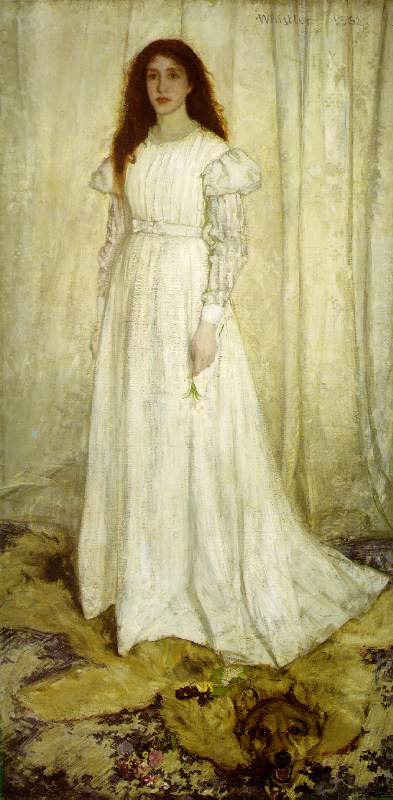
But I have been thinking about the strange colliding time-collapsing feeling I had when I saw Symphony in White, No. 1 in the V&A a couple weeks ago, and I have been thinking that term, officially, starts tomorrow, and I find myself realizing that two years ago, the last time I spent some number of weeks reading and writing and thinking on my own outside of an academic term, it was in Washington and I was learning how to believe in beauty. I grew so much that summer—I spent my days with myself, but I grew outside myself. So, too, do I find myself looking back on the past seven weeks spent mostly with my interior monologue (which has developed a disconcerting habit of impersonating Symonds), and being grateful for how I saw the daffodils and the crocuses bloom, and how I took long walks by the river, and how I came to love Oxford with a hurting feeling I know does not wrench my gut for just any love. In these seven weeks I went to Ireland and Scotland, and I went to London, and I made some awesome new friends, and spent time with some awesome old ones (academia: small place), and some of my favorite people in the world came to visit me from the other side of the Atlantic. Yet all the same, how have I grown? I have grown in eight- or nine-hour days in the Upper Reading Room, locked in passive-aggressive fights about whether to keep the window open with the English dons who sit near me in the southeast corner by the nineteenth-century literature reference collection, and reading my way into the mentalité of Oxford 150 years ago. I have grown in the heady enthusiasm of making discoveries, of cutting pages and discovering folios of manuscript material. I have grown in the meals of ever-increasing complexity and variety I have cooked for myself, and in the late nights when I ask the Symonds in my mind what it would mean to him to know that there are gay bars in Oxford today. (I still don’t know how he would react to this information, and I think that if I did I would have a much better JP than I do now.) I have grown because spending so much time alone is always an experiment: when I was in Washington, the interior monologue that led me to bookshops and to Pride and finally, pivotally, to the National Gallery shifted my sphere away from politics, and found for me the compass that guides my life today. I came back to Princeton and I picked a major. I came back to Princeton and I applied to Oxford. I came back to Princeton and I started to talk to my mentors about grad school. I wrote my Oxford application and I saw in it, with its personal statement and writing sample and recommendations, the echo of a grad school application. I went to the information sessions and talked to my friends who know from Oxford and heard how few class hours there are, how much of the work is my own. I learned I would have seven weeks between terms to put to good use on my own. I said to myself that I would cross the ocean, and then I would know whether it would be safe to leave me to my own anxieties, aspirations, and interior monologue for six to eight years, and perhaps the rest of my life.

Today was the last day before the start of the second, and last, term. Today the weather could not have been more perfect, and today I set out bright and early on a charity-shop crawl in search of a dress, because this is Oxford and I am going to a black-tie dinner next weekend, and if I am going to play the part of someone who goes to black-tie dinners, I am going to play by the rules. But before I found a great dress, some hours later, I happened by serendipitous accident into the best secondhand bookshop, and perhaps the most secret bookshop, in all of Oxford. It’s no Oxfam—you won’t find a book there for under £5. But you will find the third volume of Symonds’ Renaissance in Italy, the one on The Fine Arts. And you will find W.H. Mallock’s The New Republic, in lovely early-twentieth-century leather binding. And you will tell yourself that it is simply absurd to spend too much money on the collected works of Pater when the collected works of Pater will not fit in your suitcase. And you will ask for the first time in your life to please see that book behind the locked glass door, because you read the word “Ionica” on the binding and you know it’s one of of a very rare edition of William Johnson Cory’s “Uranian” verse, which was for Symonds a key pinpoint in the homoerotic literary tradition. And the shopkeeper will watch eagle-eyed as you flip through the gilt-edged pages and take in the details; and as your eyes widen when you realize that the label with the Eton crest identifying the Ionica as a prize book is inscribed to someone with the same name as the name on the flyleaf of the Symonds you’re anxiously clutching. And you will buy the Symonds and the Mallock and step out into the sunshine, wondering if you can justify charging the £65 Ionica to your research grant.

For after all, dear reader, it is the last day of seven weeks spent talking to Symonds. And (before finally going back to shopping just at the end of business hours and finding an ideal dress at the last possible minute) I spent hours trying to discover the identity of the man who wrote his name on the flyleaf of my new possession (no fruit has been borne yet, but I haven’t given up). And I spent the rest of the day in a café making my cappuccino last for hours and marking up a JP draft. In the long-shadowed, golden-glowing evening, I mixed fresh vegetables in with my pasta sauce out of a jar, and I watched the new Doctor Who, and wrote a blog post in which I, appropriately, sent tense consistency all to hell. And now I find myself called to reflect. What did I learn over my Easter vacation, dear reader? I learned that the world’s great college towns defy the expectations of minor nineteenth-century men of letters and grow up to have gay bars. And I learned that little girls defy their own self-sabotaging, anguished expectations and grow up to have research grants.

It Gets Better: brought to you by long, hard days of writing an 11,500-word essay in the sweet spring air of the city of dreaming spires. By dint of work and purpose, we make our lives into the very things we dream of inhabiting.

Things You Can Say in Oxford, Where You Live in a Palimpsest

Was there a boy (chances are it was a boy) who lived in this room decades ago before me, and sat like me at this desk (or one like it) in the heat and sunshine and the springtime sounds of Broad Street, with half a cup full of tea gone cold and Bach crackling on the radio, and pored over the pages of Calamus, seeking in himself the words to do justice to “the tender love of comrades”?

It wouldn’t surprise me in the least if there were an anonymous boy whom history has forgotten, whose name was not Symonds or Pater or Wilde, who was a member of this college which has not lent its name to anything particular in the history of homoerotic Oxford, but who thought all the same about who he was and what he was reading.

I wonder what he’d think if he could imagine 2011. I wonder what he’d think if he knew there was a girl now sitting at his desk.

The best moments in reading are when you come across something—a thought, a feeling, a way of looking at things—that you’d thought special, particular, to you; and here it is, set down by someone else, a person you’ve never met—maybe even someone long-dead. And it’s as if a hand has come out and taken yours.

On “It Gets Better,” Briefly

Yesterday came the news that Dharun Ravi, the roommate who videotaped Rutgers student Tyler Clementi’s hookup last fall immediately before Clementi jumped off the George Washington Bridge, is being charged with a hate crime. Those who grope, when a suicide happens, for someone to blame it on will I suppose have their closure, though as my friend Katherine wrote when I posted the news story on Facebook, “Nobody wins.” Clementi is still dead, and Ravi’s life is probably not going to go too well from now on. For this teenager, unlike (we might assume) the many LGBT teenagers who have been targeted by Dan Savage’s viral campaign in the wake of Clementi’s suicide, it will not “get better.”

Though a woefully poignant note, this seems an appropriate one on which to take a moment to reflect on what “It Gets Better” means. The immense popularity of the campaign, in which thousands of people all over the world—from these sweet older men to President Obama—have posted videos on YouTube, has led to the elevation of teen suicide as one of the causes les plus célèbres of the LGBT rights movement. It is a cause which has demanded the attention of not only the representatives of several departments of the U.S. government and the employees of several major international corporations, but also of pop stars such as Lady Gaga, whose “Born This Way” was written to be marketed as a gay anthem, and to encourage the positive-thinking, neatly-packaged Pride attitude that seems to have worked so well for the “It Gets Better” stories. When the Fox TV show Glee, which has also focused a lot of attention on what it is like to be a white gay male teenager in a school environment, premieres a 90-minute special episode written around “Born This Way” next week, it will become the latest addition to this mega-narrative promising salvation to LGBT teenagers that has responded with such commercial—as well as heartfelt—force to Tyler Clementi’s, and other young people’s, suicides.

Ostensibly, it is a narrative which offers so much hope and promise—stay alive; everything’s gonna be okay—but as the months have ticked by, my feelings about it have gotten ever more complex. My acceptance of it as something which I can both relate to and believe in has faded since I wrote my first response to Clementi’s death, and since I contributed to Princeton’s “It Gets Better” video. As I go to Holy Week services this week and get hung up on the degree to which the words, and the acts of devotion they demand, make no sense since I was raised without a promise of salvation as part of my worldview, so do I hesitate more and more to hurtle headlong for “It Gets Better.” Justification by faith is no more sensible to me whether we’re talking about how God sent his Son to die for us or whether we’re talking about a telos in which anonymous gay (yes, usually gay) kid from flyover country realizes he (yes, usually he) was “Born This Way,” and therefore has the impetus to move to a city and go to Pride and dance to Gaga at the clubs and eventually get gay-married and live happily ever after. I speak facetiously, of course, but this is not to elide the comparison between religious faith and “It Gets Better” faith. I’m getting a sense now that this is what’s been lying behind my hesitation to embrace the IGB narrative over the course of the past several months. I think I’m just not a person who has faith.

But I am not without belief, and not without causes, and not without spirituality, of a certain sort. If I am anything, I am a believer in good works, and in the quasi-Transcendentalist belief in God-as-metaphor, as a divine presence in all things that are good and virtuous that we can experience at the best of times as a shiver of pleasure. And it’s these things I think of when I think of getting better: of developing oneself to be more virtuous, and to be able to feel that shiver when confronted with beauty. My God is not externalized, in the promise of salvation nor the promise of Pride, but is something I may perceive in swift glimpses if I play my cards right, if I do my reading and practice my vocation of being a teacher. And this is something that does not happen without good works—without those of oneself and one’s daily self-fashioning, and most critically without those of the bettering influences around one, the dearest friends and most caring mentors, the families biological and adopted, and even the anonymous donor who means you get paid for doing what you love for the first time. For me, coming into this world without faith, it does nothing to believe that “it gets better” first, and then proceed from there. It is only through the daily Pilgrim’s Progress of psychological labor that I have even so much as come to appreciate the goodness of my life, how fortunate I am, how much better my life is now than it was just three years ago, and how much I now have to give that it is my duty to pass on to those whom I believe need to be told not “It Gets Better,” but how to help themselves—just as my teachers, slowly but surely, brought home to me.

Late last night, a bout of insomnia had me reflecting on what it is to be a 21-year-old Canadian-American academic brat living alone on another continent (or, well, an island in the North Sea), for whom going to work every day means going to the Bodleian Library to write about John Addington Symonds, which work is (or will be, this summer) subsidized in part by a grant because some members of her department thought what this 21-year-old Canadian-American academic brat does with her life is worth paying her for. Three years ago, when I was an 18-year-old gazing rapt at the light at the end of the long, dark, horrible tunnel of high school, and looking ahead to a summer working at the local cinema and who-knows-what to follow in September at a university I was convinced I hadn’t deserved to get into, I could never have imagined living in a room in Broad Street, writing original scholarship by sunlight in the Upper Reading Room. I could never have imagined being the one to discover Symonds’ letters to Roden Noel in the Bodleian’s English literary manuscript collections, or the one to cut the pages on nineteenth-century books no one has ever opened for a hundred years. I could never have imagined having mentees of my own. I could never have imagined having a pint at the pub with friends, or using Facebook to keep in touch with other friends on the continent I came from. I could never have imagined living in a world in which what I do, and what I value, is valued. I no longer hate myself. And if there is any evidence of bettering, surely this is it.

But I did not come to realize that my life is better because someone in a YouTube video told me; I came to realize it through dint of purpose and the gentle guidance of teachers who taught me how to read and how to write, how to love, how to teach; who took seriously what I said to them and responded in kind; and, whether eminent chaired professors or my parents, have given me guidance when I needed it. My teachers have taught me not that I will be their colleague someday, but that I am worth working towards that goal, and moreover that such a specific goal (rather like that of the gay-married coastal-city-living IGB gay, I suppose) need not define who one is or what one can contribute. My teachers have taught me that even if it doesn’t get better, we shouldn’t stop trying. And for me it’s that purpose, not the faith, that is so much worth living for.

One last thing: if things have gotten better for me, and if I remain resolved to continue my Pilgrim’s Progress, it has nothing to do with moving to a city (after all, I have nearly always lived in or near cities) or knowing the words to every song Lady Gaga has ever released (which I probably do). For me, there is no gay marriage on the horizon. And while this is in part because this narrative does not even begin to map onto my life, and its whitewashing of the queer experience strikes me as incredibly problematic, it is also because sexual orientation is not at the center of my struggle, and because my self-loathing of past years was far displaced from a closet. Gaga notwithstanding, I live in a Victorian world, before a certain Symonds set the word “homosexual” to paper, and the competing discourses with which people of all kinds struggled to express inchoate desires didn’t always cohere around sexual object choice and the mechanics of what someone then might have called “voluptuousness.” My discourse is one in which the language of passion speaks as much, if not more, to the cults of truth, of good, and of beauty as it does to the cult of the body.

And so I ask that anyone who speaks a language in common with mine feel free to reclaim the words “it gets better” from the neatly-packaged narrative that those words have been sold as. And as we labor onwards, suspecting that the Celestial City is nowhere to be found, but that we ought to keep on towards it anyway, let us please make sure that we say an atheist’s prayer for the poor lost souls of all those people who take an action like jumping off the George Washington Bridge—regardless of whether their torment was the homophobic taunts of a schoolyard bully.

… to my knowledge, nobody professes to doubt that, so far forth as we possess a power of bettering things, it is our paramount duty to use it and to train all our intellect and energy to this supreme service of our kind. Hence the pressing interest of the question, to what extent modern progress in natural knowledge… is competent to help us in the great work of helping one another?”
—T.H. Huxley

Apologia Pro Studio Humanitatum

If you are one of those people who, in the wake of a transatlantic agenda to delegitimize the academic profession and the teaching and practice of “useless” subjects that profession enshrines, have struggled to find the words to suggest that maybe such delegitimization might not be such a good idea after all, Nicholas Dames’ article “Why Bother?” in the latest issue of n+1 is required reading. Reviewing three of the most eloquent and popular recent defenses of “useless” subjects and the academic profession—Martha Nussbaum’s Not for Profit: Why Democracy Needs the Humanities, Louis Menand’s The Marketplace of Ideas: Reform and Resistance in the American University, and Terry Castle’s The Professor and Other Writings—Dames ends with this moving conclusion drawn from his words of praise for Castle’s An Academic’s Progress of a memoir:

Richard Rorty once argued that Western culture needs the novel, in order to force us to imagine lives and destinies different from our own. Perhaps the humanities, in their current plight, need to be novelistic again. Not necessarily in their fictional mode, such as the moribund campus novel genre with its essentially demystifying comedy, but the novelistic ability to marshal narratives and details that give us back some sense of why the humanities exist for individuals — how, to put it bluntly, they still rescue lives. One doesn’t enter the academy to become a disillusioned professional (although that will happen along the way). One doesn’t enter it to equip businesses with flexible analytic intellects (although that will also happen). One enters it, shamefacedly and unhappily, perhaps, but enters it nonetheless, in order to devote oneself to something greater than personal resentments — to salvational or transformational modes of thought. Because, put another way, all the grievances that take aim at higher education express real suffering, and that suffering has causes and modes of expression older than most sufferers usually know. The humanities should be, if not their solace, then their weapons of choice. Prig and cynic and naïf she may be, but the newly minted academic knows this — after all, she most likely came from their midst — and one good way of explaining as much is to explain how that knowledge feels. Without such explanations, which might soften resentment into curiosity or sympathy, there may soon be very little left to be embarrassed about.

I read this article—and am writing this post—from a crowded English train, surrounded by the remains of an issue of the Guardian (crossword puzzle completed), a train-station takeaway americano, and a book, stickered with the seal of the Oxford History Faculty Library, that I should really be reading for research purposes. Tony Judt’s words on the decline and fall of the post-privatization British rail system are ringing in my mind as I contemplate the forlorn-looking and extortionately-priced offerings of the refreshments trolley. Dressed in corduroy and herringbone, pecking away at my MacBook, my ticket for Oxford in my jacket pocket, I am nothing if not the intended audience for Dames’ slightly unorthodox answer to the “How do we defend humanists and the humanities in these strange days of declining-and-falling, neoliberal cost-cutting?” And so perhaps this is why I find his the most persuasive gesture towards an answer I have come across in many months, and the closest to articulating my own thoughts on the subject. Dames’ answer to “Why Bother?” is neither strictly utilitarian nor merely tautological. It rests on an understanding of what knowledge and intellectual curiosity are and can do, and why people undertake lives of the mind, that I share and believe with an almost religious fervor. And it comes on the heels of a compelling and compassionate review of a memoir that, as I noted when I read it, comes closer than any campus novel to mirroring my own experience of the young intellectual’s bildung—priggishness, cynicism, naïveté and all.

But what sits uncomfortably about Dames’ answer is that it could not be more ideologically opposed to an argument like Nussbaum’s, defending the humanities for the sake of the good they can bring to society at large. As Nussbaum defines it, this good is tangible, almost quantifiable, and the problem therefore (as those more qualified than I to dispute claims made by Martha Nussbaum have noted) is that her argument doesn’t counter the assumption that value must be tangible, discernible, measurable, or that it can consist (even in measurable terms) of intellectual and spiritual fulfillment. But it is a good that is general, that speaks to the need for the humanities of those outside the university walls as well as in. It explains why those doing the defunding and the devaluing need those whom they are trying to devalue and to defund, and why humanities education and research can be beneficial to those who don’t stay in the academy all their lives. Dames, by contrast, seems rather not to get the joke of Castle’s elegant pastiche of the eighteenth-century novels she studies. It seems as if he invests the role of the plucky young protagonist whose life is changed by books and whose angst is managed by the order of an academic career with heroic importance—and one has to wonder, as it seems one always does, if the psychological satisfaction of those who make lives in the academy is really worth so much as to be the backbone of a humanities-justification argument. One wants to believe that the professor, or even the cynical graduate student, has as much right to love what she does as the member of a state legislature voting for or against her continued employment, and one knows from lived experience that only a teacher who believes in the goodness, and the changing power, of what she teaches is capable of passing that love onto her students. I for one would like to be able to say that Dames resolves the question that still keeps me awake at night: whether it is not just purely selfish to follow a calling which gives me so much pleasure, when I am plainly only one of a few who will benefit from my putative academic career.

We can resolve this dilemma—at least temporarily—but only if we make recourse once again to our battered “for its own sake” tautology. The thing is that I don’t believe in dismissing out of hand any ideas, expressed in expressive language, that I find moving enough to peck out a couple thousand words about on the train. And so I feel inclined to say that Dames’ ideas are valuable to this ongoing conversation—that they humanize the humanists. But the conversation can’t stop with a validation of the motives and the psychological struggles of the privileged few. It needs to find language with which to relate the cosmology of those who think for a living, and those who teach as a vocation, to anti-profit-motive values that involve those in the real world as well.

I’d posit that the humanities offer not just the Terry Castles of this world, but everyone, the chance to decide for themselves what it means to live a good life, and to act in accordance with the principles they have devised. The humanities offer all of us alternative epistemological paradigms, that don’t require an output or an end or a profit. They offer doubt, but they also offer possibility. What they don’t offer is empiricism, equations, or the assumption that there are answers. But for all that, they are no less admitting of possibilities—for a good humanist will recognize the necessity of scientific methods to fill in the gaps in her worldview. The humanities allow us to make ourselves, and our world, as we would have them be. And they do, in the end, promise a place for the seekers after knowledge and the people whose calling is to expand those possibilities of thought and action still further.

Making the case for the humanities and those who teach them today involves preaching the value not just of those apparently special individuals for whom humanistic inquiry lies at the root of existence, but also of those for whom it plays any part, however small. Those who seek to impart their evangelical message to those in the halls of power can couch their requests in the rhetoric of outcomes and utility, or they can do what primary-school teachers—and parents—are doing right now all over the world, and assign their students Harry Potter in an effort to encourage them to read and to recognize not just the benefits but also the joy of reading. They can start small, they can meet their students (first-graders and members of Congress alike) where they are, and then—oh then!—guide them one step forward towards realizing that they had the right answers, the reading-comprehension but also the literary-critical, key inside them all along. Infinite patience and infinite kindness are as impossible things for us to ask of the world’s intellectuals public and private as they are of ourselves (or of our children’s first-grade teachers), but we can certainly start small—with the conviction that what we do, as Dames argues, matters—and from there become slowly and surely better.

On Continuity and Change; or, In Which I Make a Motivational Speech

Just under two years ago, my life changed when I looked at a painting. It was the summer of 2009 and I was a frustrated editorial intern in the office of a progressive 501(c)3 in Washington, DC, groping my way through nine lonely-making weeks of hardening cynicism about what DC is for and how little power anyone in it has to make it a less messed-up place. I began the internship thinking I wanted to be a journalist, and by the sixth week, I knew that as laudable as the people who use their pens for good in DC are, it wasn’t my calling. I was looking for a way out—and so I went to the National Gallery.

My visit to the National Gallery was the first time I chose on my own to go to an art museum. I knew virtually nothing about art, how to look at it, how to appreciate it, what it meant to look at a painting. I roamed from room to room, seeing for the first time paintings by artists from Watteau to Eakins to Cassatt. And I stopped dead when I happened by chance across an enormous painting by James McNeill Whistler, perfectly framed in an archway so as to stand out amidst all the other 19th-century offerings in the National Gallery. Called Symphony in White, No. 1, the painting is a full-length, life-size picture of a woman—not so much a portrait as a depiction of something unreal and ethereal, the rough brushwork unlike the hyperrealism of many of Whistler’s contemporaries, the vacant expression in the woman’s eyes deflecting attention from her face and in turn towards the folds of her white dress, and to her shoe, peeking out from under its hem, as she points her toe at the head of a grotesque bearskin rug. It’s an awe-inspiring image: two years ago, without yet having the words in me to describe what I was seeing, I sat down and looked at that painting for solid minutes. I had never done such a thing before, but I stared at the Symphony, it stared back, and the vacant stare looking down on me seemed to assume a cosmic significance. It sounds trite to say this now, but it was at that moment that my life changed. Struck as I was by the painting’s beauty, I resolved to work to increase the number of beautiful things in the world, and decrease the number of ugly things. I wanted to think about things that were good, and I wanted to do things with my life that would not make me cynical.

As I walked out onto a sunny, humid National Mall, I knew I was going to be an academic, not a journalist. When I found myself telling this story to a stranger in a coffeeshop the following week, I knew it was true. And I haven’t wavered since. The hold Whistler and his contemporaries (artistic, literary, and otherwise) have maintained on me since that day is a big part of what has driven me headlong into the nineteenth century as my period of study, and as I have learned more about their historical context I have modified quite a bit the juvenile creed of aesthetic hedonism with which I began. Instead of reading the Symphony in White goddess’s (for so I came to think of her) stare as an exhortation simply to seek beauty, I came to see it as an invocation of duty: a call to better myself and the world around me, to believe in my power to do good on my own terms, to (in the words of the very Victorian man, himself no aesthete, who has become the center of my life) “live with steady purpose in the whole, the Good, the Beautiful,” and to always aim not just to be and to do good, but (in the words of a much-admired mentor and friend) to be and to do “better.” In an 1890 essay “On the Relation of Art to Science and Morality,” John Addington Symonds wrote that “art is able to assert man’s moral nature at moments when it seems in other spheres to have been paralysed or vitiated.” So it was with me in the National Gallery in the summer of 2009. I looked at a painting by the artist most famously derided by Ruskin, whose blank-eyed model bespeaks the painter’s lack of interest in giving his painting a moral, and imbued that painting with all the meaning I could muster out of all a young adult’s desperate search for purpose and ethical paradigm.

Today I took a break from the exhausting enterprise of organizing my Symonds source material and headed into London, because this is the first weekend of the Victoria and Albert Museum’s special exhibition on the aesthetic movement and I couldn’t wait to see it. I now spend my days, and my thoughts, with a circle of intellectuals who all engaged in some way with the questions the aesthetes raised about the relationship between ethics and art, and I am preoccupied above all with trying to understand what it meant to be someone to whom such questions mattered so much. This afternoon, I had already spent an hour and a half or so in the exhibition, soaking up material culture and fun facts and beautiful Kelmscott Press books and more Burne-Jones and Rossetti than I could even begin to process, when I rounded a corner and let out an audible gasp: there she was. My goddess. And for the first time, I believe, since Whistler first exhibited his series of three Symphonies in White, she was flanked by her companions, who usually live at the Tate and at a museum in Birmingham—though none is as majestic as she. She dominated the wall in the V&A as she had in the American National Gallery. Just as I was two years ago, I was struck by her size, by her majesty, by the ability of her stare to be at once vacant and to contain multitudes. I wanted to do something to tell her what it meant to me, to see her again. I wanted to cry, or possibly to genuflect. I wanted to say, thank you. Thank you for changing my life.

Two years ago I was a lost kid whose sense of home was rapidly being destabilized by the culture shock occasioned by living 3,000 miles from home in (DC and Princeton alike) another world. Two years ago, I was an anxious kid who cried a lot because I was convinced Princeton had only admitted me for being the child of an alumna, because I failed to live up to the impossibly high standards I set for myself, and above all because I couldn’t imagine any way to do good in the world that would allow me also to preserve my sense of self, my sense that it is okay (and in fact necessary) to be myself. I didn’t know that I had to help myself before I could help others. When I saw Symphony in White, No. 1 again today, I looked her in the eye—as a historian, as a student and a teacher, as someone who, as often as I fail at living the virtuous life to which I aspire, wakes up every morning willing to try again. I am someone who finds the question “Where are you from?” impossible to answer, but call the University—qua idea—my home. I am someone who believes I have a right to exist, that I am important, that my life has a purpose, and that I am capable of fulfilling it to the best of my ability. It is no coincidence that it was after I came back from Washington that I started to recognize I have the capacity to make a difference in the lives and the minds of those around me; after all, it would be a mortal sin to my white-clad goddess not to act upon one’s calling.

Recently, I’ve been evincing a lot of skepticism of the Dan-Savage-constructed “It Gets Better” narrative: the uncomplicated teleological happy ending, and the notion that simply crafting such a narrative can be a solution to awful, scary, stomach-turning things like teenage suicide. But I have also recently been evincing a desire to move beyond mere skepticism, and so here I am. I am sitting in a room on Broad Street, dreaming spires visible from my window, buried in a mass of notes from which I’m going to make an original contribution to my field. And it’s from here that I look up to the National Gallery postcard of Symphony in White, No. 1 over my desk and ask: does it get better?

Yes, dear reader. Yes it does.

QOTD (2011-04-06); or, Why I Will Not Be Using the Word “Hermeneutic” in My Thesis

Twenty years before Freud published his famous analysis of the Schreber case, arguing that Schreber’s extraordinary fantasies were a result of paranoia stemming from repressed homosexuality, John Addington Symonds published his A Problem in Modern Ethics. Therein, he highlights these lines from a case study of an anonymous “Urning” in Krafft-Ebing’s Psychopathia Sexualis:

… when he first becomes aware of the sexual stirrings in his nature, and innocently speaks about them to his comrades, soon finds that he is unintelligible. So he wraps himself within his own thoughts…. He imagines that he alone of all the people in the world is the subject of emotions so eccentric…. How many unexplained cases of suicide in young men ought to be ascribed to this cause!

Those who have studied Freud in his historical context will be aware that, although his role in the formation of modern psychoanalysis was pivotal, he wasn’t the only person at the turn of the twentieth century thinking about the mind and mental health in relation to desire. Scientists like Krafft-Ebing who collected and edited personal narratives about individuals’ sexual histories (something which Symonds was himself very actively involved in in later life, though thanks to Edmund Gosse none of his research has survived) no doubt had specific pathological narratives in mind which they sought to highlight through their selection and organization of the case studies. The case study Symonds presents us with in Modern Ethics is no exception, but what’s striking is how this narrative maps onto the model of homosexual desire that Freud (in)famously gives us in Schreber. In the Krafft-Ebing case study, a severe mental-health risk (suicide) is instigated by the idea that someone would “wrap himself within his own thoughts”—in modern psychoanalytic terms, repress his sexual identification, covering it over with conscious thoughts—and that this coping mechanism would cause him to believe—as the paranoiac does—that he is the only person who feels as he does, and that therefore he is at risk of persecution from everyone. It’s the link between repression and paranoia that emerges in the Krafft-Ebing case study (and, in particular, in the bits Symonds highlights from it, performing his own editorial work!) that seems so strikingly to prefigure Freud. For we historians, this is an interesting muddling of the timeline: we whose scholarly duty seems to be to warn other critics against applying critical frameworks to historical moments prior to their invention need to keep in mind that critical frameworks do not suddenly come into being with the jolt of electric current that accompanies the flipping of an “on/off” switch. Rather, they develop—as all ideas and paradigms do—gradually over time, thanks to the contributions of many individuals. Freud may loom large in the history of psychoanalysis and indeed of sexology, but to a certain extent he is also affected by the way that people think and express their thoughts in the period at which he starts to think and write about the mechanisms of sexual desire. I haven’t done the reading to be able to do more than speculate, but I wonder in what ways Freud’s immersion in the genre of the case study, which has its narrative conventions just like any other genre, affected the nature of the frameworks he extrapolated from his own case studies!

These all may seem like very elementary points to be making, and I don’t need to do the JSTOR search to make an educated guess that they’ve been made before by readers of Freud more sophisticated than I. But the bottom line that any given intellectual figure is both shaped by his or her historical context and yet exists as an individual apart from it seems too often forgotten by scholars of all stripes. Every day I read secondary literature about Symonds and his circle which believes it appropriate to refer to Symonds as a gay liberationist (in the framing of one ’90s queer theorist I was reading yesterday, a sort of Foucault avant-la-personne) or for that matter to dismiss him as a “minor man of letters” whose form somehow camouflages into the prized Morris wallpaper of his drawing-room. For scholars whose discipline is all about questioning categories, I find that queer theorists aren’t always as perfect as they might be at distancing themselves for the categories they in turn have created, and the world-historical figures—the Freuds and the Foucaults—they have elevated. Of course, no one is perfect, nor should they be. It is rather the lack of interest in trying to see the world from their subjects’ point of view that irritates me.

But then, I suppose, that’s why I’m a historian, not a queer theorist. From each according to her abilities, to each according to her needs.

In the Interests of Accountability; or, Lost Causes, the Good, and the Beautiful

Since I last wrote here, the first of my two Oxford terms came to an end. In the past two weeks, I’ve enjoyed visits from my father and from some friends from Princeton, I’ve made lots of new friends at Trinity, particularly among the graduate student body (or, as they say here, the MCR), and I’ve switched academic gears in a big way. From churning out one or two eight-page essays a week, I’ve gone to major big-picture conceptualizing of my senior thesis, and starting work on what will one day be the first chapter of it, my spring JP. In little moments snatched between languid walks across Port Meadow, harried sightseeing in London, and several pints of bitter, I wrote a five-page proposal for my thesis, which I’m submitting as a part of my applications for summer research funding. As I emailed drafts back and forth with my adviser, I became terrified by the enormity of the project I am taking on; as I walked miles through the green spaces of Oxford and rode miles underground across London, my mind drew scary blanks on how I would start to write my JP, which is not as far along as my fall JP was this time last semester. The last of my guests left this afternoon and college has emptied itself eerily out for the vacation. I went to Tesco this afternoon and bought £15 worth of ingredients I can make into meals with a single saucepan and a hob in the JCR kitchen. I dithered: uploading pictures to Facebook, catching up on magazines and iPlayer, writing letters to the editor. And it wasn’t until 10pm, after I’d submitted my first thesis funding application and dithered in front of the Victorian literature shelves in the college library, the dinner dishes glaring at me from the washbasin in my room, that I realized I needed a plan, and a method by which I can remain accountable to it, if I am to have a draft of my JP in to my adviser by May 1. (“A draft?!” I hear you say, Princeton juniors? Yes: because I am doing a JP on top of a full Oxford courseload, and because Oxford’s academic year goes well into June, I have a month-long extension.)

And so here, for the whole internet to read, it is: tomorrow I will return to the Upper Reading Room of the Bodleian for the first time in two weeks, write some deadlines and benchmarks for the next six weeks in my diary, and start to make a skeleton outline of my JP. A week from tomorrow, I am going on holiday to Ireland for a week, but by then I will have read all my primary sources, and a reasonable number of secondary ones. When I return, I will have just over three weeks to pull together 30 pages on three themes in the intellectual background and Victorian cultural context of John Addington Symonds’ writing on homosexuality—yes, that’s a week on Henry Sidgwick, T.H. Green, and ethics; a week on Benjamin Jowett, Matthew Arnold, and Hellenism; a week on Walt Whitman, democracy, and the British fantasy of America; and a few days in which to hash out my critical space with respect to the historiography and to draw some conclusions about what is innovative about Symonds’ theory of male homosexuality in his late-Victorian context. Frankly, dear reader, I am terrified.

But after eight weeks at Oxford, I can just about manage to write at least a draft of an intellectually interesting essay in a week, and I know how fortunate I am to have the vacation to focus on only this, and a month after next term starts to revise and make it good. I know how fortunate I am that when writer’s block strikes, I can leave the Bod and walk through the Parks and think, “Symonds would have known this path.” I know how fortunate I am that I can go in the same day to the University Museum and to hear Evensong sung in Christ Church Cathedral, and can think about how much Symonds and others like him struggled to reconcile the conflicting identities of those two very different Gothic buildings.

I have been in England ten weeks, now, and I am starting to miss Princeton—or, to be specific, Rocky College and my Princeton family—desperately. I am thinking daily about the friends who are growing and changing every day without me to see them do so, and the friends who will leave Princeton in June whom I worry I will never see again. Following the life of my home for three years on the Internet, I come across gems like this which make me proud to represent my university (and more particularly my own small community and university family) abroad, and which far outweigh the number of times I have had to explain to a new acquaintance here in Trinity College that Princeton makes admissions decisions based on academic merit as well as on athletic ability or legacy status. I did not think that I would find myself identifying with Princeton even in another academic institution. I have always thought of myself as someone who lives in and is defined by the culture of universities, but I did not realize that one University with a capital U would loom so large in a life with so much academic peregrination still ahead of it.

But even as I nearly cried putting my friends from Princeton on a bus to Heathrow this afternoon, I knew it was right for me to come to Oxford. Reasons of cultural diversity and realizing that Princeton really is, as someone once said to me, the Disney version of Oxford aside, I could not have written as good a JP as I am now writing if I had never seen the place where Symonds’ intellectual and cultural compass was formed. I am discovering (with thanks due to some key observations from my adviser and from my Victorian history tutor this term) that the primary problem I have with much of the existing work on Symonds is that it does not invest itself fully in what it meant to be and to think like a Victorian, Oxford-educated intellectual. It does not adjust its outlook to a very narrow circle of men (and the very occasional women) preoccupied with large-looming questions about how to live a good life in a modernizing, industrializing, capitalizing, secularizing age—questions which we oh so (too?) rarely consider as vital as someone like Symonds must have done. We in the 21st century can’t really know what it was like to think like a Victorian, I suppose, but we can get flashes of realization when the Magdalen choir sings the Magnificat or when we see Ruskin’s watercolors up close in the Ashmolean Print Room or when we walk out along the Isis into countryside that is literally the stuff of poetry. When one lives in Oxford one sees how someone like Symonds, or someone like Arnold, or someone like Ruskin, or someone like Pater, or someone like Wilde (for they were all such different individuals and thinkers), built an aesthetic compass, and rendered it so central to their cosmologies that the pursuit of happiness or of knowledge or of beauty, as well as the building of a better world, seemed possible. In Oxford, where dreaming spires reached to Heaven and no dark Satanic mills could pour coal dust into the sky, the search for “sweetness and light,” the quest “to burn always with [a] hard, gem-like flame,” the mission “to live with steady purpose in the whole, the Good, the Beautiful,” the possibility that one might be able—as Wilde wrote in “The Soul of Man Under Socialism”—”to live,” seemed realizable. To Symonds, who died before the Wilde trials sounded out loud and clear all sorts of appellations for the love that dare not speak its name, it was worth dedicating one’s life to a particular strain of humanistic inquiry whose overarching purpose was to develop a cultural and literary history and a set of ethical precepts governing what he was the very first person to call male homosexuality. And would he have done so had he not learned to think in the “home of lost causes”? Back here in the present in a room on Broad Street, the Trinity bells are sounding midnight, and I can’t help but think that without Oxford so many things—from Symonds’ first forays into academia to mine—would have been quite impossible.

Intellectual Curiosity, Hope, and Charity; or, The Humanist’s Progress

In my memories, my childhood of not-belonging is characterized, above all, by my atheism. Raised in a household which celebrated Christmas with Santa, Easter with the Easter Bunny, Hannukah with candles, and Passover with a heavily edited Haggadah that removed all mention of God, I had no qualms about announcing to a series of classmates and teachers in a series of schools in reasonably conservative and religious areas of America that I did not believe in God. I remember shocking and awing third-grade classmates who told me I was surely going to Hell, a sixth-grade English teacher who didn’t understand how anyone could be “just coldly rational,” and person after person after person who denied the possibility of my living a just and moral and good life without faith, who wondered why, although I sometimes stood and sometimes did not for the Pledge of Allegiance, I never, ever said the words “under God.” I was bullied for a variety of reasons at school—my cleverness, my unorthodox (read: weird) dress sense, as time went on my gender nonconformity. But above all I can remember having to put forth complex intellectual arguments to defend my atheism to all comers, long before I was in high school. As history tells us, there is seemingly nothing so threatening to many people as to tell them you deny their articles of faith—and I can attest to this from a life of being told I was going to Hell, not for my sexuality or my gender nonconformity, as the “It Gets Better” videos might suggest, but for my atheism.

Of course, though, I was raised an academic brat in an upstandingly, old-fashionedly humanist family which always, always educated. When I was a child I read the illustrated Children’s Bible along with D’Aulaire’s Greek Myths and illustrated versions of the creation myths of various non-western cultures; as I grew older, I came to cherish the intricacies of a Bach fugue or a stanza of Miltonic verse, to respect a tradition which seeks “to justify the ways of God to man” even if I felt as though I could never understand the intellectual position which might compel a Milton, or a Bach, to do so. I entered churches for concerts, played my violin and viola in a string quartet for weddings. I went to bar and bat mitzvahs. Once, I attended a Catholic funeral mass; another time, I stood at a graveside and heard a priest intone the Anglican funeral liturgy. Through the rituals of life in which people are born, reach adulthood, marry, die, I have come to have the familiarity we all have with the words of ceremonial religious services. I have phonetically memorized the Hebrew of some of the primary Jewish prayers; I can say the Our Father in English and in Latin. And because I am an intellectual historian, I have become conversant in the language of spirituality and spiritual doubt, and have come to have the greatest sympathy with those of my Victorians who sought to reach an understanding of God, the Church, and Jesus’ teachings that would allow them to integrate science and faith, or else to reach an understanding of virtue and morality and the call to live a good life that is both virtuous and moral without needing to use Jesus’ death and resurrection as a guiding light.

Because I am a visitor in Oxford, I have been going to many Christian services, to see inside the college chapels and the city churches and to hear the music, which is of an impressively high standard. Because I am studying more than anything else the intellectual history of this university community, and the time in which it became a secular rather than a faith-based place of intellectual inquiry, I have been paying close attention to aspects of the services beyond the architecture and the singing. I have been engaging intellectually with the language of the liturgy, and I have been mentally and spiritually joining in when the priest intones a prayer for peace, or for the continued health and good fortune of the university community. I have been noticing a combination that speaks to the recent history of religion in this university: the High-Churchiness of the pageantry, the vestments and the singing and, once in a while, the incense; but also the fact that every sermon on a text is a practice of close-reading, a search for unapparent meaning that takes as its guiding force the understanding that, as Benjamin Jowett once controversially contended, the Bible is a literary text, which speaks in the language of metaphor. One does not need to be a Christian to hope for peace, and one does not need to be a Christian to take lessons of individual self-development from the beautiful words of the King James Bible. One knows one is not a Christian when one stands quietly while those around one intone their belief in the Trinity, in Jesus’s death and resurrection and future return, in the promise of salvation, in Heaven and in Hell; one knows one is not a Christian when one sits quietly while those around one move to kneel before a priest who places a piece of wafer and a drop of wine in their mouths, which we are to understand, either literally or metaphorically, as the body and blood of the God-man who died to save us. One knows, full well, that one is not a Christian when one finds oneself unable to make this leap of faith.

But this is Oxford, this is one of the more liberal homes of the already-liberal Church of England, and these are no longer the days of primary school, when I had no choice but to take pride in being hellbound. No one here will shun me if I come for the words and the music but not for Communion, and if I take from Jesus’ teachings the call to better oneself but only the loosest, most absolutely metaphorical understanding of the promise of salvation. No one will cast me out if I choose to say the responses to some parts of the service but not to others, and there are always more besides me—as there must always have been, to a certain extent, in these churches and chapels—who are not believers. And it is in this context that I have found myself growing up, and growing more credulous of what religion can do to supplement—though not to supplant—the moral compass of those of us who were raised with no belief in God, but who have come to believe in the goodness in all of us, calling us to be better.

It was in this spirit today that I attended the first Sunday-morning church service of my life, which I did because Philip Pullman was giving the University Sermon at the University Church of St Mary the Virgin. The University Sermon is of longstanding tradition in this university which began life as a seminary; in the 1820s, Newman launched his theological career from the St Mary’s pulpit. It is thus remarkable that the leaders of the church and of the university had invited a noted atheist to preach to them, and it was worth attending this service only for that reason: to watch a secular-humanist sermon mingle with prayers of faith, and to watch the vicar come rather awkwardly to the lectern after Pullman’s sermon to say the prayers that the preacher is traditionally meant to, but in this case would not, say. But the thing is, Pullman’s sermon was only out of joint with the liturgy if you (as, I imagine, many do) consider the core of religious worship to be faith in God. No doubt that faith is the reason why many of the people who come to St Mary’s every Sunday do so—but when Pullman, in white tie and bands and academic gown, expressed his skepticism about the meaning of faith, it seemed right and proper and in the best traditions of the theological history of Oxford that he should do so. When he spoke about the cardinal virtues; about the greatness of Charity, or Love; about the faith in the laws of physics as a more sense-making, but no less inductive, humanist’s faith; about the necessity of a superstructure, like concert orchestras and institutions of learning and the National Health Service, which can help us to enshrine virtue in our society; and about, finally and gloriously, the proposal that Intellectual Curiosity replace Faith in the canon of virtues; I was in awe, grinning and nodding right along, even though I knew that no one around me was seeming quite so physically engaged, and I found myself wondering if it was all right to express such enthusiasm in church. Pullman began by stating his lack of belief in God, the incongruity of his appearance before the Oxford congregation; but by the end of his piece, in the course of which he’d cited as higher authority not only the Bible, but also William James and John Ruskin, he’d articulated a vision of morality, in adhering to which I think we all ought to consider ourselves good and Godly.

Though it seems as if St Mary’s posts the texts of past University Sermons on its website, it of course has not posted Pullman’s yet. So I hope you will take my word for it when I say that the shape of Pullman’s speech seemed to me to resemble so much my own trajectory of religious understanding, from up-front apostate to Ruskinian; from rhetorical rationalist to believer in the value of good works. Though this belief has been enhanced recently in light of all the Victorianism, all the Oxonianism, I have been absorbing, and all the Anglican services I’ve sat through and in my own funny way believed in, I think it was set in motion the day I matriculated at Princeton, just shy of two and a half years ago. That day in the middle of September the freshman class filled the University Chapel and heard a service which had all the form of a religious convocation (bespeaking the seminarian history of my home university, too!), but consisted of a mix of prayers, blessings, and songs of which as many were secular as were grounded in a religious tradition of a belief in God or gods. I shall never forget that, instead of the prayer to God which graces every Oxford service, asking Him to protect the university, its faculty and its students, the Princeton Dean of the College, Nancy Malkiel, offered up a prayer to Wisdom, asking that loosely pagan deity to grant to that university all the good that is done by the spirit of teaching and learning and (in the words of Pullman) intellectual curiosity. I think it was at that moment that I became interested in, and in a certain sense convinced by, the language and the form of a religious tradition to help us to understand the good, the true, and the beautiful—whether they inhere in God or in ourselves.

It is for this Platonic reason that, when Pullman said somewhere in the middle of his sermon that he considered himself something of a Greek or Roman pagan, I smiled as broadly as I did. For Pullman was drawing on a tradition I have known since I read D’Aulaire’s alongside the Children’s Bible; which I sensed I could consider myself a part of when I was moved for days, and for years, afterwards by Dean Malkiel’s prayer to Wisdom; which I have become conversant in since reading Matthew Arnold’s articulation of the relationship between Hellenism and Hebraism; and which (it must be said!) characterizes John Addington Symonds’ vision of an ethics given us by ancient Greece, with which we can live in accordance in our own times, adopting as our creed Goethe’s exhortation, Im Ganzen Guten Schönen/Resolut zu leben, “To live with steady purpose in the whole, the Good, the Beautiful.”

So Philip Pullman is a Hellenist, and so am I; if Pullman calls himself an unbeliever, then so am I. I still cannot, and have no desire to, make my leap of faith in the direction of the man in the sky. But to be honest, I don’t think either of us are unbelievers full-stop. The devout Christian organizes her devotion around her faith in God; Pullman and I have a creed which calls us to revere—if not to worship—intellectual curiosity, or Wisdom. What is this but another inductive precondition for an ethical and virtuous life, another belief (we needn’t call it a Faith) in something Better?

Eminent Victorians and the Age of Majority

Yesterday was my 21st birthday: age of majority and all that jazz. In the past year, I’ve really started to think of myself as an adult, and so I feel as if this birthday marks something real that my 18th didn’t. Of course, I’m still in the process of Becoming, and always will be—but I feel much more myself than I did three years ago, back when I lived in the suburbs and, although I knew I was an academic brat, didn’t know I would come to call the world’s great universities my home.

Now I am living in a room that looks out onto Broad Street, and I spend my days reading Victorian history. In particular, I spend a lot of time thinking about John Addington Symonds and his circle of friends and colleagues, most of whom he’d known since he was an undergraduate right here on Broad Street, at the college next-door. I spend a lot of time thinking about men who, in my mind at least, were Eminent Victorians, and how their biographers trace their success and literary acumen back to their undergraduate careers. Symonds and Wilde: two double firsts (Wilde’s was the highest first in Greats Magdalen had ever seen, if I remember correctly); two Newdigate Prize for Poetry winners. Two men who, when they were my age, walked around this town in gowns reading Plato. When Symonds was 21, he was being coached towards his first by Benjamin Jowett, one of the greatest dons of Victorian Oxford. When Symonds was 21, his world was changing as his head-over-heels love for the boys who sang in the choir at Bristol Cathedral collided with his study of Plato, and he began to see things between the Greek lines that Jowett wasn’t telling him. When Wilde was 21, he swanned around Oxford being clever, impressing his tutors and his classmates, and spending far too much money on furnishings for his room.

Yesterday, I spent £3 on postcards for my wall, which didn’t particularly strike me as extravagant. Today, I exchanged a series of emails with my advisor sorting out what I’m going to say about Symonds for the purposes of my spring junior paper. I can’t read Greek, and my poetry is shit. I don’t think I even know what a heroic couplet is.

And yet I had a chilling sense of almost-deja-vu two weeks ago, when I was sitting in the Radcliffe Camera reading Thomas Arnold’s edition of Thucydides’ History of the Peloponnesian War (Arnold’s bits in English, obviously; not Thucydides’ bits in Greek, as we’ve just established the only words I can read in Greek are ones like παιδεραστια, ερως, ἐραστής, and ερωμηνος). For it is not improbable that, 150 years ago, Symonds sat in the Radcliffe Camera reading Arnold’s edition of Thucydides too, just as I know for a fact that he must have taken the same path that I do every day, east down Broad Street to the Bodleian. It’s a funny, funny thing—and it makes me wonder why I haven’t done the equivalent of reading my prizewinning poem at an honorary degree ceremony in front of dozens of dignitaries including Matthew Arnold, as Symonds did in 1860.

The comforting thing, though—and, in part, why I’m drawn to spending my days thinking about this man—is that Symonds was no Wilde. He was a well-reviewed author and scholar who held the esteem of many of the greatest intellectuals of his day, and counted heavyweights like T.H. Green and Henry Sidgwick among his friends, and Swinburne and Pater and Wilde himself among his eager readers. But when he died too early in Venice in 1893 it was not in the flames of martyrdom or in the glow of celebrity. It was quietly, of the accumulation of years of consumption and years of nervous breakdowns, with a modest but unheroic reputation which, for fear of scandal, was quickly covered up by a literary executor who knew too well what Symonds was saying behind the elaborate Hellenic metaphors of his poetry, and was one of the earliest recipients of his privately-circulated essays about what a much more famous Newdigate Prize-winner would, two years hence, loudly proclaim to be “the love that dare not speak its name.” (Symonds, rather sadly and sweetly, called it in some of his letters and poetry “l’amour de l’impossible.”) Symonds quickly faded drab, against the flashiness of Pater and Wilde, and when the critics talked and talked through the twentieth century about Jowett’s Oxford and the Greats curriculum, the texts in the back of their minds were Studies in the History of the Renaissance and The Picture of Dorian Gray, not a pamphlet printed in ten copies called A Problem in Greek Ethics.

When Symonds was 21, he may have been at the peak of the fame and glory he would accumulate during his lifetime—which seems to me all the more reason to sit and worry that I haven’t got a JP topic yet, never mind a prizewinning poem, though I have got a pretty awesome set of mentors, tutors, and advisors who I don’t hesitate to say could give Jowett a run for his money. And it makes me wonder what I will write that will be reviewed by the Walter Pater of my day in the popular literary press, and it makes me wonder what I will do to advance the discipline of cultural history, and it makes me wonder what I will privately circulate that will become the basis for my posthumous reputation. It makes me wonder how the person I am going to become will manifest herself in my work. And it makes me wonder whether I will die quietly in Venice, and whom I will die with: my long-suffering wife and cherished daughters? My doted-on gondolier?

Symonds was not, really, Eminent, as Victorians go. But he was a scholar who put his heart into his writing and into his many loves, who fathered three daughters, who loved the hills of Rome, of Switzerland, and of the village outside Bristol where he grew up. He also highly esteemed Middlemarch, which he read as it was published serially in 1871-2. The first time Symonds read Middlemarch, he was at the beginning of his career, barely starting on his massive five-volume cultural history of the Italian Renaissance, and only just starting to articulate what was so impossible about l’amour d’impossible. But I wonder if, later in life, he thought more about that book about ordinary people, about people whose lives are important for all their ordinariness, and who were important enough for one very talented woman to write a book about them. I wonder what Symonds would have thought of that, because I’m quite sure that he never would have countenanced the thought that there is a 21-year-old girlwoman in Oxford today who maybe will never win the Newdigate Prize or read Greek well enough to pass an exam in anything remotely related to classical studies, but who could certainly see living a quiet cultural historian’s life—and maybe, just maybe, writing a book about another quiet cultural historian who, sure enough, rests in an unvisited tomb.