Rededicating Ourselves to Banishing Hate and Finding Joy

The world is too much with us; late and soon,
Getting and spending, we lay waste our powers;
Little we see in Nature that is ours;
We have given our hearts away, a sordid boon!

—Wordsworth

100_0933
They broke their backs lifting Moloch to Heaven!
—Ginsberg

There is too much Moloch in the world. Too much gray modern ugliness. Too much hate-driven oppression, anguish, and despair. Sometimes the mechanic nature of modernity makes it awfully difficult to continue. And while I try not to overshare overmuch about my emotional state in this space, today I had a very, very difficult day coping with modernity. It is hard, in a world of NOMs and teabaggers and other threats to the sanity of the public discourse, to maintain an even keel. It’s challenging to look the world in the eye day after day, and to believe in that increasingly trite-sounding quotation about the arc of history bending towards justice. There is an expectation in our society that thoughtful people interested in the world around them engage with politics. But what if politics doesn’t want to engage? What if elections and campaigns and battles upon battles speak only to Moloch, not to humanity?

Sometimes reason just won’t do. Sometimes we have to step back and rely instead on art and eternal beauty. There are things that matter more than winning elections and coming out on top of the 24-hour news cycle. It is never wrong to do what we can to maintain our faith in the promise that we will find beauty all around us, if only we keep looking. If it comes to a choice, throw reason to the winds and run headlong for beauty!

In the back of my mind, there’s a voice telling me that this is the corniest post I’ve ever written. But you know what? It’s time I stopped worrying about that voice. There are so many things more important than it.

Once I pass’d through a populous city imprinting my brain for future use with its shows, architecture, customs, traditions,
Yet now of all that city I remember only a woman I casually met there who detain’d me for love of me,
Day by day and night by night we were together—all else has long been forgotten by me,
I remember I say only that woman who passionately clung to me,
Again we wander, we love, we separate again,
Again she holds me by the hand, I must not go,
I see her close beside me with silent lips sad and tremulous.

—Whitman


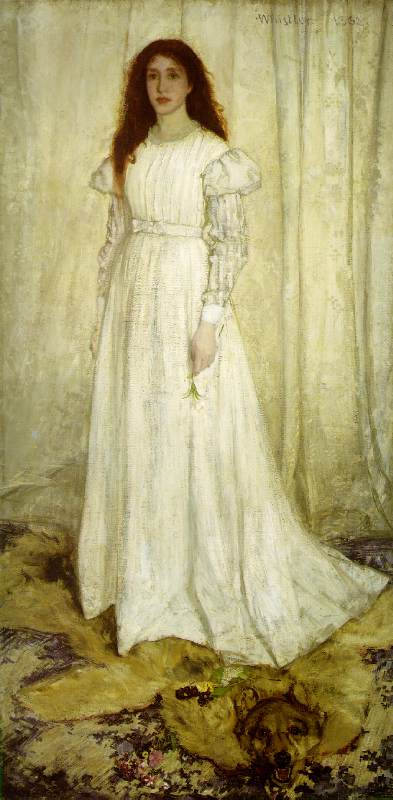
—Whistler

Failing to fetch me at first keep encouraged,
Missing me one place search another…

—Whitman

Holy the supernatural extra brilliant intelligent kindness of the soul!
—Ginsberg

America I’m putting my queer shoulder to the wheel.

Rationalizations and Reality Checks

Last night, I was sitting on my window seat, blaring public radio and refreshing half a dozen websites; making phone calls; covering the New Jersey elections—and, to a lesser extent, Maine and NY-23—as if it’s my job. (In fact, it sort of is; I’ll have a piece up at Campus Progress later today about NJ.) I went to bed last night full of depression and malaise, not even fully angry at the voters who elected an incompetent Republican governor in my state, nor at those who voted to take away the rights of LGBT Mainers. No, I was just sad. Sad and frustrated and wondering what the point is of letting my schoolwork suffer while I care about politics. I put on a 50-year-old comedy radio show that had nothing to do with politics, and I fell asleep consumed by guilty that I wasn’t listening to a cable news show instead. It’s so hard. It’s so hard to do enough, because it’s never enough. It seems as if the forces of good and equality and righteousness are up against so much.

This afternoon, after I’d turned in my copy and gotten an H1N1 vaccine (all the while grumbling, “If we had public health care, I wouldn’t have had to pay $15 out-of-pocket for this”), I went to get lunch and wound up chatting with one of the dining hall workers, who is from Haiti. He was telling me that his cousin is running for office in Haiti, and that he was going to go back to Haiti to vote for his cousin. We talked about how we’re both from warm places, and how much colder it is here in New Jersey. We didn’t, of course, talk about the American election.

And that’s because there are people to whom American politics is simply not the center of the universe—not just those who live in privilege and so don’t want to work to get everyone health care and equal rights, but those whose universe is focused differently. I’m going to go out on a limb and guess that Corzine vs. Christie, or marriage in Maine, aren’t questions that make a whole lot of difference to someone whom one of the richest universities in the world can barely manage to pay a living wage. And we all should remember that. Those of us who wake up the next morning election after election, full of elation or remorse and the will to organize and to vote again, should remember that American electoral politics are not the be-all and end-all of reality.

I’m telling that to myself as much as to anyone else, because here I am, now, sitting in Princeton and eating my eggs and drinking my coffee, wondering what to do next. I am left winded by this election, suffering post-2008 disillusionment the way a lot of us are. I feel exhausted by politics, by reading hundreds of blog posts per day, by writing and talking and posting shit on Facebook. I feel lost after phonebanking and campaigning for Corzine, donating to Maine, and being left with the notion that the progressive grassroots is powerless in the face of far more entrenched and well-funded lobbyists.

I would like nothing more than to put politics in a box for the next ten years, and train to be the best historian that I can possibly be. I would like to be able to tell myself that devoting the next two and a half years to telling the story of Princeton’s gay alumni is as worthwhile an endeavor as devoting the next two and a half years to fighting for marriage equality in New Jersey. I would like to believe that going to grad school and fighting for one of those rapidly-disappearing tenure-track jobs is as morally conscionable a career path as getting paid subsistence wages to organize for another pie-in-the-sky progressive cause. I want to believe that telling the untold stories of Americans dead for thirty or forty or fifty or a hundred years is as important as telling the untold stories of Americans suffering today.

I want someone to tell me that it’s okay if I can’t do everything, and that furthermore it’s okay to choose my schoolwork over campaigning. I want someone to tell me that historiography can be a fight for social justice too. But the fact that I want so desperately to hear those glad tidings makes me think that it can’t possibly be true. It makes me believe that this is just rationalization to explain away the fact that I spent the weeks before the election writing my midterm papers and not out in the streets. It makes me believe this is just an attempt to justify my privileged access to elite higher education and a cushy academic job after.

But all the same. All the same I think that ten or fifteen years hence, if I do keep doing this, it will be worth it. The organizers will organize and my god, I wish them well. But how will we know if the arc of history bends towards justice unless there are historians to interpret and understand it?

Through the Rabbit-Hole; or, On Anglophilia, Fantasy, and Autobiography

This morning (or, if we’re going to get technical about it, this afternoon), after I woke up and wasted 45 minutes on the computer and showered and did all those morning-type things, I firmly told myself that just because it’s Sunday of midterm break, I shouldn’t allow my standard of dress to lapse. I’ve realized this semester that making an effort to dress not just in clothes that are clean, but clothes that match and look nice, has a positive psychological effect on my work ethic and my self-image—mindful of this and of the necessity of being productive over break, I put on halfway decent trousers, a reasonably stylish sweater, my favorite corduroy blazer, and even (gasp!) socks that match the rest of my clothes. Becoming preoccupied with how much sweater sleeve extends beyond jacket sleeve is a great way to avoid thinking about actually relevant things, like the paper I need to write this week, and so it was with this in mind that I grabbed a book and a notebook to write things about the book in, and strode through the Holder cloister to lunch. When I wear my corduroy jacket, and a reasonably stylish sweater and halfway decent trousers, I stride. I don’t trudge. It’s great.

I suppose it only hit me about 20 minutes later, sitting in the dining hall eating my scrambled eggs with a fork and knife as I peered at a book about Alice in Wonderland in the context of Lewis Carroll’s Oxford (it’s for a paper), how ridiculous I am. Most of the undergrads who stay on campus over break are athletes, and it was they, in their muscle shirts and sweatpants, whose loud chatter filtered through the hall to my seat at the last table. They were banging their fists on the tables and laughing with abandon; I was learning about the debates over the liberalization of Christ Church under the Deanship of Henry Liddell and fiddling self-consciously with my sweater sleeves. I do this a fair amount, in the dining hall; I think I must be in perfect keeping with the self-conscious Anglophilia (and, specifically, Oxoniphilia, to coin a word) that pervades much of Princeton’s architecture and early history. The Ivy League is all about trying to attain some idealized, romanticized vision of what British elite higher education is like or ought to be like—and, I’m beginning to think, this is particularly true at Princeton, which, although it was founded in 1746, didn’t come into its own until the late 19th century, when Oxford and Cambridge were both developing their modern institutional culture and when, in my reductive understanding, romanticized versions of cultural institutions seemed to proliferate on both sides of the Atlantic. As ridiculous as it may be, and as out-of-sync with any modern conception of elite higher education anywhere (boisterous athletes or no boisterous athletes), it’s not entirely inappropriate to spend a lunchtime sitting at one of those long wooden tables in a self-consciously constructed college dining hall, reading about Victorian Oxford and fiddling with sweater sleeves. It’s not Princeton today, but it was certainly at least one aspect of Princeton 100 years ago.

It’s easy, therefore, to be an Anglophile at Princeton, but I’ve admittedly been one all my life. In fact, I’ve probably been an Oxoniphile all my life, or at least for as long as I’ve known about Oxford—why else would I construct a Princeton that is totally out-of-keeping with reality? Why else am I keeping my fingers crossed that I’ll get to study abroad at Oxford—not just in England, but at Oxford—next year? It’s a strange coincidence that is maybe not entirely coincidental that, when I chose to write about Lewis Carroll for my seminar on biography because I thought the Alice books might bear on my final project about my own childhood, I found myself rather unwittingly coming back to the politics and institutional culture of Oxford. Because it seems, ever-increasingly, that I always do.

The last time I read Alice in Wonderland and Through the Looking-Glass must have been before I was nine, because I can’t remember reading it at all after my family moved from Georgia to California. But I do have powerful memories of being dwarfed by the rows upon rows of shelves in the university library where I went with my dad to check out an edition that contained both books with the Tenniel illustrations. It might, even, have been the same edition I found in the stacks of a university library yesterday, as I started to read for this paper. I couldn’t believe the things that came back to me about the text that I hadn’t thought about in ten or so years, like the “Pig and Pepper” chapter or the part of the trial scene where the guinea pigs are suppressed. I can remember sitting in my old bedroom, reading that trial scene, thinking that probably stuffing rodents in a bag and sitting on them is probably not really how disruptions are suppressed in a courtroom, but giggling at the image all the same. And now I step outside of myself to see myself, ten years and a seeming lifetime later, drinking coffee, wearing corduroy blazers instead of dresses, and devouring a satirical subtext about the politics of a developing modern Oxford that I would never have understood, much less discovered, ten years ago.

Carroll’s children’s books have been subject to enough critical study that I’m sure I have nothing new to say about them, but I’m nevertheless tempted to read the Alice books as a view of Oxford through a child’s eyes, the way that a child would write her life, where she is the center of her own story and her Dean of Christ Church father is the King of Hearts in a pack of cards (as one of the secondary sources I’m reading suggests). It makes me wonder what it means for a child to write her life, or for a somewhat childlike adult (as Carroll was, another secondary source posits) to write her life for her. A child’s life is writ small, a child’s world limited. And so Alice dreams that a chess set comes to life in a looking-glass world, and nine-year-old me creates a proliferation of universes and characters to inhabit them alongside myself. Whether it’s Alice telling her story to her cat, or me telling mine to my dolls and stuffed animals, children write themselves the heroes of their own lives, of adventures where the fairies at the bottoms of gardens are real. It’s what we do, and it’s why kids are still reading Alice.

As far as Lewis Carroll was concerned, Wonderland appeared to cease to exist when his child-friends grew up. Other Victorian children’s authors seem to agree; I’m reminded of that preoccupation with “growing up” in Peter Pan. But I’m not so sure. It’s three months till I’ll have completed my second decade (check out that future perfect construction!) and I’m still chasing an English and Oxonian fantasy universe, superimposing it upon reality when I get close enough to snatch at it and hang onto it. I laugh at myself, here at university in America: what remains of my proper, pre-teenage childhood has long since been relegated to boxes in my family’s garage, and yet I’m still longing for a rabbit-hole and a shortcut to Wonderland.

So, I May Have Mentioned I’m from California….

I met a girl in the dining hall a couple days ago who asked me where I’m from. “California,” I said, which led me to field the usual set of questions. Where in California? San Diego? Is that… northern? southern? Oh, it’s in the south, near the Mexican border? What’s the weather like? I guess everyone’s really liberal, right? (No, I say forcefully, not in San Diego, which is a military town and also has large populations of religious groups like Mormons and right-wing evangelical Christians, and whose urban area is far eclipsed by its suburban area.) After we talked a little about California geography and culture, this girl told me I didn’t look Californian. “You look very east-coast,” she said.

I laughed politely, but really, I can’t say I’m surprised. Shortly after coming to college, and realizing it was actually quite a lot better than high school, I disowned California with enthusiasm. Even out west, I’d faithfully read the local sections of the NYT and (most of) the New Yorker; through Facebook, I remained connected to the friends I’d made when my family spent a year in Massachusetts. As a dual citizen, I’ve always looked to Canada to welcome me when my home state in the US didn’t seem to. And so it was an easy transition to being a New Jersey resident, to buying sweaters and taking trains and finally, this past summer, switching my voter registration. I tell people on airplanes I’m from New Jersey now. I live here.

I suppose this isn’t really fair to poor California, which was my home for nearly 10 years before I came east. California’s tried its best, with its warm weather and San Francisco, and the wildfires and Prop. 8 and Arnold Schwarzenegger weren’t really its fault. And I know this is more about how soul-crushing high school was than it is about the biggest and most diverse state in America. I’m sure some people with similar mindsets to mine are perfectly happy even in SoCal. I’m sure many people even get through 10 years in the suburbs without considering dropping out of high school, and I’m sure on the other hand that quite a lot of teenagers have gone through a phase where they came home from school every day and lay on their bedroom floors listening to Pink Floyd’s The Wall over and over again.

I know, too, that I’m not being entirely fair to New Jersey. Extolling the virtues of the whole state when I only have the experience of living in an affluent college town is incredibly unfair to the cities in New Jersey struggling with poverty and violence which need attention and help. This state has its own problems, whether they be budgetary or race- and class-related or political-cultural, just like California. And yet, here I am, represented by the smartest Representative in Congress. Here I am in a world which looks to New York and Philadelphia, not the beach and the Bible, as arbiters of style and strictly-interpreted moral values. Here I am on the east coast. It’s going better than SoCal did, anyway.

A wonderful thing about (North) America is that so few of us are deeply rooted anywhere. I am a third-generation American on one side of my family tree and a third-generation Canadian on the other. My parents have lived all over this country and all over the world; I have lived enough different places that folks in San Diego (military town, remember) would ask if I’m a military brat. (No, I’m an academic brat, I’d say, and get blank stares.) I have no more reason to call the place I went to high school home any more than I do to call the place I was born home, but what is wonderful about (North) America is that I get to choose. If I am living somewhere I love, then it’s home, it’s “where I’m from,” simple as that.

So. Maybe I’m from New Jersey. Maybe I’m from Canada. I’m not sure. But now, every time I tell someone at school I’m from California, it feels increasingly like a lie.

On Predestination; or, I’ll Be a History Major If I Want, Goddammit!

At some point in the first semester of my senior year of high school, I started to ask my teachers whether they would write letters of recommendation for my college applications. I was (and still am!) very close to some of my teachers, and I wanted to be fair to everyone; I didn’t want any of the teachers I approached to feel as if I was burdening them, nor did I want any of the teachers I didn’t approach to feel left out. I remember in particular asking one English teacher whether a history teacher would be offended if I didn’t ask him for a recommendation.

“No, I think that’s fine,” the English teacher said. “You want to do English, right?”

I didn’t quite meet his eyes. Yes, I was our quizbowl team’s acknowledged “lit person,” and yes, I had always done well in and enjoyed my English classes (the good ones, anyway) and the books we read in them. But I knew even then that I didn’t want to be an English major; I think I knew on some level since middle school that I wanted to do history, and that I wanted to study the people (not the texts) who populate our world. So I told my English teacher, “Yeah, I guess,” and he wrote some of my recommendations. And I applied to seven colleges, and I was accepted to four, and I came to Princeton.

Freshman year, I considered and then quickly discarded sociology. I realized I actually have very little interest in quantitative analysis and charts and graphs and all the other markings of social science methodology. I realized I’m more interested in who people are and were and how they interact and interacted—particularly over a given span of time. I took a class spring semester called Gender and Sexuality in Modern America, and I realized with exciting unequivocality that I really wanted to Study, on some sort of a permanent basis, Gender and Sexuality in Modern America. And so that was it: I started telling people that I’m going to be a history major.

This decision has not been without some resistance, both actual and perceived. I am interested in literature, and in many of the questions literature engenders, and the methods used to read it, as well. I have taken a couple English classes, and in some ways have enjoyed them more than some of my history classes. I think some people are simply surprised that I’m not interested in making the English department my own, given my obvious enthusiasm for reading—and writing. My friends in the English department frequently tease me that theirs is the better discipline, too, and although I know they don’t actually harbor any ill will towards me for my choice of major, I can’t help but feel sometimes as if I have chosen the “lesser” discipline. Sometimes, in the academic blogosphere, for example, and in some conversations I’ve had on campus, there is a higher moral weight placed on academic conversations that deal in abstractions. Some people, I sense, consider it better evidence of intelligence to take an interest in theory-and-criticism type thinking, whether that be through the lens of literature specifically or else in a more amorphous universe of something like queer studies or cultural studies. At Princeton, because the structure of our departments means that there are fewer ways to easily be interdisciplinary (at the undergrad level), many of the folks interested in theory therefore cluster in the literature and language departments. History is seen as solid and unyielding. History is seen as, well, historical, not prone to revolutionary new ways of thinking—and not prone to the more “intellectual” abstraction of literature.

Of course, this is nothing anyone has said to me specifically. But just as it was once assumed that I, the only girl on our quizbowl team, would be the “lit person,” and that the half-dozen boys on the team would cover history and politics and math-science, I feel as if some sort of essential characteristic of my identity is leading people to assume that I Am an English Major. My mother studied literature in her higher education; my father’s field not dissimilarly deals with the very close examination of a specific set of texts. I have been friends with English teachers, English professors, and English students all my life (in, perhaps it should be noted, both senses of “English.” For some reason American anglophiles often seem drawn to literature, though of course I’m no less an anglophile despite doing American history). But I think all this gentle nudging of my academic interests towards literature has caused me to shy away, to do something that’s different from, though still overlaps with, what my friends and my family are doing. Even though I am zeroing in on a really fascinating and rewarding subject for my independent work that’s very history-rooted, I think that my choice of major is as much reactionary, as much not-literature, as anything else. I mean, it’s important work; I think history is very important and I’m proud to be training up, as it were, to contribute to the discipline. But in the back of my mind there’s always this “Everyone expects me to be doing literature; I should be doing literature right now” dynamic.

Today, two different people—English professors, as it happens, whose work and teaching skill and intelligence I value enormously—told me that it’s perfectly all right that I’m planning to study history. That’s been one of the Themes of the Week, in fact, and particularly because my English professors are telling me this. One of them is teaching an American studies course, and I talked with him today about what it means to be part of an interdisciplinary field, and the practice of doing interdisciplinary scholarship. I started thinking about how it’s perfectly acceptable to sit somewhere between straight English and straight history (I use the word “straight” with tongue totally in cheek, because my academic interests are in no way “straight”!) and to use the one to inform the other. It made me realize that although I have chosen history, it doesn’t mean forsaking English. Although I have chosen archives, it doesn’t mean forsaking fiction.

Since I started at university, I’ve learned a great deal from my literature classes and my literary friends not just about how to read but also about how to link abstractions like literary theory to reality, or rather to all sorts of realities. I’m learning not to fear theory, because in certain ways and when not carried to extremes, the abstract extrapolations about the patterns of the world’s function build the bridges between all the fields that I love. It makes it much easier to connect my history to my English to my American studies to my political theory to my anthropology (to name the subjects in which I’m taking classes this semester) and have everything work together in this great intellectual system. It’s actually quite mind-boggling, and of course this is the whole reason I’ve committed myself to the higher education system for the forseeable future. In the ivory tower, this is the sort of thing that can happen.

I think that in high school we’re encouraged to see disciplines as very rigid and immutable. You take six (or however many, in my case it was six) classes in quite well-established subjects that have essentially not changed since they were first instituted in the high-school curriculum. When I asked my English teacher for a letter of recommendation, I was taking English, math, civics/political science, French, computer science, and stagecraft. In other years, I would have taken a lab science instead of comp sci, or a world or European or American history class instead of poli sci, or music instead of theater. But these categories are unquestioned. There is no disagreement in high school about What English Is. There is no disagreement about What Math Is. There is no disagreement about What History Is, or What Poli Sci Is, or What Theater/Performance Is.

Then you get to college, and you realize that these are questions that do not have answers, or at least have so many possible answers that it’s quite impossible to settle on just one. And you realize that living in the thick of intellectual forment just generates more of these really fundamental questions, and what’s more, you realize that it’s perfectly acceptable to work through them and to not have answers to them. It’s perfectly acceptable to declare your concentration and start planning your thesis in history, and yet discover and embrace the practice of reading fiction as if for the first time. It’s perfectly acceptable to let history inform literature, and literature inform history. I love it. I am so profoundly grateful. And what’s more, I feel like I belong here; I don’t feel shut out by some sort of more-theoretical-than-thou dynamic. I get the sense that, in ten or so years, when I’m a little better-educated, I will be an academic with something to contribute to the humanitarian (in the sense of “the humanities”) discourse. That’s a heady feeling—and it’s a feeling for which I’m profoundly grateful.

I guess it would have been about two years ago now that I looked down and muttered when asked, “You want to do English, right?” I had no idea then how much my world would be utterly, utterly changed.

Loving and Being; or, My Antonia Is Totally Relevant to 21st-Century Adolescents

I’m in a class called American Women Writers, and last week we read Willa Cather’s My Antonia. For those of you who aren’t familiar with My Antonia, it’s a pioneer story, but it’s no Little House on the Prairie. Gender and sexuality are critically important to, and problematized in (if I’m using that word correctly) My Antonia, and you can read it as a lesbian novel, or a gay novel, and/or a novel about the confusion of gender identity, gender presentation, and performing gender. We talked in class about Cather’s relationship to gender and sexuality: her long-term relationships with women, and her propensity for dressing in masculine drag and adopting a masculine persona. When we related Cather’s life back to the novel, we talked about her protagonist, Jim Burden, who can be read either as a straight male figure for Cather, or as a gay man. The most interesting question, I think, that my professor posed is this: does Jim desire the title character, Antonia (who is described as a woman at once masculine and maternal) or does he desire to be her?

Sure, we used textual evidence to discuss this question in precept, but I just want to reverse the genders for a minute and talk about Rob Macgillivray. Rob was my imaginary friend for many years, the hero of all my stories and all my mental adventures. He figured in the stories I told myself while I tried to fall asleep at night, and the fiction I wrote for my teachers or my parents or just for me. Rob was dashing and handsome, graceful and chivalric, transgressive and iconoclastic. Even in a story set in my middle school, Rob would find an excuse to wield a fencing foil. Rob would always break the rules and get into trouble (something I was much, much too cautious and shy and scared ever to do), but he would always be witty enough to talk his way out of punishment. Rob embodied the young heroes of the adventure stories I read, like Kidnapped and Swallows and Amazons, and of Celtic romance novel after Celtic romance novel. He was in the back of my mind when I played imaginary games with my sister, or when girls asked me “So… who do you like?” and I had to scramble to make someone up. And he was in the absolute forefront of my mind in the complex worlds I spun out for myself in the dark of my bedroom at night. I’ve always had some difficulty falling asleep, and the universes of sailing ships and boarding schools and living history museums and armies and trades guilds and so much else besides got me through middle school. I especially couldn’t have done it without Rob.

I didn’t save as much as I wish I had from my childhood—for example, I don’t have the original portraits I drew of Rob and the other five Macgillivray siblings when I was 11—but I do have a lot of my preteen and early teenage fiction saved on my computer. Among a lot of really awful highly romanticized tale-telling about the second Jacobite rebellion, and fiction I turned in to my middle-school English teachers complete with footnotes about historical detail so that they would see how clever I was, and a sort of disconcertingly clever modern retelling of said second Jacobite rebellion, set in a public high school and complete with a superintendent of schools named Dr. George Hanover, there was Rob:

Rob was dressed all in black, wearing jeans and a turtleneck although it was 80 degrees outside, and a large black hat. Of course, the rims of his glasses were black, too. He intended to start the school year by bringing in some money, playing guitar at lunch, and so he was dressed in a sort of stereotypical artist outfit to gather interest from the kids and play to the crowd a little.

I knew Rob Macgillivray of old. That is to say, last summer, when we played members of the gentry in colonial Boston [at a historical reenactment summer camp], I fell madly in love with the dashing, handsome cavalier who often visited the house of my “father.” Wonderful, you may think. She gets to spend all her waking hours (and all her sleeping hours, too) with the guy she thinks is the coolest thing on earth! Well, you’d be wrong. I don’t know if you’re a teenage girl, but if you’re not, I’ll explain that having to actually talk to your crush as if everything’s normal is a feat akin to winning the National History Day competition.

“My apologies, lady,” said the boy, bowing in an overly dramatic way. “Please forgive me. I am Journeyperson Robert—though my name is Rob; call me Robert and I’ll hurt you—at your service.”

Rob laughed. He knows I get along infinitely better with boys than girls. Girls can be too normal sometimes, even people like Katie and Irene. Boys stay weird, no matter how teenager-like they get.

I suppose that if anyone had asked me at the time, I would have said I was in love with Rob—or, rather, I would have been too embarrassed to admit that, and would instead have said that my fictional alter-ego was in love with him. But I’ve been thinking about Willa Cather, and I’ve been thinking about how in ninth grade when I had a crush on a boy I dealt with that by trying to dress just like him, and then I found a story I wrote when I was thirteen that ends like this:

As soon as Natasha was out the door, Anne dived under her bed, pulling out the canvas bag she had stowed there, filled with all the boys’ effects she had managed to “borrow” over the past couple of months. She quickly changed into the long pants and collared shirt that Second Stage boys commonly wore, then, mindful of the cold, added a sweater. The clothes weren’t of the best condition, seeing as most of what Anne could find were cast-offs and outgrown garments, but they would do. She tied her hair back into a messy ponytail, and hoped that, since it wasn’t overly long, nobody would comment on the fact that hardly any Second Stage boys wore their hair long.
She then tossed out all of the female clothing in the chest except for her most favourite outfits, pushing this under the bed. The remaining contents of the trunk all went in Anne’s knapsack, except for a few toiletries and toys that she deemed appropriate for a boy. The canvas bag was emptied into the trunk, the lid closed, and then Anne shouldered her knapsack and dragged the trunk along the ground, managing to make it out the back door and into her new life as the boy Andrew.

I know, I know, it’s a bit weird—not to mention presumptuous—to psychoanalyze one’s own adolescent fiction. But I’m thinking of the clothes I wore at the beginning of my relationship with Rob Macgillivray, and those I wore at its end. I’m thinking of the real-life people who were my crushes and my heroes, and how difficult it was to sort out whether I wanted a brother or an aunt or a boyfriend or a girlfriend or just someone whom I could idolize. I remember how difficult it was to understand those things, and I remember how much more right and straightforward my relationship with Rob seemed—but as I look at my middle-school fiction, I see how I cast him as a brother and a husband and a teacher and a best friend and a far-away crush. I’m reminded that these things are never, ever straightforward.

We can puzzle about whether Jim Burden desires Antonia or desires to be her—and that was certainly one of my favorite topics that we discussed in precept on Thursday. But I have to ask whether Jim knows which it is, or whether Cather knows which it is, and whether either the writer and the narrator would even want us to know which it is. I wonder if maybe it’s also a little bit of both. We talked very much in binaries in precept: is Jim straight or gay? Is he masculine or feminine? Is Antonia masculine or feminine; passive or active? Is it good or bad to be a woman in Cather’s pioneer world?

But what if it’s both? What if it’s neither? What if, six, seven, eight years later, I still don’t know whether I’m striving to become Rob or to gain his admiration or to spend the rest of my life with him?

Costumes; or, I Actually Made It Through This Post Without Saying “Performativity”

I was walking across campus one day last week when I ran into a friend. We chatted for a few minutes about this and that, and then he said to me, “I like your outfit!” I looked down at myself: jeans, sensible cheap brown shoes, brown-and-navy-striped sweater, brown corduroy blazer. “Thanks,” I said, delighted that my efforts to select clothes that matched when I’d gotten dressed that morning had paid off—and delighted, too, that my current costuming strategy was an overall success.

Since I had that conversation, I’ve been thinking a lot about how I dress, and how I used to dress. Clothing is an expressive medium, and over the years I’ve completely changed my style of dress again and again and again. Childhood and adolescence is convenient in this respect: you outgrow things. A lot. You lead an active life, and things wear out. And so every couple years, you get to completely reinvent not just your wardrobe, but the first impression you want to give people, what you want them to take away from a glance or a brief interaction.

I’ve always been big on first impressions. I would pick out my first-day-of-school outfit with something akin to fervent devotion, whether it was the party dress I wore in first grade, the plaid skirt and sweater vest I wore in fifth grade, the flowing thrift-store garments I wore in eighth grade, the cargo pants and aggressively political t-shirt I wore in tenth grade, the baggy form-concealing sweatshirt I wore in 12th grade, or the well-fitting jeans and button-down I wore to my first class this semester. From first period (or, later, first lecture) on, I would be making a statement about whether I intended to fit in or stand out, about whether I lived in a world in touch with reality or entirely removed from it, and (increasingly, later on) how I understood and wanted other people to understand my gender identity. And somehow, underlying all these costumes of first impression, lay the desire to please: somehow I expected to please my teachers by wearing my approximation of a school uniform, even though I was educated at Montessori and public schools all my life. Somehow I expected to please them, too, by the display of individuality that was wearing peasant skirt and blouse one day, overalls the next, and dressing as a member of the Continental Congress the next (as a side note, I wish I still had those breeches, but I outgrew them years ago). Somehow I expected to please the boys in my classes whom I wanted to befriend by wearing their hoodies and cargo shorts, their jeans and t-shirts, though of course I stood out more by virtue of being a girl who wore those clothes. I struggled to blend in or to stand out, and then, by the time of a few months ago, I suddenly realized I wanted to be able to dress nicely, and stylishly, the way young grown-ups dress. Tired of being asked by a store clerk for my mom’s permission before I took a free sample at Trader Joe’s, I graduated to jeans and blazers and button-downs and sensible shoes.

I thought that my new style of clothing was absolutely unremarkable at a place like Princeton, until I had a conversation on Facebook with a friend who told me that my clothing style is “distinctive.” That seemed incredibly bizarre to me, because there was a time when I took my style cues from the Society for Creative Anachronism, and when I would actually answer to the name “the smart girl who wears those weird clothes.” Now I look at my friends’ clothes, or sometimes at catalogues or shop windows, and try to approximate the things I like with the help of the racks of Target or Kohl’s or Old Navy. When my friend suggested that how I dress is even noticeable, or worth remarking on, the world of middle school came flooding back. I’ve been thinking since about the long skirts, and the brightly-colored vests, and the clogs, and how my mother would sometimes braid my hair. I’ve been thinking about the knee-breeches and the full-sleeved white shirt I bought from an online costume shop with my allowance, and the stockings and the leather boots and the plastic Halloween sword I would wear at my side, and the baldric I made for it out of an old scarf of my mother’s. I’ve been thinking about how complicated getting dressed then was, as complicated as being an actor and putting on your costume. I’ve been thinking about how good I became at letting my dress fall just so over my chair, or posing in just the right way with my hand on the hilt of my plastic rapier. I must have looked ridiculous—but the attention, whether positive or negative, was sufficient enough.

I compartmentalized a lot of what it was like for me to be 12 or 13 when I got a little older and started caring about fitting in, and over the past few months I’ve taken such melancholy joy in unpacking my childhood—waxing nostalgic for the good old days when I wore petticoats as easily as doublets and didn’t care what anybody thought. I was still, mentally, dating an imaginary friend, who didn’t seem to care either; it would be a long time before I wore shorts every day through the (balmy San Diego) winter because a boy I had a crush on was known for doing the same. It would be a long time before I cut my hair, and before I became terrified of the women’s restroom because, occasionally, another girl would tell me I was in the wrong place.

I’m not sure if being “the smart girl who wears the weird clothes” is what I’m still going for—or rather, after years of trying for casual not-caring about clothes, I’m going for once again. I think I’d settle for being just “the smart girl.” But now that I’m thinking again about how clothes come together to make an outfit—a costume—that says something about who you are, I feel as if I understand all over again the 13-year-old girl who laid out a week’s worth of costumes across her bedroom floor. I’m not sure if I’ll ever voluntarily wear a skirt in public again—too much has changed since then—but I remember how that girl aimed to be herself and to celebrate her individuality—and, also, to belong to a world that wasn’t the one she lived in. And maybe, as I write this, it’s occurring to me that this is the critical point.

In 8th grade, I wrote a 98-page novella called Musicians’ Guild. I haven’t ever read it in full since I finished it, simply because I think I would be so embarrassed by what I found. But I do remember that the characters in Musicians’ Guild dressed the way I dressed back then, in a brightly-colored thrift-store approximation of the clothes of the emerging early modern Anglo middle class (or something like that). Perhaps it wouldn’t be too far of a stretch to say that now, I dress not like a Princeton student but rather like a student at the University in My Head (UMH—see here)—a universe something along the lines of the idyllic, romanticized bits of Brideshead Revisited, but with American studies and computers.

I’ve never been too good with reality. I’ve never been too good with socialization, and fitting in. But as I reconstruct a Whiggish narrative of my adolescence, I am struck by what I meant, back then, by deliberately choosing the costumes of difference. I am struck by what I meant, and indeed what I utterly failed at, when I deliberately chose costumes of careful conformity. And I wonder what it means, now, that my new veering-on-pretentious east coast style (which would, I know, be very out of place in San Diego) has taken over both my reality world and my fantasy one. I no longer am sure what I’m trying to tell the world by my costuming, and I suspect it will take the perspective that growing out of college provides before I really will know. And yet, I’m not sure I really do care. I care that right now my clothes make me feel okay about how I look, and that last week my friend complimented them. I think that’s all I need to know now—and with that, it’s back to my neverending schoolwork. When you’re dual-enrolled at Princeton and UMH, you really have a lot of work to do.

The Alternate Frenzy and Calm of Routine; or, A Little About My Daily Life

I love term-time, as our neighbors across the Atlantic might call it. In part, I love it precisely because our neighbors across the Atlantic call it that; I have a tendency during term-time to use words like “term-time,” and also to say I run into people “in the staircase,” or—in the manner of a British friend whose phrasing everyone we know seems to have adopted, that I am going to eat dinner “in hall.” “Hall” is a more dignified-sounding way of saying “the dining hall,” but it also seems to better characterize my mealtime pose, the one term-time causes me to adopt. When I was living in DC this summer, I ate a hurried and distracted sandwich at my desk, and then later that day cooked yet another batch of pasta to the strains of NPR’s All Things Considered. When I was spending time with my family, our meals were characterized with only the sorts of in-jokes my family can manage—from the “spy names” we invented and with which we labeled our plastic water cups to some really arcane commentary on Paradise Lost.

But during term-time I spend hours in hall, with a languorousness it’s impossible to manage when my schedule is dependent on my family’s or my employer’s. I arrange my course schedule to ensure I can allow at least two hours a day for lunch, and I’ll sit at one of the long wooden tables my residential college (if I’m feeling particularly Anglophilic, I’ll leave out the oh-so-American “residential” clarification) thought appropriately atmospheric to include in its dining hall. I’ll drink cup after cup of coffee. I’ll read my assigned reading, or a New Yorker, or the school newspaper, or the internet. Sometimes I’ll see my friends and we’ll talk, as we always do, with in-jokes to rival my family’s, though perhaps not quite as absurdly silly as theirs. But it’s also frequent that the hours will slip by alone, and I’ll feel a distinct sense of solitary ownership of my college as I walk forth to the coffee machine, and back to my book, and forth to the coffee machine again. I do the same at dinner—just without the coffee.

In the evenings I come home (sometimes before dinner, sometimes after), and I jog the four flights of stairs—my staircase—to my room over the archway—my archway—where I put on the kettle and make a cup of tea. I read and I drink tea, and I’ll pull up my Baroque station on Pandora. Sometimes I’ll write. I suppose I am the very picture of pretentiousness, but the beauty of term-time is that the routine is utterly my own. I get to structure my day, and my week, so that there is time to spend looking down at the path below my archway, drinking tea, Edith Wharton (or whatever I was assigned in a given week) held open on my lap.

But I don’t get the three days of calm without the four days of frenzy, and so during my four-day week my cheap brown leather shoes pound the sidewalks, my corduroy blazer flaps behind me, and my bookbag slung over my shoulder bangs against the back of my thigh as I trace my habitual paths across campus. It’s classrooms and library and student center and coffeeshop, and it’s scribbling notes in lecture or typing emails while I wait for lecture to begin, and it’s running into friends on the paths of my day and catching up, or just answering questions about the latest queer-related thing I’m planning. And sometimes I’ll get some one-on-one time with a professor; sometimes I’ll have a particularly productive meeting. Sometimes, all too unexpectedly, the frenzy will give way to calm, and I’ll find myself with a half-hour to kill. I curl up in an armchair in the college common room. “I suppose I should use this time to read,” I think to myself, because staying caught up with the page counts is the curse of term-time. And then I nearly make myself late to class, because suddenly I’ve killed an hour.

When I go to an admissions committee meeting, or strategize about campus LGBT activism, or write a piece for a campus publication, I’m part of Princeton. And more often than not, I do shove myself into the fabric of this place. But I suspect I simultaneously live in a mental universe with no resemblance to anyone’s fabric, one wherein tea and hall and staircases blend seamlessly with Allen Ginsberg and The Muppet Show and (when I can bear it) Congressional politics. I was recently accused of not “enjoy[ing] drinking, music, and fun,” and when you’re leveled with such a bizarre accusation, your inclination is to dispute it. But my profound antisociality, my profound Anglophilia, my profound nerdiness, and my profound joy at sitting on my window seat, listening to Bach, and drinking tea probably speak for themselves. For all that I go to Princeton, and care about Princeton, and talk a lot about Princeton, I apparently have dual enrollment with The University in My Head.

The University in My Head (I guess its sweatshirts probably say “UMH”) reminds me of moments from this summer in DC. I spent nine hours a day absorbed in politics and news and finding things to say about them, and in learning how to be a journalist. But it was the times I didn’t have to think about those things that were the most beautiful times: when I plowed through book after book by Edmund White, when I wrote poetry, when I went to the Smithsonian and the National Gallery, when I sat for hours in the coffeeshop the way I do in hall here. If I were aiming for cliché, I guess I’d say that at UMH, it doesn’t have to be October to be term-time.

I guess I’d also tell myself that I also go to a real university, where the reading actually has to be done before next week’s lectures. But that’s okay, because I think I’m discovering how to make from my life my own beauty and joy.

In Which I Get Defensive About Princeton, Again; or, Ivy League Admissions from Across the Rubicon

I usually think Kevin Carey is really smart and spot-on when it comes to analyzing higher ed policy. And given the poor decisions Harvard has made recently in doing damage control on its endowment losses, I thought I would really appreciate his most recent piece in the Chronicle of Higher Education (you might need to have a subscription/be on a university network to access that link):

Harvard spent the money on many things. But not a dollar went to increasing the number of undergraduates it chose to bless with a Harvard education. In 1990 the university welcomed slightly more than 1,600 students to its freshman class. In 2008, $32-billion later, it enrolled slightly more than 1,600 freshmen.

That is remarkable stinginess. Harvard undergraduate degrees are immensely valuable, conferring a lifetime of social capital and prestige. The university receives many more highly qualified applicants than it chooses to admit. Because the existing class includes underqualified children of legacies, rich people, politicians, celebrities, and others who benefit from the questionable Ivy League admissions process, Harvard could presumably increase the size of its entering class by, say, 50 percent while improving the overall academic quality of the students it admits.

I have my issues with the first paragraph, but I find the second one far more problematic. Carey states as fact that “the existing class includes underqualified children of legacies, rich people, politicians, celebrities, and others who benefit from the questionable Ivy League admissions process.” I know, I know, there’s been bestseller after bestseller that has attempted to demonstrate the extent to which Ivy League admissions are unfair to the earnest but non-connected student who just can’t get into Harvard because s/he doesn’t know people in power. I’m sorry, but that’s just not the case. You have to meet a basic standard of academic competence to be admitted to Harvard. Or Princeton. Or any of their peer institutions. I know, I know, George W. Bush, but since about the late ’80s family connections have begun to be far less of a point on which college admissions turn. If you’re worried about nepotism, you should be taking your concerns to politics or journalism and publishing, not colleges.

One phrase of Carey’s stands out to me—maybe, if you’ve been reading this blog for a while, you’ve already figured out which phrase I’m referring to: yes, it’s “underqualified children of legacies.” First of all, that’s not the right phrasing: “legacies” are the children of alumni, so unless Carey’s referring to third-generation admits (and yes, they exist, but are no more dangerous than second-generation ones), he’s at least a little confused. But to make an actual point, alumni children are not de facto less qualified than other admits. In fact, if anything, they are likely to be a very academically well-qualified constituency: their parents received a very high-quality education. They probably went on to become middle-class, if they weren’t already. The children were probably raised with encouragement to academic pursuits. They probably had a certain number of environmental advantages.

You probably know that I’m the child of a Princeton alum. And I find the insinuation that I am less entitled to be here because my mother spent 10 years on this campus pretty insulting, frankly. I wouldn’t have lasted very long here if I couldn’t engage with my professors and my peers on a higher level, and I worked very hard both throughout high school and in the admissions process to get here. I find it very hard to believe that all this places me at some greater advantage, or suggests I’m less qualified to be here, than the kid whose parents also both have graduate degrees, but got them from different universities than mine did. If there’s anything that places me at a disadvantage here at Princeton, it’s the fact that I went to a crappy California public high school with no funding, while some of my peers went to excellent public or private schools. My friends who went to Andover or Exeter or Deerfield, or Stuyvesant or Bronx Science or Boston Latin, or even Princeton High School itself, had a better secondary education than I did. That’s a pretty big leg up. And so we all have our advantages and disadvantages, and we all come here with different skills and weaknesses. But to say that the fact that my mother was here 30 years ago gives me less right to be here today? That’s just plain unfair.

I don’t hide the fact that I’m the child of an alum partly because I don’t believe it’s something of which I should have to be ashamed, but also partly because I think that, now that I’m here—however I got here—it gives me an interesting perspective. Because I know a great deal about my mother’s experience here, I can see the contrast between my Princeton and my mother’s Princeton. I see how, in the intervening 30 years, my Princeton has become much more in-line with modern progressive America. And I see how my mother was a part, however small, in making that the case. If I didn’t want to further that legacy—if I didn’t want to do all I can to make Princeton the best possible social/cultural and academic environment—I wouldn’t think very highly of myself. There’s a way to say “legacy” without ritually spitting over your shoulder. Someone ought to tell Kevin Carey.