Receiving the Classical Tradition; or, Three Weeks in Greece, and What Came After

As a tourist in Greece, it requires a double take to realize that the country is in a bit of a mess. After all, even a functional Greece wouldn’t look as clean and shiny and new as France or Germany, the US or Canada. It’s never been as wealthy, as full of luxury goods. The large number of men in late middle age who apparently do nothing but sit in cafes and drink iced coffee can be chalked up to cultural differences, and in Athens homeless people don’t beg in the street on anything near to the scale of Paris, London, or any of the large US cities. But look again, picking yourself off the floor whither you’ve fallen in shock at the sight of the insanely cheap food prices (I’m still reeling at the memory of one particular shopping trip, on which I bought for two euros an assortment of fruit and veg that would easily have cost ten in Paris). Then you’ll see how many storefronts, in Athens and outlying towns, are boarded up and empty, how many supermarket shelves are thinly stocked, how many services are inexplicably missing. The trains haven’t run in over a year, for instance, and on the rare occasion that you find a post office that isn’t shut due to strikes or lack of money, you may discover, as I did, that it inexplicably sells neither envelopes nor stamps. When I travelled round the Peloponnese for a week with two friends, we not infrequently found ourselves the only diners in a restaurant, even at peak mealtimes in touristy areas; more than once, we suspected ourselves to be the only guests at our budget-to-midrange hotels. Even what the internet suggests to be one of the best restaurants in Athens, where we ate twice, wasn’t more than half-full on either occasion, while I can readily imagine that at its US equivalent you’d never be able to get a reservation. The strongest reminder of the economic crisis came in Selianítika, the little village on the Gulf of Corinth that for two weeks played host to fourteen Americans’ study of written and spoken ancient Greek: we arrived to discover that the village’s only ATM had been recently blown up by thieves desperate for the cash inside it. But you’d almost never have known it, so loudly did the beachfront bars blast American pop hits and so enthusiastically did large bathing-suit-clad Greeks sling back cheap beers and plunge into the salty water as a respite from the scorching midday heat. Greece right now is a strange country—but at least, as far as this traveller could figure out, there isn’t any reason not to give it your badly-needed business.
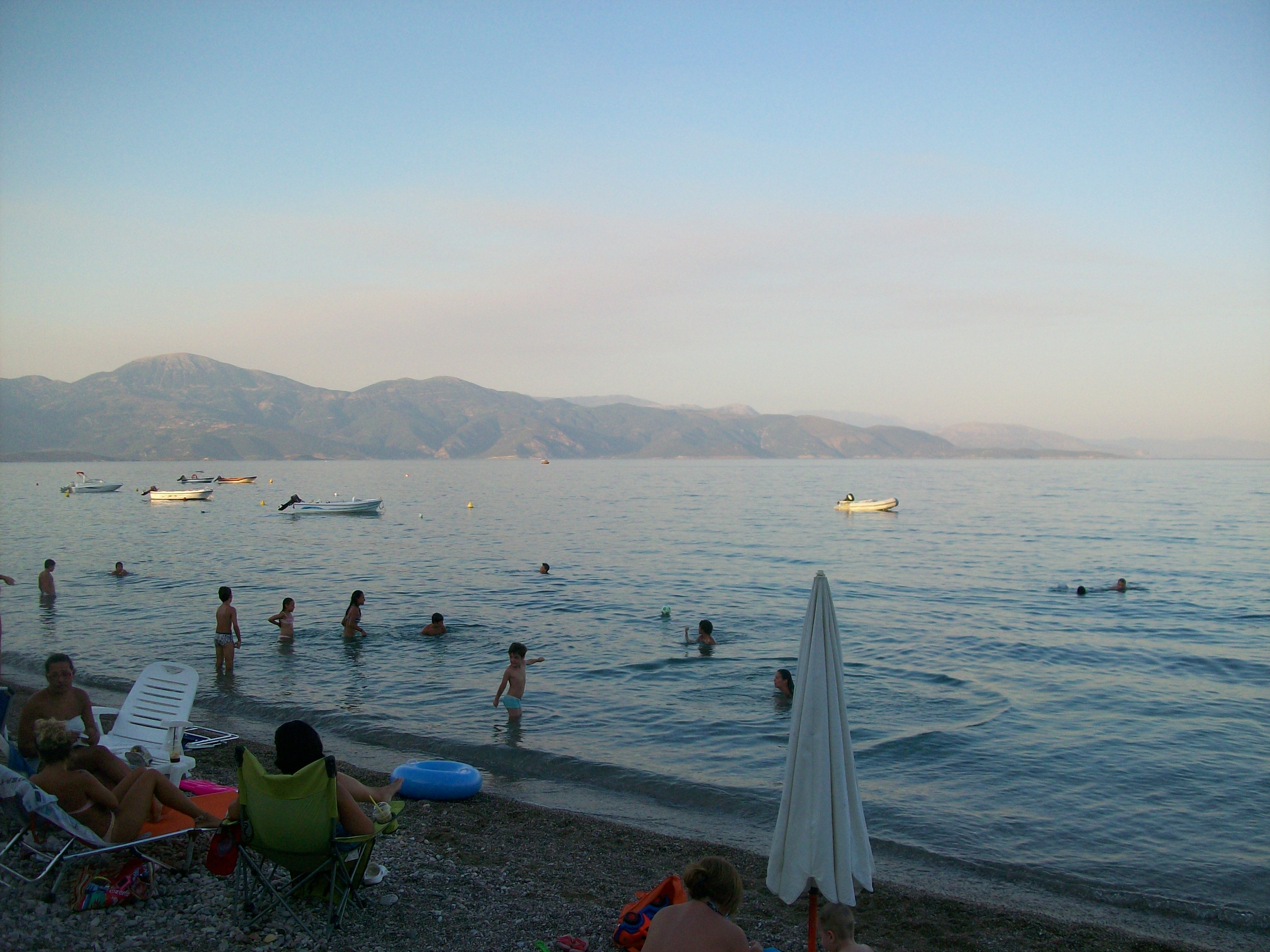
The beach at Selianítika.

But what are the implications, then, for the tourist and would-be conversational Attic speaker? Well, as in so many other parts of elite academic life, it means cognitive dissonance. It takes exactly the same state of mind to walk past the Big Issue-seller on the way to the Bodleian as it does to settle, amidst economic crisis and large-scale unemployment, into a routine of climbing mountains in blazing 100-degree sun to view the ruins at the top, wandering through archaeological museums looking at Mycenaean pot-shard after Mycenaean pot-shard, and spending fourteen days in a fruit garden surrounded by a ragtag international collection of philhellenes, would-be opera singers, and the odd innocent holiday-maker, among whom (aside from we hapless English speakers) the lingua franca seemed to be German, with modern Greek, Italian, and even Latin thrown in. Just so have generations of young academics before me wound up their grand tours by traipsing round some ruins in the Peloponnese. Just so have centuries of Oxford reading parties blundered headlong into some rural area on the Continent in order to get to grips with Plato and Homer. Just so have they been met with strange Germans and Germanophiles intent on enthusiastic amateur cultural and artistic pursuits as combined with swimming and calisthenics. Just so have ancient adventures, philosophical quandaries, and the mysteries of the attraction of the relative pronoun come to seem more vivid and palpable than the daily lives of locals who pop up every once in a while to provide some essential service, speaking a modern language the philhellenes find impossible to understand. It isn’t pretty, and it’s certainly got the weight of cultural-imperialist history to it.
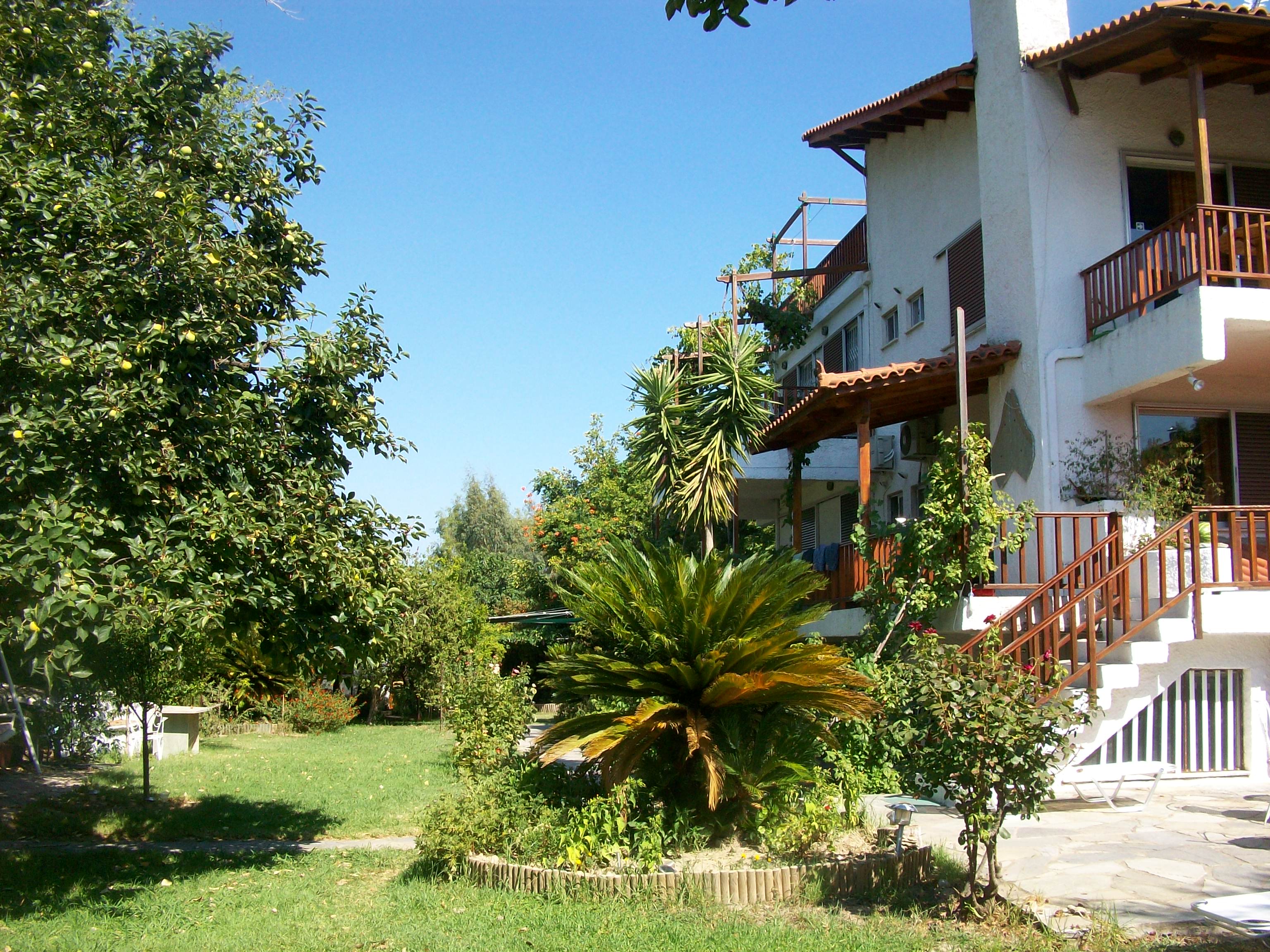
The Hellenikon Idyllion, home of spoken Attic.

For that matter, everywhere I went in Greece, I found myself wading waist-deep through my own palimpsest. I thought of Schliemann and Byron, of course, revisited Cavafy, and read Symonds’ travel narrative about Athens. Atop the Acropolis, I thought of Freud’s “Disturbance of Memory” there in 1904; when a sudden downpour at Epidaurus sent my travelling companions and me running headlong for the archaeological museum, and we stood in sopping-wet silence in its main hall, dripping on the tile floor and looking at the remains of shrines to Aesclepius, I made a less-predictable connection (though perhaps one no less redolent with a sense of the uncanny!) to the eerie shots of Woody Allen and Diane Keaton in the planetarium in Manhattan. Greece does funny things to the spirit. Some of them are wonderful: in the sculpture gallery in the Acropolis Museum, the conviction pierced me like a thunderbolt that it is utterly wrong for the British Museum to keep hold of the Elgin Marbles when they so obviously demand to be seen here, in their proper context—something that it is quite impossible to appreciate when you’ve only seen the ghostly parade make its way across the wall of the gallery in London. At the top of the hill at Delphi, looking down at the lean white columns half-restored out of the ruin of the Temple of Apollo, standing starkly erect against the backdrop of the lush green valley below, I could easily see why, when, in an apocryphal (albeit plausible) story related by one of our teachers, the great classicist Kenneth Dover beheld that same view, he felt himself moved to the point of literal orgasm. But at the same time, I can’t say that I was surprised that my struggles with reading and speaking ancient Greek left me exhausted in body, mind, and spirit, as easily overwhelmed by a variety of personal issues as by my efforts to keep up with Attic-immersion conversations about Plato’s concept of τέχνη. Disturbances of memory crowd upon one in a country where you can walk through the physical remnants of civilization from a thousand years before Homer; where recent history is fraught with all sorts of conflicts and questions of national identity that seem at once foreign and familiar, at once of a piece with the longer history and separate from it.
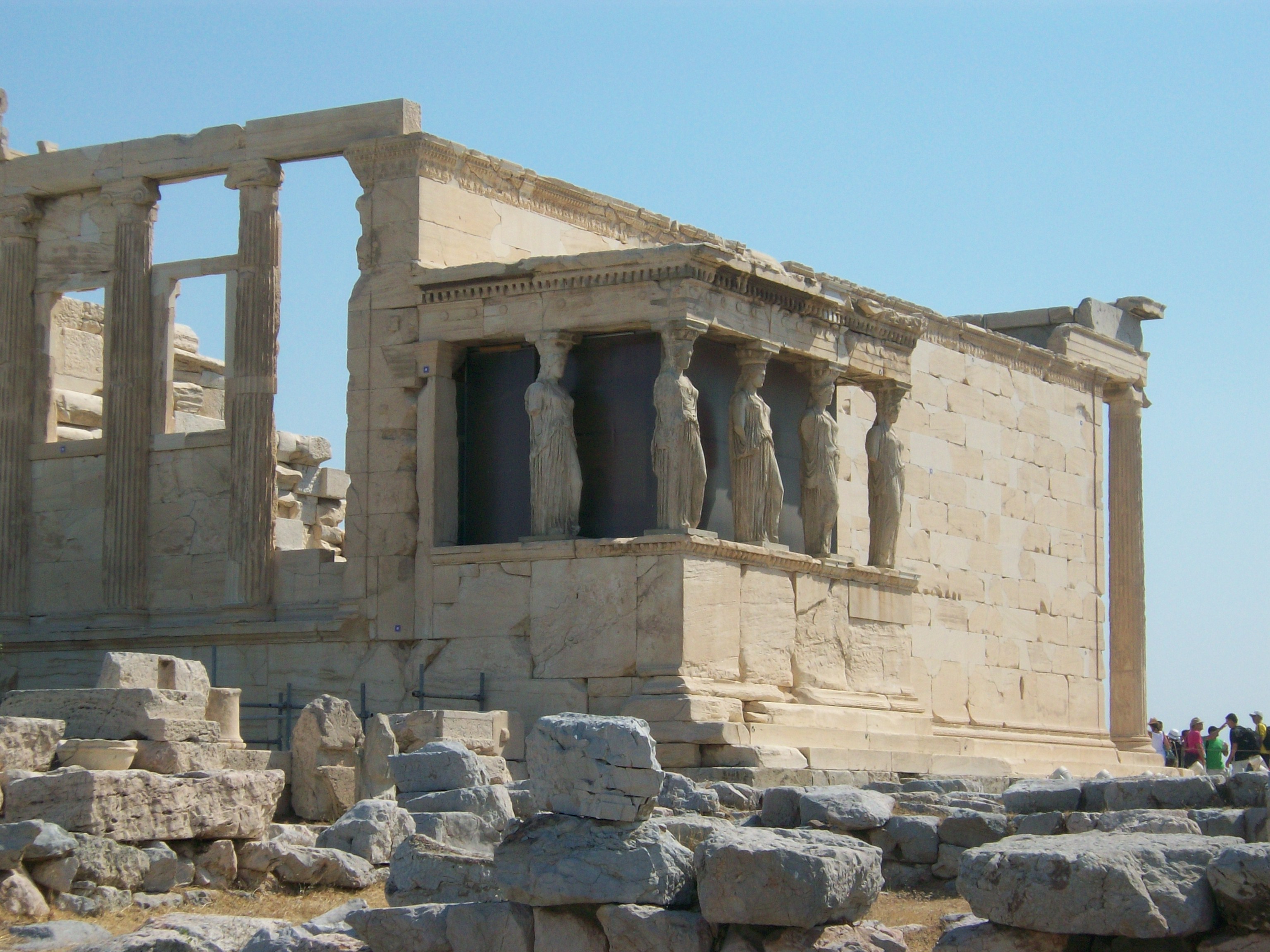
On the Acropolis.

So, on the one hand (μὲν), Greece was wonderful, utterly unlike anywhere I’ve ever been, a rich learning experience. But on the other hand (δὲ), I spent a lot of it sad and confused—which I remain now, despite being back in the mind-clearing, noise-free world of my usual close of summer in rural Canada. Being somewhere so puzzlingly unheimlich heightened the sense that this has been a very difficult, unheimlich summer, spent floating back and forth across the western hemisphere with no fixed address or institutional affiliation, no motivation to make academic progress, and no shortage of personal conflicts through which to struggle. The contrast with a year ago—coming to Canada to piece together six weeks spent in English archives and to start writing my first chapter, before I fell headlong into the whirlwind of thesis year—is stark. It leaves me wondering if this deadened feeling of writer’s block that has resulted in an unproductive summer is travelling’s fault, or growing-up-and-graduating-college’s fault, or my own. It leaves me wondering how real academics manage the tendency of summertime to leave one at loose ends, and the tendency of real life and its accumulation of small troubles to intercede upon one’s ability to sit down and write. It leaves me wondering if real academics ever see their work the way that novelists and poets and visual artists see theirs: something that can be done as much by being thoughtful and reflective about one’s life as by sitting at the computer and banging out words, something that takes time and quiet and country walks and human relationships for it to percolate, something that can act as its own form of therapy, helping the writer to understand all that is most unheimlich about other times, other places, and herself in relation to them.

The Temple of Apollo at Delphi.

I spend a lot of my academic life—one which, like many academic lives, observes no distinction between work and home, between the professional and the personal—thinking about how many other young women and men before me sat at desks scattered across the western hemisphere and weighed their life’s ambivalence in μὲν… δέ clauses, thereby managing to cope somehow with the (admittedly relatively softball) pitches life throws at them. Thus, on my last night in Greece, my program had a talent show of sorts, and I stood up in front of ragtag mix of American students and teachers, Greeks, and the odd German, and gave a performance at which I wasn’t particularly talented, but which meant the world to me. As I said to my audience, barely able to look them in the eye, I started wanting to learn what the classical tradition had to do with me, started realizing how deficient my education had been in this regard, and thus took up Greek, for a wide variety of reasons academic and personal. But all of them could be summed up synecdochically (there’s a nice Greek word!) by my desire to understand what has since become my favorite passage in the Greek corpus, Phaedrus 251-252. Almost eighteen months since I bought my first Greek textbook from the Turl Street Oxfam shop in the Easter vacation and one of the various Indo-European philologists who suddenly and coincidentally appeared in my life taught me to notice “Ο ΠΑΙΣ ΚΑΛΟΣ” (“the beautiful boy”) inscribed on the red-figure vases in the Ashmolean, almost a year since the start of the most intense nine months in two decades’ worth of schooling, I read my passage aloud to thirty or so philhellenes, in Greek and in my own English translation—and I could claim to understand every word of it, in heart and in mind.
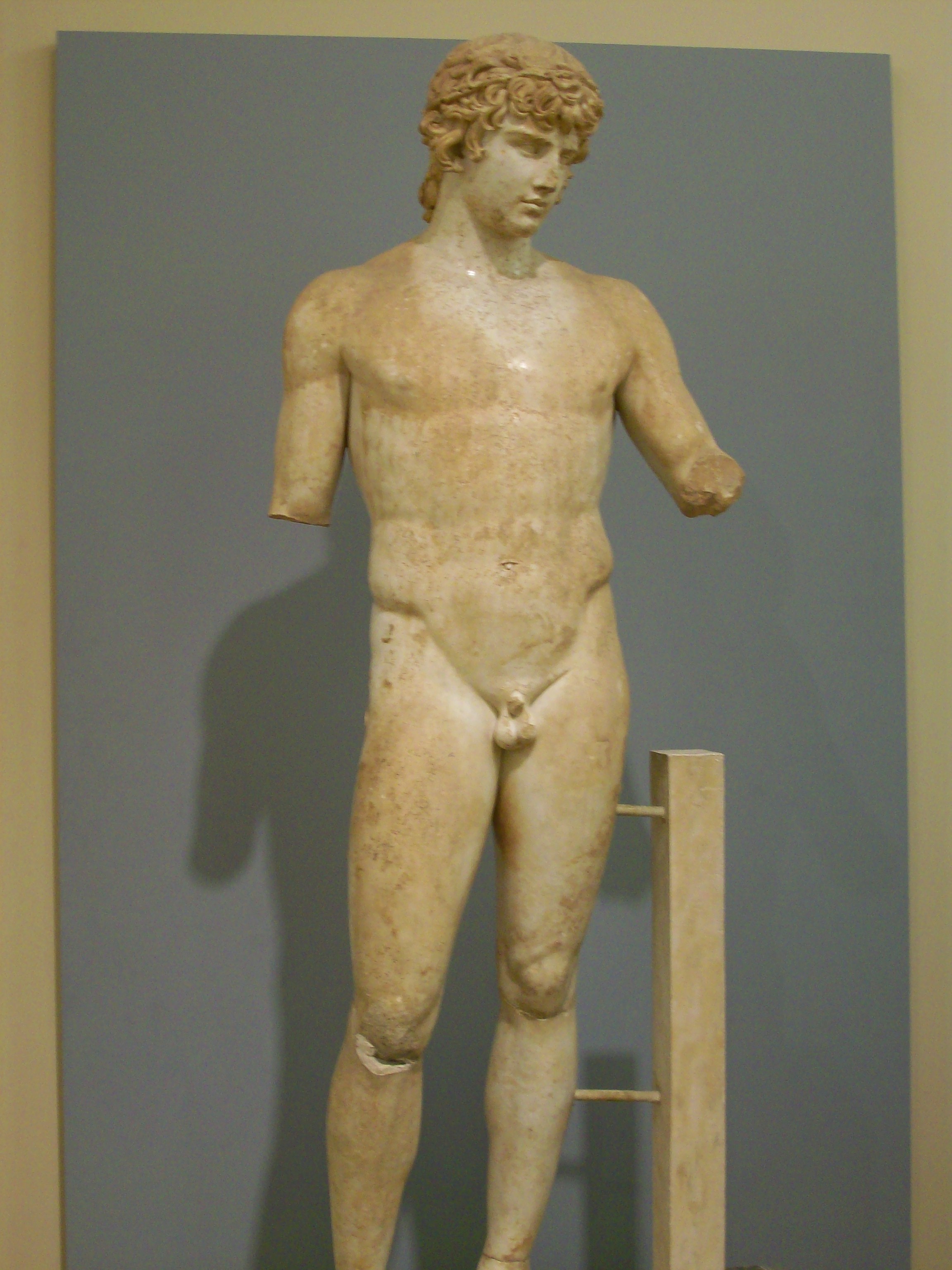
Statue of Antinous, one of the most famous τῶν παιδῶν κάλων, in the Delphi Archaeological Museum.

I append the relevant passage below. It’s a fitting note on which to close this summer, and one which, as I look out on the sun-dappled Pacific Ocean (to which no poet, so far as I know, has ascribed the darkness of wine), doesn’t make me feel so bad. Not so shabby for eighteen months of Greek. Not so shabby for twenty-two-and-a-half years of life.

Rosy-fingered dawn over the wine-dark sea at Selianítika.

ὁ δὲ ἀρτιτελής, ὁ τῶν τότε πολυθεάμων, ὅταν θεοειδὲς πρόσωπον ἴδῃ κάλλος εὖ μεμιμημένον ἤ τινα σώματος ἰδέαν, πρῶτον μὲν ἔφριξε καί τι τῶν τότε ὑπῆλθεν αὐτὸν δειμάτων, εἶτα προσορῶν ὡς θεὸν σέβεται, καὶ εἰ μὴ ἐδεδίει τὴν τῆς σφόδρα μανίας δόξαν, θύοι ἂν ὡς ἀγάλματι καὶ θεῷ τοῖς παιδικοῖς. ἰδόντα δ᾽ αὐτὸν οἷον ἐκ τῆς φρίκης μεταβολή τε καὶ ἱδρὼς καὶ θερμότης ἀήθης λαμβάνει: δεξάμενος γὰρ τοῦ κάλλους τὴν ἀπορροὴν διὰ τῶν ὀμμάτων ἐθερμάνθη ᾗ ἡ τοῦ πτεροῦ φύσις ἄρδεται, θερμανθέντος δὲ ἐτάκη τὰ περὶ τὴν ἔκφυσιν, ἃ πάλαι ὑπὸ σκληρότητος συμμεμυκότα εἶργε μὴ βλαστάνειν, ἐπιρρυείσης δὲ τῆς τροφῆς ᾤδησέ τε καὶ ὥρμησε φύεσθαι ἀπὸ τῆς ῥίζης ὁ τοῦ πτεροῦ καυλὸς ὑπὸ πᾶν τὸ τῆς ψυχῆς εἶδος: πᾶσα γὰρ ἦν τὸ πάλαι πτερωτή. ζεῖ οὖν ἐν τούτῳ ὅλη καὶ ἀνακηκίει, καὶ ὅπερ τὸ τῶν ὀδοντοφυούντων πάθος περὶ τοὺς ὀδόντας γίγνεται ὅταν ἄρτι φύωσιν, κνῆσίς τε καὶ ἀγανάκτησις περὶ τὰ οὖλα, ταὐτὸν δὴ πέπονθεν ἡ τοῦ πτεροφυεῖν ἀρχομένου ψυχή: ζεῖ τε καὶ ἀγανακτεῖ καὶ γαργαλίζεται φύουσα τὰ πτερά. ὅταν μὲν οὖν βλέπουσα πρὸς τὸ τοῦ παιδὸς κάλλος, ἐκεῖθεν μέρη ἐπιόντα καὶ ῥέοντ᾽—ἃ δὴ διὰ ταῦτα ἵμερος καλεῖται—δεχομένη τὸν ἵμερον ἄρδηταί τε καὶ θερμαίνηται, λωφᾷ τε τῆς ὀδύνης καὶ γέγηθεν: ὅταν δὲ χωρὶς γένηται καὶ αὐχμήσῃ, τὰ τῶν διεξόδων στόματα ᾗ τὸ πτερὸν ὁρμᾷ, συναυαινόμενα μύσαντα ἀποκλῄει τὴν βλάστην τοῦ πτεροῦ, ἡ δ᾽ ἐντὸς μετὰ τοῦ ἱμέρου ἀποκεκλῃμένη, πηδῶσα οἷον τὰ σφύζοντα, τῇ διεξόδῳ ἐγχρίει ἑκάστη τῇ καθ᾽ αὑτήν, ὥστε πᾶσα κεντουμένη κύκλῳ ἡ ψυχὴ οἰστρᾷ καὶ ὀδυνᾶται, μνήμην δ᾽ αὖ ἔχουσα τοῦ καλοῦ γέγηθεν. ἐκ δὲ ἀμφοτέρων μεμειγμένων ἀδημονεῖ τε τῇ ἀτοπίᾳ τοῦ πάθους καὶ ἀποροῦσα λυττᾷ, καὶ ἐμμανὴς οὖσα οὔτε νυκτὸς δύναται καθεύδειν οὔτε μεθ᾽ ἡμέραν οὗ ἂν ᾖ μένειν, θεῖ δὲ ποθοῦσα ὅπου ἂν οἴηται ὄψεσθαι τὸν ἔχοντα τὸ κάλλος: ἰδοῦσα δὲ καὶ ἐποχετευσαμένη ἵμερον ἔλυσε μὲν τὰ τότε συμπεφραγμένα, ἀναπνοὴν δὲ λαβοῦσα κέντρων τε καὶ ὠδίνων ἔληξεν, ἡδονὴν δ᾽ αὖ ταύτην γλυκυτάτην ἐν τῷ παρόντι καρποῦται. ὅθεν δὴ ἑκοῦσα εἶναι οὐκ ἀπολείπεται, οὐδέ τινα τοῦ καλοῦ περὶ πλείονος ποιεῖται, ἀλλὰ μητέρων τε καὶ ἀδελφῶν καὶ ἑταίρων πάντων λέλησται, καὶ οὐσίας δι᾽ ἀμέλειαν ἀπολλυμένης παρ᾽ οὐδὲν τίθεται, νομίμων δὲ καὶ εὐσχημόνων, οἷς πρὸ τοῦ ἐκαλλωπίζετο, πάντων καταφρονήσασα δουλεύειν ἑτοίμη καὶ κοιμᾶσθαι ὅπου ἂν ἐᾷ τις ἐγγυτάτω τοῦ πόθου: πρὸς γὰρ τῷ σέβεσθαι τὸν τὸ κάλλος ἔχοντα ἰατρὸν ηὕρηκε μόνον τῶν μεγίστων πόνων. τοῦτο δὲ τὸ πάθος…, πρὸς ὃν δή μοι ὁ λόγος, ἄνθρωποι… ἔρωτα ὀνομάζουσιν….

But the newly-initiated man, who has then seen much, whenever he sees a godlike face or bodily form that represents Beauty well, first thrills at the sight, and then some awe overcomes him. Beholding his beloved, he reveres him like a god. If he did not fear a reputation for excessive madness, he would sacrifice to his young beloved [παιδικοῖς], so as to worship him. And, seeing his beloved, he is so changed from the thrill that he is possessed by sweat and unwanted heat: for, when he accepts the flow of beauty into his eyes, it moistens the roots of the feathers; growing warm, these roots, which once had been closed through their hardness and prevented from growing, are melted. Having nourishment poured upon them, they become swollen and begin to bear forth from their roots the stems of feathers across the entire form of the soul, for all of it was feathered long ago. Then the whole soul seethes and throbs, just as, when growing teeth, one suffers pain around the gums. Just like this scratching and irritation in the gums, is the pain that the soul has when it begins to grow feathers: it seethes and throbs and tickles, as it produces them. Then when the soul regards a beautiful youth [παιδὸς κάλλος] and the thrilling feeling comes upon it, it receives this nourishing yearning. As it does so it is watered and warmed, ceases from its pain and is filled with joy. Yet when it is separated [from the beloved], the soul becomes dry and unkempt, dehydrating and closing up the buds of the feathers; and inside, having been shut up with the yearning, the feathers spring and throb, each one pricking the passage accorded it, so that the soul, having been stung all round, is caused to ache—until, once more recalling the memory of the beautiful one, it rejoices. And, out of the mixture of these two things, it is perplexed by the strangeness of its feeling and springs up in anger; and, driven insane, it can neither sleep at night nor remain anywhere by day, but, in longing, runs whenever it thinks to see the beloved; seeing him, the soul is bathed in the waters of yearning. The obstructed passages are let free, the soul has respite from its stings and relief from its pains, and this brings forth the sweetest pleasure there is. Indeed, such a man is incapable of being left alone by he who remains more beautiful than all others, but forgets his parents and siblings and all his friends, and neglects his property, caring nothing for its destruction, nor for the customs and manners in which he took pride before. Disdaining everything, he is prepared to be a slave to the one whom he desires, and to sleep anywhere it is permitted so as to be as close as possible to him: for he is in awe of the one who possesses beauty, and finds him the only healer of his greatest troubles. And people call this suffering about which I am speaking Love.

QOTD (2012-08-03); or, Postscript

With thanks to Tony Grafton and his comment on my last post for the reference, here is Natalie Zemon Davis concluding her ACLS Haskins Lecture in 1997:

The study of the past has been a constant joy, a privileged realm of intellectual eros. The necessary constraints under which the historian operates—to find evidence for every affirmation—I have accepted freely: that quest is what makes it so much fun. The mistakes I made—say, a project not finished (or as I like to say to myself, still remaining to be done)—seem trivial compared to really important mistakes, as those we might have made in parenting. Moreover, the study of the past provides rewards for moral sensibility and tools for critical understanding. No matter how evil the times, no matter how immense the cruelty, some elements of opposition or kindness and goodness emerge. No matter how bleak and constrained the situation, some forms of improvisation and coping take place. No matter what happens, people go on telling stories about it and bequeath them to the future. No matter how static and despairing the present looks, the past reminds us that change can occur. At least things can be different. The past is an unending source of interest, and can even be a source for hope.

I like this theory of history a lot. It doesn’t mean you necessarily think things are better than they were in the past, or that they inevitably will become so. But it can give you the hope that they might, the will to make them so, and the inspiration to teach—because however and in whatever venue it happens, that’s the only way anything really gets better.

First-World Problems; or, in Which Our Heroine Strives to Find a New Outlook on Her Middle-Class Liberal Guilt

Greetings from Granville, Basse-Normandie, on whose cliffs I have been climbing and on whose plages I have been promenading for the past three days, really and truly en vacances. I felt left behind and increasingly culture-shocked in my last weeks in Paris, as the city emptied out and the real Parisians were replaced by tourists. It turns out they’ve all (or, at least some representative sample of them) wound up here, in a little town by the seaside, full not of tourists but of holiday-makers. The distinction is a fine but an important one: there are loads of little historical and cultural tidbits here, but no Mona Lisa or Notre Dame, nothing anyone’s heard of. No one is gawking at anything; there are no crowds; occasionally someone takes a picture of the view or a particularly photogenic omelette, but there’s no strobe effect of flashes. French and British tourists, with the occasional German, Netherlander, or Scandinavian thrown in, wander up and down cobblestone streets, lie out on the beach (except for during the predictable afternoon or evening downpour, at which point they all calmly seek shelter under overhangs until it passes), and eat galettes and crêpes, which seem to be the local staple. I haven’t heard a single American accent since I’ve been here—not even, since almost none of the locals speak English, while they do speak French slowly enough to be comprehensible, my own. I’m staying in a crumbling Victorian railway hotel, across the road from the station, very few of whose fixtures seem to have been updated since the original introduction of indoor plumbing. But due to a fortunate failure of the toilet in my original budget single room, I’ve been moved to a spacious ground-floor double with ensuite bath and garden view, and I’ve been splitting my time this blissful week between people-watching on the beach and sitting at the desk in my room (though in my room all I seem to do is write emails; it seems that it’s only over leisurely lunches that I’ve been able to make progress on my academic work). Really, I’m having a wonderful time, and I could see coming to a place like this every summer to rest and recuperate, just like those who, the city museum today informed me, came here 150 years ago to take the supposedly health-giving waters.

In addition to noticing the absence of American accents in Granville, I’ve noticed the absence of posh accents. Granted, I can’t tell the difference in French, but because of its proximity a lot of British tourists come here on their holidays, and all of them sound so very normal. The tone was set on the train from Paris, when I sat opposite two older English ladies—one with a working class southern accent, one with a Yorkshire accent, who I gathered both now lived in London—who spent the entire three-hour journey exchanging gossip about the marriages and deaths and shop closures in their community, and who, when I dropped my iPod under the seat, kindly tapped my shoulder and informed me in halting, half-remembered school French. All summer, I’ve been feeling guilty that I have the freedom to spend most of it abroad. Even though I’m for the most part paying my own way, even though so many young people who finish university take the time to see a little bit of the world before starting the next stage of their lives, I felt, in Paris, as if every time I met a new person and she or he asked me what I was doing there and I struggled to find a good reason that I was spending the month there, I reeked of unconscionable privilege. It’s a relief to come to the seaside and find hundreds of other people whose national cultures allow them to come to the seaside every year. It reminds me how shocked I was when I was last in Britain and I first learned that “Where are you going on your holidays this year?” was an appropriate small-talk conversation to ask of people like hairdressers or shop owners. I’d never assume that someone in that position in the US would have the opportunity to take holiday time, and it’s good to know that, for all its faults, Europe isn’t quite so class-stratified as the US.

That said, I’m still really struggling to understand my class position, especially as my departure date for Oxford inches ever closer. The last time I was in Oxford, the part of my mind that’s always whispering, “You horrible, selfish person! How can you conscience studying history in university when there are starving children in Africa? How can you conscience having nice things, being comfortable, using the electricity and the running water? How can you not be devoting every second of your life to helping those less fortunate?” started to quiet down. And I worked hard and played hard, I learned so much (about history, about myself) and had so much fun, and I laughingly called myself a champagne socialist and really meant it, because I went to garden parties and drank champagne and bitched about the Tories. And now I’m going back, and I wonder if it’s going to happen again. I fell in love with Oxford the first time, well and truly in love, and it felt so liberating to take joy in my daily work and not to hate myself. But I also stopped being an activist, stopped being committed first and foremost to raging against the machine, grew disturbingly to accept my place amongst the privileged few, and started ever more frequently to rationalize my intention to stay there: “We need hearts and minds as well as bodies, and universities are there to help the former to flourish. We need teachers who will inculcate that sense of commitment to making the world better that young people need to do the work in the trenches. Guarding the world’s knowledge is a good in itself. College communities are utopias and we need them as a visible alternative to the capitalist consensus. My happiness matters; I have as much of a right to it as anyone else to love myself and what I do.” But none of it really seems to explain why, instead of getting a job this summer, I took off for Europe; none of it seems to explain why I’m spending my money on omelettes instead of giving it to the homeless; none of it seems to explain why I deserve to make a living studying dead white men while there are other people even in my own countries who can’t afford to eat at all. I may be really excited to go back to Oxford, to start a new academic project, to live in the city that changed my life. But that doesn’t make it okay.

In the past couple weeks, the conversation about such justifications that I had with a friend on the banks of the Seine has haunted me, and in the past few days, a long discussion on my Facebook wall about the custom of “subfusc,” or academic dress, at Oxford has spiralled into a stormy argument about privilege, class inequality, and exclusion. And suddenly I once more feel guilty that I’ve been so excited to move up to a graduate’s, instead of a commoner’s, academic gown. Because just like carbon offsets don’t actually stop global warming, donating your spare income or volunteering your spare time to charity doesn’t erase the fact that you have money in the bank, a fancy scholarship letting you study a “useless” subject, all the free wine any student could possibly want, and a life generally full of material and spiritual comfort. And it’s not like I do a lot of that donating/volunteering anyway.

There are a few reasons to believe that I’m not a morally awful human being. For I do believe we’d all of us be much poorer as a civilization if there were no one among us to study and to teach the humanities. And I do believe that we all have a fundamental right to the pursuit of happiness, and that there is a place for it at the table of human interests alongside our obligation to the greater good. I believe that we can’t do the greatest good of which we are each individually capable unless we each love what we do so much that we can’t help but infect others with our joy in it; and I know that those who devote every waking hour of their day to helping others very often, unless they’re made of superhuman stuff, don’t last long, in body or in spirit, at doing it (see: the Teach for America model).

This still doesn’t help me to fall asleep easily at night; nor, unfortunately, does it give me the motivation I need, if I’m not going to be utilitarian about my life, at least to put everything I have into my academic work. These two articles are not getting written; my next thesis is not getting begun. I guess what I’m saying is that I need help: at finding a way to live a socially responsible life that keeps me inspired enough to stay motivated, despite the fact that being “inspired” about what one does is a privilege that only the most fortunate have; at finding a way to have faith that academia really can be a socially responsible vocation, even and especially when it doesn’t mean giving basic education to the most underprivileged populations; and maybe trying to find other possible life choices that make me feel as if I have a reason to keep living just as much as the life of the mind, while doing more to actually lead a good and socially useful life.

But on the other hand (isn’t there always another hand?) as I free-associate from guilt to guilt now, another thought occurs to me. One thing I’ve learned in my work is that supposed social responsibility often has its dark side, especially in historical hindsight. It’s only when we look at Victorian social reformers with fresh eyes that we can see both the transformative effects of their particular brand of progressive reformist Protestantism upon those living in urban slums in England or America, and their unintentionally devastating effects as missionaries in countries far from their own. Indeed, as any bright-eyed Ivy League grad who’s gone into development work post-graduation could probably tell you (and many have told me), it’s awfully tricky to know how you, as a rich white American, can help those of the world’s communities that are in the greatest need, or even to know how you might begin to judge which communities are. There’s an argument to be made, after all, that instilling the very wealthiest Westerners with a little kindness and human feeling might have a profoundly socially good effect in countries where the gap between rich and poor is greater and the opportunity for social mobility more limited than it has been in a very long time.

Last night, I watched Lena Dunham’s film Tiny Furniture, and unexpectedly felt a lot of sympathy for her character’s plaintive cries that, a few months post-college, she’s still “figuring it out.” Dunham’s character seems to do that in extraordinarily different ways to the ones I’ve chosen, but her desperate pleas for just a little more time really do seem like a generational thing. There is so very much wrong in the world that every problem is an urgent problem, and even people like me have cuts to humanities departments right and left to worry about. Yet I sometimes feel as if all that 22-year-old college graduates can think about is how overwhelmed they are by how unfinished they are, how ill-prepared they feel to take on the world’s problems and make their own, how wronged they feel by the adults in their lives for leaving them such a mess that they have nowhere near the right real-world skills to clean up. It’s certainly true of my friends and myself, some of whom have landed in long-term career paths but most of whom haven’t, and who a few months or a few years out of college are still having the same late-night conversations about how to spend our lives in ways that are both good and give us pleasure.

Well, in our fallen world, I don’t see a lot of people or institutions offering to help young adults figure these questions out. But I do see one, ready with its texts canonical and very much not, with its ethical questions, with its mental gymnastics, with its reserves of moral support practiced at dealing with young adults’ “quarter-life crises.” It’s the university, folks, where so many crippling ethical dilemmas are born, worked through, and hopefully made peace—but not too much peace—with. In a way, it’s a dirty job, trying to prod entitled well-to-do American kids into developing a social conscience and a sense of humanity. But someone’s got to do it, I think—otherwise the bankers keep screwing us all over, the generals keep waging war, the Lena Dunhams of this world keep making dubious choices in men instead of taking charge of their lives, and none of us is cultivating any garden at all—least of all our own.

QOTD (2012-07-21)

Some excerpts from Horace Mann’s remarks upon his inauguration as president of Antioch College in 1853:

Sir, the work of education, always paramount to all others, sometimes assumes a super-added importance. Its appropriate object is youth, and its appropriate duty is to imbue them with the saving predestinations of wisdom and love. Education addresses itself specifically to the young, because the young are always ductile and mouldable; while, under our present methods of human culture, the hearts of men fossilize with a rapidity and a flintiness that have no parallel in natural petrifications.

This Western country is increasing in its wealth beyond all precedent in ancient or modern times. It has a annual lake trade of three hundred millions of dollars, and a river trade of four hundred millions, beside its immense traffic upon the Gulf; yet all this, when compared with its undeveloped resources, is only the pocket-money of a school-boy. But without the refining influences of education, wealth grows coarse in its manners, beast-like in its pleasures, vulgar and wicked in its ambitions. Without the liberalizing and uplifting power of education, wealth grows overweening in its vanity, cruel in its pride, and contemptible in its ignorance…. If a poor country needs education, because that is its only resource for changing sterility into exuberance, a rich country needs it none the less, because it is the only thing which can chasten the proud passions of man into humility, or make any other gift of God a blessing.

… such is the diffusive nature of human action that no limits can be affixed to the influences which the humblest institution, or the humblest individual, may exert. Some influences act more directly upon one department of human interests and some upon another. It is the high function of a College to act more or less upon all human interests and relations.

I completely failed to find online the text of Mann’s 1859 Baccalaureate address, in which appears his famous exhortation, “Be ashamed to die until you have won some victory for humanity” (if you have a source, let me know!), but the above paragraphs have been helping me over the course of the past week to rebuild from scratch the ethical principles by which I live and the reasons for which I justify pursuing the life path I do. It’s essential routine maintenance, but boy is it exhausting and emotionally draining—and I wonder if it’s really keeping me from just getting on with things and doing the work I spend so much time wondering whether I should be doing.

Baby-Stepping Towards Adulthood

Just now, I received an email that began, “‎Dear Ms. Rutherford, This is to inform you that preparation for your Confirmation of Acceptance for Studies (CAS) number at the University of Oxford has begun.” As preliminary–and silly–as “preparation for your Confirmation of Acceptance” sounds, this is the important document standing between me and my student visa application, for which I’ve been eagerly waiting. But the silly tentativeness with which the very helpful woman in the History Faculty office framed this email also speaks volumes about where it seems as if my life is right now. Over the past few weeks, my mind has accommodated itself to the notion that I graduated from college, a place that I’m now speaking about in the past tense. I’ve had some distance from the people and the place that has helped me to be able to figure out what I think about it, overall; coming back to my thesis after months away, I’m starting to recover from my burnout and be able to do academic work again; and I’m also just doing a lot of thinking on my own. I’m reading for pleasure, I’m walking, I’m looking at art and listening to music, I’m talking to friends and family, and most importantly I’m trying to figure out what I want out of life, and what a good life entails. Just as the History Faculty are preparing my CAS, it seems, so am I preparing to formulate a set of principles and goals and hierarchy of needs that will help me decide whether the adult life I want to live is both a personally enriching and a socially valuable one–and, if it’s not, how I can try harder to make it so. And, well, I guess that if there’s anything more impenetrable than immigration bureaucracy, “What is the good life?” is it. It’s worth a little thought.

I write now from Paris, where I’m spending the month of July rather on a series of whims and coincidences. I’ve not been doing very much to further the pursuit of my short-term academic goals: I’m still not quite up to the level I need to be at to benefit from the ancient Greek class I’m taking in August; the academic article I’m trying to write is in the earliest planning stages; my subscription to the Bibliothèque Nationale Française has gone largely unused. Instead, in the city of the flâneur, I think I’ve been benefiting from being a little less goal-oriented. Some days I sit and read and write at home, but on others I walk halfway across the city in alleged pursuit of some English-language bookshop or better-than-average cafe, but really just to walk, and to have the time to myself to think about what I’m doing here. There are a lot of reasons that brought me to Paris, but all of them are personal, and as ever, the balance between what is good for me and what is good for society is very difficult to strike.

This year, I consciously tried to take some time away from agonizing about whether what I’m doing with my life is socially beneficial (and then doing it anyway) in order just to focus on doing what I’m doing with my life in the best possible way. Then, and perhaps accordingly, this year was a bit of an emotional rollercoaster. Between writing a thesis, leaving the first place I ever lived as my own person, and learning what love is, I was rather preoccupied with dealing with huge personal emotions, some of them for the first time. Going back to read my thesis in preparation for the article I’m writing has been quite painful: as I revisit every sentence, I can remember exactly how I was feeling when I wrote it, and whether it was a joyous or a melancholy day down at my desk in the library basement. I can see all the conversations I had with my advisor reflected in its pages, and wince especially at the parts where I can only now see what he meant, why he was right, or why there were some points that I could have fleshed out in more detail or with more substantive evidence. In this thesis, also, are all the pieces of my world that over the past year came to mean the most to me about acknowledging and acting in accordance with my own desires for connection and comradeship. When I read the story I told of Symonds’ journey through Plato, through Oxford, through faith and science, through passionate positivist pursuit of the truth, through personal relationships, and when I see how I brought in outside, related writers and thinkers like Freud and Forster, I remember how Oxford, the Anglican tradition, the Phaedrus, psychoanalysis, Howards End, and the people with whom I became friends over the past couple years all helped me to feel as if I was discovering for the first time something extraordinary about what it means to be human, and as if living well and living joyously are important for their own sake, not merely ancillary to living a purposeful and socially useful life.

Well, it’s been a long and difficult several months since the last time Oxford sponsored me for a student visa, and the novelty value of the world’s beauty has soured just a little. There are upsides to this: I started to think, again, about the social value of my life goals, and realized that while I can ethically justify becoming a university teacher and living a life that is fully invested in intellectual community for its own sake, I can’t justify according to my own idiosyncratic code of ethics being a freelance researcher/writer who isn’t committed first and foremost to some kind of communitarian enterprise. (This isn’t a prescriptivist position—it’s a calculus based on how I think I can best use my unique talents to make myself and others better. Others, with a different distribution of skills, wants, and needs, may reach different conclusions.) And I realized, just a little more recently, that while part of being committed to the public good is taking public stances for unpopular positions when you believe that you’re in the right, doing so doesn’t do much social good if in trying to explain your position others, you end up alienating them, or making them believe that you’re purely self-interested instead of trying to put your own house in order before trying to move outside of it.

Last night, a friend who was in town for the weekend walked with me up and down the Seine for hours, and he quizzed me on my moral principles, trying to prod me into defending my intuitions about what is a sufficiently good way to live, and leading me to talk in circles about whether any life path that doesn’t focus on solving world hunger is justifiable. It was a very undergraduate kind of conversation, like many such conversations I’ve had before in my dorm room or around my co-op’s kitchen table—the kinds of conversations you can have when it doesn’t matter whether you need to wake up early in the morning sharp enough to put in a productive day at your job. Because, you see, I think one of the things that we do in the modern western world when we become adults is that we start thinking about putting food on our own tables, on living lives that make us more materially comfortable (because the older you get, the harder it gets to sleep on an air mattress or see the world while staying in youth hostels), on seeking out the people who will make us feel less alone and will help us to share the burden of leading stressful, busy lives. I’d argue that that’s one of the many reasons why university is a good, and why our society needs people who will devote their lives to ensuring that it continues to be a good: that three- or four-year haven from the world is where we get the chance to stay up late talking about ethics and morals, and where high-minded ambitions of solving world hunger—or instilling love for the humanities in a new set of young people—are born.

But my friend is a better arguer than I am—I’m not a very good one, especially when I have a quick and forceful interlocutor and don’t get to take thousands of words to spin out my thoughts—and, besides, thinking that the university is a good doesn’t insulate professional academics from the various calls of pragmatism, seductive materialism and security, and marketized politico-economic logic. I’m as guilty as the next academic of wanting things that give me pleasure: a high-ceilinged and big-windowed apartment in a pleasant place to live, a prestigious job with good students who are easy and fun to teach, my name on the cover of a well-reviewed book, maybe pets or even a family, leisure time in which to really appreciate them, the ability to keep visiting new places and meeting new people. And I know as well as the next humanist with slight Marxist tendencies that while the downside of the capitalist consensus is that it enslaves us to things and alienates us from people, it can in the here and now get food on tables that haven’t got any in a way that all the utopianism in the world can’t—and that teaching the British history survey isn’t exactly helping to bring about the revolution either.

In short, my conversation last night, from which I’m still reeling, ended with a big “I don’t know.” I felt embarrassed that I couldn’t satisfy my friend with the rationality of the life choices that I’ve thus far made, but I also feel that as I’m lucky enough to have more time before pragmatism really sets in, I might as well take it. I have at least two more years before I have to settle, and I have a lot more to learn about myself and what, therefore, is the social good that I am actually capable of doing. And so, as I sit in Paris and read over my BA thesis, I become ever more certain that my next thesis is going to be more centrally about love, about what it is that draws us to other people, about the things about the world that we intuit and can rationally explain the least of all. I’m curious to know, in Victorian Britain, what sex had to do with love, and why; I’m curious to know how what students read in schools shaped their ideas about love in and outside the classroom; I’m curious to know what sexual science, coeducation, shifting socioeconomic structures and population distributions, the changing social role of religion, and many other exciting developments of the nineteenth century, have to do not only with how people had sex with each other but with how they cared for each other. And, because when we do projects like this, we can’t deny that we’re studying ourselves first and foremost, I hope also to learn what love has to do both with desire and with social responsibility in my own life, and what the hell a sentimental education is good for, anyway.

At the end of the next two years, will I be able to start a PhD with an easy conscience? Probably not. Will I have become mired in even more navel-gazing whirlpools? Probably. And will I have spent two more years pacing up and down wallowing in the luxury of being able to think about what I’d like to do with my life, and sitting up till all hours discussing it with members of my intellectual community? Undoubtedly.

As academics say when they give papers at works-in-progress talks: “I’m still early in my thinking about this.” It’s one of my favorite pieces of academic jargon, and I am profoundly grateful that there still exist enough people with power, money, and prestige who will take a bet on a young historian’s moral waffling turning into something properly good.

Small World; or, Bettering in the Neoliberal Age

Today was the first day I was properly happy with my post-graduation life. This morning I used the Wonders of Modern Technology to talk on the phone with a friend fifteen time zones away; from only eight time zones away, I got a delightful unexpected email from another friend I know in quite another context. Then my parents and I drove at 75 miles an hour across the California desert-scape to campus, where I spent much of the afternoon sitting at a table outside under the cloudless sky, wearing sunglasses and linen trousers and attempting to do some editorial work on a project I love dearly for which I’m even (gasp!) being paid.

At one point, I took a break to wander into the campus bookstore, where I failed to find a copy of A Passage to India but did, in an unforeseen coincidence, run into a new paperback edition of David Lodge’s trilogy of campus novels, Changing Places, Small World, and Nice Work. I’ve been thinking about David Lodge’s books a lot recently, because as my parents and I talk academic politics at the dinner table, and as I myself flit between continents and universities, it seems as if very little has changed since the 1970s, with the exception of one extremely important plot point. The Rummidges of this world are still being pushed into bizarre Thatcherite partnerships with business, Anglo-American academics still find excuses to pursue exciting conference travel, people still get laid at the MLA, and the entire subculture still takes on a sort of darkly comic tone. But the great public university system that once enabled Morris Zapp’s life of glamor and ease is now crumbling (in fact, literally, as I saw from one building I passed through today), and it’s definitely not a paradise for anyone in the humanities or even the human sciences now. The sunshine and occasional ocean views obscure scarce and badly-apportioned resources, a real mess that can’t quite be turned to comic ends.

But, perversely, it was my anger about the UC situation today (and, indeed, the present state of affairs at UVA) that afforded me at least some measure of self-acceptance. For as I sat garnering a sunburn amidst what was once part of the United States’ great testament to what public money could do, I posted links about UVA to Facebook, and I felt sufficiently fuelled to fire off angry emails about much smaller-time political wranglings at Princeton—still so well-to-do and so insulated, but not always absolved of the need for a few strongly-worded missives. And as I was doing this, a letter came in from my dear advisor, who is always an apt person to be recalled to mind when one wishes to remember what kinds of teaching, learning, and preservation are at stake in the battles for the heart and soul of the university. A report from overseas, from the Small World of academic life, that letter reminded me (as if I needed reminding) what good is done to the greater world by our small one, and why it is so morally, spiritually, emotionally worth paying quite learned people to study what they love and to pass it on to young people who need most in the world to come into contact with that guiding spirit of love.

The pedagogic eros: it works in mysterious ways, and in more wholesome and heart-stirring and profound ways than any use of the term “pedagogic eros” would usually care to admit. It connects friends across the world, and scholars to their work and to their students amidst a wide range of working conditions. It breathes connection—to people and places, texts and ideas—into the air of anywhere that honors Wisdom, and it has the power—if not cruelly debased by the rule of the market—to turn even the humblest concrete campus into its own city of dreaming spires. It can help us to bear with each other, to lighten the load of the accumulation of small daily troubles, to ease the anxiety of wondering whether the “terrible disease of loneliness” will ever be cured. Since at least the days of Plato—that is, in the story of the days of Plato that we tell—it has taught us to sublimate, sublimate, sublimate, but also that there are more erotes, and more ways to connect, than a paradigm in which all is sublimation might lead us to think.

Which is all to say that if my undergraduate days are over, the battle for the soul of the university is not, and my ability to play a part in that battle is only beginning. Though it may be tempting to mourn lost youth, and indeed rather difficult not to, it is only through some modicum of self-acceptance and perhaps even self-love that we can purpose ourselves to the higher causes of loving the others and the great moral principles for which we live. And so look for me on the barricades—we shall not be moved!

References:
David Lodge, Collected Works
Jeff Nunokawa, Collected Notes

Going Back, Moving On; or, In Which a Bachelor’s Degree Is Conferred

The first thing I noticed on Thursday, when I woke up in my childhood bedroom for the first time in two years, is how quiet everything is. There’s not much wildlife, no people walking past outside, no churchbells or sirens. It seems as if there’s only one ambient noise at a time. Every once in a while, a single car will drive past, or a single child will shout, or a single lawn mower will rev its engine, but then everything lapses into silence again. “Culture shock” is the only way to describe how I’m coping with returning to the place where I lived for nine years: it’s been a long time since I spent my days under the capacious, cloudless blue dome of the southern California sky, drove 80 miles an hour down the freeway, sat on a sun-drenched concrete terrace at the UCSD student center and slurped at a bowl of Japanese noodles, or even taken an elevator seven floors up instead of walked three floors down to find some books to read under Library of Congress catalogue number PR. It’s nice to see my family, nice to be on vacation, nice to have good weather. But cleaning out the piles of paper that pack my childhood bedroom hurts—to have to go back in time again, to high school, as if the past four years hadn’t happened—and as always when I go west, I feel profoundly and suddenly cut off from the close relationships one forms when one lives on a college campus and eats meals with the same people every day. And this time, it’s not just for the summer—it’s for good.

For the last few weeks before I left Princeton, I told my friends I was feeling remarkably “zen” about the end. Unlike in previous years, when I’d been stressed and depressed about going away, and irrationally afraid that I would lose touch with the people about whom I care, this year I felt primed to deal with impermanence. I was sick of Princeton, for one thing, and ready for a break; for another, I knew that at the end of June I would be diving into a European adventure with some of my closest friends; for a third, Oxford in September is a known quantity, full of its own wonderful people and new academic horizons. To be sure, it hurt a bit to pack up the co-op’s pots and pans; I felt at loose ends as people slowly started to trickle away. But in the last few days, I calmly said my goodbyes. I gave hugs. I made sure to track everyone down. I saw old friends who came back to town for alumni reunions, and felt as if not much had changed in my relationships with them. My family came to town, helped me to finish packing my life into boxes, and cheered me resolutely through three days of awards presentations and academic processionals. By day I donned academic regalia and sat and stood through solemn ceremonies; by night I sat on the floor in empty dorm rooms or went out and danced; I spent the weekend a bit buzzed on too much sparkling wine and forgot to hurt—that is, until the very end.

On Tuesday morning at 10:30am, 2,067 degree candidates processed onto the front lawn of Princeton’s campus, and despite the ludicrousness of the situation, despite the incongruity of a wind ensemble from Philadelphia playing the classics of the British festival band repertoire, I cried. I cried when it became clear that, after weeks of worrying, the weather was going to miraculously hold off to make it through the ceremony; I cried when the University president pronounced, “Auctoritate mihi a curatoribus Universitatis Princetoniensis commissa, vos ad gradum primum in artibus et cum honoribus, ut indicatum est, admitto”; and I cried at her Commencement address—one of the better defenses of a liberal arts education I’ve heard of late, and it’s my business to keep an eye out for defenses of a liberal arts education. It concluded, in part, thusly:

What I am saying is that to be successful in the 21st century, just as in the 18th century, a society requires citizens who are steeped in history, literature, languages, culture, and scientific and technological ideas from ancient times to the present day. They need to be curious about the world, broadly well-informed, independent of mind, and able to understand and sympathize with what Woodrow Wilson referred to as “the other.” Our colleges and universities need scholars who have dedicated themselves to the life of the mind, to preserving the wisdom of the ages, to generating new knowledge and a deeper understanding of the past, and to passing that knowledge and understanding on to the next generation.

Here, President Tilghman points to something I’ve been thinking about a lot recently: the two senses of time that operate simultaneously in any modern university, but particularly a university like Princeton that relies for its continued success upon strong and lasting alumni relationships. There are the beneficiaries of liberal arts educations who use them as stepping-stones to other things: to lives of public service or to wealth accrual or both; to starting businesses or starting wars; to making peace or making families; to inventing new technologies and curing cancer. In the crass terms of Annual Giving, getting those people back to Reunions every year through the appeal of orange-and-black debauchery keeps investment (at the bottom line, of the financial sort) flowing into the university’s twin projects of teaching and research. In my own terms, skeptical of market logic and the rule of capital, there are many ways more than money to do good in the world, and when done right a liberal arts education can instill young people with a sense of civic responsibility they can impart in some way to their chosen life path, always remembering that the universities that set them on that path continue to require their ideological, if not their financial support. At any rate, this is one side of university time: a series of comings and goings seen from the individual perspective, in which the student graduates and then moves on, a little wiser and richer, save only—in the case of somewhere like Princeton—returning once in a while to renew the connection. In this sense of time, university is something that happens between the ages of 18 and 22, and then there’s “real life.”

But there’s another sense of university time, and it’s the one Tilghman comes to at the very end of the paragraph I quoted. Each of us who goes to university only graduates once. But every year, those whose lives are spent in having new ideas and preserving the world’s old ones pass them on to the young people who move fleetingly through their lives. (As Andrew Delbanco writes in his recent book about College, “One of the peculiarities of the teaching life is that every year the teacher gets older while the students stay the same age.”) Every year, a professor at a place like Princeton says hello to dozens of new students and goodbye to dozens more, not to mention salutations and valedictories to colleagues and staff members and their families whose careers take them from campus to campus. For those who stay behind, I imagine, June is full of saying goodbye to people you will in all likelihood never see again, as well as to people you in all likelihood will—you just don’t know on what campus, in what country, in what year, in what guise. And I suspect, furthermore, that the observers of each sense of university time don’t fully understand the other’s sense: to the faculty and staff, alumni’s eagerness to parodically relive their college days must seem ludicrous; too rarely, on the other hand, do alumni stop to think about the full weight of what the faculty and staff do to keep an institution of higher learning operational and emotionally alive. But to observants of neither sense do the precise codes that sense prescribes for saying goodbye make saying goodbye any easier to bear.

I’m expostulating all this half-baked theory because I’m beginning to think that some of the reason a sense of severance and loneliness crept up on me when I made it out west to my parents’ home is that I don’t quite know into which category I belong. For years, I have made periods of loneliness, at Princeton or away, easier to bear by reminding myself that the university is my home and it will always be there for me. There is no leap into the unknown, no discontinuity; I’ll be returning in September to friends, mentors, and colleagues I know and to projects with which I’m familiar. I trust in the knowledge that academia is a small world, and that people from one’s previous postings have an uncanny habit of popping up when one least expects it (especially in Oxford). I’m also in the privileged position of being able to travel to see friends who are staying in the US, and/or who haven’t chosen academic paths—the only hurdle is the leap of faith it takes paranoid, shy me to trust that when I send an email out into the void, my friends miss me as much as I miss them, and will answer. Heretofore, for the most part, they’ve tended to.

And yet. On Tuesday night at 2am, diploma in hand and packing all but done, I sat down on the window seat in my empty room with one of my closest friends and we solemnly marked it as the end of an era. We’d got to know each other this year, quite by a series of chances, and a friendship flowered of the type that the novels tell me flowers when you study, read and write, eat and drink, laugh and play together, when you are young and your heart is open to connecting with others. We’ll see each other this summer. We’ll see each other next year. We’ll call and write. But we said goodbye so poignantly because we knew that, with me leaving Princeton, it wouldn’t be quite the same. That romantic openness of undergraduate days—when you can take a class in any discipline and you never know what new ideas will be stirred within you—that allowed this friendship to flourish isn’t going to come round again. When I return to the city of dreaming spires—the place where I first knew what love was, a lightness of spirit I brought back to Princeton for this final year—things will be a little more circumscribed by my professional aspirations, by the slow shift from student into scholar, from one sense of time to another. (As an aside, given that time is a river, and given that one of the last things that I did as an undergraduate was go mess about in a rowboat, I wonder what is to be made of the fact that Jerome K. Jerome’s three men, striped blazers and guitar and dog and all, spend 150-odd pages struggling resolutely upstream.)

There are still so many unanswered questions, still so many places I haven’t been and so many languages I don’t know, still so many ways my heart might yet grow larger and my soul wiser. But out here on the other side of the world (or so it seems), it is near-overwhelming to look at the walls of this old bedroom and think how much has happened inside me since I first put these posters up. And it hurts so much to think that everything that happened is now past, and that—as any Victorian or Edwardian worth their salt could have told you—youth fades, and then we have to get on as best we can with finding another sense of time, one that’s as much focused on doing good in the world as it is on our own self-development.

Princeton commencement

References:
Bloom, “Eros,” in The Closing of the American Mind, 132-137
Davies, The Rebel Angels, 65, 187, 257
Collini, What Are Universities For?
Delbanco, College: What It Was, Is, and Should Be, 9
Nabokov, “The University Poem
Forster, The Longest Journey

QOTD (2012-06-09)

From Adam Phillips, “Promises, Promises,” in his essay collection of the same name:

If we talk about promises now, as I think we should when we talk about psychoanalysis and literature, then we are talking about hopes and wishes, about what we are wanting from our relationship with these two objects in the cultural field. It is a question of relationships, but perhaps it also points to the drawback of making ‘relationships’ the primary category. I think we should make our primary category something like moral aims, or preferred worlds, what Stanley Cavell refers to… after Emerson, as ‘moral perfectionism’, which he defines as ‘some idea of being true to oneself’, but which ‘happily consents to democracy’. Our description of our relationships—which entails our description of what it is not to have one, what a good one is, and so on—depends on our moral aims, on the kind of selves and worlds we are consciously and unconsciously committed to fashioning. There can be no democracy without the notion of relationship as somehow central, but the idea of being true to oneself may involve redescribing the idea of relationship so radically that it may sometimes be barely recognizable…. Democracy thrives by valuing rival and complementary interpretation. It is not equally clear what being true to oneself thrives by, or whether it could ever be subject to generalization or, indeed, formulation. Our relationship to ourselves must be inextricable from our relationship with others; but in what sense does one have a ‘relationship’ with oneself, or with a book, or with its author, or with a tradition? In other words, is there sufficient resemblance between these objects to make ‘relationship’ the right, or rather the illuminating, word?

What we actually do—or find ourselves doing—in the presence of a book or an analyst could not be more different, from one point of view. The implication of Literature and Psychoanalysis is that we must be using them for distinguishably different things. But how we use them depends on what I am calling here our ‘moral aims’, our conscious and unconscious moral projects about whose very consequences we can have so little knowledge. What or who we seek to be influenced by—to be changed by—depends on the kinds of selves (and worlds) we want to make and the kinds of culture in which we happen to live.

I have a sense that Phillips here is making a rather Forsterian point, and I think a line of Forster’s speaks to some of his rhetorical questions: “The only books that influence us are those for which we are ready, and which have gone a little farther down our particular path than we have yet got ourselves.”

I first read that line right at the beginning of this academic year, just before I discovered Forster proper and started on this year’s emotional, intellectual, and ethical course, defined by personal relationships, books, and—yes—psychoanalysis. It seems, too, a fitting way to end—and today, after much writer’s block, I started finally to find the words to talk about what it means to end one era, and to allow another to begin. Here comes summer, and with it a lot of processing.

Shameless Self-Promotion; or, Baby’s First Conference

On Friday, I will be attending my first real academic conference—and giving my first talk—ever! It’s at the Ohio State University this Friday and Saturday, and it’s called Queer Places, Practices, and Lives: A Symposium in Honor of Samuel Steward. Samuel Steward was a fascinating person and an OSU grad, who was at the center of gay identity formation in mid-20th-century America in a way analogous to how Symonds was at the center of homosexual/Uranian identity formation in 1870s-90s Britain. The conference features a bevy of panels and plenaries on all sorts of aspects of queer identity construction in history and in the present, in addition to attendant methodological questions about discovering and preserving queer histories.

I’ll be speaking at 9am on Friday on a very cool panel that will be taking a variety of disciplinary perspectives to queer masculinities. I’ll be talking about Symonds’ life and work in relation to methodological issues that arise at the intersection of the history of sexuality/queerness and intellectual (and other forms of) history, and I hope that it’s going to be a lively conversation. Should you, dear reader, by any chance happen to be in the area, I’d love to see you there!

Finishing undergrad is a strange, special, and difficult time, about which I hope I’ll have the energy and the inspiration to write in the couple weeks (!) between now and graduation. But until then, it’s time to sit my last exam, and then fly to Ohio.

Reflections on the End of an Undergraduate Career

I read so much, in my scholarly life, about young people whose minds were broadened and whose lives were changed and whose souls took wings when they spent three or four years within quads and cloisters. It is strange to think that my time as an undergraduate is nearly at a close, and conceptually difficult to wrap my head round as well: after all, my career in quads and cloisters is far from over, yet this special time of golden youth that the poets elegize won’t come round again, and I can’t help wondering if I’ve made the best use of it. I go up and down, day by day: today the weather is beautiful and the leaves are spreading out over the great trees that ring the quad, and I am sitting on my window seat and feeling grateful. My father is visiting me today, and I’ve been able to introduce him to many friends and mentors (and give him a bound copy of my thesis) and feel proud of how many connections I’ve made, how much good work I’ve done, these past few years. Other days maybe the weather isn’t so nice, and I struggle to be the best friend and the best scholar and the most open-hearted person I can be, and I sink into dark moods and wonder whether it was all worth it. But today, happily, I feel rather balanced, rather at peace, sad to put my life in boxes again in a few weeks, but ready nevertheless, excited to travel in continental Europe this summer and then to move to Britain come autumn.

The University sent we seniors a long and detailed survey about our lives these past four years, and told us that we can’t collect our caps and gowns and other graduation accoutrements unless we complete it. I also heard a rumor that our responses are actually read, so I took some time and some honesty with the final, free-response questions. I wanted to share some excerpts, because I want to illustrate how it’s possible to leave this rather strange place a little bit bitter but still profoundly grateful—how possible it is to be extremely ambivalent about Princeton and to value it while simultaneously being skeptical about some of its most visible aspects. When that column about Annual Giving that I wrote for the Daily Princetonian attracted so much vitriol a couple months back, I was disappointed to see how little space there is here for a discourse of nuance and complexity surrounding students’ and alumni’s relationships to their alma mater. When I wrote my comments on this survey, I wanted to give balance and ambivalence another go:

I have not necessarily found it easy, over the past four years, to find a “home” at Princeton. Too often, in my experience, the attempts to artificially inculcate community through university or residential-college team spirit, and the overwhelming attitude of orange-and-black exceptionalism that dogs eating-club culture, overshadow what is truly remarkable about forming connections and community with other people here. I have flourished through close friendships and mentoring relationships with faculty and grad students, and found a few close friends my own age. I feel at home here when I’m sitting on a university policy committee, talking to faculty at a reception after an academic talk, in a meeting with my thesis advisor, or lingering after dinner at my co-op, talking about ideas or just complaining about my day. But all this community has come at the expense of a powerful sense of exclusion from “mainstream” Princeton. It has been years since I attended a major undergraduate event like Lawnparties; I don’t feel as if I belong at even the undergraduate events that attempt to be most inclusive, like this fall’s Orange and Black Ball. Princeton has given me the opportunity to achieve academically beyond my wildest dreams, but I have a lingering sense of regret that I haven’t been able to have a normal undergraduate experience because I feel like such a cultural misfit.

Yet, over the past four years, I have grown from a child into an adult, and from a student into a scholar. Thanks to intellectual and moral support from my academic mentors, I began to see myself as someone capable of carrying out large-scale research and of making innovative intellectual discoveries, and then I actually did that, writing an original and smart senior thesis into which I poured my soul and my intellect and of which I’m extremely proud. Princeton helped me logistically to write that thesis: through preparation from my writing seminar to my departmental independent work; through extremely good academic advising (my thesis advisor is truly a gentleman and a scholar); through financial support that enabled me to do copious research overseas and (in a few weeks) to present my research at a conference alongside senior faculty; through the provision of a life-changing opportunity to study abroad at the same university that my research subject attended. But as important to the process were the books I’ve read in my classes and in my spare time, the conversations I’ve had, and the interpersonal connections I’ve made that have helped me to bring a truly humane element to my scholarship. In all honesty, I’ve spent more of my time here frustrated that the opportunities for those conversations and connections aren’t thicker on the ground than I have spent inspired by the ones that have materialized. Yet I’ve learned that this is a place where academic drive and ambition make all kinds of remarkable conversations and connections possible. If it weren’t for them, I wouldn’t be able to grow out of Princeton and out of being an undergraduate, and I wouldn’t feel emotionally and intellectually capable of moving to another country and beginning graduate school next year.

On another note, I’m a member of the 2 Dickinson St. Co-op, and I think it’s worth emphasizing to my reader how special that place is, and how unlike any other part of Princeton. It’s an organic community (the fruits and vegetables, literally!), in which each participant has a stake and commitment, and it’s a building in which one always feels at home. Our membership is the most diverse of any organization I’ve been involved in, from freshmen to post-docs and everyone between, including students who have taken time off or otherwise have a broader diversity of life experiences than your average, say, eating club. We cook tremendous food, we are moderate and mature social drinkers, we have talent shows and go on hikes, we sit outside in the hammocks on our porch and read for pleasure. Some of our members who aren’t in grad school already are grad-school-bound, but those who aren’t are equally intellectually curious, invested in their coursework and independent work and in the idea of a collegial academic community such as is extremely rare among undergraduates here.

This is all to say that I know that the administration are interested in learning how to build more close-knit and intellectually and socially stimulating communities here, and have struggled with how to encourage the ones that are healthy and discourage the ones that aren’t. 2D is a community that I think those who make decisions at this university often forget about–and while perhaps that’s one reason that we’ve flourished so organically and autonomously for decades (learning to manage our own efficient and successful financing and accounting system, for instance), it seems to me that the University may well want to take an interest in what we’re doing and how well we’re doing it. 2D and the other co-ops could be models for how to build communities elsewhere on campus that are truly student-driven, self-sustaining, and socially healthy.

And now I’m off to read and write, to socialize, to think and feel, to see if I can squeeze in any more soul-growing in these last few weeks—after all, golden youth doesn’t end until the fifth of June!