On Atheist Churchgoing; or, Why I Will Miss This Country

Almost three years ago today, give or take two or three weeks, I went to church for the second time in my life (the first was my grandmother’s funeral), to hear Philip Pullman preach. It was my first term in Oxford, and as the days got slightly longer I was just starting to love this place, and I went to hear Philip Pullman give the University Sermon at the University Church because I wanted to see what an atheist would say when given a literal pulpit. Because it was my first Sunday morning service, I hung on to every word of the liturgy with an intensity I can’t always muster anymore, and when Pullman talked about the common ground that atheists have with Anglicans, quoting Ruskin and Hopkins, I found my way in to the Church. I’ve been there ever since, nearly every week, in Princeton and in Oxford. I keep finding new ways of articulating that same common ground Pullman did: the history, the music, the prayers for peace and justice. One of the reasons I joined the choir at my college on my current posting to Oxford is so that I would have an excuse to go to chapel every week; and while when I first started attending college evensongs I used to visit New College and think that Symonds had praised the singing there, too, these days I think more broadly, all the time, about the generations of anonymous undergraduates who have sat in Corpus’s wooden choir stalls, and who likely have taken every possible theological position it is possible to take with respect to the Trinity and the established church—after all, mandatory daily chapel wasn’t abolished, I think, until after the War.

As I’ve sat in pews and choir stalls over these last few years, I’ve found that the liturgy has a very powerful effect: namely, that the more you repeat words week after week, year after year, the more you start to believe them. Not the extraterrestrial bits—for how does someone who was raised secularly conjure a Heaven and a Hell out of nothing?—but the attitude of prayer, of penitence and concentration and hopefulness; the practically-minded bits about loving one another; the sense of wonder at creation; and most importantly for me the cycle of the week, of the liturgical year, of the festivals and the story of Jesus’s life that is told every year from Advent to Pentecost (-ish), roughly following the academic calendar as well. This repetition keeps me rooted to a sense of a longue durée, and it’s the cyclical nature of it that always—every service—reminds me that people have been saying these same words since 1662, regardless of whether (unlike most of the congregations who make a great point of saying the same words that were said in 1662, or longer ago) they were high-born or had beautifully embroidered vestments or could say the words in Latin or knew what, exactly, the words signified. Because I imagine that for a great many people who attended services of the established church when doing so was prescribed by law, the words didn’t so much signify a particular theological position on the Trinity or transubstantiation (which if you listen closely to the C of E communion prayer, even in modern language, it definitely does!) as the right time to plant the crops and the times of year when the days would grow shorter or longer.

My mind wanders to such thoughts most weeks in Corpus chapel, but today our preacher particularly drew our attention to the modern Church’s origins in a long-ago time when different ways of life were practised. Today is Candlemas, a very Anglo-Saxon name for the Feast of the Presentation of Christ in the Temple, and an occasion which (or so I was reliably informed by an observant evangelical member of the congregation) is most definitely not observed by the more modern, forward-looking, urban evangelical congregations these days. Our preacher (who was excellent) focused her attention very closely upon the varied significances of this festival: the really religious bit, in which the lines from the Gospel of Luke embedded in the Anglican choral tradition as the Nunc Dimittis give an early indication of what a marvel the infant Christ will become; but also the ye-olde-Englande traditional bit, when Candlemas marked the time when farmers began to plant their crops; and the takeaway message for our lives, the bit with the common ground for the cynical unbelievers, the miraculous sense of wonder experienced by anyone who (as the old man Simeon does in the Gospel reading) holds an infant in his arms and marvels at the sheer extent of the possibility contained within that one tiny body.

As I have sat in chapels and churches week after week, I have often, I think reasonably, had cause to interrogate myself about what I’m doing there. How far have I come away from being the atheist whose main draw to church was Philip Pullman, and what do I mean when I recite with the congregation the words printed on my service leaflet? I have often stopped just short of wondering whether I should learn more about how to become a Christian, whether I should look for the dotted line on which to sign, so that I might feel like a bit less of a charlatan when I twist myself into layers upon layers of metaphor so that I can say the Apostles’ Creed without lying. What was wonderful about today’s sermon, though, and about the old feasts like Candlemas (similarly Ascension Day, or the last Sunday of Advent, or any other liturgical day connected to a folk tradition), is that they demonstrate how belief can lie less in metaphysics and more in a sense of connection to the past, to the earth, and to fellowship with other people in the present. The Church of England doesn’t bother much about heaven and hell, but it has always made me feel welcome, has never asked what I am doing there or why I haven’t gone and gotten baptised already, and always reminds me to marvel at creation, from the connections I pursue with other people to the Shetland ponies in the field opposite Iffley village church and the first daffodil shoots that today I saw poking up on the lawn outside my house. “Glory be to God for dappled things,” Pullman quoted Hopkins as saying, three years ago, and I still think atheists might listen to Christians if in nothing else at least in guidance for how to marvel at and cherish the natural world around us, where time is not linear and progressive but cyclical.

I am starting to hear from Ph.D. programs, and it is starting to dawn on me that this will be my last spring in Oxford probably for some time. I will be moving to a city next year, and while this spring will bring with it news of a new life, greater opportunities, new connections to form and hopefully new routes to happiness, I don’t think that spring is quite the same in concrete jungles, where you have to look much harder to find a daffodil or a newborn lamb, and where the Christianity (or at least this has been my sense) shares a little less common ground with the secular experience.
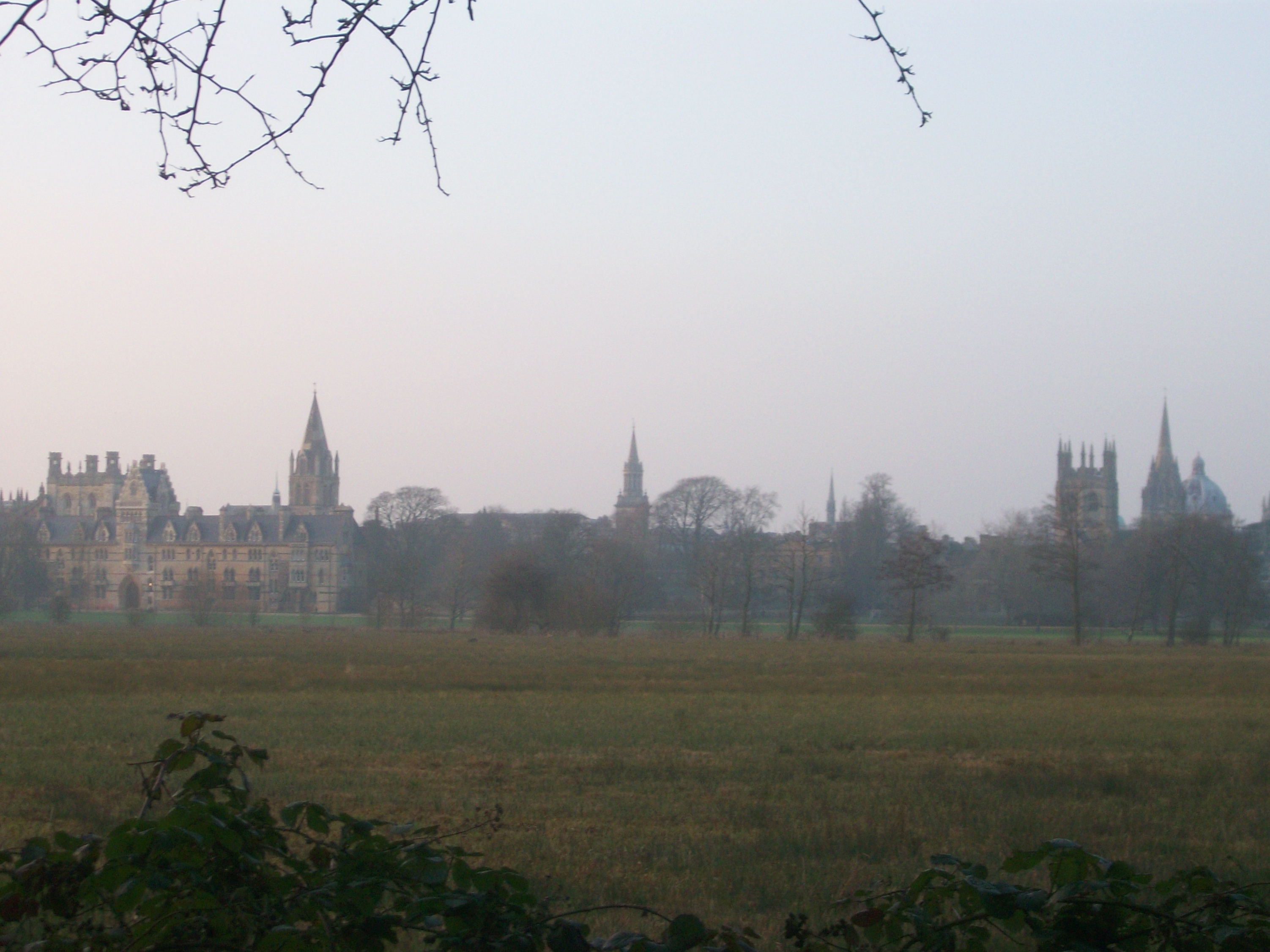
QOTD (2014-02-02)

Last term, a Christ Church undergraduate made student-paper headlines for bringing a homemade flamethrower to a college “bop” (party for all the undergrads in college). But we junior deans and equivalent officers who lie awake at night worrying that such things will happen on our watch should be relieved that matters are no longer as they were in the late-Victorian period, as described by M.C. Curthoys in the History of the University of Oxford, vol. 7:

One outward sign of the new seriousness was the exclusion of dogs, whose nocturnal howlings had occasionally disturbed the peace of the unreformed colleges; Warden Sewell carefully enforced the rules against them at New College in the early 1860s, while George Bradley made their removal an issue at University College. Supper parties, a long-standing target for moral reformers, were suppressed at Trinity during 1857 and 1858 by the dean, Frederick Meyrick, who detested their ‘noisy and ill-conducted’ proceedings, ‘gross language’, and ‘filthy songs’. Gatings and rustications were imposed on attenders at rowdy wine parties in the following decade….

As proctors during 1882-3, Scott Holland and A.L. Smith of Balliol conducted a purge against prostitution in the town, declaring their priority to be ‘protecting the Undergraduates from needless temptation by vigilantly attending to the public decency of the streets’. Their actions… were reinforced by the University branch of the Church of England Purity Association, founded in 1883, whose 800 members in 1887 included about 30 per cent of all undergraduates in residence…. Membership at Keble, where the association seems to have originated, was almost universal; Oriel and Worcester also provided substantial support. Sexual vice was thereafter a diminishing concern among disciplinary officers; entering a college after hours, though still an offence, ceased to be automatically associated with gross moral turpitude, and ‘climbing in’ over the college walls could become a relatively good-natured test of ingenuity. In other matters it proved more difficult for college deans to take concerted action. L.R. Farnell, Sub-Rector of Exeter from 1882, complained of their failure to agree a common policy towards college bonfires, undergraduate celebrations usually of sporting victories, which threatened to get out of hand in the mid-1880s. Some colleges treated them as occasions for licensed uproar, like bump suppers (previously disreputable occasions but which became sanctioned as official college events). These provided essential outlets for the violent energies of the young men confined within college walls. During the restoration of the Bodleian, when the Schools tower was covered in wooden scaffolding, rockets, bombs, and sparks from a vast bonfire blazing in the nearby front quadrangle of Hertford, in celebration of the college going head of the river in 1881, presented an alarming prospect. The conflagration, ‘fed with tables and chairs by a mad set of undergraduates who were chiefly occupied in dancing insanely about it’, had the permission of the Senior Proctor. A Harvard graduate visiting Queen’s witnessed Provost Magrath looking on benignly at a bonfire circled by undergraduates variously hanging from trees or bashing tin baths.

Spectacular breakdowns of control, widely reported in the press, showed that the establishment of a new order in the colleges was not uniformly smooth. Rapid expansion in student numbers during the 1860s placed additional strains on the colleges’ disciplinary resources. An early sign of trouble was the gating of the whole of Merton College following a bonfire in the college on 5 November 1865. All the undergraduates at Trinity were threatened with rustication in Hilary term 1867 after a succession of incidents, including the blocking up of a passageway with snow to prevent access to morning chapel and the cutting of the chapel bell-rope. The same sentence was threatened at University College in March 1868 after a fellow had been ‘screwed up’ (i.e. shut in his rooms by the insertion of screw into his outer oak door), and the rooms of an undergraduate vandalized, apparently in the wake of an unpopular decision of the governing body. At the end of November 1868, the governing body at New College actually carried out the sanction of mass rustication when the undergraduates reused to give up the names of those responsible for smashing an unpopular student’s windows. The culmination of this turbulent period was the Christ Church library riot…. Further outbreaks occurred at the end of the 1870s. Discipline broke down in Wadham after eights week in 1879 when the authorities prohibited the holding of a college concert. In the following summer Bradley rusticated the whole of University College after the undergraduates refused to incriminate those responsible for screwing up the oak of a tutor, who was also Senior Proctor; they were subsequently taken back when the culprit owned up.

The History of the University of Oxford

I was much struck, this rainy afternoon of Sunday of second week, by the text of the Vice-Chancellor’s annual Oration, published as a supplement to last week’s University Gazette. The Vice-Chancellor’s intimation that Oxford ought to be allowed to charge higher tuition has caused a lot of disconcerted muttering in common rooms in the last week, but he’s right that there is a large gap between the already outrageous-seeming £9,000 per student per year and the real cost of educating each student with the low teacher-student ratios, excellent library system, and other distinctively Oxonian features on which the University prides itself. He’s also right that tripling tuition does no one any good when that rise in income is more than undone by the loss of government funding for undergraduate education. I have been suspecting for years now that if Oxford and Cambridge hope to compete with the best American research universities, they need to become more like them in their approach to funding as well, both in terms of private donation (already well underway) and in terms of a massive rise in tuition and–I hope–a commensurate rise in financial aid for those who need it. I don’t know whether I trust the V-C’s politics (I mean, instead of throwing up his hands and saying “Well, so much for government funding; better look elsewhere”, he could be agitating for the renewal of that funding), but I do think he sees the present situation accurately. And hurrah for him pointing out that online courses are best suited for certain initiatives in the Department for Continuing Education, but perhaps not for everything the University does!

I love my university, and I love to study its history, in part because it serves as such an excellent case study in the workings of continuity and change. An institution that has for centuries sustained its own bizarre internal culture but also been inextricably and fundamentally linked to major world-historical events can tell us much about national and international politics, class and gender, and of course the history of ideas and of education. Present-day Oxford is telling in a way few institutions are in quite such a clear way about the ways in which the twenty-first century is rather like the nineteenth: I thought as much yesterday when, taking the minutes at an MCR meeting, I found myself adopting the phrases Sidgwick used when he took the minutes as Secretary for a number of University and college organizations; but it’s there too in the Vice-Chancellor’s reminder that the Department for Continuing Education is the modern-day descendant of the wonderful University Extension movement of the nineteenth century, which sought to make the university’s resources more accessible to members of the public who might not have the time, ability, money, level of preparation, or desire to complete a full degree course, and which first changed the idea of Oxford as the preserve of the moneyed elite so well-known to us from literary representations like Jude the Obscure. This institution tells us untold stories about an entire departed world and the kinds of relations between people and ideas that existed within it, which I see echoed all around me every day in the routines I follow and ceremonies I observe as a member of it.

Yet there is change too, and that change is in some respects farcical and in some worrying. The Gazette and the Oxford Magazine were once institutions, and I suspect I’m one of a very few these days who takes any great delight in sitting down in a common room or study and reading them; more troublingly, the editorial in the 0th week edition of the Oxford Magazine pointed out that, with the burgeoning of career administration and bureaucracy, Congregation (the so-called “parliament of dons”) is little more than ceremonial, its meetings ill-attended, existing only to wave through legislation already determined by a set of bureaucrats with no experience or even real stake in teaching or research. In this respect the “ancient universities” are very different now from how they were in the days long before their doors were opened to the Judes of this world, before government funding for undergraduate education—or, indeed, the very existence of research—was ever on the table. I’m certain that there must be a way for we university folk to have our cake and eat it too, that retaining some hold on government funding and the commitment to democratic access and an educated citizenry that comes with it does not necessarily entail red tape, efficiency experts, and the watering-down of all that is valuable here. I don’t know how to achieve that outcome any better than anyone else, but I suspect that the first step is to care: whether by supporting the lecturers’ strike on 31st October or by showing up or pressuring your nearest don to show up to a meeting of Congregation, or perhaps by taking a learned interest in the history of institutions such as this one—not from some quaint local-history, chronicling perspective, but from one that takes seriously the importance universities hold for the nation.

QOTD (2013-06-20); or, The Special Relationship, Antecedent

From Corpus Christi College’s Pelican Record, 9:1 (Dec 1907), p. 4:

It is probably generally known that Princeton University some time ago applied to the College for leave to have a copy made of the Corpus Pelican, to be erected in their own University buildings. The leave was given, the copy made and transported; the function has now been held, and the Pelican has been duly inaugurated in its new home. Our readers will be glad to know that on the day of the ceremony the President sent to Princeton the following telegram, the exact words of which he has kindly communicated to us. It ran as follows:–

‘Corpus Christi College, Oxford, sends greeting, and rejoices that Princeton University has erected a reproduction of Turnbull’s dial in its original form.’

The last words refer to the fact that the American dial stands, not on a square pedestal like ours, but on an octagonal base, such as is shown in the C.C.C. MS. by Hegge, who died in 1629. This earlier base was recently discovered beneath the square pedestal of the Corpus dial, the insertion having been made at a considerably later date.

The President has received the following letter from the President of Princeton University:–

Princeton University, Princeton, N.J.
November 1, 1907.
President’s Room.

My Dear Sir–
We had yesterday the pleasure of unveiling the beautiful reproduction of the Turnbull sun-dial which stands in the quadrangle of Corpus Christi College, presented to us by Sir William Mather. The Right Honourable James Bryce, the British Ambassador to the United States, made the address of presentation; the weather was brilliant and perfect; and all who were present wished me to convey to you the warm thanks of Princeton University for the courtesy shown by yourself and the Fellows of Corpus Christi in permitting this copy of the dial to be made and presented to us. It will always be for us a visible symbol of the connexion we already sensibly felt between our traditions and the traditions of Oxford. I hope that you may yourself some day visit Princeton and judge whether we have suitably placed the interesting column on our own grounds.

With much respect,
Sincerely yours,
Woodrow Wilson.

QOTD (2013-04-15); or, Oxoniana

Arthur Sidgwick, writing in Corpus Christi College’s newsletter, the Pelican Record, vol. ii no. 4 (June 1894):

THE JUMPING FROG.

It has been mentioned above that a curious question has arisen about this famous tale; and as I have been unwillingly mixed up in it, I have been asked to put down a plain statement of the matter as far as it has gone.

It appears that in 1865 Mark Twain heard this story from a Californian gold-miner who had witnessed the incident in 1849. How the tale was given by Mark to a paper—how the paper perished immediately afterwards—how fatal the Frog was to all who undertook to tell of it—Mark Twain sorrowfully informs us in the North American Review for last April. The story finally was translated into French; and that the Revue de Deux Mondes (in which it appeared) still continues to drag on a precarious existence, can only be accounted for (says M.T.) by the badness of the translation.

Anyhow, the story was included in Mark Twain’s works about twenty-five years ago; and when I was collecting simple tales for Greek prose exercises in the year 1876, I borrowed this tale, aong others, for the purpose. A Greek version of the same was printed in the ‘Teacher’s Key’ to the work.

Last year, however, a certain Professor Van Dyke, of Princeton, told M.T. that his story was not new, but was related by a Greek writer at least two thousand years ago: that he, Van Dyke, had seen both the original and a translation thereof, and offered to send him either. M.T. preferred the translation, because ‘Greek makes him tired.’ Accordingly he received from the Professor—a copy of the exercise in my Greek Prose Composition!

Hereupon M.T. writes his article for the North American Review, musing sadly on the hollowness of all earthly things, and especially on the impossibility of getting hold of a story which has not been told before. He sorrowfully compares the stories point by point, and gloomily admits that they are the same.

The English newspapers—it is the slack season at the end of the Easter Vac. [yes, it is—ER.]—follow suit, and most of them accept M.T.’s view, commenting (in the tone of weary anthropologists) on the oldness of everything. But the Daily Chronicle, in an amusing leader, suggests that the professor has been playing it very low down on his friend; and indicates the true character of the Greek original.

At that point it became my duty to intervene. I wrote to the D.C., confirming their divination about the Greek original, confessing my gross plagiarism, and protesting against the high antiquity attributed to me. When one is getting on in years, one grows testy about the question of age, and objects to being thought older than one is, even if it be only a trifling difference of 1946 years.

The points still to be cleared up may be put briefly in the form of questions, as follows:—
(a) Is the Professor a real person, or did M.T. invent him?
(b) If he is real,
1. Did he take M.T. in?
2. Was he himself deluded?
3. Did he and M.T. make up the jest together?
If (b 1) or (b 2) is the truth, the next move is M.T.’s.

Update: A Facebook correspondent has pointed out that there is a certain consonance between this and a riveting academic detective story in this week’s TLS, to which I commend my readers’ attention.

Microhistory? or, Steps Towards a Thesis Proposal

Dissent has published a review article about Harvard historian Jill Lepore and her recent collections of essays, which makes a rather heavy-handed case that Lepore should be identified as a microhistorian. This appellation leapt out at me: I have read “microhistories” in every methods or historiography class I’ve ever taken, been assigned over and again Carlo Ginzburg’s The Cheese and the Worms and asked to consider the relationship between Ginzburg’s mad miller Minocchio and his intellectual and cultural context, and Ginzburg’s success at articulating it. But I’ve also wound up with an idea of microhistory as something that’s over and done with, a quaint relic of the 1960s-’80s “history from below,” or maybe of the postmodernist transmogrification of everything into a text and a narrative, à la the work of Natalie Zemon Davis from that period. It has never occurred to me that a historian of a younger generation might be described as writing microhistory, and indeed it’s made me wonder if, by the criteria this piece lays out, I am a microhistorian. After all, I have, since I began writing history, been interested in “second-tier” figures in the modern intellectual classes, and I use those figures—as this piece characterizes Lepore’s work—as a lens through which to view contemporary trends in sensibility, sentiment, ideas, intellect, values, ways of engaging with the world. Symonds’ life, and the way in which he pieced together a theory of homosexuality from a disparate set of intellectual influences, are a window onto what sex and love meant to the Victorians. So, I am hoping, are the ways in which Arthur Sidgwick put into practice philosophical and political positions that he’d developed as a young man in his relatively quiet, unhistoric political life as a teacher, parent, and activist in local politics another window onto late-Victorian and Edwardian ideals of liberalism and social reform from that afforded by the ever-chic, ever-larger-than-life Bloomsbury.

But I’m not sure this is what makes something microhistory. To me a microhistory is primarily self-contained, and one of the radical things that it does is that it does not feel a need to make the case for its subject’s importance. Menocchio or Martin Guerre are intrinsically interesting people, not necessarily because they can be connected directly to trends in life and thought larger than themselves. They leave a lasting impression on our sense of the colorful tapestry that is early modern Europe, but I don’t think of them primarily as figures who help us to understand things larger than themselves—c.f. another example of microhistory cited by the Dissent piece, Darnton’s Great Cat Massacre. Ginzburg and Zemon Davis both demonstrate prodigious contextual knowledge about the times and places in which Menocchio and Martin Guerre lived, but they use it not to get from their subjects to something “bigger,” but rather to add more detail and color to the lives of their subjects—particularly, in Zemon Davis’s case, to establish what we know and can’t about the life of Martin Guerre.

By contrast, I am not drawn to—or, perhaps, I don’t have the prodigious skill it takes to pull off—projects that can maintain historical interest intrinsically. With Symonds, I felt driven to talk up his importance to the story of the development of male homosexuality as an identity; I got myself into countless tussles with a secondary literature that doesn’t regard him as quite so important as I do in order to firmly establish the necessity of taking on this project instead of any other. Maybe this was kind of a juvenile impulse, the desire of a student still trying to establish herself as a “real” historian and demonstrate that she knows what is an appropriate subject for research and what isn’t. But I find myself doing it again with Sidgwick. For the first half of the Easter vacation I despaired a bit about my putative master’s dissertation project, not sure whether—absent a pivotal academic discovery like Symonds’—I could make a case for why we should care about Sidgwick. (Nor, in fairness, am I sure that there’s enough in his diary to sustain intrinsic interest, in the way that there sometimes is with a single breathtaking document that a historian has the excellent fortune to stumble across.) I feel that, without a way to connect Sidgwick in an important way to big names and big trends in the late-Victorian intellectual culture that interests me, this isn’t a project that would sustain my interest, much less my readers.

Happily, though, while going over some notes I’d made in Michaelmas, I remembered the key fact that (I hope!) is going to make it all hang together: Sidgwick was a member of the Cambridge Apostles. He makes passing, coded references to Apostles meetings and dinners in his diary (the Apostles were famously secretive, and used a certain set of slang to discuss meetings and members’ issues). William Lubenow’s The Cambridge Apostles, 1820-1914: Liberalism, Imagination, and Friendship is a flawed group biography of the Apostles’ widespread infiltration of and influence upon public life in the period, but it does decode those references in the diary and mention Sidgwick’s (along with his brother Henry’s) membership in the organization, and its primary subject is the Apostles’ relation to a particular stripe of turn-of-the-century liberalism that shaped fora from parliamentary politics to university reform to the novels of E.M. Forster and, indeed, the narrative of the development of sexual, and particularly homosexual, identity. It was this connection that helped me to see that Sidgwick’s work as a teacher and as an activist in Oxford university and local-government politics, and his personal relationships to his wife and children and to his students, might be a route to understanding what all these moving fin-de-siècle pieces might have to do with each other, how they might add up to a cohesive worldview, and what it has to do with other intellectual-cultural movements in the period, from Decadence to the evangelical Christianity that spurred so much social reform and poor relief. (I’m also personally compelled by the fact that when Symonds moved to Switzerland in 1878, this is precisely the world that he left behind, and seeing it through Sidgwick’s eyes (he and Symonds were good friends as young men, though they later drifted apart) may help me to understand what Symonds was missing and why his worldview may have been shaped more fundamentally than I’ve previously suggested by his expat status.)

We have a tendency to get distracted by larger-than-life personalities, it’s true, and that’s why people like Symonds or Sidgwick can help us to retell stories that have hitherto placed disproportionate emphasis on figures such as Wilde and the Bloomsbury Group. But I’m interested in telling these stories not for the sake of Symonds and Sidgwick, though they are people for whom I feel immense affection. Rather, what motivates my interest in history in meta terms is the perspective it can give us on huge humane things: how we treat each other, how we perceive ourselves in relation to others, how those connections are negotiated through the historically contingent avenues of sex, love—or pedagogy. For the most compelling thing about Sidgwick, to me, was that he was a lifelong teacher with a fierce passion for his vocation and a dedication to making education accessible to more people, whether in a set of lectures on Greek verse composition that attempted to recast the skill as accessible to and learnable by non-public-school audiences, in his successful efforts to remove Greek as an entrance requirement to Oxford, or in his lifelong commitment to women’s education in school, university, and private contexts. This is a model very far from that of the mid-Victorian schoolmasters in the mold of Thomas Arnold who have already received a great deal of historical attention; it allows us to engage in questions of what a university is for and what relation education has to do with social equality that are still extremely current.

I still need to learn what late-nineteenth-century liberalism is, much less what Sidgwick has to do with it, but I am excited to think that he is, after all, a way to ask the biggest questions. Before I hand in my dissertation proposal midway through next term, I will need to do more to nail down the precise primary sources I will need to track down and read in order to develop the sense of Sidgwick’s worldview I was able to develop for Symonds. Unfortunately, Sidgwick doesn’t have Symonds’ voluminous paper trail, but his diaries are of course all in Oxford, and his contributions to the Oxford Magazine and his many textbooks and school editions of classical texts are freely available here as well. Some of his children’s papers are also in Oxford. But I need to determine whether the Apostles thread will be worth a trip to Cambridge, and indeed how far in general I will need to venture outside of Sidgwick’s own life in order to tell this story.

But as I begin to push forward on this I think that my conclusion has to be that focusing your research, and the stories that you tell with it, through the lives of C-List celebrities doesn’t make you a microhistorian. At the end of the day I’m interested in the macro, and still—bright-eyed youth that I am—see my great lifelong research question to be, “What does it mean to connect with others?” But I stand on the shoulders of giants, from Ginzburg and Zemon Davis to, perhaps, Jill Lepore, to my own teachers, who have given me a sharp sense of the relation between micro and macro and an ambitious sense of what it is possible to do with history.

Resurrection

Yesterday, I had a powerful sense of getting better.

Here in Britain this year, the moveable feasts of Easter Sunday and the changing of the clocks coincided, and just as Christians are singing their alleluias for Eastertide, so are we pagans for whom the New Testament is one great redeeming story among many hailing British Summer Time, The Giver of Light. The change, coinciding happily with good weather, has been a marked one, enough to make new life stir within one’s soul.

Yesterday it was a friend’s birthday and a beautiful cloudless day, and the sun called to us through the windows of the café where we convened for tea in her honor, and then chased us through Christ Church Meadow and up along the High Street and Longwall Street on our way to Holywell Cemetery, where we spent a happy hour calling to each other amongst the graves. “Here’s a President of Corpus!” “Here’s the Bishop of Mombasa!” “Here’s Maurice Bowra! “Here’s Grenfell of Oxyrhynchus fame!” (My friends are a rarefied bunch.) The sun still shone golden upon the yellow stones of Magdalen as we made our way back across the bridge and home. Shortly thereafter, I convened with three others to cook dinner together, and as the sun finally set behind the playing fields and Boar’s Hill, we made soup and pasta and sat down for a long leisurely meal, drinking and laughing. It was a taste of summer, and perhaps of normal, well-adjusted adulthood: two men and two women in their mid-twenties hanging out, none of us talking about dissertation topics or how there are no jobs.

Meanwhile life goes on, and today I returned to the library, but the sense of feeling whole and alive that I gathered in yesterday’s sunlight remained with me. This time exactly one year ago the sun was shining in Princeton, too, but I sat dumbly staring into space in a depressive, gin-driven stupor, unbelieving that life could go on innocently all around me when my thesis had been ceded, finally, to the History Department. It was the most alcohol I’ve ever drunk, but I remember that day more clearly than many of the other occasions on which I’ve overindulged, remember the despair that came from watching the world continue as if nothing had happened and not knowing what I would do next.

In some ways I’ve felt as if the last year has been a slow recovery from that single moment of bewildered sadness. It’s been a year of breaking with old patterns and re-establishing new ones, looking in all kinds of new places for happiness and only finding it when I didn’t expect to, and most of all yearning to rekindle in my heart the burning love that made it possible for me to hand that thesis in. I still wonder nearly every day if that was my one great passion, the only time I will ever burn with a hard, gem-like flame, if after this it’s just going through the motions. They say that nothing is ever quite like the glukúpikron torture of your first love.

But last night at the end of the sun-kissed day I felt sleepy and warm and safe, and today in the library I felt as if I might be able to find in me some of the old enthusiasm again. Today was not so exceptional, but for that it still felt very much like old times, like the days I spent in the library during my first spring in Oxford when I started to learn how to love. To round off the day I went to evensong, as I did so often during that first Easter vacation. The resurrection brings with it hope, the priest said; and I’ve no doubt that if I ventured to tell her why this mattered, she’d have raised her eyebrows and said “ah” dubiously in the way that Anglican priests so often do when I venture to discuss theology with them. But afterwards I crossed a golden-stoned Tom Quad still bathed in sunshine, and was so very happy that just as color returns to the world and lambs are born and liturgies are said and some people dream of the messiahs to come, I am learning how to live and to love again and always.

GLORY be to God for dappled things—
For skies of couple-colour as a brinded cow;
For rose-moles all in stipple upon trout that swim;
Fresh-firecoal chestnut-falls; finches’ wings;
Landscape plotted and pieced—fold, fallow, and plough;
And áll trádes, their gear and tackle and trim.

All things counter, original, spare, strange;
Whatever is fickle, freckled (who knows how?)
With swift, slow; sweet, sour; adazzle, dim;
He fathers-forth whose beauty is past change:
Praise him. (Hopkins)

Progress Report; or, Some Thoughts Delivered in the Vague Direction of Michael Gove

When I do outreach workshops with teenagers, trying to get them excited about coming to university (and maybe even studying history!) I make myself out to be a bit like Indiana Jones. To the 15-year-olds from inner-city London or rural North Wales who come to visit Oxford on a programme that seeks to demystify the supposedly (or maybe actually) posh university and give them the same sort of university-application resources that students from independent schools get, I’m an eccentric, renegade American on an adventure who dives headfirst into archives and comes up for air ready to wave manuscripts in their faces and lecture them about Victorian women’s menstrual cycles. This is, naturally, exactly the sort of persona one wants to cultivate in stints as a schoolteacher, but it sure obscures the dull reality of the days spent in the library trying day after day to pull together the motivation to write master’s essays on the history of political thought (“this needs to be less about sex and more about political theory,” my supervisor said upon reading a draft), all the while thinking to myself that at least if I stay in Britain for my doctorate, I’ll never have to write another term paper. It’s been a long term.

But it’s nearly over, it’s staying light ever later, and doing these outreach sessions helps to remind me of the big picture of what the hell I’m doing here aside from what seems like just another year of term papers. After all, my funding is grounded in the idea of furthering mutual understanding between Britons and Americans, and I received that funding, I presume, in part because I spent 25 minutes in a conference room in Los Angeles telling a panel of interviewers how much I believed in universities and cared about what’s happening these days in the politics surrounding British education at the secondary and higher levels. Happily, this happens to be true, and actually having the opportunity to talk regularly with ordinary schoolkids—the ones I work with come specifically from schools who do not have a history of sending students to Russell Group universities—is an extremely effective way of putting what the newspapers have to say about British education, and the changes it has undergone since the ascent of the coalition government and Education Secretary Michael Gove, into perspective.

This became particularly apparent to me today. My lesson is centered on a handout including some excerpts from a primary source I’m particularly interested in at the moment, the diaries/daybooks of a Victorian classicist called Arthur Sidgwick. Sidgwick faithfully records everything—and I mean everything—that happens to him in his daily life, but the part that I’m most focused on—and that I discuss with the kids—is the story of his courtship, engagement, marriage and children. We look (or try to look) at the way he discusses getting to know and falling in love with his wife (after the first session, I ditched the section where he falls in love with a student—call me a whitewasher of the queer experience in history if you like, but that was just too complicated to take on in an hour with school groups), and what that can or can’t tell us about love, desire, and relationships in Britain c. 1850-1914. I make clear to the kids that this is my actual research question at the moment, that I don’t know the answers to the questions I’m asking them, and just see what happens and hope that it gets them excited.

When it doesn’t, however (like today), I veer off into more general conversation. Today, mindful of Michael Gove’s proposal to re-orient history education around narrative, I asked them what they thought about the fact that their history education has been entirely in isolated, thematic chunks (for instance, as one girl said she was doing this year, the American West and the history of medicine). To a student, they said they couldn’t imagine that a chronological approach would seem as fun or as accessible—they looked very bored indeed when I said that I had done all of American history from the Pilgrims to the present three times over in school! One boy said he felt that the anti-chronological approach had led him to make unexpected connections across different time periods, and that narrative would give you set answers about how one thing led to another and not allow you to draw your own conclusions. It was an interesting statement, and one that if I were a more experienced teacher I might have picked up and run with: what about things that are actually different in the past, not the same? Isn’t it important to know how different social or cultural contexts came about, and to assess whether change over the time is the same thing as progress or regress over time? Admittedly, these weren’t concepts that I truly started to grapple with until I started taking history classes in college, but the reason that my college classes—particularly those in American history—got me so excited was because they upended my preconceived, progressive narrative of American history. Getting that narrative drilled into me from a young age gave me a base of general knowledge that my college teachers were able to query and fill in, particularly about complicated topics such as gender, race and sexuality that often defy our attempts to make them into progressive narratives.

Anyway. Wary of digressing like that in my class, I returned the discussion back to Sidgwick’s diaries. A girl asked if Sidgwick’s obsessive recording of the minute details of his life was typical or representative, and by way of comparison I brought up the diaries of the prime minister W.E. Gladstone. Not one of my twenty students had ever heard of him at all. While I was explaining him and comparing his diaries to Sidgwick’s, I tried to figure out of this was worrisome or even remarkable. How many US Civil War-era politicians could I name, for instance? Certainly not as many as I could abolitionists, which is no doubt a result of historians’ and history teachers’ increasing acknowledgement over the past decades that history is made as much by people outside the corridors of power as within them. A central criticism of the new National Curriculum for history has been that it restores focus to dead white men that had been removed by a Labour curriculum that sought to emphasize the everyday experiences of ordinary people, and the contributions of minority and women figures to history. Gladstone and Disraeli get their own bullet point, however, in the new curriculum, and while I do hope that means that a new generation of schoolchildren will have the opportunity to titter at Gladstone’s “reform” of prostitutes, I still don’t know whether I think that matters. After all, just like David Cameron and Ed Milliband, Gladstone went to Oxford; like Nick Clegg, Arthur Sidgwick went to Cambridge. What it says about modern Britain that twenty kids from “nontraditional” university backgrounds have come up to Oxford for an open day attempting to demystify elite universities and encourage them to apply, only to sit in a fancy classroom in a sixteenth-century college and have an American grad student teach them their own country’s fairly recent history, menstrual cycles and all, is a question far above my pay grade, but it’s certainly one that I feel duty-bound to keep thinking about.

Either that, or it’s just that it beats writing about utilitarianism.

QOTD (2013-02-10); or, Halfway Hall

Rowan Williams, in a lecture at Canterbury Christ Church University last September, excerpts of which were read as part of the Oxford Corporate Collegiate Service at the University Church tonight:

What then is a university for?

I want to argue that universities historically have existed not simply for the pursuit of learning, but for the pursuit of intelligent citizenship…. The point of a university in this sense is, I would say, very clearly and very significantly to promote intelligence in public discourse…. But I do believe that public discourse requires critical edge. It requries the ability to weigh different perspectives, and the ability to argue in public. In the Middle Ages and in many other contexts, part of the significant purpose of university education was to equip you in what used to be called rhetoric—the ability to mount a good argument in public, and the ability to know what the difference was between good and bad, relevant and irrelevant, arguments. Pick up any one of the public media organs,… listen to any number of public speeches, and you’ll see that the capacity to distinguish between good and bad, relevant and irrelevant arguments is not a capacity in huge supply, and it is very important that somebody should be there to take responsibility in furthering it…. A university is part of the equipment of a healthy, self-critical society, because it trains the intelligence. It trains the intelligence in argument and honesty. It trains people in the capacity to engage with honesty and intelligence in public debate. But for that, it needs a view of what intelligence is about. And the Christian tradition offers a robust and very resourceful account of what intelligence is all about, relating it to the divine image, to love, to the overcoming of fragmentation, the fulfilment and reconciliation of people, the liberation of mind and heart. The point of a university is to foster the honesty of public discourse, and to do so by taking seriously a whole range of intense and, yes, specialised research activities…. When Cardinal Newman in the 19th century wrote his celebrated essay on ‘The Idea of a University’, he did so not simply out of a narrowly or an abstractly theological set of concerns, but out of a set of experiences of the intellectual life which had their heart and their impulse in one particular Anglican university of his day. The University of Oxford at the beginning of the 19th century was in many ways an extremely hierarchical inflexible and rather dull place. But there were one or two settings within that university where this capacity to ask fundamental questions of each other, this expectation of intelligent public discourse as the result of university education, were a reality.

And so it is of the University of Oxford in our day. In the service, this was followed by the organ suddenly swelling and the massed choirs of seven colleges leaping to our feet to sing “Jerusalem,” as the University proctors and bedels in all their regalia escorted the preacher of the University Sermon to the pulpit. I couldn’t help but beam, and sing fortissimo. There are plenty of people I know who have dedicated their lives to universities and university teaching who would find this expression of academic identity alienating, if not outright b.s. Which is fine; it doesn’t have to work for everyone. But just as going to evensong reminds me that there’s more in the world than profit and publish or perish, wearing an academic gown and performing university ceremonies reminds me that there are larger truths and ethical obligations to which we pledge ourselves when we make our lives inside ivory towers. And being so reminded gives me the strength to keep going.

It’s Sunday of fifth week of Hilary Term: halfway through the first year. And still, always, my first love is lost causes and impossible loyalties.

2012 in Review; or, The Year I Read Forster

It is an annual tradition, dear reader, that I use this space to take stock in the last days of the year of everything that I’ve learned and thought and read since the last annual post. This one needs to take in perhaps the most momentous year since the blog began, nearly four years ago. I know I say that every year, but: 2012 was the year that I worked night and day, in my big sunlit bedroom on Holder quad or at my desk in the History Graduate Study Room three floors underground, on a labor of love that I called “John Addington Symonds: Humanism, Love, and Sexual Identity in Victorian Britain.” 2012 was the year that, one fine day in May, I left the college dining hall after lunch, gingerly walked the brown paper bag with the two copies of that thesis over to the history department, took my congratulatory chocolate-chip cookie to my afternoon seminar, went home afterwards, drank an enormous quantity of gin, then promptly fell into a postpartum depression that lasted for months. 2012 was the year that saw my biggest fight yet with a university for which I’d come to feel great affection, at which my time nevertheless finished in a whirlwind of ceremonies, receptions, and dinners in which I felt humbled by people I highly esteemed telling me that I’d accomplished things worth accomplishing in my time there. 2012 was the year that the rain stopped just in time on a Tuesday morning, the bells of Nassau Hall tolled, I put on a gown and a hood and a mortarboard, a brass band from Philadelphia incongruously played Last Night of the Proms music, Shirley Tilghman told thousands of graduates that the liberal arts matter for their own sake, I cried three times, and I headed off to brunch a bachelor of arts. 2012 was the year that I spent a month wandering the streets of Paris, living with one of my best friends, never getting started on the Symonds article I’d set myself to write, and then going to the French seaside to read Greek for hours on end at an English tea shop or on the promenade or in a crumbling fin-de-siècle railway hotel. It was also the year that I spent a week riding buses around the Peloponnese, climbing mountains at midday in hundred-degree heat to look at the archaeological sites at the top; and that I then passed two weeks in a garden on the Gulf of Corinth, surrounded by ancient-Greek speakers and other eccentrics, eating fruit and crepes, reading Homer for the first time and Plato for the second, and becoming progressively more depressed. 2012 was the year that I criss-crossed from Greece to the Gulf Islands, down to San Diego and then via New York and Washington back to England again, and then one day the sun came out in the Upper Reading Room, I was reading Anne Carson, and I felt the cloud of depression lift its weight off my shoulders. Since then, some days have been better than others, and the Symonds article still isn’t finished, but 2012 was the year that I ended singing carol services and observing Advent, determined to do what I could to keep candles lit against the darkness.

More importantly, 2012 was also the year that I read Forster.

In last year’s annual post, I wrote that I’d read Howards End because a boy told me to. Funnily enough, I then went on to spill hundreds of words saying that Howards End meant something to me because in 2011 I’d learned to love Oxford, humanity, and the worldly goodness and gentleness and ordinary beauty that I mean when I say “God,” but that I didn’t know how to love individual persons. I knew why “Only connect!” was important. But I didn’t know how to put it into practice.

Dear reader, if you ever read a book because a boy told you to, and it quickly becomes the most important book you’ve ever read, maybe you should ask yourself what that has to do with love. For the next year, I did nothing but, without entirely realizing I was doing it. My commonplace book shows that I finished A Room With a View on Christmas Day, and The Longest Journey on the 8th of January (I remember that, curled up on my sofa with endless cups of tea, when no one else was back yet in Princeton and it was only me and Symonds and the snow and darkness). I know that I read Forster’s short stories early in the new year, and his essays in the spring, when Princeton ended with almost a month of no schoolwork to do. I remember thinking that Forster might be able to teach me how loving others could help me to love myself, and I remember only feeling my sense of self—especially after handing in my thesis—slipping farther and farther away. I read A Passage to India in Paris, in cafés or in the queue for student rush tickets at the opera, and then, finally, on 21 December, I recorded one line from Where Angels Fear to Tread in my commonplace book: “… human love and love of truth sometimes conquer where love of beauty fails.”

I decided to become a humanist in the summer of 2009 because of a painting in the National Gallery in Washington, and for the next couple years there was a handwritten sign over my desk that said “Seek Beauty.” But time went on, that sign was replaced by other ones, I went to Oxford, came back, and went back again, and it didn’t seem so much that I was seeking beauty as I was a greater understanding of humans and of truth, and a perhaps less ambitious set of tactics for getting on in the world and leaving it a little better besides. When I came back from Greece I wanted to know how the people we live with can help us to finish our articles on Symonds, rather than leave us sulking in grape arbors reading Petrarch and not being much help to anyone. I wanted to know how they can help us to remember who we are and what we want, instead of to forget.

At the end of 2012, I still can’t really scan Homer properly, and the Symonds article is about four thousand words too long. But I have got to know more than I ever would have countenanced back in 2009 about eros ouranios, eros pandemos, and eros glukupikros. I have long since given up hope of ever establishing any kind of division between my work and my personal lives. But I have come to believe that one of the things that love means is wanting to know more.

How the globe would get on, if entirely peopled with individuals, is impossible to foresee. However, Man has another wish, besides the wish to be free, and that is the wish to love, and perhaps something may be born from the union of the two. Love sometimes leads to an obedience which is not servile—the obedience referred to in the Christian epigram above quoted. Love, after a dreadful period of inflation, is perhaps coming back to its proper level and may steady civilization; up-to-date social workers believe in it. It is difficult not to get mushy as soon as one mentions love, but it is a tendency that must be reckoned with, and it takes as many forms as fear. The desire to devote oneself to another person or persons seems to be as innate as the desire for personal liberty. If the two desires could combine, the menace to freedom from within, the fundamental menace, might disappear, and the political evils now filling all the foreground of our lives would be deprived of the poison which nourishes them. They will not wilt in our time, we can hope for no immediate relief. But it is a good thing, once in a way, to speculate on the remoter future. It is a good thing, when freedom is discussed, not always to be wondering what ought to be done about Hitler, or whether the decisions of the Milk Marketing Board are unduly arbitrary. There is the Beloved Republic to dream about and to work for through our dreams; the better polity which once seemed to be approaching on greased wheels; the City of God.

dreamingspires