On Whitman and Wilde, Homosexuality and History… and some Meta Questions as well

I think that the first thing I ever read in which I recognized gay themes was Wilde’s “Ballad of Reading Gaol.” We read it in my Grade 10 English class, along with The Picture of Dorian Gray and The Importance of Being Earnest (one of the best pieces of amateur dramatics I was ever involved in, if I do say so myself), but very little attention was paid in our class to the double-life themes in the novel and the play that I would later regard as common sense. As far as I can recall, I learned the story of the trial and two years’ hard labor, and used the 10th-grade version of biographical criticism to discover the tragedy of “Reading Gaol” for myself, particularly in its final stanza:

Yet each man kills the thing he loves
By each let this be heard.
Some do it with a bitter look,
Some with a flattering word.
The coward does it with a kiss,
The brave man with a sword!

We had to do a final, capstone project at the end of the year, and my friend and I put on a skit making fun of everything we’d read. The only texts I couldn’t find it in myself to write jokes for were Elie Wiesel’s Night, and “Reading Gaol.” I don’t think I could have expressed then in so many words what I found particularly awful about Wilde’s two years’ hard labor, and how the relentless meter of the poem represents to me how jail stripped the life out of Wilde. In 10th grade, I certainly didn’t know that there is a school of thought which understands Wilde as a watershed figure in gay literary history; I don’t think I knew that the trial of Oscar Wilde brought homosexuality—or something like it—into the public consciousness. If I did know it then, I certainly wouldn’t have thought it as important or as relevant as I do now. But three years ago (it seems like a lifetime ago, now), I figured (though I probably wouldn’t have said it in this way, either) that the three dozen cucumber sandwiches I made for our staging of Importance of Being Earnest were some sort of Edenic precursor to the fallen world of post-trial Reading Gaol.

I know, I know, there are dangers in telling the Wilde story this way. And I’d be the first person to argue that things are always more complex than the Wilde-is-a-martyr-for-the-gay-cause reading. I guess you could even say that, as I have learned more and more about gay culture and the history of gay culture and the history of the history of gay culture, I have proceeded from not understanding Wilde at all to memorizing a famous story to being able to complicate that famous story. That’s something, I think, to be proud of; in this world we have so little opportunity to learn queer literature and queer history that it’s an accomplishment to have any understanding of the genre even at the most basic level. Now, however, I’m reading Richard Ellman’s landmark biography of Wilde, and finding it tempting to fall back upon that romanticized narrative of decline and fall. Ellman makes it easy, I think (though maybe I just know the old story too well by now, and am superimposing it upon Ellman’s rendering); his Bosie captures the giant Oscar and enthralls him and pulls him down; the prose, moreover, is as ebullient in the chapters telling of Wilde’s travels in America as it is dull during the prison sentence. It’s really quite an incredible piece of scholarship, all the same; I can see why it has been so successful. (Incidentally, I wonder why the person who created the Wikipedia entry on Ellman copy-pasted only the first half of the Oxford Dictionary of National Biography entry. Seems an odd choice.) But I can see how the 1997 Wilde film (with Stephen Fry, who must have gotten such a kick out of getting to play Wilde) was based so heavily on Ellman’s work—both portray unquestionably gay Wildes. This is what, I suppose, I’m finding unexpected, coming back to Wilde after months or even years of reading about gay stuff and drumming into my head that it’s dangerous to impose modern notions of sexual orientation upon historical figures. Ellman’s portrait of Wilde is all aestheticism, but also all rentboys and also all petulant Oscar-Bosie quarrels. The interesting thing that is actually quite surprising me is that if Ellman is to be believed, this “aesthetic” version of homosexuality wasn’t all Platonic pederasty; in fact, the London life which eventually resulted in Wilde’s downfall as he became blackmailable by Queensberry and others seems to me to adhere pretty damn closely to modern patterns of sexual and romantic behavior, casual sex interspersed with long-term relationships, Robbie Ross and rentboys and back and forth to Bosie (yes, the alliteration was intentional).

Ellman devotes a great section to the famous meeting between Wilde and Whitman in the course of Wilde’s grand tour of America. Wilde paid a visit to Camden (I said to my friend a little while ago, “Could you imagine Oscar Wilde paying a visit to Camden today?), where Whitman was living with his brother and sister-in-law; the two men drank elderberry wine and uttered many now-famous lines, Wilde questioning Whitman as to his views on all manner of poetics and aesthetics. Ellman concludes the passage about Whitman with these lines:

Wilde would later tell George Ives, a proselytizer for sexual deviation in the nineties, that Whitman had made no effort to conceal his homosexuality from him, as he would do with John Addington Symonds. ‘The kiss of Walt Whitman,’ Wilde said, ‘is still on my lips.’ He would expand upon this theme a little later when signing John Boyle O’Reilly’s autograph book in Boston. Under an inscription by Whitman, Wilde wrote of him, ‘The spirit who living blamelessly but dared to kiss the smitten mouth of his own century.’

See, I’ll confess I did something of a double-take on reading the word “homosexuality” there. I have spent a reasonable amout of time in my life advancing my belief that it’s erroneous to call Whitman a gay or even a homosexual poet, since I’m not persuaded that’s how Whitman would have understood his own sexuality, nor how his poetry suggests that he understood it. I’m of the opinion that it’s unwise to attribute labels to people posthumously that they wouldn’t have used or understood themselves, and moreover I think it’s important to recognize that Whitman really does extol the virtues of all humanity in his writing. People who read this post will know better than I do, certainly, but I’m disinclined to think that the countless times Whitman writes about the beauty and sexual allure of women are just a front to distract readers from the times he writes about the beauty and sexual allure of men. That seems a bit too contrived, and while apparently I lack the vocabulary to write about this issue properly, it just doesn’t seem right to talk about Whitman in terms of sexual object choice.

But what, I suppose, Ellman’s biography is making me question is whether maybe we can talk about Wilde in terms of sexual object choice. He certainly seems to want to. Is that a product of 1895 (the year of Wilde’s trial) versus 1882 (the year of Wilde’s trip to America)? Is it a product of the 19th century versus the 20th, and of 1987 (the year Ellman’s biography was published) in particular? 1987 seems like a not-unexpected year, zeitgeist-wise, to talk up the homosexuality of famous people. Or is it a reading which we can ever resolve as objectively accurate, whatever the historical context?

I have to confess that this idea that things might not be objective is really quite alarming to me. I’m used to being able to trust things that authors say when I’m not in possession of all the facts, and the idea (as obvious as it may seem) that even different people who have quite a lot of facts could arrive at different interpretations of historical events and characters is sort of earth-shattering. I’m still trying to figure out what that means—and, at the bottom line, whether I should trust what Ellman is saying. He cites an impressive array of sources, to be sure, but can I and should I take that as an indication that it is reasonable to think of Wilde as homosexual in modern sexual-object-choice terms? And then what about Whitman? If Ellman is right about Wilde, is he right about Whitman too? Or can anyone ever be right? What is objectivity, anyway?

Okay, okay, so I’m working myself up into a frenzy, and I know perfectly well that there are no answers to these questions. I also know that to a certain extent it is pointless to reconstruct the lives and motivations and desires of people whose social contexts could not have given us a clear picture of what those might have been (i.e. if we can’t prove homosexuality in Whitman’s case, we can’t rule it out, either). These are things you don’t get answers to, no matter how much more learned in Literary Gay Men Studies you become, no matter how many years of school you have. I suppose all I can really say is that I’ve known Wilde’s writing for years, but that—as with so many other cultural stalwarts I’ve rediscovered more recently—interpretations change so much with knowledge (for example, instead of writing 1,800 words ranting about Wilde and Whitman, I should really be writing 1,800 words analyzing Alice in Wonderland and Through the Looking-Glass for a paper which has caused me to learn more about Victorian intellectuals than I’d thought possible).

I know, at some level, I should be able to accept the enormity of my new world after the provincialism of high school. I know that, just as I swallow and accept the bizarre-seeming premises on which Kant bases his metaphysics of morals, or just as I skim over the names of Victorian intellectuals with whom I know I’m supposed to be familiar (if only my secondary education hadn’t been a bit thin on Victorian intellectuals) and wait for context to make all clear, I should be able to accept the premise that knowledge and the universe which it touches upon are infinite, and wait for the context to slowly illuminate the ever-widening edges of the sphere of enlightenment. (That may have been a mixed metaphor.) But more often than not I find myself standing back, agape, dumbstruck, unable to believe how far the mental journey from high school has taken me, back from that first reading of “Reading Gaol” a lifetime ago.

Rededicating Ourselves to Banishing Hate and Finding Joy

The world is too much with us; late and soon,
Getting and spending, we lay waste our powers;
Little we see in Nature that is ours;
We have given our hearts away, a sordid boon!

—Wordsworth

100_0933
They broke their backs lifting Moloch to Heaven!
—Ginsberg

There is too much Moloch in the world. Too much gray modern ugliness. Too much hate-driven oppression, anguish, and despair. Sometimes the mechanic nature of modernity makes it awfully difficult to continue. And while I try not to overshare overmuch about my emotional state in this space, today I had a very, very difficult day coping with modernity. It is hard, in a world of NOMs and teabaggers and other threats to the sanity of the public discourse, to maintain an even keel. It’s challenging to look the world in the eye day after day, and to believe in that increasingly trite-sounding quotation about the arc of history bending towards justice. There is an expectation in our society that thoughtful people interested in the world around them engage with politics. But what if politics doesn’t want to engage? What if elections and campaigns and battles upon battles speak only to Moloch, not to humanity?

Sometimes reason just won’t do. Sometimes we have to step back and rely instead on art and eternal beauty. There are things that matter more than winning elections and coming out on top of the 24-hour news cycle. It is never wrong to do what we can to maintain our faith in the promise that we will find beauty all around us, if only we keep looking. If it comes to a choice, throw reason to the winds and run headlong for beauty!

In the back of my mind, there’s a voice telling me that this is the corniest post I’ve ever written. But you know what? It’s time I stopped worrying about that voice. There are so many things more important than it.

Once I pass’d through a populous city imprinting my brain for future use with its shows, architecture, customs, traditions,
Yet now of all that city I remember only a woman I casually met there who detain’d me for love of me,
Day by day and night by night we were together—all else has long been forgotten by me,
I remember I say only that woman who passionately clung to me,
Again we wander, we love, we separate again,
Again she holds me by the hand, I must not go,
I see her close beside me with silent lips sad and tremulous.

—Whitman


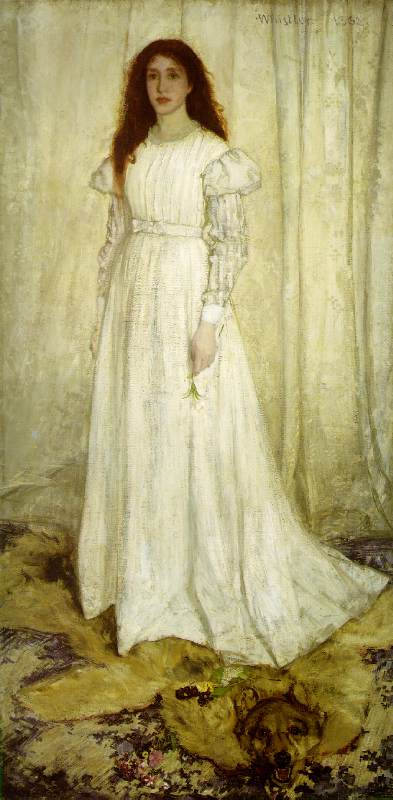
—Whistler

Failing to fetch me at first keep encouraged,
Missing me one place search another…

—Whitman

Holy the supernatural extra brilliant intelligent kindness of the soul!
—Ginsberg

America I’m putting my queer shoulder to the wheel.

Through the Rabbit-Hole; or, On Anglophilia, Fantasy, and Autobiography

This morning (or, if we’re going to get technical about it, this afternoon), after I woke up and wasted 45 minutes on the computer and showered and did all those morning-type things, I firmly told myself that just because it’s Sunday of midterm break, I shouldn’t allow my standard of dress to lapse. I’ve realized this semester that making an effort to dress not just in clothes that are clean, but clothes that match and look nice, has a positive psychological effect on my work ethic and my self-image—mindful of this and of the necessity of being productive over break, I put on halfway decent trousers, a reasonably stylish sweater, my favorite corduroy blazer, and even (gasp!) socks that match the rest of my clothes. Becoming preoccupied with how much sweater sleeve extends beyond jacket sleeve is a great way to avoid thinking about actually relevant things, like the paper I need to write this week, and so it was with this in mind that I grabbed a book and a notebook to write things about the book in, and strode through the Holder cloister to lunch. When I wear my corduroy jacket, and a reasonably stylish sweater and halfway decent trousers, I stride. I don’t trudge. It’s great.

I suppose it only hit me about 20 minutes later, sitting in the dining hall eating my scrambled eggs with a fork and knife as I peered at a book about Alice in Wonderland in the context of Lewis Carroll’s Oxford (it’s for a paper), how ridiculous I am. Most of the undergrads who stay on campus over break are athletes, and it was they, in their muscle shirts and sweatpants, whose loud chatter filtered through the hall to my seat at the last table. They were banging their fists on the tables and laughing with abandon; I was learning about the debates over the liberalization of Christ Church under the Deanship of Henry Liddell and fiddling self-consciously with my sweater sleeves. I do this a fair amount, in the dining hall; I think I must be in perfect keeping with the self-conscious Anglophilia (and, specifically, Oxoniphilia, to coin a word) that pervades much of Princeton’s architecture and early history. The Ivy League is all about trying to attain some idealized, romanticized vision of what British elite higher education is like or ought to be like—and, I’m beginning to think, this is particularly true at Princeton, which, although it was founded in 1746, didn’t come into its own until the late 19th century, when Oxford and Cambridge were both developing their modern institutional culture and when, in my reductive understanding, romanticized versions of cultural institutions seemed to proliferate on both sides of the Atlantic. As ridiculous as it may be, and as out-of-sync with any modern conception of elite higher education anywhere (boisterous athletes or no boisterous athletes), it’s not entirely inappropriate to spend a lunchtime sitting at one of those long wooden tables in a self-consciously constructed college dining hall, reading about Victorian Oxford and fiddling with sweater sleeves. It’s not Princeton today, but it was certainly at least one aspect of Princeton 100 years ago.

It’s easy, therefore, to be an Anglophile at Princeton, but I’ve admittedly been one all my life. In fact, I’ve probably been an Oxoniphile all my life, or at least for as long as I’ve known about Oxford—why else would I construct a Princeton that is totally out-of-keeping with reality? Why else am I keeping my fingers crossed that I’ll get to study abroad at Oxford—not just in England, but at Oxford—next year? It’s a strange coincidence that is maybe not entirely coincidental that, when I chose to write about Lewis Carroll for my seminar on biography because I thought the Alice books might bear on my final project about my own childhood, I found myself rather unwittingly coming back to the politics and institutional culture of Oxford. Because it seems, ever-increasingly, that I always do.

The last time I read Alice in Wonderland and Through the Looking-Glass must have been before I was nine, because I can’t remember reading it at all after my family moved from Georgia to California. But I do have powerful memories of being dwarfed by the rows upon rows of shelves in the university library where I went with my dad to check out an edition that contained both books with the Tenniel illustrations. It might, even, have been the same edition I found in the stacks of a university library yesterday, as I started to read for this paper. I couldn’t believe the things that came back to me about the text that I hadn’t thought about in ten or so years, like the “Pig and Pepper” chapter or the part of the trial scene where the guinea pigs are suppressed. I can remember sitting in my old bedroom, reading that trial scene, thinking that probably stuffing rodents in a bag and sitting on them is probably not really how disruptions are suppressed in a courtroom, but giggling at the image all the same. And now I step outside of myself to see myself, ten years and a seeming lifetime later, drinking coffee, wearing corduroy blazers instead of dresses, and devouring a satirical subtext about the politics of a developing modern Oxford that I would never have understood, much less discovered, ten years ago.

Carroll’s children’s books have been subject to enough critical study that I’m sure I have nothing new to say about them, but I’m nevertheless tempted to read the Alice books as a view of Oxford through a child’s eyes, the way that a child would write her life, where she is the center of her own story and her Dean of Christ Church father is the King of Hearts in a pack of cards (as one of the secondary sources I’m reading suggests). It makes me wonder what it means for a child to write her life, or for a somewhat childlike adult (as Carroll was, another secondary source posits) to write her life for her. A child’s life is writ small, a child’s world limited. And so Alice dreams that a chess set comes to life in a looking-glass world, and nine-year-old me creates a proliferation of universes and characters to inhabit them alongside myself. Whether it’s Alice telling her story to her cat, or me telling mine to my dolls and stuffed animals, children write themselves the heroes of their own lives, of adventures where the fairies at the bottoms of gardens are real. It’s what we do, and it’s why kids are still reading Alice.

As far as Lewis Carroll was concerned, Wonderland appeared to cease to exist when his child-friends grew up. Other Victorian children’s authors seem to agree; I’m reminded of that preoccupation with “growing up” in Peter Pan. But I’m not so sure. It’s three months till I’ll have completed my second decade (check out that future perfect construction!) and I’m still chasing an English and Oxonian fantasy universe, superimposing it upon reality when I get close enough to snatch at it and hang onto it. I laugh at myself, here at university in America: what remains of my proper, pre-teenage childhood has long since been relegated to boxes in my family’s garage, and yet I’m still longing for a rabbit-hole and a shortcut to Wonderland.

On Predestination; or, I’ll Be a History Major If I Want, Goddammit!

At some point in the first semester of my senior year of high school, I started to ask my teachers whether they would write letters of recommendation for my college applications. I was (and still am!) very close to some of my teachers, and I wanted to be fair to everyone; I didn’t want any of the teachers I approached to feel as if I was burdening them, nor did I want any of the teachers I didn’t approach to feel left out. I remember in particular asking one English teacher whether a history teacher would be offended if I didn’t ask him for a recommendation.

“No, I think that’s fine,” the English teacher said. “You want to do English, right?”

I didn’t quite meet his eyes. Yes, I was our quizbowl team’s acknowledged “lit person,” and yes, I had always done well in and enjoyed my English classes (the good ones, anyway) and the books we read in them. But I knew even then that I didn’t want to be an English major; I think I knew on some level since middle school that I wanted to do history, and that I wanted to study the people (not the texts) who populate our world. So I told my English teacher, “Yeah, I guess,” and he wrote some of my recommendations. And I applied to seven colleges, and I was accepted to four, and I came to Princeton.

Freshman year, I considered and then quickly discarded sociology. I realized I actually have very little interest in quantitative analysis and charts and graphs and all the other markings of social science methodology. I realized I’m more interested in who people are and were and how they interact and interacted—particularly over a given span of time. I took a class spring semester called Gender and Sexuality in Modern America, and I realized with exciting unequivocality that I really wanted to Study, on some sort of a permanent basis, Gender and Sexuality in Modern America. And so that was it: I started telling people that I’m going to be a history major.

This decision has not been without some resistance, both actual and perceived. I am interested in literature, and in many of the questions literature engenders, and the methods used to read it, as well. I have taken a couple English classes, and in some ways have enjoyed them more than some of my history classes. I think some people are simply surprised that I’m not interested in making the English department my own, given my obvious enthusiasm for reading—and writing. My friends in the English department frequently tease me that theirs is the better discipline, too, and although I know they don’t actually harbor any ill will towards me for my choice of major, I can’t help but feel sometimes as if I have chosen the “lesser” discipline. Sometimes, in the academic blogosphere, for example, and in some conversations I’ve had on campus, there is a higher moral weight placed on academic conversations that deal in abstractions. Some people, I sense, consider it better evidence of intelligence to take an interest in theory-and-criticism type thinking, whether that be through the lens of literature specifically or else in a more amorphous universe of something like queer studies or cultural studies. At Princeton, because the structure of our departments means that there are fewer ways to easily be interdisciplinary (at the undergrad level), many of the folks interested in theory therefore cluster in the literature and language departments. History is seen as solid and unyielding. History is seen as, well, historical, not prone to revolutionary new ways of thinking—and not prone to the more “intellectual” abstraction of literature.

Of course, this is nothing anyone has said to me specifically. But just as it was once assumed that I, the only girl on our quizbowl team, would be the “lit person,” and that the half-dozen boys on the team would cover history and politics and math-science, I feel as if some sort of essential characteristic of my identity is leading people to assume that I Am an English Major. My mother studied literature in her higher education; my father’s field not dissimilarly deals with the very close examination of a specific set of texts. I have been friends with English teachers, English professors, and English students all my life (in, perhaps it should be noted, both senses of “English.” For some reason American anglophiles often seem drawn to literature, though of course I’m no less an anglophile despite doing American history). But I think all this gentle nudging of my academic interests towards literature has caused me to shy away, to do something that’s different from, though still overlaps with, what my friends and my family are doing. Even though I am zeroing in on a really fascinating and rewarding subject for my independent work that’s very history-rooted, I think that my choice of major is as much reactionary, as much not-literature, as anything else. I mean, it’s important work; I think history is very important and I’m proud to be training up, as it were, to contribute to the discipline. But in the back of my mind there’s always this “Everyone expects me to be doing literature; I should be doing literature right now” dynamic.

Today, two different people—English professors, as it happens, whose work and teaching skill and intelligence I value enormously—told me that it’s perfectly all right that I’m planning to study history. That’s been one of the Themes of the Week, in fact, and particularly because my English professors are telling me this. One of them is teaching an American studies course, and I talked with him today about what it means to be part of an interdisciplinary field, and the practice of doing interdisciplinary scholarship. I started thinking about how it’s perfectly acceptable to sit somewhere between straight English and straight history (I use the word “straight” with tongue totally in cheek, because my academic interests are in no way “straight”!) and to use the one to inform the other. It made me realize that although I have chosen history, it doesn’t mean forsaking English. Although I have chosen archives, it doesn’t mean forsaking fiction.

Since I started at university, I’ve learned a great deal from my literature classes and my literary friends not just about how to read but also about how to link abstractions like literary theory to reality, or rather to all sorts of realities. I’m learning not to fear theory, because in certain ways and when not carried to extremes, the abstract extrapolations about the patterns of the world’s function build the bridges between all the fields that I love. It makes it much easier to connect my history to my English to my American studies to my political theory to my anthropology (to name the subjects in which I’m taking classes this semester) and have everything work together in this great intellectual system. It’s actually quite mind-boggling, and of course this is the whole reason I’ve committed myself to the higher education system for the forseeable future. In the ivory tower, this is the sort of thing that can happen.

I think that in high school we’re encouraged to see disciplines as very rigid and immutable. You take six (or however many, in my case it was six) classes in quite well-established subjects that have essentially not changed since they were first instituted in the high-school curriculum. When I asked my English teacher for a letter of recommendation, I was taking English, math, civics/political science, French, computer science, and stagecraft. In other years, I would have taken a lab science instead of comp sci, or a world or European or American history class instead of poli sci, or music instead of theater. But these categories are unquestioned. There is no disagreement in high school about What English Is. There is no disagreement about What Math Is. There is no disagreement about What History Is, or What Poli Sci Is, or What Theater/Performance Is.

Then you get to college, and you realize that these are questions that do not have answers, or at least have so many possible answers that it’s quite impossible to settle on just one. And you realize that living in the thick of intellectual forment just generates more of these really fundamental questions, and what’s more, you realize that it’s perfectly acceptable to work through them and to not have answers to them. It’s perfectly acceptable to declare your concentration and start planning your thesis in history, and yet discover and embrace the practice of reading fiction as if for the first time. It’s perfectly acceptable to let history inform literature, and literature inform history. I love it. I am so profoundly grateful. And what’s more, I feel like I belong here; I don’t feel shut out by some sort of more-theoretical-than-thou dynamic. I get the sense that, in ten or so years, when I’m a little better-educated, I will be an academic with something to contribute to the humanitarian (in the sense of “the humanities”) discourse. That’s a heady feeling—and it’s a feeling for which I’m profoundly grateful.

I guess it would have been about two years ago now that I looked down and muttered when asked, “You want to do English, right?” I had no idea then how much my world would be utterly, utterly changed.

Should We Be Surprised About Princeton’s GNH News?

At risk of flogging a dead horse, I was interested by the fact that my erstwhile editor Jesse flagged an article in today’s Yale Daily News about gender-neutral housing with the headline “Surprising.” I had a conversation this morning about how I’m becoming slowly convinced that it’s only popular conception that perpetuates the stereotype that Yale is more sociosexually progressive than other Ivies, and how it’s very unclear to me whether that stereotype has considerable basis in fact. Institutionally, Princeton since the Goheen era has been equally progressive as Yale, if not considerably more so. Anyway, this is the comment I left on Jesse’s post:

I mean, it is surprising and it isn’t. As I said when I first saw that article, it definitely bucks convention to think that Yale would be behind the trend on something sociosexual, and that Princeton would have gotten there first. But there are totally ways to rationalize this, and it’s especially easy to make the point that Princeton is not institutionally more conservative than Yale (undergraduate student culture is a different matter).

Princeton and Yale began coeducation in the same year. Princeton followed Yale by only three years in establishing a gay student organization (still both in the heyday of the gay liberation period). Yale has never had a woman president. It was five years behind Princeton in establishing an administration-run LGBT resource center. The institutional support for these types of reforms linked to a more developed understanding of gender and sexuality and a larger acknowledgment of the heterosocial real world in which we live has developed at relatively the same pace at both institutions.

As I think the YDN article indicated, what distinguishes Yale here is a logistical challenge provided by its all-encompassing residential college system. This is certainly a common hurdle: Harvard, which also has a developed residential college system, has a very limited GNH policy. Princeton, whose residential colleges serve only freshmen and sophomores, had little difficulty in extending GNH to upperclass students, but I can tell you from firsthand knowledge that giving underclass students the option (because of the residential colleges) is going to be a nearly insurmountable hurdle.

I’ve been thinking about this all day, and it’s starting to make more and more sense why things have panned out the way they have. Princeton’s eating clubs have entrenched a certain type of conservatism on campus, but it’s certainly not one reflected in the administration–our president is one of the most progressive of any university. And I’m not precisely sure how Yale got the “gay Ivy” designation (though George Chauncey has some ideas) but I’m very dubious about the extent to which that’s supported in fact.

I have to go back and re-read the Chauncey article, in particular light of the work I’m starting to do in learning about the history of gay Princeton. I’m very interested to learn more about where there are parallels and where there are divergences, and how valid this construction of Yale as “liberal” and Princeton as “conservative” is. Certainly the GNH developments complicate that construction—though it’s important to remember this may all be down to logistical factors and not ideological ones at all.

Heteronormativity, Again; or, The Experience of Reading Twilight

I may have mentioned to you by now, dear reader, that my English professor lectured this morning on Stephenie Meyer’s novel Twilight, and that our discussion section in the afternoon also dealt in large part with that book. I read it (okay, most of it) earlier this week, after spending the past few years trying to avoid doing just that. As I read the reviews of Twilight, its sequels, and the ensuing movie, I remained profoundly troubled by something amorphous about the way the series portrays its protagonist’s relationship to sexuality and to other non-sexual interpersonal reactions. When talking to others, I repeated the reviews’ sentiments: Bella (said protagonist) is not a real character; she’s just a conduit for desire. The books push pretty hard some themes about chastity, traditional notions of feminine motherhood, male chivalry, and other aspects of a conservative construction of gender, sexuality, and family. I said again and again, particularly when thinking of girls I know who are in the books’ target age range: is this the sort of universe, with the sort of values, that we want to encourage our girls and young women to take pleasure in?

Being asked to take the books seriously for class this week, and to consider them as a work of literature and a social statement, did revise how I thought about them. Actually reading them did, too. My impression of Bella is not entirely that she is a conduit for male desire: in fact, her identity as a shy know-it-all, who becomes obsessed with not just Edward’s charm, but a smartness and quickness that can match her own, came perilously close to echoing my own adolescent experience. In fact, I became profoundly uncomfortable with just how much I could recognize my own teenage fetishization of that one kid in my classes whose maturity, exoticism, eccentricity, and wit would always stand out to me. The knowledge that I might have been like that, like the Bella the reviews demonized, was enough to make me stop reading at points.

By contrast, when my professor lectured this morning, I hung onto every word (she is such a brilliant woman). She had some interesting things to say about how race and class are represented in Twilight, but what really grabbed me (of course) was her discussion of sexuality. She dwelt on the way that bodily fluids and bloodletting play out in this novel about vampires: Twilight dwells on childbirth, but there is no mention of menstruation (which you would think would be a pertinent issue in a universe where blood is something of a sexual stimulant). My professor discussed moments of defloration, comparing Bella’s impregnation to the point at which she is turned into a vampire. She brought up a very interesting and kind of disconcerting point about what Bella’s “change” into a vampire could be saying about menopause and the loss of fertility. And, she said, Twilight is oddly hygienic, for a universe that should revolve around blood. There are no sexually transmitted diseases in Twilight—a fact that stuck out to me for the reasons this blog probably demonstrates. There is no threat of AIDS.

My professor went on to talk about the polymorphous perversity (best phrase EVAR) of vampiric sexuality, its infantile nature, the inherent necrophilia in loving a vampire (which Meyer describes as “a walking corpse”), the oral sadism of the vampire’s bite. But, of course, there is no homosexuality in Twilight. Despite the obvious ambiguity of Edward’s sexual appeal, there are no gay couples in Forks, WA. There are no explicitly gay vampires. Bella herself doesn’t experience same-sex attraction. My professor suggested (and I thought this was really interesting) that closeting a standard social construction of homosexuality and gayness in the Twilight world allows Meyer to be freer with the polymorphous perversity, and with the other transgressive aspects of vampiric sexuality.

But I still feel as if the degree to which key aspects of sexuality are omitted from Twilight problematizes the aspects which are left in. And that’s consoling, in a way, because it means I don’t have to fear relating entirely to Bella and her experience of sexual awakening. Bella has no crisis of sexual identity. Neither do her vampire friends and lovers (but maybe that’s just because they’ve had hundreds of years to construct an identity). There are no labels in Twilight. There are no communities of sexuality. And when my class was discussing this series of books, and some folks in my class were talking about how much they could identify with Bella, I didn’t—entirely—feel as if I could contribute. For all that it confuses clear-cut sexualities; for all that it builds upon and complicates our traditional notion of the innocent love story, it is still profoundly and aggressively heteronormative. It excludes those who acknowledge anti-heteronormativity, and only includes those for whom transgressive sexuality unravels along with the thread of Meyer’s plot by the time the fourth book comes along.

Some of my fears about what this book says about our culture were allayed by reading it. I think I might moderate my ranting against it from here on out. But in other ways, I’m still very confused and somewhat disconcerted by what aspects of human sexuality Stephenie Meyer has chosen to put in, and what she has chosen to leave out.

(cross-posted)

A Discourse Concerning Being a Generalist

I’m doing my first reading for my first class to really examine the Great Thinkers of Western Civilization, which, because the class is about political theory, happens to be Rousseau’s Discourse Concerning Inequality. The reading list consists of Rousseau, Kant, Hegel, Marx, and Nietzsche, and I’m struck as I read Rousseau how contingent developing any type of theory about the nature of human existence is contingent on having a really broad general intellectual knowledge. This was particularly true in the 18th century, when “natural philosophy” hadn’t yet wholly split off into the natural sciences and philosophy, and these two branches hadn’t yet split into the present sorts of disciplines you can major in at your average American research university. I’m sitting here thinking that my political theory reading could easily be relevant to my anthropology class on human evolution as well, and while it’s awesome when it’s not just my departmentals that inform upon each other, but my other random classes as well, it’s probably more interesting to consider what this brings to bear upon the Era of the Academic Hyperspecialization.

The education press is full, of course, of discussion of the fact that academia these days is highly specialized. It’s common to see folks complaining at Inside Higher Ed that newly-minted PhDs come out of grad school so much trained to think solely about a postcolonial reading of the work of an obscure Jamaican author or the role of a single gene on the X chromosome that they’re ill-prepared to teach undergraduate survey courses for which there’s the highest need, like 20th Century American Literature or Intro to Evolutionary Biology. This is particularly a concern in an era in which more and more newly-minted PhDs will not get jobs at places like Princeton which are looking for theorists with an expertise in Caribbean literature or high-powered researchers who can benefit from well-funded lab facilities. Those kinds of jobs simply don’t exist, and instead what the profession is looking for are people who can take on a 6/6 load of intro-level courses and teach them all well. But we know all this. And what, exactly, does it have to do with Rousseau, who never had to adjunct a semester in his life?

There’s probably very little relationship behind the kind of generalist Rousseau (or, to pick a more modern-day example for the sake of demonstrating diversity, Foucault) was and the kind of generalist a community-college job posting expects you to be. One is an essentially elite category (according to society’s measure of these things), and the other isn’t. One can often seem entirely devoted to appearing completely incomprehensible, and one is entirely devoted to making academic subject matter comprehensible—frequently to an audience not used to deciphering incomprehensible things. But the intellectual development of our culture wouldn’t get very far without people who are capable of synthesizing all its disparate aspects—whether that be a Rousseau drawing on what we would term the disciplines of history, politics, philosophy, anthropology, biology, sociology, and maybe something like cultural studies to advance a complex diagramming of the nature of human interaction; or a skilled teachers who can make American literature relevant to the stay-at-home mom taking a night class and biology accessible to the business major who needs to pass a science requirement, neither of whom has any particular humanistic background or inclination. A generalist who can understand why and how Rousseau can impact the life and worldview of a student who sees no point in politics or philosophy or cultural and social theory is as necessary to our intellectual culture as the transdisciplinary vision of Rousseau himself.

I’ve said it before and I’ll say it again: we have no business locking ourselves in the ivory tower if we can’t poke our heads out every once in a while to inform the discourse of reality as well.

(cross-posted)

QOTD (2009-09-14)

From Christopher Isherwood, Christopher and His Kind:

The Memorial was published on February 17, 1932. There were a few really favorable notices. The best of them was in the Granta. I remember how one reviewer remarked that he had at first thought the novel contained a disproportionately large number of homosexual characters but had decided, on further reflection, that there were a lot more homosexuals about, nowadays.

Funny, that.

Incidentally, naïve question: who are Christopher’s “kind”? Gay men? Expats? Literary types? None of the above? By “his kind,” does he mean “people like him,” or “people whom he fancies”?

The third-person POV in this book is awfully interesting. I’m trying to figure out what I make of it.

Coded Language

As I read more and more about what it meant to be a gay man in any decade of the 20th century, I become immersed in a language. Sometimes that means just picking up enough in context, or inferring enough from the slang of our own era, to know what someone means when he talks to another man in a bar, using words the undercover cops wouldn’t know. Sometimes I see someone give me a funny look in conversation, and I realize I’ve used a turn of phrase natural in the 1950s but completely anachronistic—and perhaps offensive—in our time. And sometimes—as happened just yesterday—it’s not so much basic comprehension that I gain, but a sense of what greater significance simple words had to someone living in a different time and place and social context.

I’ve read, or listened to a recording of, Ginsberg’s “Howl” more times than I can count. My iTunes says I’ve listened to my favorite recording of Ginsberg reading “Howl” (yes, I have more than one) 19 times, but I’m sure that’s not accurate. It doesn’t count the number of times I’ve listened to just Part I, my favorite part, and stopped before I reached the end of the track. It doesn’t count the times I listened to one of the other versions instead, for a change (though I find the other versions jarring, because I’m so used to Ginsberg’s cadences in the first version). And it doesn’t count the times that I’ve opened one edition or another and stared at the pages, passing my eyes over words obscene and sublime, or perhaps sublimely obscene; the times I’ve typed those words out on an electric typewriter, or quoted them in conversation, or added them as epigrams at the start or finish of my essays as they happen to take on temporarily a significance that informs what I’m trying to get across.

Last night I was listening to Part I of “Howl” again, trying to fall asleep, as I do at least a few nights a week. I tune out a bit, usually, when I do this—sometimes I murmur along with my favorite parts, but usually I just let Ginsberg’s voice lull me. I tuned back in for this part:

who bit detectives in the neck and shrieked with delight in policecars for committing no crime but their own wild cooking pederasty and intoxication,
who howled on their knees in the subway and were dragged off the roof waving genitals and manuscripts,
who let themselves be fucked in the ass by saintly motorcyclists and screamed with joy,
who blew and were blown by those human seraphim, the sailors, caresses of Atlantic and Caribbean love,
who balled in the morning and the evenings in rosegardens and the grass of public parks and cemeteries scattering their semen freely to whomever come who may,
who hiccupped endlessly trying to giggle but wound up with a sob behind a partition in a Turkish Bath when the blonde & naked angel came to pierce them with a sword,
who lost their loveboys to the three old shrews of fate the one eyed shrew of the heterosexual dollar the one eyed shrew that winks out of the womb and the one eyed shrew that does nothing but sit on her ass and snip the intellectual golden threads of the craftsman’s loom,

This passage is preceded by a section about young political radicals, and alludes to their naïveté without condemning it; it is followed by a hymn to the heterosexual essence of Neal Cassady, Ginsberg’s great unrequited love. And in looking for details about the political movements or characters that made up the Beat Generation, I’ve never really paid much attention to that above passage. Despite its prurient nature, it never struck me as particularly interesting.

But all it takes is some conversance in stereotypes of gay culture (not to put a negative connotation on “stereotype”; it’s just what they are), and you realize how exciting it is that Ginsberg is including all these things. He puts a humorous, light-hearted, camp spin on being arrested in a police raid. He applies the same sense of joie de vivre to bikers and sailors, and to sex in parks and bathhouses—marred only by that sob in the “Turkish Bath.” And then, of course, the poem turns to the essentially pathetic (in the sense of pathos, though maybe I’m not using that word correctly) underbelly of this whole situation; it invokes loss and traitorousness and all that other stuff Ginsberg must be feeling as he goes on to sing to “N. C., secret hero of these poems.” This was 1956. Ginsberg hadn’t yet morphed into the Great Icon of Homosexuality he would become. His journals from both the period in which he was writing and the period he was writing about reek of that tortured self-psychoanalysis that characterizes how a lot of gay men in the ’40s and ’50s tried to make sense of their lives. But still. Still there is this sense of what fun, what larks, what silliness can be had if you giggle your way through the maneuverings of your tortured soul. And still he was not afraid—even in 1956—to share that bubbling of joy.

On the live recording I have, there’s a ripple of laughter in the background when Ginsberg, then in his mid-60s, solemnly intones lines like “scattering their semen freely to whomever come who may,” and in the past when I heard that laughter I thought they were giggling because he said “semen.” I thought they were behaving the way most people do when a prurient subject is raised. But knowing what I know now, being conversant in some tropes, I’m not so sure of that. This time the laughter sounded entirely different: it sounded relieved, this outburst of held-in breath that is thrilled this sagacious, bearded man proposes to “scream with joy” when engaging in a bout of anal sex; that in 1975 (whence the recording dates), it is finally possible to publicly agree on delight in bikers and sailors. It’s almost as if they’re screaming with joy with him.

I read books where anonymous interviewees talk about holding papers over their faces in police raids of New York bars. I read accounts of gay life at mid-century written in the 1990s, where the participants are still afraid to reveal themselves. I watch old movies filled with references so coded they got through the Hollywood censors; I read the letters and diaries of famous figures, some of whom were closeted until they died and those letters and diaries were revealed. And I follow the news religiously and sometimes despair that America will ever change, that gay public figures will ever have any civil rights, much less be able to admit that they have sex lives like straight public figures do.

But 52 years ago, when he published “Howl,” Allen Ginsberg launched himself onto the national scene with an obscenity trial about what continued for the rest of his life, and long after, to be his most famous work. He stood in a witness box and defended his right to “scream with joy.” He read “Howl” again and again, and in my recording he reads for a group of students, decades before homosexuality was decriminalized in this country. And yet he asserted his right to “scream with joy” and the students laughed—not at him, as I’d once thought, but perhaps with him.

That, to this cynical blogger and proto-historian, is incredible. It’s been nearly three years now, my relationship with Ginsberg and with “Howl,” and I’m so glad that after all that time the tools that I gather, and the codes that I learn, continue to dig up more things inside the head and the life of that wonderful man.

So many books….

Every day, I’m aghast by how many books there are that I haven’t read, that I should read. Every time I go to a bookstore (which is relatively often at times like now, when I’m living in a city with good independent bookstores), I come out with more books that sit piled on my desk, or occasionally actually do get read. Every time I go into a library, I check out armfuls, and too often they come due before I’ve read them. I’m painfully aware of how little I’ve read, particularly the painfully obvious things that someone who wants to do what I want to do should be reading. I can’t tell you how many times I’ve smiled and nodded and pretended to know what’s going on when someone references Foucault, for example.

Sometimes I blame my post-Prop. 13 California public school for my under-read nature. I thought only this could explain my glaring gaps in classic British and American literature in comparison to my peers from east-coast schools. But maybe it’s just that I’m lazy; the internet, with its easy access to blogs, newspapers and magazines, means that I read fewer novels. I also favor the esoteric over the edifying; I’ve been meaning to read Jane Eyre for months, but every time I think I finally will go get it from the library, I get sidetracked by another memoir of gay life in the 1970s.

The British academic-humor novelist David Lodge writes about characters who play a game called “Humiliation,” wherein they try to win by naming the most embarrassing work of literature they haven’t read—one English professor wins by confessing that he’s never read Hamlet. Well, I’ve read Hamlet (and I was, if I say so myself, a very good Horatio in my 12th-grade English class’s reading), but I could think up a dozen equally embarrassing things I’ve never read. Jane Eyre, for instance, as I mentioned above. Pride and Prejudice, or indeed anything else by Austen. The Grapes of Wrath (which I faked my way through having read when it was assigned in 11th-grade English). Anything by Hemingway. I started One Flew Over the Cuckoo’s Nest, but never finished it. I’ve never read one of the more “grown-up” Dickenses—just A Christmas Carol and David Copperfield. Never read a Russian novel.

I also have to read theory, the stuff I need to talk about gender and sexuality with my friends and peers. I can’t tell you how often I’ve been told that something I wrote related to an idea advanced by Judith Butler—but I’ve never read Butler. Never read Eve Sedgwick. Never, as I mentioned above, read Foucault. Or Freud. I purport to be an American cultural history major, but I never finished Zinn’s People’s History of the United States, and as far as most other famous American historians are concerned, I can only recognize names and titles. I came to American countercultures, queer theory, and literary history through the Beats, but of Kerouac I’ve only read On the Road. Of Burroughs I’ve only read Naked Lunch. I have, however, read quite a lot of Ginsberg.

Of course, it does me little good complaining if I keep bringing home book after book that I never read. This summer, partly thanks to my daily commute on the bus, I’ve rediscovered reading for pleasure, and it’s been incredibly exciting—I can’t think of the last time I read so many books in one summer, but it must have been before high school, before I was really reading only adult books. But as I take on the task of catching up in the adult world of cultural literacy and start the background reading I’ll need to dive into my independent work at school, I’m daunted by how much there is to go. I’m sure that when I’m really an adult, I’ll still have glaring gaps in my literary consumption—everyone does; that is, after all, why “Humiliation” is such a successful joke in Lodge’s writing—but it would be nice to think that I’ll eventually catch up to the wide breadth of literature that my friends and family are able to reference.