On Predestination; or, I’ll Be a History Major If I Want, Goddammit!

At some point in the first semester of my senior year of high school, I started to ask my teachers whether they would write letters of recommendation for my college applications. I was (and still am!) very close to some of my teachers, and I wanted to be fair to everyone; I didn’t want any of the teachers I approached to feel as if I was burdening them, nor did I want any of the teachers I didn’t approach to feel left out. I remember in particular asking one English teacher whether a history teacher would be offended if I didn’t ask him for a recommendation.

“No, I think that’s fine,” the English teacher said. “You want to do English, right?”

I didn’t quite meet his eyes. Yes, I was our quizbowl team’s acknowledged “lit person,” and yes, I had always done well in and enjoyed my English classes (the good ones, anyway) and the books we read in them. But I knew even then that I didn’t want to be an English major; I think I knew on some level since middle school that I wanted to do history, and that I wanted to study the people (not the texts) who populate our world. So I told my English teacher, “Yeah, I guess,” and he wrote some of my recommendations. And I applied to seven colleges, and I was accepted to four, and I came to Princeton.

Freshman year, I considered and then quickly discarded sociology. I realized I actually have very little interest in quantitative analysis and charts and graphs and all the other markings of social science methodology. I realized I’m more interested in who people are and were and how they interact and interacted—particularly over a given span of time. I took a class spring semester called Gender and Sexuality in Modern America, and I realized with exciting unequivocality that I really wanted to Study, on some sort of a permanent basis, Gender and Sexuality in Modern America. And so that was it: I started telling people that I’m going to be a history major.

This decision has not been without some resistance, both actual and perceived. I am interested in literature, and in many of the questions literature engenders, and the methods used to read it, as well. I have taken a couple English classes, and in some ways have enjoyed them more than some of my history classes. I think some people are simply surprised that I’m not interested in making the English department my own, given my obvious enthusiasm for reading—and writing. My friends in the English department frequently tease me that theirs is the better discipline, too, and although I know they don’t actually harbor any ill will towards me for my choice of major, I can’t help but feel sometimes as if I have chosen the “lesser” discipline. Sometimes, in the academic blogosphere, for example, and in some conversations I’ve had on campus, there is a higher moral weight placed on academic conversations that deal in abstractions. Some people, I sense, consider it better evidence of intelligence to take an interest in theory-and-criticism type thinking, whether that be through the lens of literature specifically or else in a more amorphous universe of something like queer studies or cultural studies. At Princeton, because the structure of our departments means that there are fewer ways to easily be interdisciplinary (at the undergrad level), many of the folks interested in theory therefore cluster in the literature and language departments. History is seen as solid and unyielding. History is seen as, well, historical, not prone to revolutionary new ways of thinking—and not prone to the more “intellectual” abstraction of literature.

Of course, this is nothing anyone has said to me specifically. But just as it was once assumed that I, the only girl on our quizbowl team, would be the “lit person,” and that the half-dozen boys on the team would cover history and politics and math-science, I feel as if some sort of essential characteristic of my identity is leading people to assume that I Am an English Major. My mother studied literature in her higher education; my father’s field not dissimilarly deals with the very close examination of a specific set of texts. I have been friends with English teachers, English professors, and English students all my life (in, perhaps it should be noted, both senses of “English.” For some reason American anglophiles often seem drawn to literature, though of course I’m no less an anglophile despite doing American history). But I think all this gentle nudging of my academic interests towards literature has caused me to shy away, to do something that’s different from, though still overlaps with, what my friends and my family are doing. Even though I am zeroing in on a really fascinating and rewarding subject for my independent work that’s very history-rooted, I think that my choice of major is as much reactionary, as much not-literature, as anything else. I mean, it’s important work; I think history is very important and I’m proud to be training up, as it were, to contribute to the discipline. But in the back of my mind there’s always this “Everyone expects me to be doing literature; I should be doing literature right now” dynamic.

Today, two different people—English professors, as it happens, whose work and teaching skill and intelligence I value enormously—told me that it’s perfectly all right that I’m planning to study history. That’s been one of the Themes of the Week, in fact, and particularly because my English professors are telling me this. One of them is teaching an American studies course, and I talked with him today about what it means to be part of an interdisciplinary field, and the practice of doing interdisciplinary scholarship. I started thinking about how it’s perfectly acceptable to sit somewhere between straight English and straight history (I use the word “straight” with tongue totally in cheek, because my academic interests are in no way “straight”!) and to use the one to inform the other. It made me realize that although I have chosen history, it doesn’t mean forsaking English. Although I have chosen archives, it doesn’t mean forsaking fiction.

Since I started at university, I’ve learned a great deal from my literature classes and my literary friends not just about how to read but also about how to link abstractions like literary theory to reality, or rather to all sorts of realities. I’m learning not to fear theory, because in certain ways and when not carried to extremes, the abstract extrapolations about the patterns of the world’s function build the bridges between all the fields that I love. It makes it much easier to connect my history to my English to my American studies to my political theory to my anthropology (to name the subjects in which I’m taking classes this semester) and have everything work together in this great intellectual system. It’s actually quite mind-boggling, and of course this is the whole reason I’ve committed myself to the higher education system for the forseeable future. In the ivory tower, this is the sort of thing that can happen.

I think that in high school we’re encouraged to see disciplines as very rigid and immutable. You take six (or however many, in my case it was six) classes in quite well-established subjects that have essentially not changed since they were first instituted in the high-school curriculum. When I asked my English teacher for a letter of recommendation, I was taking English, math, civics/political science, French, computer science, and stagecraft. In other years, I would have taken a lab science instead of comp sci, or a world or European or American history class instead of poli sci, or music instead of theater. But these categories are unquestioned. There is no disagreement in high school about What English Is. There is no disagreement about What Math Is. There is no disagreement about What History Is, or What Poli Sci Is, or What Theater/Performance Is.

Then you get to college, and you realize that these are questions that do not have answers, or at least have so many possible answers that it’s quite impossible to settle on just one. And you realize that living in the thick of intellectual forment just generates more of these really fundamental questions, and what’s more, you realize that it’s perfectly acceptable to work through them and to not have answers to them. It’s perfectly acceptable to declare your concentration and start planning your thesis in history, and yet discover and embrace the practice of reading fiction as if for the first time. It’s perfectly acceptable to let history inform literature, and literature inform history. I love it. I am so profoundly grateful. And what’s more, I feel like I belong here; I don’t feel shut out by some sort of more-theoretical-than-thou dynamic. I get the sense that, in ten or so years, when I’m a little better-educated, I will be an academic with something to contribute to the humanitarian (in the sense of “the humanities”) discourse. That’s a heady feeling—and it’s a feeling for which I’m profoundly grateful.

I guess it would have been about two years ago now that I looked down and muttered when asked, “You want to do English, right?” I had no idea then how much my world would be utterly, utterly changed.

Should We Be Surprised About Princeton’s GNH News?

At risk of flogging a dead horse, I was interested by the fact that my erstwhile editor Jesse flagged an article in today’s Yale Daily News about gender-neutral housing with the headline “Surprising.” I had a conversation this morning about how I’m becoming slowly convinced that it’s only popular conception that perpetuates the stereotype that Yale is more sociosexually progressive than other Ivies, and how it’s very unclear to me whether that stereotype has considerable basis in fact. Institutionally, Princeton since the Goheen era has been equally progressive as Yale, if not considerably more so. Anyway, this is the comment I left on Jesse’s post:

I mean, it is surprising and it isn’t. As I said when I first saw that article, it definitely bucks convention to think that Yale would be behind the trend on something sociosexual, and that Princeton would have gotten there first. But there are totally ways to rationalize this, and it’s especially easy to make the point that Princeton is not institutionally more conservative than Yale (undergraduate student culture is a different matter).

Princeton and Yale began coeducation in the same year. Princeton followed Yale by only three years in establishing a gay student organization (still both in the heyday of the gay liberation period). Yale has never had a woman president. It was five years behind Princeton in establishing an administration-run LGBT resource center. The institutional support for these types of reforms linked to a more developed understanding of gender and sexuality and a larger acknowledgment of the heterosocial real world in which we live has developed at relatively the same pace at both institutions.

As I think the YDN article indicated, what distinguishes Yale here is a logistical challenge provided by its all-encompassing residential college system. This is certainly a common hurdle: Harvard, which also has a developed residential college system, has a very limited GNH policy. Princeton, whose residential colleges serve only freshmen and sophomores, had little difficulty in extending GNH to upperclass students, but I can tell you from firsthand knowledge that giving underclass students the option (because of the residential colleges) is going to be a nearly insurmountable hurdle.

I’ve been thinking about this all day, and it’s starting to make more and more sense why things have panned out the way they have. Princeton’s eating clubs have entrenched a certain type of conservatism on campus, but it’s certainly not one reflected in the administration–our president is one of the most progressive of any university. And I’m not precisely sure how Yale got the “gay Ivy” designation (though George Chauncey has some ideas) but I’m very dubious about the extent to which that’s supported in fact.

I have to go back and re-read the Chauncey article, in particular light of the work I’m starting to do in learning about the history of gay Princeton. I’m very interested to learn more about where there are parallels and where there are divergences, and how valid this construction of Yale as “liberal” and Princeton as “conservative” is. Certainly the GNH developments complicate that construction—though it’s important to remember this may all be down to logistical factors and not ideological ones at all.

The Practice of Doing Journalism

Readers may know that I occasionally “do” journalism, and have received a certain amount of education and job experience about how to be a writer, reporter, journalist, thing. I’m used to being the interviewer, and so it’s been awfully interesting to find myself in the middle of the media coverage of Princeton’s new gender-neutral housing option and be the one answering student reporters’ questions.

Yesterday I spoke to a reporter who, among other things, asked me about the tenor of other students’ reactions. Had I heard any negative feedback? I explained that I hadn’t from individuals, just read anonymous Daily Princetonian comments, which are about as reliable a source as YouTube comments. The reporter confessed to difficulty finding anyone with a negative reaction, and really kept pushing that. I cautioned her against the old Prince trick of just getting a statement from the Anscombe Society, who is against everything cultural-values-related that the majority of the campus is for, and then hinted that maybe, if she couldn’t find reliable negative reactions, maybe that’s just because there aren’t any.

A number of people have pointed out both in person and on the Internet that they can’t really see what all the fuss is about—for them, gender-neutral housing is a total non-issue, and they can’t imagine why the fact that Princeton has taken this long to implement it should be getting any attention. And as much as I’m pretty proud of the fact that we did this, I can’t blame them: I’ve said from the beginning that what Princeton would be doing by implementing gender-neutral housing would only be bringing the university into sync with the heterosociality of the real world, and that preserving gender-segregated living is totally artificial and totally outdated.

But when you write a story, you need a quote from the opposition. At least, that’s common wisdom, something ingrained into every journalism student’s head at some point. Of course, though, what that means is that you give the opposition the same weight as the majority view, even if that’s very far from being the case. When the Prince does it, they render the views of the two dozen members of Anscombe equally important as those of the 4,500-odd undergraduates not in Anscombe. And when the national media do it, they render the views of the minority who believe that health care reform would institute “death panels” equally important as those of the majority of Americans who don’t believe that, and who would actually rather like some health care reform, now, if at all possible. It’s tricky, dangerous territory.

To all those folks who wondered “What’s the point?”, I’d say that this story is still a story, even if it’s not controversial. The story is, in fact, that gender-neutral housing at Princeton is not controversial—that four decades after there was a serious and fully two-sided debate around whether to admit women to this university, it has finally become in touch with reality. As far as I’m concerned, that’s really exciting.

(cross-posted)

Loving and Being; or, My Antonia Is Totally Relevant to 21st-Century Adolescents

I’m in a class called American Women Writers, and last week we read Willa Cather’s My Antonia. For those of you who aren’t familiar with My Antonia, it’s a pioneer story, but it’s no Little House on the Prairie. Gender and sexuality are critically important to, and problematized in (if I’m using that word correctly) My Antonia, and you can read it as a lesbian novel, or a gay novel, and/or a novel about the confusion of gender identity, gender presentation, and performing gender. We talked in class about Cather’s relationship to gender and sexuality: her long-term relationships with women, and her propensity for dressing in masculine drag and adopting a masculine persona. When we related Cather’s life back to the novel, we talked about her protagonist, Jim Burden, who can be read either as a straight male figure for Cather, or as a gay man. The most interesting question, I think, that my professor posed is this: does Jim desire the title character, Antonia (who is described as a woman at once masculine and maternal) or does he desire to be her?

Sure, we used textual evidence to discuss this question in precept, but I just want to reverse the genders for a minute and talk about Rob Macgillivray. Rob was my imaginary friend for many years, the hero of all my stories and all my mental adventures. He figured in the stories I told myself while I tried to fall asleep at night, and the fiction I wrote for my teachers or my parents or just for me. Rob was dashing and handsome, graceful and chivalric, transgressive and iconoclastic. Even in a story set in my middle school, Rob would find an excuse to wield a fencing foil. Rob would always break the rules and get into trouble (something I was much, much too cautious and shy and scared ever to do), but he would always be witty enough to talk his way out of punishment. Rob embodied the young heroes of the adventure stories I read, like Kidnapped and Swallows and Amazons, and of Celtic romance novel after Celtic romance novel. He was in the back of my mind when I played imaginary games with my sister, or when girls asked me “So… who do you like?” and I had to scramble to make someone up. And he was in the absolute forefront of my mind in the complex worlds I spun out for myself in the dark of my bedroom at night. I’ve always had some difficulty falling asleep, and the universes of sailing ships and boarding schools and living history museums and armies and trades guilds and so much else besides got me through middle school. I especially couldn’t have done it without Rob.

I didn’t save as much as I wish I had from my childhood—for example, I don’t have the original portraits I drew of Rob and the other five Macgillivray siblings when I was 11—but I do have a lot of my preteen and early teenage fiction saved on my computer. Among a lot of really awful highly romanticized tale-telling about the second Jacobite rebellion, and fiction I turned in to my middle-school English teachers complete with footnotes about historical detail so that they would see how clever I was, and a sort of disconcertingly clever modern retelling of said second Jacobite rebellion, set in a public high school and complete with a superintendent of schools named Dr. George Hanover, there was Rob:

Rob was dressed all in black, wearing jeans and a turtleneck although it was 80 degrees outside, and a large black hat. Of course, the rims of his glasses were black, too. He intended to start the school year by bringing in some money, playing guitar at lunch, and so he was dressed in a sort of stereotypical artist outfit to gather interest from the kids and play to the crowd a little.

I knew Rob Macgillivray of old. That is to say, last summer, when we played members of the gentry in colonial Boston [at a historical reenactment summer camp], I fell madly in love with the dashing, handsome cavalier who often visited the house of my “father.” Wonderful, you may think. She gets to spend all her waking hours (and all her sleeping hours, too) with the guy she thinks is the coolest thing on earth! Well, you’d be wrong. I don’t know if you’re a teenage girl, but if you’re not, I’ll explain that having to actually talk to your crush as if everything’s normal is a feat akin to winning the National History Day competition.

“My apologies, lady,” said the boy, bowing in an overly dramatic way. “Please forgive me. I am Journeyperson Robert—though my name is Rob; call me Robert and I’ll hurt you—at your service.”

Rob laughed. He knows I get along infinitely better with boys than girls. Girls can be too normal sometimes, even people like Katie and Irene. Boys stay weird, no matter how teenager-like they get.

I suppose that if anyone had asked me at the time, I would have said I was in love with Rob—or, rather, I would have been too embarrassed to admit that, and would instead have said that my fictional alter-ego was in love with him. But I’ve been thinking about Willa Cather, and I’ve been thinking about how in ninth grade when I had a crush on a boy I dealt with that by trying to dress just like him, and then I found a story I wrote when I was thirteen that ends like this:

As soon as Natasha was out the door, Anne dived under her bed, pulling out the canvas bag she had stowed there, filled with all the boys’ effects she had managed to “borrow” over the past couple of months. She quickly changed into the long pants and collared shirt that Second Stage boys commonly wore, then, mindful of the cold, added a sweater. The clothes weren’t of the best condition, seeing as most of what Anne could find were cast-offs and outgrown garments, but they would do. She tied her hair back into a messy ponytail, and hoped that, since it wasn’t overly long, nobody would comment on the fact that hardly any Second Stage boys wore their hair long.
She then tossed out all of the female clothing in the chest except for her most favourite outfits, pushing this under the bed. The remaining contents of the trunk all went in Anne’s knapsack, except for a few toiletries and toys that she deemed appropriate for a boy. The canvas bag was emptied into the trunk, the lid closed, and then Anne shouldered her knapsack and dragged the trunk along the ground, managing to make it out the back door and into her new life as the boy Andrew.

I know, I know, it’s a bit weird—not to mention presumptuous—to psychoanalyze one’s own adolescent fiction. But I’m thinking of the clothes I wore at the beginning of my relationship with Rob Macgillivray, and those I wore at its end. I’m thinking of the real-life people who were my crushes and my heroes, and how difficult it was to sort out whether I wanted a brother or an aunt or a boyfriend or a girlfriend or just someone whom I could idolize. I remember how difficult it was to understand those things, and I remember how much more right and straightforward my relationship with Rob seemed—but as I look at my middle-school fiction, I see how I cast him as a brother and a husband and a teacher and a best friend and a far-away crush. I’m reminded that these things are never, ever straightforward.

We can puzzle about whether Jim Burden desires Antonia or desires to be her—and that was certainly one of my favorite topics that we discussed in precept on Thursday. But I have to ask whether Jim knows which it is, or whether Cather knows which it is, and whether either the writer and the narrator would even want us to know which it is. I wonder if maybe it’s also a little bit of both. We talked very much in binaries in precept: is Jim straight or gay? Is he masculine or feminine? Is Antonia masculine or feminine; passive or active? Is it good or bad to be a woman in Cather’s pioneer world?

But what if it’s both? What if it’s neither? What if, six, seven, eight years later, I still don’t know whether I’m striving to become Rob or to gain his admiration or to spend the rest of my life with him?

QOTD (2009-10-16)

Auden, “Musée des Beaux Arts,” offered without comment:

About suffering they were never wrong,
The Old Masters; how well, they understood
Its human position; how it takes place
While someone else is eating or opening a window or just walking dully along;
How, when the aged are reverently, passionately waiting
For the miraculous birth, there always must be
Children who did not specially want it to happen, skating
On a pond at the edge of the wood:
They never forgot
That even the dreadful martyrdom must run its course
Anyhow in a corner, some untidy spot
Where the dogs go on with their doggy life and the torturer’s horse
Scratches its innocent behind on a tree.
In Breughel’s Icarus, for instance: how everything turns away
Quite leisurely from the disaster; the ploughman may
Have heard the splash, the forsaken cry,
But for him it was not an important failure; the sun shone
As it had to on the white legs disappearing into the green
Water; and the expensive delicate ship that must have seen
Something amazing, a boy falling out of the sky,
had somewhere to get to and sailed calmly on.

In other literary news, Elizabeth Bishop’s letters are lovely, and the NYT’s reports of the sex in Edmund White’s City Boy (see antecedent post) seem, at a third of the way through, to be greatly exaggerated.

Have I mentioned how much I enjoy that my full-time job as a student, so to speak, is basically to read?

QOTD (2009-10-14)

Edmund White, in an interview with Salon, says one of my favorite things ever about same-sex marriage:

In the past, when gays were very flamboyant as drag queens or as leather queens or whatever, that just amused people. And most of the people that come and watch the gay Halloween parade, where all those excesses are on display, those are straight families, and they think it’s funny. But what people don’t think is so funny is when two middle-aged lawyers who are married to each other move in next door to you and your wife and they have adopted a Korean girl and they want to send her to school with your children and they want to socialize with you and share a drink over the backyard fence. That creeps people out, especially Christians. So, I don’t think gay marriage is a conservative issue. I think it’s a radical issue.

I adore White’s books for so many reasons, and I think the fact that I read five of them this summer has influenced a lot of my thoughts about the history of gay men these past few months. He’s got some wonderful prose, and he writes candidly about gay culture and being gay—that’s a strikingly rare combination, and a risky undertaking in a literary world that tends to ghettoize gay writers. The last few pages of The Beautiful Room Is Empty, in which he has this sort of dadaesque description of Stonewall, are some of the best writing I can think of, for example—not only is the prose just glittering in its surreality (I find it really difficult to describe why good prose is good; you’ll just have to take my word for it), it’s a great way of turning the conventional riotous watershed OMG-Judy-Garland-died-and-now-we-have-a-revolution-on-our-hands kind of narrative on its head.

The NYT reviews of White’s two memoirs, My Lives and now City Boy (I’m still waiting for my copy of City Boy to arrive from Amazon; I’ll report back when I read it) seem profoundly on edge about the frank discussion of sex that pervades them. I mean, this is the Times we’re talking about, so it’s not too surprising; the paper hasn’t always been the most with-it on gay stuff. But even I, who am utterly unshockable, remember looking awkwardly around to see if anyone on the bus was looking over my shoulder while I read what the Times facetiously calls “that S-and-M chapter” in My Lives. Even I was glad that, unlike a lot of other books I’ve read with a lot of sex in them, this one’s cover was discreet.

But I think we have to be profoundly thankful to White for writing literary books in which the narrator acknowledges his sexuality with at least the mannerisms of honesty (even if he’s applying creative license to what actually goes/went on in his head and his life). It’s an increasingly common thing, but it still takes a high degree of courage and literary acumen.

Oh yeah, and he teaches fiction at Princeton. What could be better?

BREAKING: Gender-neutral Housing Comes to Princeton!

I’ve never legit gotten to break a story before, but I just found out that some news I’ve known for 24 hours is now public: Princeton will have a gender-neutral housing option starting in this spring’s housing lottery for the 2010-11 school year.

The proposal, authored by student members of the Undergraduate Life Committee, with the help of yours truly, was approved by the ULC two weeks ago and then got a necessary second endorsement from the Council of Masters (of the six residential colleges) yesterday. It’s a pilot program which designates Spelman Hall, an apartment-style housing option for upperclass students (in which, significantly, every student gets their own bedroom), as gender-neutral. Instead of having to draw in groups of four students of the same gender, there will be no gender requirement on groups entering the Spelman draw. The ULC, the USG, the Housing office, and anyone else with a stake in the issue will be watching pretty closely to see how this plays out next year. Depending on interest, they may choose to expand gender-neutral housing to other upperclass dorms, or to keep it restricted to Spelman.

This is a big step forward for Princeton, which, until the ULC undertook this proposal, was the only university among the Ivy League and a set of other R1 universities that had never actively considered a gender-neutral housing proposal. While this pilot program may go on to affect relatively few people next year—particularly since it’s only an option for students eligible for the Spelman draw anyway—it’s a major change in university policy that brings Princeton quite dramatically and unequivocally into the 21st century. I can’t help gloating that it puts us ahead of Yale (which withdrew its pilot program last year to considerable undergraduate ire), and the fact that it happened with relatively little fanfare speaks very, very well for this university and its administration.

I’m extraordinarily proud that I can say I had a part in making this happen, however small. We all have to do what we can to make our communities places we can be proud of, and create circumstances that will be better for the next generation. Now we have to turn our attention to making sure the pilot program goes well next year, but I can’t resist taking at least a few days to bask in the warmth of having made real, discernible change to the policy of this place.

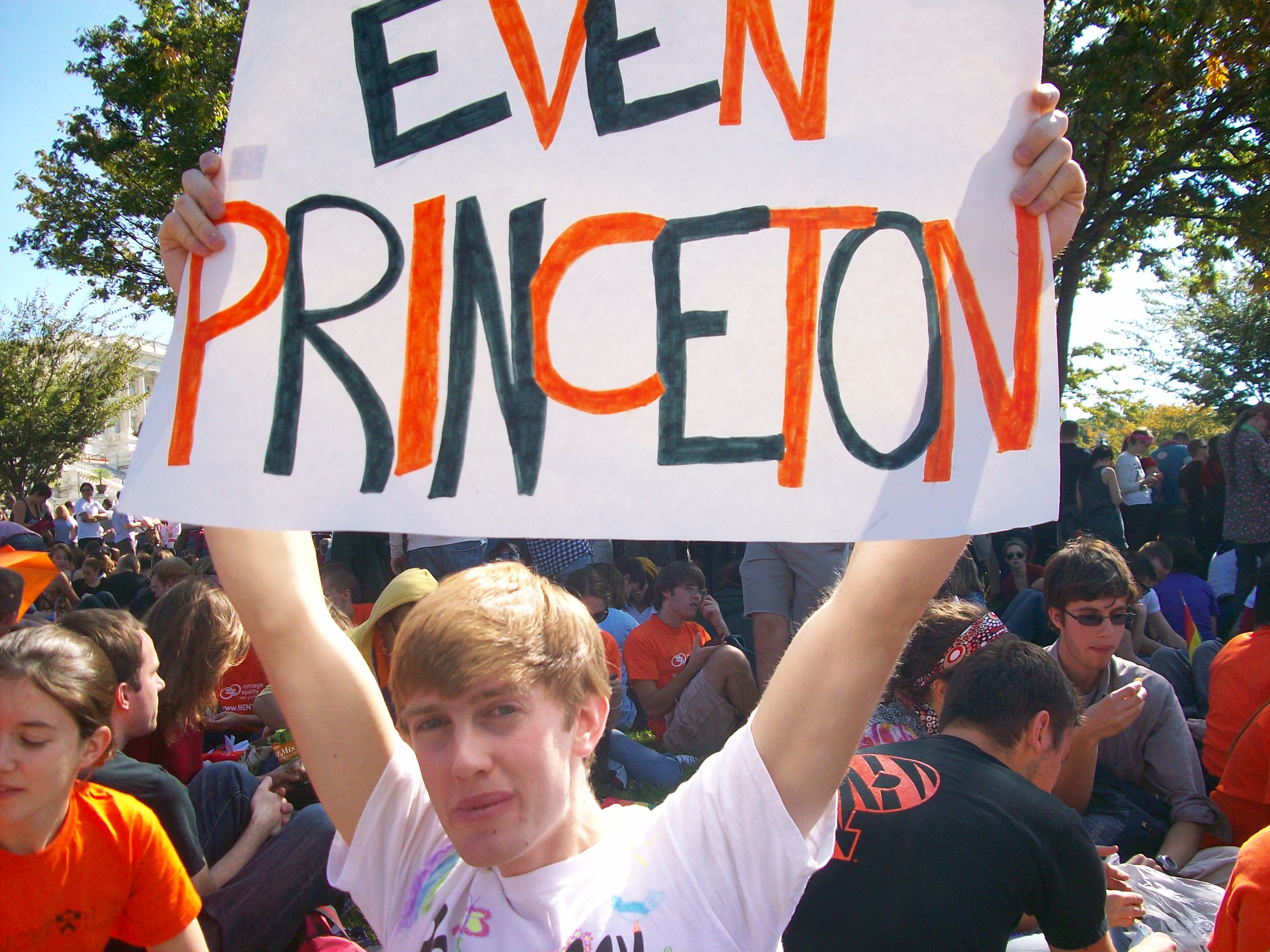
Even Princeton, folks. Even Princeton.

(cross-posted)

Even Princeton; or, This Is What Democracy Looks Like!

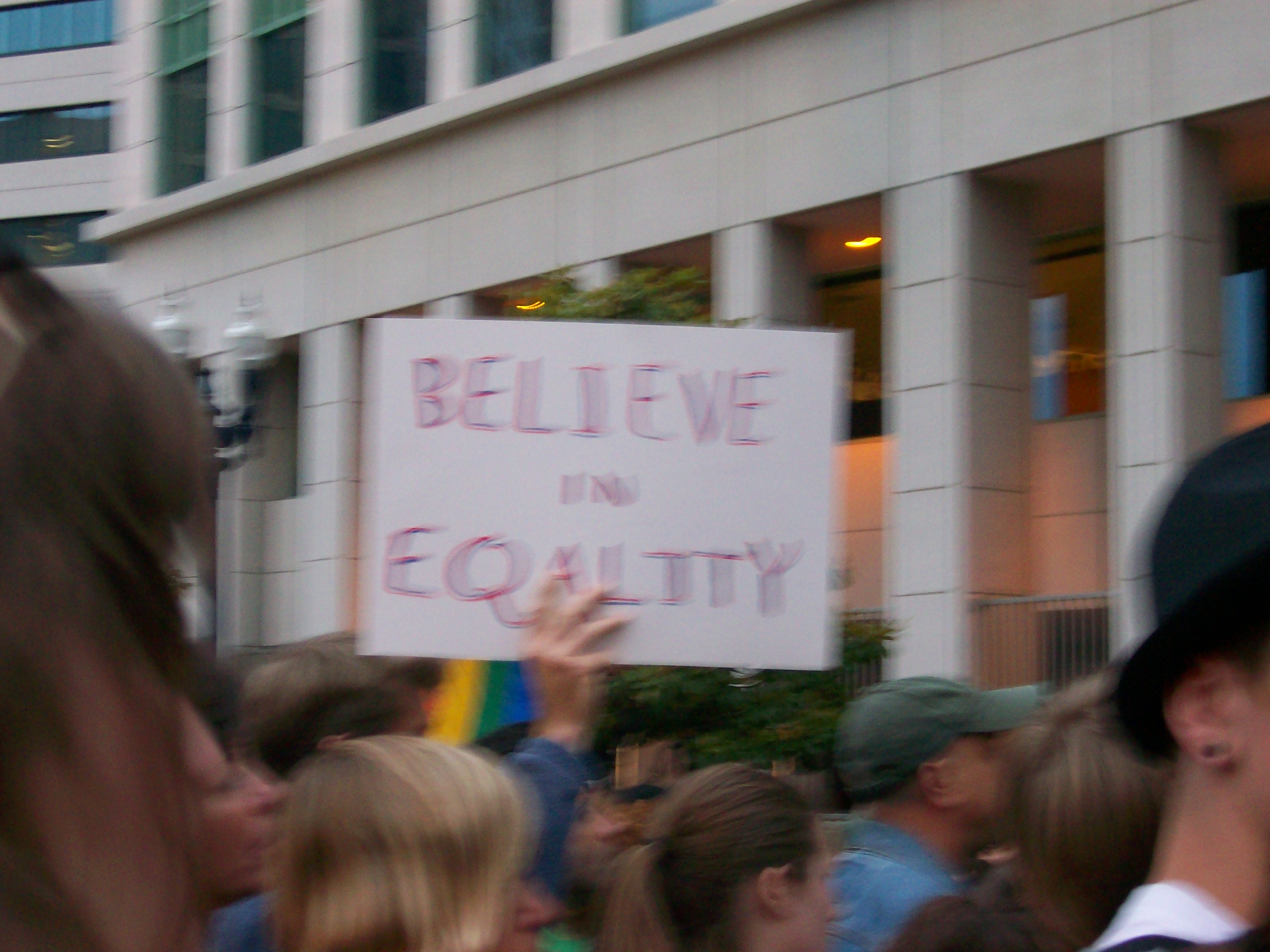
I have marched on the San Diego Hall of Justice and City Hall in Manhattan. I’ve protested in Princeton and at Scripps Ranch High School. Today, I marched on Washington. Today, like my mother before me and in the footsteps of a proud tradition of activists and organizers, I got in a van at 6:30am and drove down to Washington.

100_1212

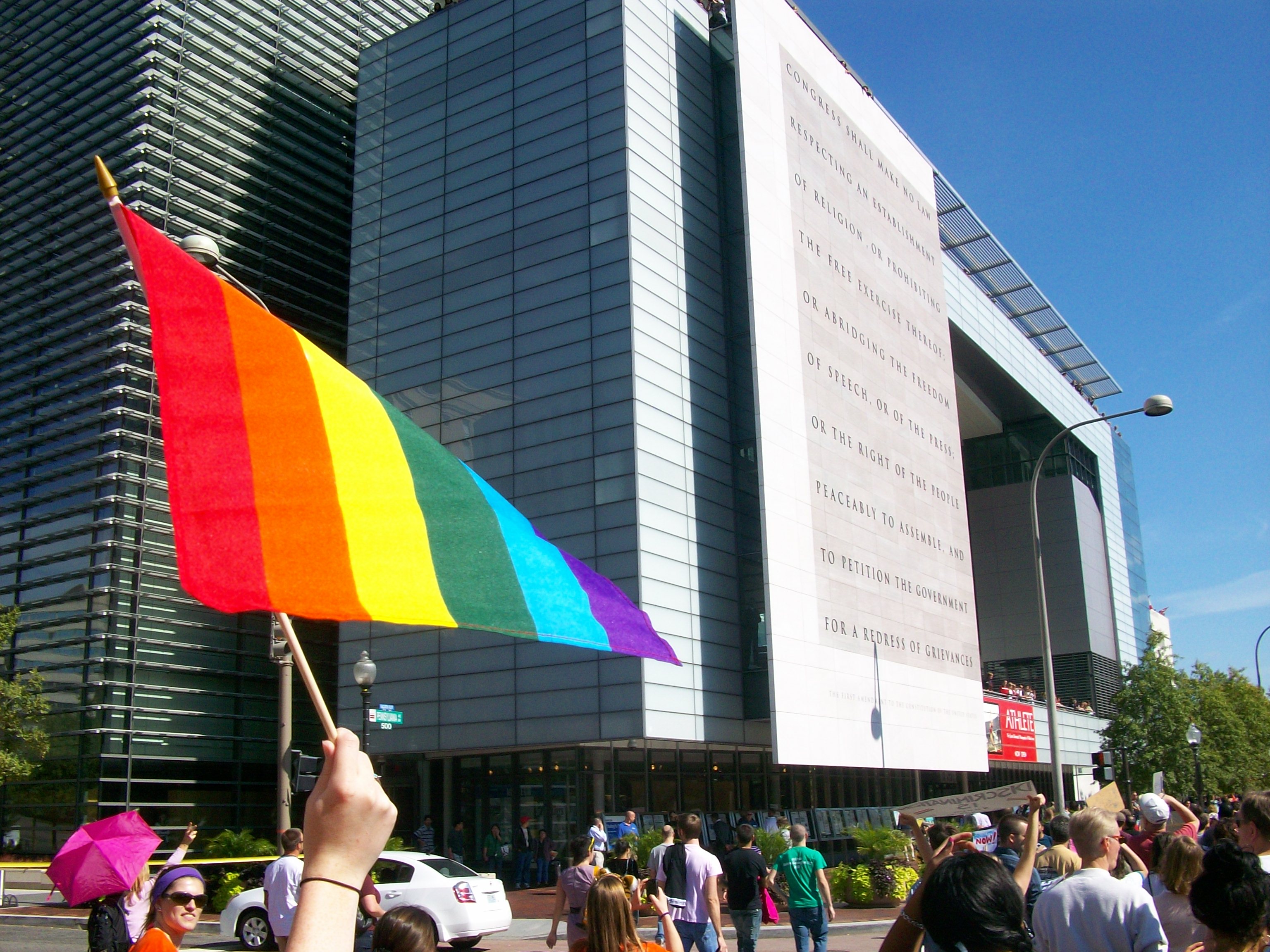
I marched. I chanted and shouted and cheered (I lost my voice). I cried, especially at the rally when Dan Choi spoke, when Staceyann Chin performed, and when Cleve Jones spoke. I cried most of all when the cast of Hair, who canceled a show to come to the march, sang “Let the Sunshine In.” Readers will perhaps be aware that no song is dearer to my heart than “Let the Sunshine In.” It represents all that is wonderful and all that is left unfulfilled with regard to the American promise. There was no way I could have heard it sung live on the steps of the US Capitol with rainbow flags flying everywhere and not have started to sob. I caught a couple minutes of video of the song, but all you can hear is my tired voice cracking as I try not to cry.

100_1234

There is nothing so incredible when it comes to exercising your freedom of speech as marching past the White House, past federal buildings of all kinds, right up to the steps of the Capitol. There is nothing so incredible as marching in solidarity with your friends and your classmates, but also all the marchers around you. There is nothing so incredible as being able to get 70 people—many of them first-time marchers—from Point A to Point B, and realize that they, too, have loved every minute of it (thanks to EVERYONE, particularly the first-timers, for coming with us today!). There is nothing so incredible as someone coming up to your Princeton contingent to say “I graduated in ’05, and we would never have gotten together a group like this then.” Even in four years, things change. Just think where we’ll be only a few years from now.

100_1253

Some of the speakers at the rally referred to the activist legacy that brought us to the steps of the Capitol today. They referenced the civil rights March on Washington in 1963, and countless gay/LGBT rights marches. The invocation which began the rally called out not to God, but to the spirits of activists like Phyllis Lyon and Del Martin, Harry Hay, Frank Kameny, Harvey Milk, and many others. None of those people, in the time that they began their activism, could have brought 100,000 people to the steps of the Capitol to fight for LGBT civil rights. And yet without their struggles, that couldn’t have happened today.

100_1265

I came home tonight to two things: a tweet from a colleague-friend who proposed different means to the same or similar ends (in other words, Maine before marching), and a flyer from Princeton’s Anscombe Society, advertising their proposal for an Abstinence and Chastity Center on campus. In utterly different ways, both things questioned how I chose to spend my Sunday (and the past few weeks in planning for this Sunday). To my colleague-friend, I say that the fight for equality is not a zero-sum game; I’ve donated my time and my money to Maine even as I remain focused on making sure a contentious election in my own state works out. But doing so did not preclude me from marching today. As they say whenever we do these kind of things, we march for those who can’t—and so I marched today for second-class citizens not just in Maine, but all over America and all over the world. I marched for the people who are unable to come out or unable to travel; I marched—as one speaker at the rally said—for all the people who would have marched today had they not been lost to AIDS or to anti-LGBT brutality. As to Anscombe: I laughed when I saw the flyer that had fallen under my door; I wished I’d been able to tell the kid who dropped it so that I could tell him what a waste of a flyer it was. I wished I’d been able to make sure he knew how 70 kids at his university spent their Sunday.

100_1276

Tomorrow is National Coming Out Day, and my name will appear along with 600 others in an ad in the day’s honor in the Daily Princetonian. There is actually probably nothing more important in this struggle than coming out, and being brave enough to sign your name to something like this. But the old chant does go “Out of the closet and into the streets!” and I think the second clause is nearly as important as the first.

100_1275

(cross-posted)

The Winds of Change; or, What Do We Want? Equality! When Do We Want It? Now!

This is where our world stood 50 years ago:

homophiles

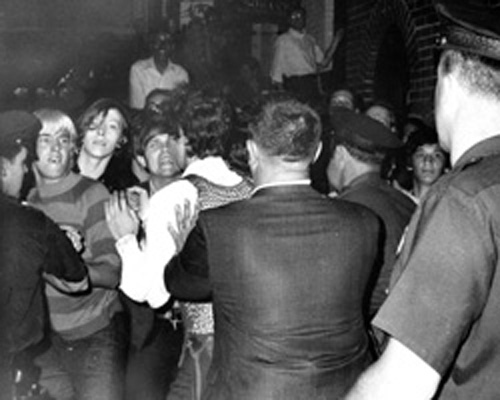
This is where our world stood 40 years ago:

stonewall_riots

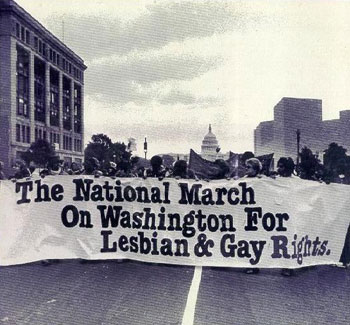
30 years ago:

1979_march

And, today, though circumstances may have changed drastically since then, we’re going to do it again. The arc of history bends towards justice, but sometimes you just have to march.

What do we want? Equality! When do we want it? NOW!

100_0501

When I get home, I’ll post a picture of our “Even Princeton” sign, out in the streets of Washington.

Costumes; or, I Actually Made It Through This Post Without Saying “Performativity”

I was walking across campus one day last week when I ran into a friend. We chatted for a few minutes about this and that, and then he said to me, “I like your outfit!” I looked down at myself: jeans, sensible cheap brown shoes, brown-and-navy-striped sweater, brown corduroy blazer. “Thanks,” I said, delighted that my efforts to select clothes that matched when I’d gotten dressed that morning had paid off—and delighted, too, that my current costuming strategy was an overall success.

Since I had that conversation, I’ve been thinking a lot about how I dress, and how I used to dress. Clothing is an expressive medium, and over the years I’ve completely changed my style of dress again and again and again. Childhood and adolescence is convenient in this respect: you outgrow things. A lot. You lead an active life, and things wear out. And so every couple years, you get to completely reinvent not just your wardrobe, but the first impression you want to give people, what you want them to take away from a glance or a brief interaction.

I’ve always been big on first impressions. I would pick out my first-day-of-school outfit with something akin to fervent devotion, whether it was the party dress I wore in first grade, the plaid skirt and sweater vest I wore in fifth grade, the flowing thrift-store garments I wore in eighth grade, the cargo pants and aggressively political t-shirt I wore in tenth grade, the baggy form-concealing sweatshirt I wore in 12th grade, or the well-fitting jeans and button-down I wore to my first class this semester. From first period (or, later, first lecture) on, I would be making a statement about whether I intended to fit in or stand out, about whether I lived in a world in touch with reality or entirely removed from it, and (increasingly, later on) how I understood and wanted other people to understand my gender identity. And somehow, underlying all these costumes of first impression, lay the desire to please: somehow I expected to please my teachers by wearing my approximation of a school uniform, even though I was educated at Montessori and public schools all my life. Somehow I expected to please them, too, by the display of individuality that was wearing peasant skirt and blouse one day, overalls the next, and dressing as a member of the Continental Congress the next (as a side note, I wish I still had those breeches, but I outgrew them years ago). Somehow I expected to please the boys in my classes whom I wanted to befriend by wearing their hoodies and cargo shorts, their jeans and t-shirts, though of course I stood out more by virtue of being a girl who wore those clothes. I struggled to blend in or to stand out, and then, by the time of a few months ago, I suddenly realized I wanted to be able to dress nicely, and stylishly, the way young grown-ups dress. Tired of being asked by a store clerk for my mom’s permission before I took a free sample at Trader Joe’s, I graduated to jeans and blazers and button-downs and sensible shoes.

I thought that my new style of clothing was absolutely unremarkable at a place like Princeton, until I had a conversation on Facebook with a friend who told me that my clothing style is “distinctive.” That seemed incredibly bizarre to me, because there was a time when I took my style cues from the Society for Creative Anachronism, and when I would actually answer to the name “the smart girl who wears those weird clothes.” Now I look at my friends’ clothes, or sometimes at catalogues or shop windows, and try to approximate the things I like with the help of the racks of Target or Kohl’s or Old Navy. When my friend suggested that how I dress is even noticeable, or worth remarking on, the world of middle school came flooding back. I’ve been thinking since about the long skirts, and the brightly-colored vests, and the clogs, and how my mother would sometimes braid my hair. I’ve been thinking about the knee-breeches and the full-sleeved white shirt I bought from an online costume shop with my allowance, and the stockings and the leather boots and the plastic Halloween sword I would wear at my side, and the baldric I made for it out of an old scarf of my mother’s. I’ve been thinking about how complicated getting dressed then was, as complicated as being an actor and putting on your costume. I’ve been thinking about how good I became at letting my dress fall just so over my chair, or posing in just the right way with my hand on the hilt of my plastic rapier. I must have looked ridiculous—but the attention, whether positive or negative, was sufficient enough.

I compartmentalized a lot of what it was like for me to be 12 or 13 when I got a little older and started caring about fitting in, and over the past few months I’ve taken such melancholy joy in unpacking my childhood—waxing nostalgic for the good old days when I wore petticoats as easily as doublets and didn’t care what anybody thought. I was still, mentally, dating an imaginary friend, who didn’t seem to care either; it would be a long time before I wore shorts every day through the (balmy San Diego) winter because a boy I had a crush on was known for doing the same. It would be a long time before I cut my hair, and before I became terrified of the women’s restroom because, occasionally, another girl would tell me I was in the wrong place.

I’m not sure if being “the smart girl who wears the weird clothes” is what I’m still going for—or rather, after years of trying for casual not-caring about clothes, I’m going for once again. I think I’d settle for being just “the smart girl.” But now that I’m thinking again about how clothes come together to make an outfit—a costume—that says something about who you are, I feel as if I understand all over again the 13-year-old girl who laid out a week’s worth of costumes across her bedroom floor. I’m not sure if I’ll ever voluntarily wear a skirt in public again—too much has changed since then—but I remember how that girl aimed to be herself and to celebrate her individuality—and, also, to belong to a world that wasn’t the one she lived in. And maybe, as I write this, it’s occurring to me that this is the critical point.

In 8th grade, I wrote a 98-page novella called Musicians’ Guild. I haven’t ever read it in full since I finished it, simply because I think I would be so embarrassed by what I found. But I do remember that the characters in Musicians’ Guild dressed the way I dressed back then, in a brightly-colored thrift-store approximation of the clothes of the emerging early modern Anglo middle class (or something like that). Perhaps it wouldn’t be too far of a stretch to say that now, I dress not like a Princeton student but rather like a student at the University in My Head (UMH—see here)—a universe something along the lines of the idyllic, romanticized bits of Brideshead Revisited, but with American studies and computers.

I’ve never been too good with reality. I’ve never been too good with socialization, and fitting in. But as I reconstruct a Whiggish narrative of my adolescence, I am struck by what I meant, back then, by deliberately choosing the costumes of difference. I am struck by what I meant, and indeed what I utterly failed at, when I deliberately chose costumes of careful conformity. And I wonder what it means, now, that my new veering-on-pretentious east coast style (which would, I know, be very out of place in San Diego) has taken over both my reality world and my fantasy one. I no longer am sure what I’m trying to tell the world by my costuming, and I suspect it will take the perspective that growing out of college provides before I really will know. And yet, I’m not sure I really do care. I care that right now my clothes make me feel okay about how I look, and that last week my friend complimented them. I think that’s all I need to know now—and with that, it’s back to my neverending schoolwork. When you’re dual-enrolled at Princeton and UMH, you really have a lot of work to do.