QOTD (2009-09-20), and a Rant

From Lytton Strachey’s Eminent Victorians, in the section on Florence Nightingale:

As the years passed, a restlessness began to grow upon her. She was unhappy, and at last she knew it. Mrs. Nightingale, too, began to notice that there was something wrong. It was very odd; what could be the matter
with dear Flo? Mr. Nightingale suggested that a husband might be advisable; but the curious thing was that she seemed to take no interest in husbands. And with her attractions, and her accomplishments, too! There was nothing in the world to prevent her making a really brilliant match. But no! She would think of nothing but how to satisfy that singular craving of hers to be doing something.

Reader, I can relate. So much of my life recently has been a struggle not to feel guilt for not doing enough, for not putting the greater good ahead of my emotional (and intellectual!) needs as much as I feel that I ought to. Maybe the “general will” and “duty” and “freedom of the fully rational will” in the Rousseau and Kant and Hegel I’m reading in my political theory class is getting to me; maybe it’s just that I’ve made my activist bed, and now I have to lie in it. I have to actually comply with my own exhortations to action; I’ve adopted a community, and now I have to work for it. In the space of a year, I’ve gone from sitting around a lunch table bitching about the place to actually changing it for the better.

But at the end of the day, I don’t want to spend the rest of my life lobbying and writing emails and sitting through committee meetings and talking to people and doing the logistical organizing for events. Those things are really, really important, and I’m glad that people want to do them, and I’m glad that people continue. But I want to spend the rest of my life in the classroom and the library, and honestly, I don’t think that’s too much to ask. You can satisfy your long-term emotional needs, and still be doing something too.

In his Elements of the Philosophy of Right, Hegel outlines three forms of freedom (yeah, I know this is getting a little bizarre, for one of my posts. Bear with me). The first and most basic of these is the freedom of the immediate will, which is a sort of “life, liberty, property,” human-rights idea—the right to do what you want in your own home. The second is the freedom of the reflective will, which means making choices for yourself in accordance with a long-term vision of your personal happiness (e.g. if I judge that becoming a professor will bring me the greatest happiness, I should make choices that will result in my excelling at undergrad and grad school). The third, and according to Hegel, the highest form of freedom is that of the fully rational will, which holds that our freedom is embodied in the institutions of “ethical life”—the family, the state, and the civil society—and that to ensure our freedom we have to invest ourselves in and uphold those institutions, in so far as we judge them to be rational and moral (e.g. we might not have to live in accordance with a state that allows slavery, or a family structure that condones domestic abuse). However, each of these three forms of freedom builds on the others—they’re all necessary when it comes to being and acting as a free individual.

Now, this may seem like a total tangent and just a rehashing of my professor’s lecture last Thursday, and you’re probably wondering, “How does this connect back to Florence Nightingale, and what the fuck is Emily going on about?” But I’m inclined to read the Hegel like this: there is a side to living as a fully realized individual which involves acting in accordance with what will further the greater good of society and its institutions, and there is a side which involves acting in the way that will best further your own personal happiness. These are both constituent parts of Hegel’s freedom; they’re both necessary.

And so if, like Florence Nightingale, you’re going to assign a moral value to “doing something,” the best way to go about this is to ensure that “doing something” will result both in furthering your own personal happiness and the greater good. I haven’t finished the Strachey, and his take on Nightingale is obviously different from the folklore we get in school, but we learn about her today in terms of the greater good she served—not in terms of who she was as a person, and what her idea of happiness might have been. I’m not entirely sure it’s a good thing that we care so much about how selfless she was; selflessness (very obviously) implies that there is no “self.” No identity. No personhood. And if that’s what doing something entails, well frankly, I’m not too sure I want to be identifying with Nightingale and her desire to be constructive.

I went to talk with someone today about some administrative issues, and I wound up sitting in her office for over an hour ranting at her about all this stuff. (Well, I didn’t bore her with tales of Florence Nightingale and Lytton Strachey and Hegel, but the gist was the same.) It was then, taking up the poor woman’s time with my still-so-teenlike angst, that I realized I really need to get a grip. But you can babble about 19th-century intellectuals all you like, and still go to bed wondering what you’ve done all day that’s made the world a better place. My desire to become more culturally literate (as I sit in precept or at meals every day so very aware of the enormous gaps in my knowledge) is having it out in my head with my desire to become just a shell inhabited by a desire to fix the world, and it’s enough to make me want to move to Canada permanently before I explode. (In Canada, after all, we have marriage equality and much less sexism in politics and government health care and multiculturalism and French and beautiful scenery and a Conservative party that isn’t convinced that Armageddon is nigh.)

I don’t think I can keep going on like this. I feel as if one side is going to win out sooner or later—but I dread the guilt I will be consumed by when this happens, and the lingering fear that I won’t have made the right choice.
QOTD (2009-11-18)

From Paul Venable Turner, Campus: An American Planning Tradition:

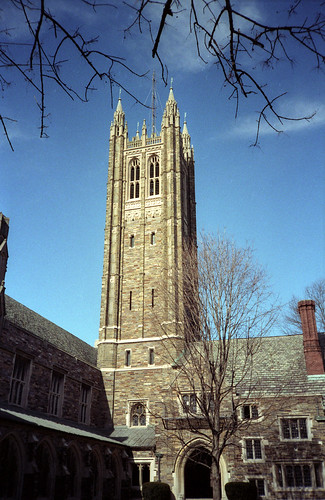
Upon assuming the presidency of Princeton in 1902, Woodrow Wilson praised the new buildings by Cope [Blair and Little Halls and Dillon Gym], saying that they were the first stage in the formation of “a sort of circle and quadrangle,… girt about with buildings in the style that is historic,” and creating “a little town” unto itself. The specific style of Cope’s buildings, a picturesque interpretation of Tudor or Jacobean collegiate architecture, appealed for several reasons. It was consummately English, and thus, according to Ralph Adams Cram, it evoked “racial memories.” And it had aristocratic connotations, which were emphasized by the carving of heraldic shields on the facades of the new structures, in line with Princeton’s adoption of a coat of arms in 1896. Wilson praised this Tudor architecture with the observation that

by the very simple device of building our new buildings in the Tudor Gothic Style we seem to have added to Princeton the age of Oxford and Cambridge; we have added a thousand years to the history of Princeton by merely putting those lines in our buildings which point every man’s imagination to the historic traditions of learning in the English-speaking race.

So yeah, the reason why I am sitting in one of Princeton’s fin-de-siècle neo-Gothic dormitories writing about Princeton’s fin-de-siècle neo-Gothic dormitories is because Woodrow Wilson was a racist Anglophile. Great.

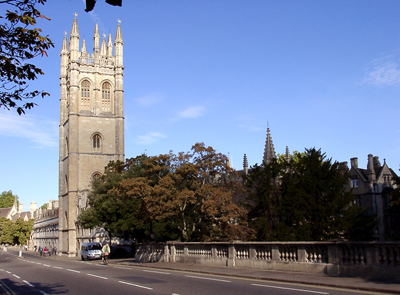
I read in another one of these Princeton architecture books that the Holder tower is meant to be a copy of the Magdalen College, Oxford tower. The two don’t actually look like each other at all (the Princeton Grad College tower is probably a bit closer), but it does sort of explain why I was looking at pictures of Oxford the other day and thinking there was something familiar about the Magdalen tower.

I have to confess, though, that while I’ve always known about how American Ivy League colleges like to imitate Oxbridge (there’s this museum in the British Cambridge somewhere that has a whole display on John Harvard and how he wanted to bring Cambridge to America—which, obviously, he quite literally did), I hadn’t really considered the racialized element of this situation. It makes me feel kind of uncomfortable, suddenly, about my enthusiasm for the Princeton-Oxford exchange-student program, and for American gothic architecture, and other aspects of the distinctly American brand of Anglophilia. I like to think that my own Anglophilia is a lot more realistic than many Americans’; I know that Britain is much more than Monty Python and the Royal Family and I try to keep abreast of the realities of modern Britain. But is it possible to achieve that “realism” when you’re still, at the end of the day, an American Anglophile? Can you be an American Anglophile without in some way associating yourself with this horrible Wilsonian version of academic Anglophilia?

The Washington Blade Shuts Down, and We Lose a Piece of History

I know that there are more important things going on in the world, news-wise, but I have to confess that I was pretty broken-up by yesterday’s news of the abrupt closure of the Washington Blade, among other gay papers owned by the same publishing company. The rest of the gay press has of course been mournfully sympathetic in its eulogies for one of the most important pieces of gay media history, but one of the best write-ups, I was pleasantly surprised to see, came from the Post, whose treatment of LGBT issues over the years has not been precisely sympathetic:

“It’s a shock. I’m almost speechless, really,” said Lou Chibbaro Jr., a Blade reporter who has written for the newspaper since 1976, covering the full arc of the country’s gay-rights movement, from early marches through the rise of AIDS and on to the latest battles over legalizing same-sex marriage.

The Blade, born in an era when most gays lived in the closet, grew in size and stature as Washington’s gay population blossomed and became more politically active and influential. Chibbaro, who wrote his first front-page story for the Blade under a pseudonym at a time when publicly stating one’s sexual orientation could be dangerous, felt the change in dramatic fashion this year, when, while covering a presidential news conference on health-care policy, he was directed to a seat in the front row.

The Blade’s closing comes at a moment of extraordinary optimism for many gays in Washington. The big story Chibbaro and the paper’s other writers have been covering is the bill supported by nearly all of the D.C. Council’s members that would legalize same-sex marriage in the city.

“Here we are, on the verge of having marriage equality, and it would be real shame if the Blade wasn’t there to cover the victory,” said Deacon Maccubbin, owner of Lambda Rising, the gay-oriented Dupont Circle bookstore, which had been advertising in the paper since the shop’s 1974 opening.

[…]

A small troupe of activists founded the Blade in 1969, a few months after New York City police raided the Stonewall Inn, a gay bar in Greenwich Village, igniting riots and launching the gay rights movement. In its infancy, the paper was known as the Gay Blade and consisted of a single, letter-size sheet of paper that its editor, Nancy Tucker, mimeographed and distributed herself, scooting around town in a Volkswagen to drop off stacks at gay-friendly bars. The paper’s mission was to unite an eclectic array of gay groups, including drag queens and government workers, literary buffs and motorcycle enthusiasts; inform readers of gay-related services; and warn them about blackmailers and other scammers.

In the ensuing decades, the Blade’s editors became more ambitious, switching to newsprint and dispatching reporters to write about discrimination against gays in the federal government, hate crimes such as the killing of Matthew Shepard in Wyoming, and political and health issues generated by the AIDS epidemic.

The article even quotes Frank Kameny as saying that the Blade “have become the voice of record for the gay community.”

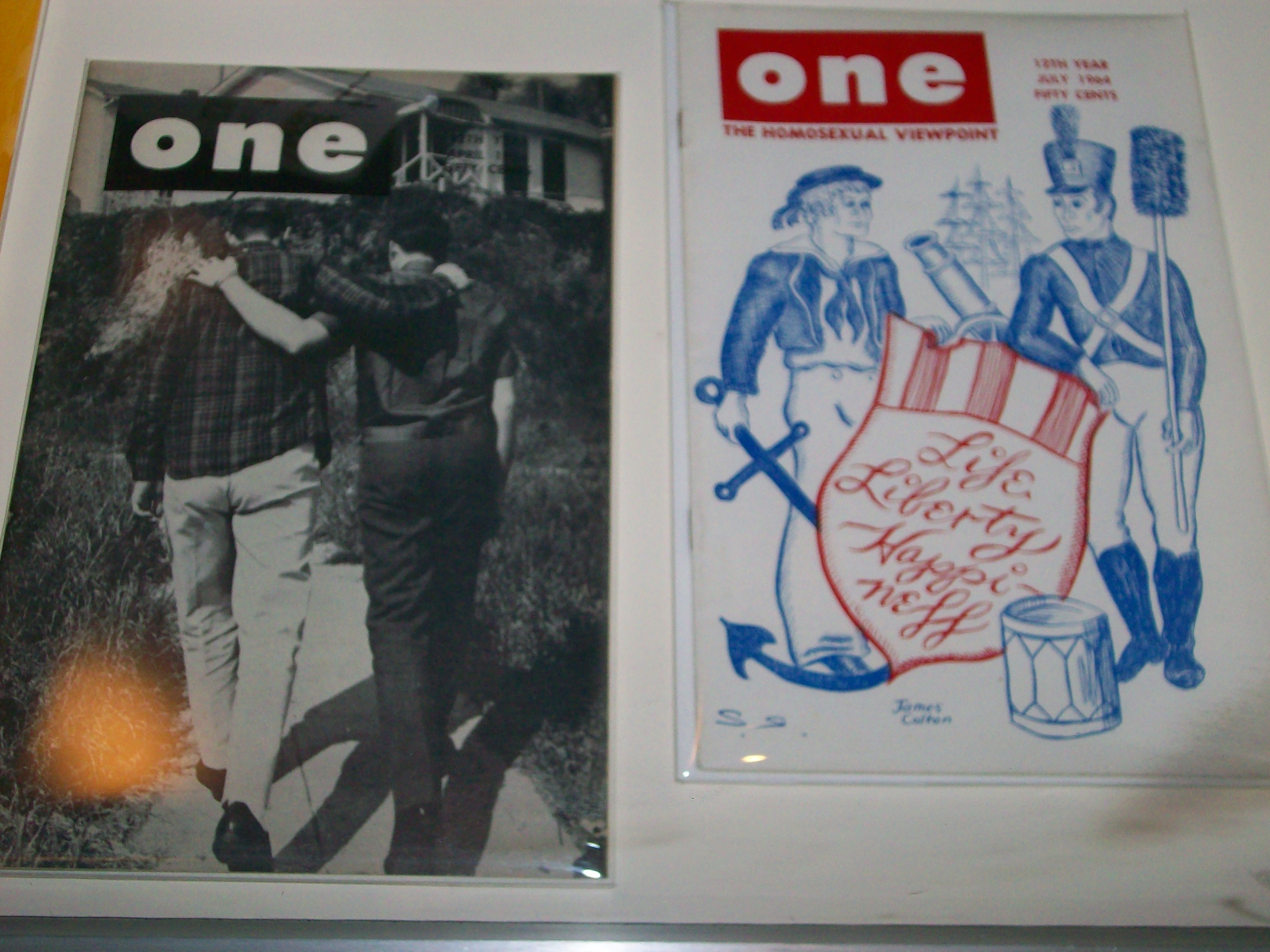
Believe it or not, the Post really gets it right: the gay press is part and parcel of gay history (I’m using the word “gay” intentionally here, for obvious historical reasons). If we are to date the modern gay rights movement back to before Stonewall, we would likely want to begin at the founding of One Magazine in 1952. It was the first gay publication founded by the first gay rights (“homophile”) organization, and it was seminal in establishing the idea that gay identity constituted not some private, internal psychopathology, but a community with a culture. One and its successors helped to spread and coalesce this idea that there was a group of people with shared goals and interests which were worth working to attain. They enabled the parallels between gay struggles and the struggles of other civil rights and social justice movements, and this in turn enabled Stonewall, the first Pride and gay rights parades, and the veritable phalanx of post-Stonewall gay papers. These included, of course, the Blade, but also half a dozen publications in New York and one for just about every other major city. These papers advertised the events of a marginalized and still largely closeted community. They printed the personal ads that couldn’t get printed in other publications. They, of course, reported on the news of hate crimes and police brutality that the mainstream media ignored. Come the 1980s, they were an essential venue of mobilization and organization and dissemination of information surrounding the outbreak of the AIDS crisis. The Blade in particular, by virtue of being based in Washington, was the paper of record of LGBT legislative struggles, reporting on the issues that still impact the community today—from the (eventual) federal response to AIDS through to the recently-passed landmark hate crimes legislation. These papers have recorded LGBT history, and they also are LGBT history.

Probably anyone reading this blog can recite a litany of the reasons the newspaper industry is dying. There are blogs and online editions of papers and myriad ways to access information without paying for it. Instead of paying to put ads and classifieds and personals in papers, people post to Craigslist or dating websites or place ads on websites. Newspapers are losing their revenue—and all these patterns impact what has become the LGBT community doubly. This is a community that is increasingly less ghettoized and more assimilated; what need has it for a particular venue for its ads and its news, when dating websites accept all sorts of advertisements (and dedicated gay dating websites also exist), or when the Post and the Times will cover the issues they once ignored? We no longer live in the era of the NYT’s notoriously poor AIDS coverage. Times have changed. And the Blade, tragically, has locked its offices and fired its staffers.

So maybe Bilerico and Pam’s House Blend and Towleroad—in collaboration, indeed, with the Times and the Post and, heaven help us, the Wall Street Journal—can fill in the hole left by the demise of the Blade and its peers. But how alienating it feels to know that we’re leaving the era when a marginalized community used its print media to band together and organize and share in its solidarity?

(cross-posted)

Contentment; or, Writing Life As It Happens

Tonight, while talking to my mother online, I said, “I don’t know, sometimes it’s more that I’m just bowled over by how much has changed [since I came to college] than anything else. Sometimes it’s overwhelming. Sometimes I just look at myself and I’m like, holy shit, really, for the first time in my life I’m not continuously depressed. I can get through a school day without bursting into tears.”

And while I’m the first to admit that I may have been being a bit melodramatic (by the end of my secondary education, I was only sobbing maybe once or twice a week!), it is true that it is only in college that I’ve found a place where I actually belong. I know I tend to go on about this perhaps a bit too much, but I assure you, dear reader, that I only do so out of sheer astonishment that the years and years of sitting alone on the outside are over, and that I can be the person I want to be and have friends and something resembling a social life in spite of it. It’s only as I piece together memories of school and that other teenage life that I realize how different things are now—and how horrible they were. I realize how much I’ve changed. I realize how much more I’m in control. I realize that, objectively, school really did suck, and it wasn’t just my overactive imagination making up the sexism and the hatred of independent thinking. I am the first to proclaim that Princeton has its faults, but I no longer live in a world where, as a girl, “smart” meant “smart-assed,” and where refusing to stand for the Pledge of Allegiance or criticizing the Vietnam War made me a traitor. If my life is circumscribed by what people think of me, it’s only because I want the people I care about—friends, and professors, and, once again, my family—to see me as intellectually curious and genuine and entertaining and interesting and worth the investment of their time. I don’t care about “cool”; “cool” will come as the rest does too. I want to spend the rest of my life in the academy, because it is here that “smart” and “cool” are, after years of self-loathing that began when I entered elementary school, finally equivalent.

My mother came to visit me this weekend, the first time that anyone in my family has come out here since I made this place my home. I have been so proud and excited these past few days to show off my life: my fourth-floor bedroom over the archway, my long meals filled with friends, my world whose compass points are library and coffeeshop and dining hall. Finally, I am living my life on my own terms. Finally, I got to show my mother who I can be, given the chance.

My mother, as you may know, went to this university too, many years ago. We’ve sat three meals now in the college dining hall—the center of my world—and talked steadily about how this place has changed since then. My mother and I have looked at each other across the long wooden (sticky) table, and across generations. She was an outsider; I, though not so very different, belong. At times it is almost impossible to describe how or why this is, but I need only look at my diaries from three or four or five or eight or ten years ago to know exactly what she means. I can relate a potted history of how this place has changed, and how people like us have gone from the margins to belonging, how we have been transplanted from the institutional rubbish-bin to the institutional center, but you’ve heard it all before—if not from me or my mother, surely from some class or lecture or book on how the world has been made easier for all sorts of people in the past thirty years. Princeton is no exception to that rule—or, on the other hand, perhaps it is. For in those thirty years, the culture I came from has not changed so much as this one; maybe this is something particular to the ivory tower, where not just women, and not just queerfolk, and not just people of color, but all the differentfolk (I am all for making a Germanic compound word out of that) can find their place.

I am working on a project for a course on life-writing (biography, autobiography, memoir, that sort of thing), which is going to be in some way about my childhood imagination. I haven’t necessarily worked out yet how it’s going to proceed thematically, but I’m trying very hard to stay away from the temptation to write my life teleologically, as something that is suddenly wonderful somewhere around February 2009. Instead I am trying to root myself in the past, in the mind of a six-year-old, in a world that was very different—one where, simply put, instead of being taller than my mother, I was short enough to cling to her metaphorical skirts (they must be metaphorical, because my mother only sometimes wears skirts). But I’m not sure whether this is going to work: all my childhood fantasies, you see, invariably led to a place like this—where nerdiness isn’t just a social curse, it’s an all-around blessing.

And so I’m sitting here just before I go to bed on another Sunday night at the end of another week, thinking this is not as tight a little essay as I’d hoped it would be, and replaying in my head not the fairies at the bottom of the garden that I’d hoped very much would make life more interesting, but my own interesting life and its two-hour dinners in the dining hall I love more than most every place I’ve spent that much time. It’s a strange thing, this caricature I’ve become of my own fantasy of student life, somehow juggling balls labeled “writer” and “historian” and “activist” and “professional gay,” yet all in that same self-important and self-serious manner my mother tells me I had when I was two. I know I’m ridiculous, of course, and I can tell that other people sometimes think so too—from the way they look at me when I say I have a thesis topic, or the bemused way in which they tell me either that I work too hard or that I spend too much time on Facebook. But ridiculousness is such a relief to revel in when you know years of every day making a conscious decision between being yourself and not feeling lonely are over. Finally I am proud, proud that I can tell my mom everything I do, and introduce her to my friends, and have us all sit down and gossip in my dining hall as if we have known each other forever.

In Which I Flaunt That Whole Ivy-League Thing Some More; or, Thoughts on the Eating Club System

So you might have heard that Princeton has some eating clubs (which, for clarity’s sake, are ten private dining-cum-social organizations for juniors and seniors, five of which use a competitive selection process sort of like fraternities do, and five of which don’t). If you follow Princeton news as obsessively as I do, you also might have heard that the university has established another in its series of task forces, which intends to “examine whether there are steps that can and should be taken to strengthen those relationships for the mutual benefit of the clubs and the University, and for the benefit of Princeton students and the undergraduate experience.” Of course, I’m skeptical, but the task force actually appears to be off to a very positive start: it’s launched a flashy website, which includes an eight-page document about the history of the clubs (a tad teleological in my opinion [though that may only be because “teleological” is my new favorite word to overuse], but a good primer if you don’t know much about the clubs). And on that website is a set of survey questions that the task force has asked all and sundry to answer. It’s a commendable gesture toward transparency and cross-community involvement, and I’d encourage everyone affiliated in any capacity with Princeton to fill in the form and offer your thoughts, whatever you happen to think about the clubs.

I spent some time composing my answers to the task force’s questions, and so in the interests of continuing to develop a cogent set of talking points regarding my feelings about the clubs, I thought I’d post those answers here:

How have you engaged with the eating clubs and what is your opinion of them?

I very rarely go to the Street at all, but occasionally will go to Terrace on a Thursday or Saturday night, particularly if there is a good band playing. I went much more frequently at the beginning of my time here, but never much enjoyed the atmosphere—even at a laid-back place like Terrace—and am glad that I’ve since discovered other social spaces where I feel as if I fit in better.

I don’t feel as if I fit in at the clubs; the atmosphere of “going out” (entailing dressing up, pregaming, putting on a different and false “self” for the night) is not one that suits me. Presently, I don’t feel as if I’m a dweeb or a nerd or a social failure or missing out on something really important by doing other things with my weekends, but I wish I’d known that as a freshman. It would have saved me a lot of depression and self-loathing. I don’t object to the clubs’ existence (though I certainly do to the bicker process! more on that in the next question), and I know that many people derive a large amount of enjoyment from them, but they remind me a little too much of high school and the notion that being popular and socially graceful are all-important.

If you think the eating club experience could be improved, what are your suggestions?

As a sophomore who does not plan on joining a club, I couldn’t comment on how the process could be improved for me, but as an outsider I would say that bicker is a particularly insidious institution. The notion that a set of entities so rooted in campus history and culture should continue, in 2009, to pride itself on its selectivity and exclusion is to me incredibly problematic. If we are going to have private upperclass dining and social organizations in which a great deal of student energy and emotion is invested, I think that the least we can do as a campus community is to ensure that those organizations are self-selecting (as the sign-in clubs are), not reigned over by a process in which many are inevitably—and, to them, tragically—left out. There’s enough stress at Princeton without sophomores crying every spring because they weren’t considered pretty enough or poised enough or athletic enough or accomplished enough or aristocratic enough for their club of choice.

What is your opinion of the relationships between the eating clubs and the University? If you think the relationships could be improved, what are your suggestions?

It is obvious to just about anyone at this campus that the clubs and the university enjoy a particularly strained relationship, as they have now for some decades. That’s no cause for alarm in itself—in some sense, a university administration and student organizations shouldn’t be on the same side, or be too closely connected. But I have perceived some antagonism in the student body that does seem ill-founded—i.e., this notion that the administration is trying to “dismantle” or “shut down” or “silence” the clubs through initiatives like the four-year residential colleges, Campus Club, etc. From my perspective, the university is picking up a sizable number of students—like myself—who were previously falling through the cracks of the club system and didn’t have the time, the culinary skills, or the social skills (necessary for a co-op or Spelman) to cook for themselves. If the clubs and the university are going to work together at all, they would do well to ensure that every student has a social “home” on-campus, that no one feels as if they “have” to join a club, and that no one feels like a loser for not doing so.

What topic(s) do you think the task force should focus on?

One of the things the task force is in a good position to do is to collect data, and I’d like to see two kinds of information come out of this initiative. Firstly, I’d like to know how the alternative social spaces on or near the Street that the university has established in recent years (e.g. the Fields Center, Campus Club, Frist, the CJL, etc.) are being used: are they acting as substitutes for the Street, as the first alternative social spaces in the ’60s and ’70s were; or, now that the clubs are accessible to more varied sectors of the university community, do these alternative social spaces serve more as supplements to Street culture? Are they places someone would stop at on the way to the Street, or places where someone would go instead of the Street? Secondly, I’d like to see some more detailed data on why students who don’t join clubs choose not to do so, particularly in the form of open-ended questions encouraging longer and more detailed answers. No matter how inclusive, the clubs cannot possibly serve every undergraduate’s social needs, and so at some point reform is going to hit a dead end—it would be useful to know if the four-year colleges and the independent/co-op communities are really filling that void, or if there are still populations of students who don’t feel as if there’s currently an upperclass dining option that suits their needs.

Agree? Disagree? Tell me, but also tell the task force! I would love it if they actually got some good feedback out of that web form.

Armistice Day Art

H.D. (real name Hilda Doolittle) was an Imagist poet, an American transplant to London whose poetry is heavily influenced by Freud and is often inscrutable, but which deals very much with the tumultuous times in which she was writing, during both World Wars. When we talk about war poetry, especially in connection with November 11, we often tend to turn to men such as Wilfred Owen, whose poetry is written from the (male) soldier’s perspective. But we read H.D. in class this week, and I think her writing is as applicable to memorializing the War to End All Wars as any other. I’m particularly interested by how she addresses the theme of Paradise lost through images of Eve and the apple. The passages which follow are from “Tribute to the Angels,” part of her long poem Trilogy. “Tribute to the Angels” was written in 1944, shortly before D-Day (yeah, I know, not WWI, but still relevant, I think).

[30]

We see her hand in her lap,
smoothing the apple-green

or the apple-russet silk;
we see her hand at her throat,

fingering a talisman
brought by a crusader from Jerusalem;

we see her hand unknot a Syrian veil
or lay down a Venetian shawl

on a polished table that reflects
half a miniature broken column;

we see her stare past a mirror
through an open window,

where boat follows slow boat on the lagoon;
there are white flowers on the water.

[35]

Ah (you say), this is Holy Wisdom,
Santa Sophia, the SS of the Sanctus Spiritus,

so by facile reasoning, logically
the incarnate symbol of the Holy Ghost;
your Holy Ghost was an apple-tree
smouldering—or rather now bourgeoning

with flowers; the fruit of the Tree?
this is the new Eve who comes

clearly to return, to retrieve
what she lost the race,

given over to sin, to death;
she brings the Book of Life, obviously.

[37]

This is a symbol of beauty (you continue),
she is Our Lady universally,

I see her as you project her,
not out of lace

flanked by Corinthian capitals,
or in a Coptic nave,

or frozen above the centre door
of a Gothic cathedral;

you have done very well by her
(to repeat your own phrase),

you have carved her tall and unmistakable,
a hieratic figure, the veiled Goddess,

whether of the seven delights,
whether of the seven spear-points.

When reading this, I was reminded of a Pete Seeger song, “Letter to Eve”—much more accessible to the average reader, but equally hauntingly powerful. Listen here, and then remember—as you always should—that the war whose end we observe on November 11 was meant to be a type of action we would never have to repeat.

The Intricacies of Marriage Equality Legislative Politics

Instead of doing work for my anthropology class, I just got distracted by a certain NYT article, which led me to go on an article-long rant about the politics of marriage equality in New York and New Jersey. So much for trying to step back from politics before I have a heart attack or contract diagnosable depression….

You can read the post at my Campus Progress blog, and if you’re interested in staying informed about what’s going to happen in two populous and incredibly important states with regard to LGBT rights in the next couple months, you should really do so.

QOTD (2009-10-09), and Theme of the Week

From Edmund White’s City Boy, on his first teaching gig, at Yale:

Once a week I took a train up to New Haven (a two-and-a-half-hour trip each way) to teach my twelve undergrads. I kept imagining that the students would be much better educated than I and would unmask me as a sham; after all, I thought, I’ve never read The Faerie Queene!

Of course few nineteen-year-olds, even at an Ivy League university, have read widely and deeply. They simply haven’t had enough time, especially when the admissions departments at such schools insist they be “well-rounded.” In high school they have to do some sort of community outreach, sing in the glee club, play lacrosse, work as a volunteer for their state senator in the summer, hold down a part-time job to learn the value of a dollar—and study with a tutor the rudiments of Mandarin Chinese twice a week after school. When would they find time to read Spenser or Flannery O’Connor?

This is of course so very true. I certainly didn’t read Spenser or O’Connor until university, and folks who don’t take English classes could easily get through without reading either. But in high school, I don’t think I would have had the desire to read Spenser or O’Connor; I wouldn’t have realized why it’s important to. University is good for many things, such as the mechanical process that is getting a bachelor of arts degree, and (in my case) giving one the intellectual tools one needs to be prepared for grad school. But I’ve found that the greatest thing university has done for me is to realize that there are people out there who will care if you have read Spenser or O’Connor, and people with whom you can have conversations about them. University reminded me that it is not shameful to delight in knowledge and in art.

This is something of the Theme of the Week, as you may realize. Ever since I spent Wednesday being more depressed than I’ve been in a while, I’ve been buoying my spirits by thinking of art instead of politics. Today I went to the Met for the first time in about 10 years, to look at art and appreciate the fact that there are things more profound than petty arguments (which is, really, all Washington politics is).

Without university, I might have intuited this, but I certainly wouldn’t have known it. When the only people agreeing with what you believe are related to you, you tend not to believe it. University has given me the power to get through my days not just with teeth-gritting attitudes of survival, but with rapturous delight.

I made a new sign for my wall. It says, “Seek Beauty.”

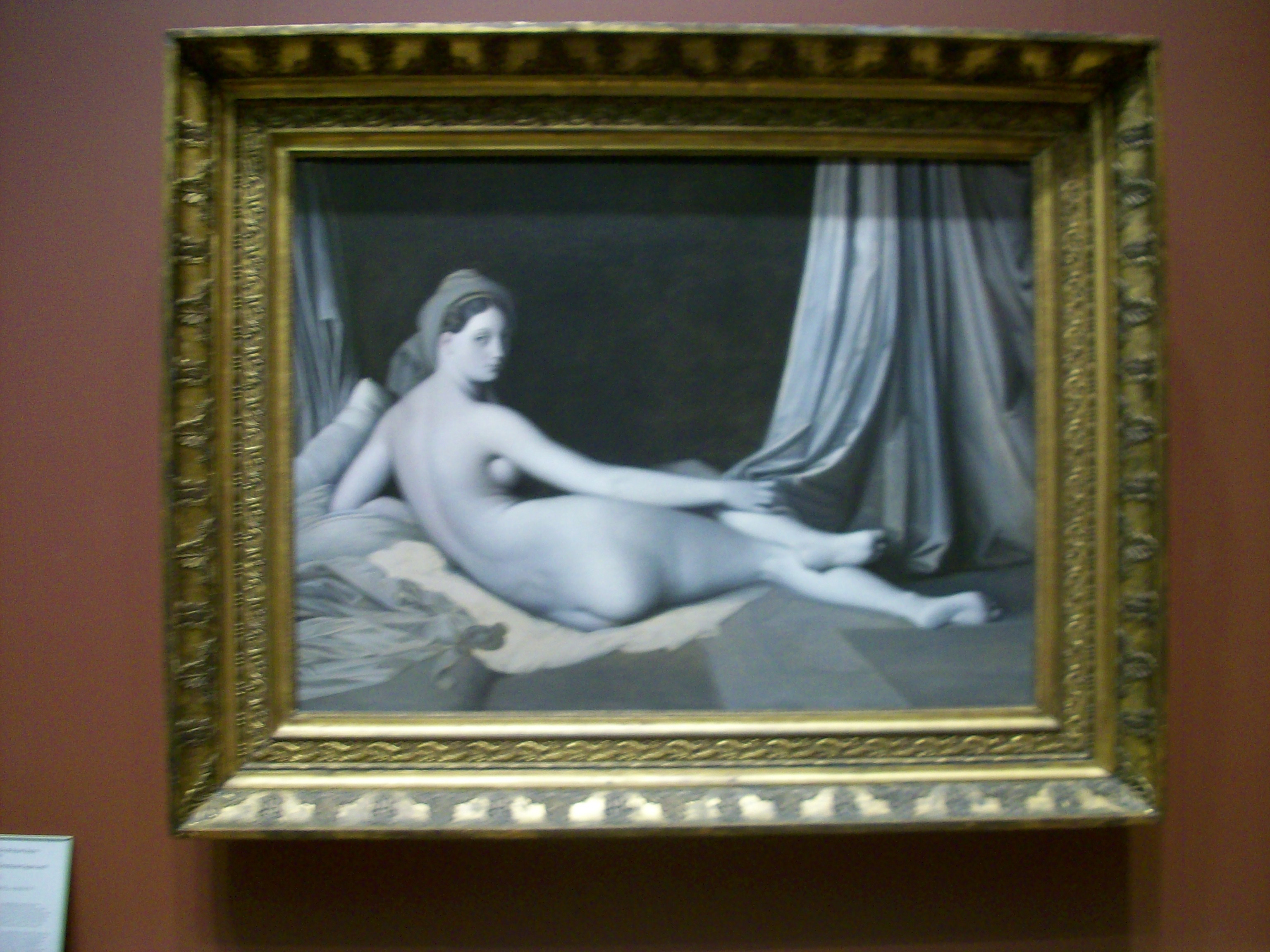
odalisque

On Whitman and Wilde, Homosexuality and History… and some Meta Questions as well

I think that the first thing I ever read in which I recognized gay themes was Wilde’s “Ballad of Reading Gaol.” We read it in my Grade 10 English class, along with The Picture of Dorian Gray and The Importance of Being Earnest (one of the best pieces of amateur dramatics I was ever involved in, if I do say so myself), but very little attention was paid in our class to the double-life themes in the novel and the play that I would later regard as common sense. As far as I can recall, I learned the story of the trial and two years’ hard labor, and used the 10th-grade version of biographical criticism to discover the tragedy of “Reading Gaol” for myself, particularly in its final stanza:

Yet each man kills the thing he loves
By each let this be heard.
Some do it with a bitter look,
Some with a flattering word.
The coward does it with a kiss,
The brave man with a sword!

We had to do a final, capstone project at the end of the year, and my friend and I put on a skit making fun of everything we’d read. The only texts I couldn’t find it in myself to write jokes for were Elie Wiesel’s Night, and “Reading Gaol.” I don’t think I could have expressed then in so many words what I found particularly awful about Wilde’s two years’ hard labor, and how the relentless meter of the poem represents to me how jail stripped the life out of Wilde. In 10th grade, I certainly didn’t know that there is a school of thought which understands Wilde as a watershed figure in gay literary history; I don’t think I knew that the trial of Oscar Wilde brought homosexuality—or something like it—into the public consciousness. If I did know it then, I certainly wouldn’t have thought it as important or as relevant as I do now. But three years ago (it seems like a lifetime ago, now), I figured (though I probably wouldn’t have said it in this way, either) that the three dozen cucumber sandwiches I made for our staging of Importance of Being Earnest were some sort of Edenic precursor to the fallen world of post-trial Reading Gaol.

I know, I know, there are dangers in telling the Wilde story this way. And I’d be the first person to argue that things are always more complex than the Wilde-is-a-martyr-for-the-gay-cause reading. I guess you could even say that, as I have learned more and more about gay culture and the history of gay culture and the history of the history of gay culture, I have proceeded from not understanding Wilde at all to memorizing a famous story to being able to complicate that famous story. That’s something, I think, to be proud of; in this world we have so little opportunity to learn queer literature and queer history that it’s an accomplishment to have any understanding of the genre even at the most basic level. Now, however, I’m reading Richard Ellman’s landmark biography of Wilde, and finding it tempting to fall back upon that romanticized narrative of decline and fall. Ellman makes it easy, I think (though maybe I just know the old story too well by now, and am superimposing it upon Ellman’s rendering); his Bosie captures the giant Oscar and enthralls him and pulls him down; the prose, moreover, is as ebullient in the chapters telling of Wilde’s travels in America as it is dull during the prison sentence. It’s really quite an incredible piece of scholarship, all the same; I can see why it has been so successful. (Incidentally, I wonder why the person who created the Wikipedia entry on Ellman copy-pasted only the first half of the Oxford Dictionary of National Biography entry. Seems an odd choice.) But I can see how the 1997 Wilde film (with Stephen Fry, who must have gotten such a kick out of getting to play Wilde) was based so heavily on Ellman’s work—both portray unquestionably gay Wildes. This is what, I suppose, I’m finding unexpected, coming back to Wilde after months or even years of reading about gay stuff and drumming into my head that it’s dangerous to impose modern notions of sexual orientation upon historical figures. Ellman’s portrait of Wilde is all aestheticism, but also all rentboys and also all petulant Oscar-Bosie quarrels. The interesting thing that is actually quite surprising me is that if Ellman is to be believed, this “aesthetic” version of homosexuality wasn’t all Platonic pederasty; in fact, the London life which eventually resulted in Wilde’s downfall as he became blackmailable by Queensberry and others seems to me to adhere pretty damn closely to modern patterns of sexual and romantic behavior, casual sex interspersed with long-term relationships, Robbie Ross and rentboys and back and forth to Bosie (yes, the alliteration was intentional).

Ellman devotes a great section to the famous meeting between Wilde and Whitman in the course of Wilde’s grand tour of America. Wilde paid a visit to Camden (I said to my friend a little while ago, “Could you imagine Oscar Wilde paying a visit to Camden today?), where Whitman was living with his brother and sister-in-law; the two men drank elderberry wine and uttered many now-famous lines, Wilde questioning Whitman as to his views on all manner of poetics and aesthetics. Ellman concludes the passage about Whitman with these lines:

Wilde would later tell George Ives, a proselytizer for sexual deviation in the nineties, that Whitman had made no effort to conceal his homosexuality from him, as he would do with John Addington Symonds. ‘The kiss of Walt Whitman,’ Wilde said, ‘is still on my lips.’ He would expand upon this theme a little later when signing John Boyle O’Reilly’s autograph book in Boston. Under an inscription by Whitman, Wilde wrote of him, ‘The spirit who living blamelessly but dared to kiss the smitten mouth of his own century.’

See, I’ll confess I did something of a double-take on reading the word “homosexuality” there. I have spent a reasonable amout of time in my life advancing my belief that it’s erroneous to call Whitman a gay or even a homosexual poet, since I’m not persuaded that’s how Whitman would have understood his own sexuality, nor how his poetry suggests that he understood it. I’m of the opinion that it’s unwise to attribute labels to people posthumously that they wouldn’t have used or understood themselves, and moreover I think it’s important to recognize that Whitman really does extol the virtues of all humanity in his writing. People who read this post will know better than I do, certainly, but I’m disinclined to think that the countless times Whitman writes about the beauty and sexual allure of women are just a front to distract readers from the times he writes about the beauty and sexual allure of men. That seems a bit too contrived, and while apparently I lack the vocabulary to write about this issue properly, it just doesn’t seem right to talk about Whitman in terms of sexual object choice.

But what, I suppose, Ellman’s biography is making me question is whether maybe we can talk about Wilde in terms of sexual object choice. He certainly seems to want to. Is that a product of 1895 (the year of Wilde’s trial) versus 1882 (the year of Wilde’s trip to America)? Is it a product of the 19th century versus the 20th, and of 1987 (the year Ellman’s biography was published) in particular? 1987 seems like a not-unexpected year, zeitgeist-wise, to talk up the homosexuality of famous people. Or is it a reading which we can ever resolve as objectively accurate, whatever the historical context?

I have to confess that this idea that things might not be objective is really quite alarming to me. I’m used to being able to trust things that authors say when I’m not in possession of all the facts, and the idea (as obvious as it may seem) that even different people who have quite a lot of facts could arrive at different interpretations of historical events and characters is sort of earth-shattering. I’m still trying to figure out what that means—and, at the bottom line, whether I should trust what Ellman is saying. He cites an impressive array of sources, to be sure, but can I and should I take that as an indication that it is reasonable to think of Wilde as homosexual in modern sexual-object-choice terms? And then what about Whitman? If Ellman is right about Wilde, is he right about Whitman too? Or can anyone ever be right? What is objectivity, anyway?

Okay, okay, so I’m working myself up into a frenzy, and I know perfectly well that there are no answers to these questions. I also know that to a certain extent it is pointless to reconstruct the lives and motivations and desires of people whose social contexts could not have given us a clear picture of what those might have been (i.e. if we can’t prove homosexuality in Whitman’s case, we can’t rule it out, either). These are things you don’t get answers to, no matter how much more learned in Literary Gay Men Studies you become, no matter how many years of school you have. I suppose all I can really say is that I’ve known Wilde’s writing for years, but that—as with so many other cultural stalwarts I’ve rediscovered more recently—interpretations change so much with knowledge (for example, instead of writing 1,800 words ranting about Wilde and Whitman, I should really be writing 1,800 words analyzing Alice in Wonderland and Through the Looking-Glass for a paper which has caused me to learn more about Victorian intellectuals than I’d thought possible).

I know, at some level, I should be able to accept the enormity of my new world after the provincialism of high school. I know that, just as I swallow and accept the bizarre-seeming premises on which Kant bases his metaphysics of morals, or just as I skim over the names of Victorian intellectuals with whom I know I’m supposed to be familiar (if only my secondary education hadn’t been a bit thin on Victorian intellectuals) and wait for context to make all clear, I should be able to accept the premise that knowledge and the universe which it touches upon are infinite, and wait for the context to slowly illuminate the ever-widening edges of the sphere of enlightenment. (That may have been a mixed metaphor.) But more often than not I find myself standing back, agape, dumbstruck, unable to believe how far the mental journey from high school has taken me, back from that first reading of “Reading Gaol” a lifetime ago.

Rededicating Ourselves to Banishing Hate and Finding Joy

The world is too much with us; late and soon,
Getting and spending, we lay waste our powers;
Little we see in Nature that is ours;
We have given our hearts away, a sordid boon!

—Wordsworth

100_0933
They broke their backs lifting Moloch to Heaven!
—Ginsberg

There is too much Moloch in the world. Too much gray modern ugliness. Too much hate-driven oppression, anguish, and despair. Sometimes the mechanic nature of modernity makes it awfully difficult to continue. And while I try not to overshare overmuch about my emotional state in this space, today I had a very, very difficult day coping with modernity. It is hard, in a world of NOMs and teabaggers and other threats to the sanity of the public discourse, to maintain an even keel. It’s challenging to look the world in the eye day after day, and to believe in that increasingly trite-sounding quotation about the arc of history bending towards justice. There is an expectation in our society that thoughtful people interested in the world around them engage with politics. But what if politics doesn’t want to engage? What if elections and campaigns and battles upon battles speak only to Moloch, not to humanity?

Sometimes reason just won’t do. Sometimes we have to step back and rely instead on art and eternal beauty. There are things that matter more than winning elections and coming out on top of the 24-hour news cycle. It is never wrong to do what we can to maintain our faith in the promise that we will find beauty all around us, if only we keep looking. If it comes to a choice, throw reason to the winds and run headlong for beauty!

In the back of my mind, there’s a voice telling me that this is the corniest post I’ve ever written. But you know what? It’s time I stopped worrying about that voice. There are so many things more important than it.

Once I pass’d through a populous city imprinting my brain for future use with its shows, architecture, customs, traditions,
Yet now of all that city I remember only a woman I casually met there who detain’d me for love of me,
Day by day and night by night we were together—all else has long been forgotten by me,
I remember I say only that woman who passionately clung to me,
Again we wander, we love, we separate again,
Again she holds me by the hand, I must not go,
I see her close beside me with silent lips sad and tremulous.

—Whitman


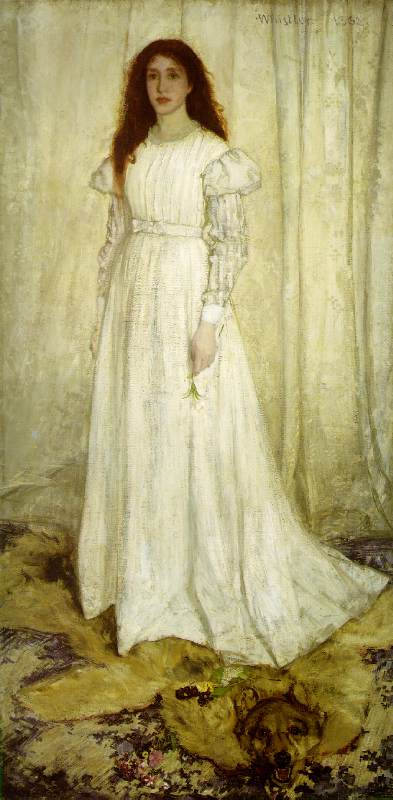
—Whistler

Failing to fetch me at first keep encouraged,
Missing me one place search another…

—Whitman

Holy the supernatural extra brilliant intelligent kindness of the soul!
—Ginsberg

America I’m putting my queer shoulder to the wheel.