Chaucer, Milton, and the Greater Good; or, Happy Belated Fourth of July

Atlantic staff writer Heather Horn has jumped, and jumped hard, on the “I don’t understand the relevance outside the academy of the methodology of humanistic study” bandwagon. Her particular permutation of the bandwagon, while not precisely about the utility of STEM fields or the necessity of building career skills or the frustrating intangibility and apparent impermeability of humanistic study (as if STEM study is ever accessible to the untrained layperson!), is nevertheless pretty well intertwined with all these issues: she’s arguing for eliminating the teaching of close-reading in high-school English classes:

We should end it. Students almost universally hate close reading, and they rarely wind up understanding it anyway. Forced to pick out meaning in passages they don’t fully grasp to begin with, they begin to get the idea that English class is about simply making things up (Ah yes–the tree mentioned once on page 89 and then never again stands for weakness and loss!) and constructing increasingly circuitous arguments by way of support. (It’s because it’s an elm, and when you think elm, you think Dutch elm disease, and elms are dying out–sort of like their relationship, see?)

[…]

If a few students really want to do close reading, they can do it as an elective or jump in head first in college. Otherwise, let’s chuck the concept. We gain nothing by teaching kids to hate books–and hate them s-l-o-w-l-y.

I shudder to think what English teachers Horn must have had in high school and college to have gained the impression that close-reading entails “simply making things up,” but perhaps the curricula she learned under were not dissimilar from the AP English Language and Composition curriculum used by my English teacher in my junior year of high school. Taught to a test supposedly devised and graded by college professors, we were drilled in recognizing different forms of figurative language, and describing setting and tone. We were taught to write a formulaic five-paragraph essay in 45 minutes, in which we would argue that the author used the stylistic devices we had been taught to recognize in order to convey a specific theme (“the author’s message about life,” is the phrase that still rings in my ears), which we had also been taught to pull out and put on display. We were drilled in order to pass a test, mostly reading short expository prose passages instead of novels, plays, or poetry, and developed little understanding of how the work we were doing related to the study of literature outside the context of the exam for which we were preparing. Indeed, I always regarded that year of English as an aberration: in freshman, sophomore, and senior years, we read books and talked about them, and I never had the sense that what we did in those three years was in any way similar to the metaphor scavenger hunt we carried out junior year. And, like Horn, I graduated high school profoundly skeptical of English classes which did that kind of work.

But in the spring of my freshman year of college, I took my first college English class, and not only did my attitude towards the study of literature change, and my understanding of what I had and hadn’t been taught in high school change, my entire life changed. The class was a survey of 14th-18th-century English literature, which at Princeton all English majors are required to take—they’re fed canon in this course because it’s thought that they wouldn’t elect it otherwise, and because the Chaucer and Milton that the course assigns is good for teaching the fundamentals of close-reading. For this course also aims to prepare prospective majors to do well in their chosen field of study, and—as I think I must have been told in the first lecture of the semester—close-reading forms the backbone of the study of literature. As I soon discovered in my practice reading exercises for precept and in the papers I wrote about Alisoun in the Miller’s Tale and the narrative style in Book 6 of Paradise Lost, close attention to the detail of language completely changed how I engaged with texts. Once I had been persuaded (through admittedly, at first, a little willing suspension of disbelief) that Chaucer and Milton had carefully chosen every word, and that we should pay them the courtesy of reading their texts that way, I found not just important issues in the poems—tackling feminism and sex on one hand, and theology on the other—but true beauty. Neither my English classes which read for theme nor my English class which read for the metaphor scavenger hunt nor my own pleasure reading for plot had prepared me for the recognition of the transcendence of Milton’s blank verse, or the hilarity of Chaucer’s puns. Taking that class gave me—or perhaps restored to me—faith and joy in the beauty of language and the literature which puts language into a form that we can read and enjoy. I’ve read a lot of books in my life, and that transformation never happened through reading a light novel in an afternoon. It took being assigned weighty texts, and being asked to pay attention to their finest details, and to write on those details and consider what I thought about them. Contrary to Horn’s suggestion, I didn’t “[construct] increasingly circuitous arguments by way of support”: I believed in what I saw in the text, because I’d finally learned the importance of the details, and their connection to plot and themes. And now, Paradise Lost is one of the most wonderful pieces of literature I’ve ever had the pleasure to read. And despite being a history major, I have taken at least one English class every semester since, branching outside of the canon to women writers, African-American writers, literature for children, popular/pulp fiction, biography and autobiography, and (on my own time) queer literature. Since the first close-reading exercise I did on Chaucer, a silly scatological meander through the Miller’s Tale, I have maintained my faith that the careful study of literature will illuminate the high and the low, and that reading carefully and attentively—reading closely—will change the way you thought you understood everything.

For reasons I have gone into before, I am not an English major, but perhaps this has attuned me more closely to the need to involve methodologies taught in literature departments in the work of other disciplines. The history papers where I have deployed my close-reading skills in the service of addressing the subjectivity of primary sources have, I believe, been the ones where I’ve gotten the closest to saying something interesting; treating the themes and theories of the past like those advanced by fiction has spurred on my greatest intellectual passions. I don’t think I had necessarily forgotten the good that learning and knowledge and careful analysis can do, but being taught actual close-reading, and not just the metaphor hunt, reawakened my sense that reading and interpreting texts and text-like media (which is what we all do, in the humanities) is not a game of pleasure-reading, nor one of baseless speculation, nor one of stringing together citations, but rather a route towards understanding the world we live in. This realization, whenever I think about it, produces an attitude of utter pleasure of which I could never have conceived in high school. Just think what could have happened if my close-reading education had been well-executed then!

Today, in the course of having a political discussion/debate/thing, I found myself reduced to tears by the liberal guilt and 20-year-old’s existential confusion which I so often find is never far away from my mind. I asked myself—as I so often do—whether I am doing the morally right thing by choosing an academic life, whether such a life helps other people in addition to myself, and whether I do in fact have a greater obligation towards selflessness and utilitarianism by virtue of being an Ivy League legacy and the child of academic parents. Every time I find myself frustrated by this problem, I desperately seek for the validation that will tell me I am not selfish to want things which will make me happy, and that furthermore I can do good from behind a lectern, on one side of a seminar table, across an office desk, at committee in a conference room, or seated next to a student in the dining hall. But when I read about human rights abuses such as those being carried out against LGBT people in Iraq (aside: read that story and then call your Congressional delegation, or, if you’re British, your MP about it. I’m serious), I wonder whether I can continue to talk about unhistoric acts when the world is in such desperate need of some historic ones.

But—as it has proved to be in opening up the world of art—close-reading can serve to illuminate these more pragmatic matters too. Last week, the Supreme Court determined—though by a narrow majority—that the precise semantic significance of the 45 words in the First Amendment to the highest law of the land does not permit religious organizations at public universities to exclude those (like LGBT people) protected by the university’s non-discrimination policy. The Court has read those 45 words time and again, and whether they have been understood to strike down school prayer, or to uphold the right of the Ku Klux Klan to walk down the street, the nine (or more, or less) justices have historically achieved their decisions through the very close reading of those 45 words. Likewise, they have read the Fourteenth Amendment to uphold or to overturn public segregation; to uphold or to overturn sodomy laws; to uphold or to overturn miscegenation laws. Reading and misreading and re-reading, those nine (or more, or less) men and women deploy the skills of my freshman-year Chaucer-and-Milton class to change the way life is lived in America, to hold back or to push forward the progress of the arc of justice. If we are to take seriously (as we must) the mission and the necessity of the mission of the Supreme Court, we must embrace the value of a practice of reading which examines the significance, the meaning and the placement, the connotations and at times the critical history, of every word in the United States’ founding document. This has been part of the mission of our country since 1787, and continues to be the integral piece of making it a more equitable and fairer place for anyone to pursue her or his happiness—as integral, indeed, as close-reading is to the study of literature.

Perhaps Heather Horn never had the luck to enroll in an English class which taught her what I have learned in mine since that one disastrous experience junior year of high school. Perhaps she only experienced dull and poorly-taught classes which put her off the study of literature altogether, as happened to so many of my peers without humanities-professor parents and the odd teacher who really knew what she was doing. For that, I am absolutely sorry, because learning how to read literature (and, with it, art) has been my greatest source of joy and hope. I only ask Horn not to condemn the careful examination of literature out of hand—because without people in the public sphere willing to invest in the necessity of the humanities and the close study of texts which they entail, our society doesn’t just forfeit the personal pleasures of a few nerds like me. Our project of “form[ing] a more perfect Union” (note that “more,” edging the project ever onward—not just “perfect” but “more perfect”!), our very nation, is at stake.
What Do the Scissor Sisters, Grindr, and My Local Barnes and Noble Have in Common? or; Presumption and Gay History; or, A Rant Which Is a Little More Sarcastic Than Usual

Starting to overcome the jetlag and culture shock that greeted me upon my arrival back home in southern California, I ventured out of the house for the first time today. My mother drove me to the mall near our house and dropped me in front of Barnes&Noble, and before too long I was standing in front of the two shelves in a back corner labeled “gay and lesbian studies,” wondering what, in my first mainstream chain media emporium in a while (it’s been all independents, academics, and useds lately), those two shelves would hold. It turned out to be largely lesbian erotica (for reasons unbeknownst to me, only one volume for gay men amidst a sea of lesbian titles), but mixed in among every volume of “Best Lesbian Erotica” published in the past 15 years were—to my shock and awe—books and books about Stonewall. There was Martin Duberman’s classic text, and a new one by a local historian who lives on Christopher Street, and one specifically aimed at young adults, and a couple others too which I’ve now forgotten. And though the books I need which was half-hoping I might find on those shelves, like David Halperin and Jonathan Ned Katz, were absent, I did see a few classic texts of the work I do in Literary Gay Men Studies standing out amongst the erotica: Randy Shilts. Edmund White. It was strange, in a conservative suburban world which I imagine is everything that my academic world is not, to think that the Mira Mesa Barnes&Noble’s usual customers might care about gay history too, enough to buy one of five different books about Stonewall. I suppose it should have come as no surprise, really—I knew kids in high school energized into activism by the legend of Harvey Milk—but the incongruity was still jarring. I was so startled that I almost bought And the Band Played On—I mean, who knows whether anyone else would?

I think perhaps that I was attuned today to the extra-ivory tower understanding of gay history (and I use “gay” intentionally; I’m sorry to say I’m not going to be talking about LBT folks too much here) because I had a couple reasons in popular culture to believe that there isn’t much of that going around these days. Sure, everyone’s excited about Pride and stuff, but the Harvey Milk craze has more or less died out, the Frank Kameny craze was more or less confined to Washington, and none of the elders of the gay community are getting any younger when it comes to getting their stories out into the wider community. The increasing normalcy of same-sex marriage has supplanted the urgency of gay liberation; on a far more nerve-wracking note, HIV infection rates among men who have sex with men are sharply on the rise because men my age, born around 1990, don’t remember how awful the 1980s were. I worry that gay men and the LGBT community at large do not only take their history for granted, but are at serious risk of losing memory of it altogether—particularly as my generation, with its oh-so-very-different outlook on being gay in America, reaches maturity.

One event which has got me worried about this is the release of the new album from the very gay dance/pop/disco/thing band Scissor Sisters, Night Work. I saw the promotional posters all over Paris, and couldn’t wait to download the album; it turns out I love it, and have been listening to it a lot the past few days. And perhaps I am attuned to love it because it is an album steeped in gay history, from its Robert Mapplethorpe cover photo to its ’80s-style promotional video to band frontman Jake Shears’ bold declaration that the album’s concept is to carve out an alternative history for the past 25 years: “like AIDS never happened.”

And yet as much as I myself am at times consumed by a profound sense of loss from reading about a time and a virus I didn’t live through; and as much as I devour the history of the era just before, Shears’ explanation of his album makes me uncomfortable enough to sour me on the music. It is irresponsible history—verging on the point of moral wrong—to pretend that AIDS never happened. It (and I do not think strong language is out of place here) desecrates the memories of those who have died from it. I do not know that we owe it to our community to become steeped in the sadness and depression of the so-called “plague” to the exclusion of happier moments in gay history, but I think Shears—and all of us who listen to and love his band’s album—owe it to thousands of people, right down to the man whose ass graces Night Work‘s cover, to remember a history that does not sweep AIDS under the rug simply because it is as depressing as all hell. Rather, we can aim for a more cautious, forward-looking revival of musical genres and cultural aesthetics, which I think is something Night Work does. 2010 so far has been a year fatigued by marriage-equality battles and soured on gay civil rights heroes; it is a year that is perhaps more willing to embrace disco as it once was. Which is fine; I only ask that we turn ourselves to fashioning a disco of 2010 instead of trying to pretend as if it’s still 1978.

I’m not the only one taking this attitude: it’s saturating Guardian writer Polly Vernon’s article about Grindr, the gay-men-meetup-and-hookup iPhone app. If the Scissor Sisters are stuck in some sort of irresponsible time warp before 1983, Vernon is all forward-thinking. Positing that we live in a “post-gay world,” and drawing attention to the apolitical nature of Grindr, Vernon is very much a part of this 2010 gay world I mentioned which is both non-radical and fatigued by politics. Not to mention the fact that Vernon is talking about that most 21st-century of cultural markers, an iPhone app—and one which, she is convinced, is on its way to revolutionizing gay culture and, in this aforementioned “post-gay world,” straight culture too.

But if Vernon does not deliberately erase key swathes of gay history, she certainly seems pretty ignorant of some of them. She thinks Grindr will change the ways that gay men meet each other, hook up, form social connections with each other, date, and understand each other as a mapped-out community. She threatens the downfall of monogamy, raising concerns about monogamous couples where one partner might cheat using Grindr… but Polly, honey, where the hell do you think American male homosexual culture has been for the last, I don’t know, 90 years? Not all gay men are alike, to be sure, or find sex partners in the same ways, but cruising is a long and storied tradition stretching back far before the invention of the iPhone or the GPS or the social networking site. Since homosexuality has existed in America, gay men have had varyingly covert ways of recognizing each other and soliciting each other. Furthermore, as Jake Shears could probably tell Vernon if he hasn’t blocked it out, non-monogamy was the norm in the urban gay culture which Grindr targets until AIDS hit. As Edmund White explains it in The Farewell Symphony (I’m paraphrasing, as the book is in a box in Princeton), the gay community in New York so much understood its identity to be based in non-monogamous values that it had serious difficulty adjusting to a world threatened by infection in which it was recommended that you know the names of your sex partners. And even in our current century, in this AIDS-ridden world, the character Jamie in Shortbus says, “Face it: monogamy’s for straight people.” For all Vernon’s insistence on “post-gay,” there is still a not-insignificant band of the rainbow flag which defines itself in opposition to the “straight” world.

Of course, straight people have never been wholly monogamous, either (ever seen a cheating Senator ‘fess up on TV? or, for a less morally-charged example, ever heard of swingers?), and so I’m not sure what Vernon thinks is so new about Grindr’s potential in the straight market. History and my academic knowledge of these things leads me to believe that a disproportionate number of users would still be gay men, but I see no reason to believe that Grindr will dramatically change how straight men and women conduct their business. Those who hook up will continue to hook up; those who might once have attracted each other’s attention by glances across a bar or perhaps by their own version of the handkerchief code (yes, I’ve seen heterosexual-geared color keys) will just be adding another tool to their repertoire. Despite the wide expert knowledge Vernon claims due to her many pseudonymous gay friends, I don’t see any reason to be as excited as she is about Grindr. Yes, I’m sure it’s a shiny toy. Yes, I think it would be hilarious to watch my friends try it out in a bar. And yes, I’m sure it’s helped a lot of men have a good time. But it seems to me as precisely much of an upgrade to old-fashioned cruising as email was to the penny post: faster and flashier, but not fundamentally altering how we use the English language. Or pick up boys. Or something.

I wish Vernon would not be so quick to assume that, just because she has some gay friends, she knows what it is like to be a gay man and to belong to the gay male community. And I wish Shears would not be so quick to assume that, just because he is gay, he can rewrite the history of his elders. But perhaps I should not either be so presumptuous as to tell a musician and a journalist what I think of what they do on the basis of having read a few books and (yes, I admit it) knowing a few gay men. For just as Vernon will never really understand what it is like to be on the gay cruising scene, and just as Shears will never really know what it was like to live in the Village in the ’80s, I will never have the full understanding of this community that my gay male friends can—and it would be wrong of me to pretend that I can too.

However, I believe that, given the particular mission I’ve carved out for myself, it would also be wrong of me to stop trying. By reading more history, and being judicious about how best to apply it, I can hopefully bring my own outsider’s perspective to the recording of this community’s life before we all forget too much of it. Perhaps, after all, I should have plucked And the Band Played On out of the sea of lesbian erotica and done my best to pay my respects, even all the way out here in the California suburbs.

Two Weeks on the Internet (6/14-6/27); or, What Happened While I Was in France

My resolution to do “This Week on the Internet” posts stopped rather abruptly after the first one, when I took off for France on June 19. Now that I’m back, here’s two weeks’ worth of catch-up, and I’ll continue with this week’s news on Sunday as planned.

Required Reading
Dahlia Lithwick on Maher Arar and the responsibility of the U.S. government to right its wrongs is so, so important.

In other news, Alice drew my attention to an old PAW article from January about race at Princeton, which is required reading for all Princeton folks.

Somewhat more lightheartedly, Sesame Street has a Twitter account, and it’s the best thing.

Below the fold: American and world politics, queer/LGBT issues, academia, books, history and literary criticism, culture, and observations of a more personal nature.
Continue reading “Two Weeks on the Internet (6/14-6/27); or, What Happened While I Was in France”

New York City Dyke March: A Curious Anachronism

My good friend Elizabeth Cooper has a great post up at Princeton’s feminist blog, Equal Writes, about last weekend’s Dyke March in New York City. Elizabeth compares the Dyke March (which styled itself as a protest, not as a parade, unlike the general Pride parade) to last October’s National Equality March in Washington (full disclosure: I helped Elizabeth organize a delegation of 80 Princeton students to attend the NEM). She found herself much less invested in the Dyke March than she had been in the NEM:

The Dyke March, on the other hand, did not feel transformative, at least for me. Although I wanted it to be a protest, it didn’t feel like such for a few reasons. Most importantly, I hadn’t been invested in the organization of the march, and therefore hadn’t really thought about what the march meant to me – it was happening, and I felt like since I was in the city partially for Pride and consider myself an activist in some respects, I should go. Amongst the people I marched with, I felt we shared this sense of not exactly knowing why we were marching. A couple of people thought we were going to be watching a parade, rather than participating in a protest. Once they realized the nature of the march, namely that it was a protest rather than a parade, they asked what we were protesting. I ventured a vague answer about protesting homophobia, but even the question made me insecure about not being more informed about what the march was about, as a whole, and for me personally.

As I was thinking about what I was marching for the day before, I had identified what meant and means the most to me personally right now – acceptance of LGBT children by their parents and family. I thought writing a slogan encapsulating that on a shirt would be cool both during the march and as a keepsake. I am happy and proud that I took the time to invest in my idea. However, at the march, it didn’t prove as valuable for making me feel engaged. People didn’t seem to read it like they would read and interact with a sign.

Elizabeth ends on the important note that visibility of any kind is important, and I absolutely agree with her that “We’re here, we’re queer, get used to it!” is still, in 2010, a valuable slogan. I think it’s absolutely worth underscoring that visibility is in itself a form of queer protest, and that actively and aggressively pushing queerness into the lives of straight people is more or less as radical as it comes. However, the moderate version of this idea (“Everyone knows someone who’s gay!” and coming out to your friends) and the more radical version (using the appearance of queerness to unsettle and challenge people, e.g. a public kiss-in or indeed a Dyke March) can work together very productively. It is not irrelevant that one of the slogans at Stonewall was “gay is good!”—that attitude of simple affirmation persists in the activities which commemorate Stonewall’s anniversary.

That said, I see in Elizabeth’s ambivalence about the Dyke March-as-protest a certain divorce of last weekend’s event from the history of gay activism. It seems as if something like a Dyke March sits rather uneasily in the context of the more mainstream civil rights movement that is LGBT activism today. Elizabeth asked what the march was protesting, and I think that was a good question. An easy example of the problems inherent in answering that question would be that, to judge from its name, a “Dyke March” would be protesting the patriarchal institution of marriage in favor of the beauty of wymynhood, or something from the ’80s like that; while moderate LGBT activism today supports marriage wholeheartedly as an institution same-sex couples should be able to buy into. I do think, though, that Elizabeth made a good choice with the issue she decided to promote on her t-shirt: it straddles this moderate-radical divide in a way that makes sense for 2010.

But a Dyke March still seems, sadly, like an anachronism to me, in contrast to the much more sign-of-the-times National Equality March, which listed clear objectives linked to headlining civil rights issues like marriage equality and Don’t Ask Don’t Tell. It makes sense that NEM would have been more energizing to Elizabeth for that reason, and not just for her personal investment as an organizer: its messaging contained much more to relate to for queerfolk of our generation, while a Dyke March seems as if it would speak largely to second-wave feminists and historians.

(cross-posted at Campus Progress)

QOTD (2010-06-24), Pride Edition

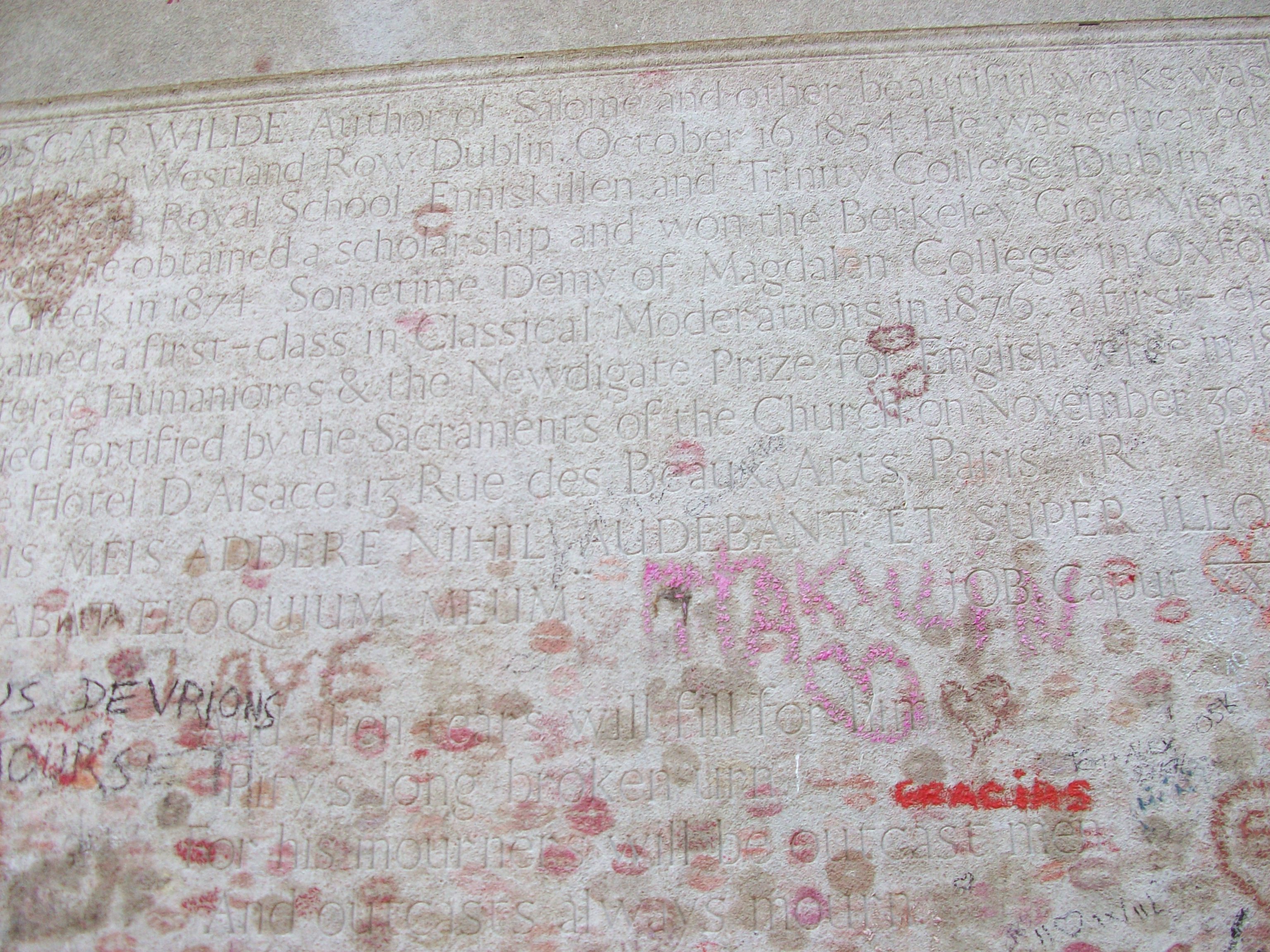
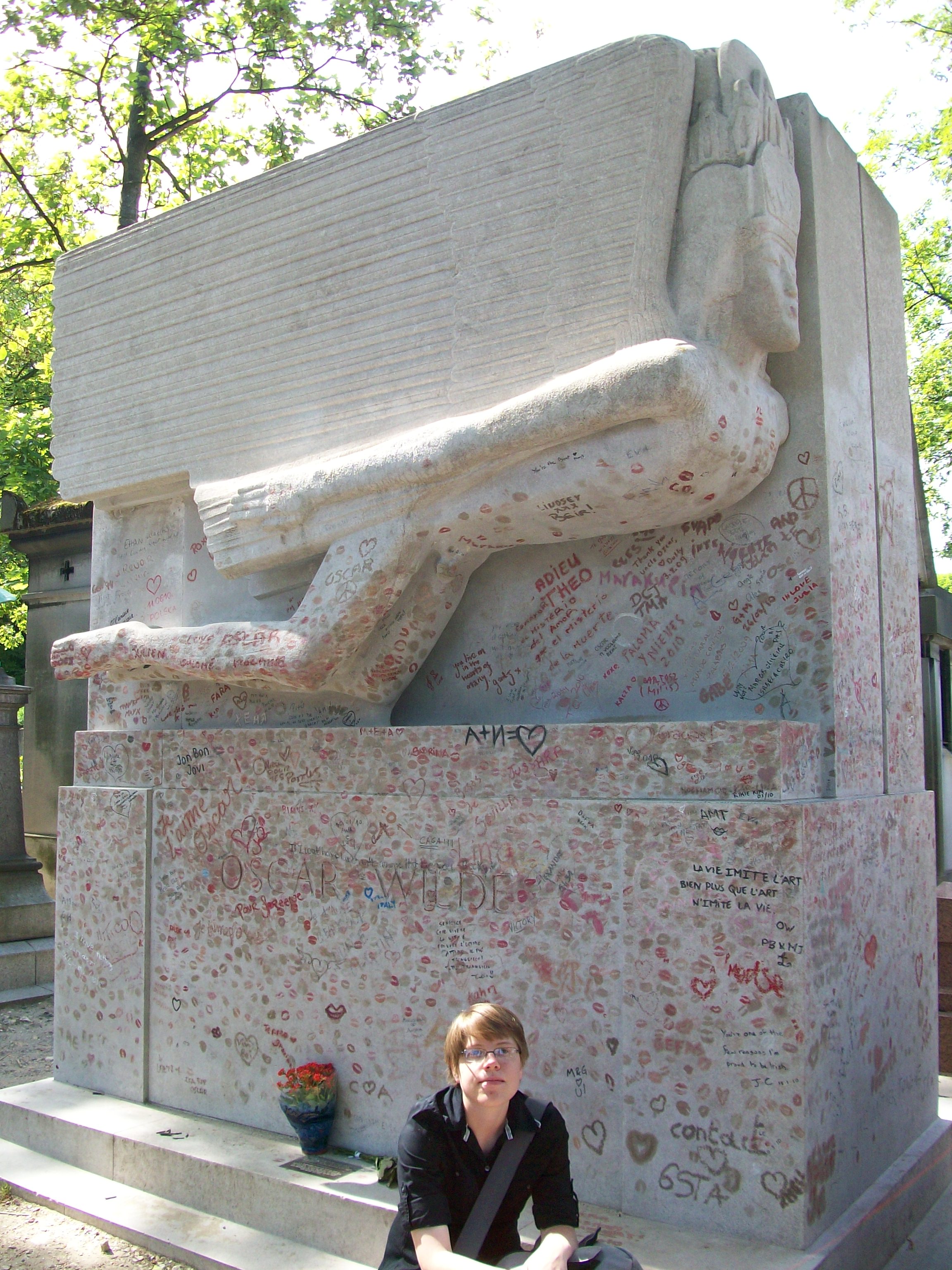
The inscription on the reverse side of Oscar Wilde’s funerary monument (designed by Jacob Epstein), Cemetière du Pere Lachaise, Paris:

OSCAR WILDE, author of Salomé and other beautiful works, was born at Westland Row, Dublin, October 16, 1854. He was educated as Portora Royal School, Eniskillen, and at Trinity College, Dublin, where he obtained a scholarship and won the Berkeley Gold Medal for Greek in 1874. Sometime Demy of Magdalen College in Oxford, he gained a first-class in Classical Moderations in 1876; a first-class in Literae Humaniores and the Newdigate Prize for English Verse in 1878. He died fortified by the Sacraments of the Church on November 30, 1930, at the Hotel D’Alsace, 13 rue des Beaux Arts, Paris. R.I.P., VERBIS MEIS ADDERE NIHIL AUDERBANT ET SUPER ILLOS STILLABAT ELOQUIUM MEUM JOB. Caput xxix.22

And alien tears will fall for him
Pity’s long-broken urn
For his mourners will be outcast men
And outcasts always mourn

His tomb was the work of Jacob Epstein, was given by a lady as memorial of her admiration of the Poet.

The verse, of course, is from “The Ballad of Reading Gaol”; what shocked me about this inscription is just how little of his career is memorialized in it. So much detail about his early life, right down to the street on which he was born, then Oxford—Salomé—and nothing else. In 1909, you could not pronounce the words “Importance of Being Earnest” or “Picture of Dorian Gray,” even on the memorial to the man who wrote them.

“For his mourners will be outcast men”: I have been thinking recently of the role that Wilde has played in the lives and literary imaginations of gay men looking to learn something about themselves, and the work his life and his letters did long after his death to further the development of community centered around a love that now dares (as we have seen in Pride celebrations all month) to speak its name. I hesitate to expand, as I have an article on the subject forthcoming and don’t want to give too much away, but the “outcasts” who “always mourn” do seem to crop up everywhere you look in this particular story. Outcasts mourned the death of Judy Garland, or so the legend has it, on June 28, 1969, before they fought back against the police officers raiding their bar on Christopher Street. And when plucked out of its context about a prisoner’s execution and placed on the tomb of the biggest gay martyr since St. Sebastian, it is so very touchingly interesting how that word “outcast” takes on its more particular meaning to the clued-in, no-longer-outcasts who come to Père Lachaise, to the only grave in Paris covered in red lipstick.

Moments of Maturity; or, an American in Paris; or, Adventures of an Academic Brat

I was talking to a friend of mine on the internet yesterday. She’s in China, on an internship and seeing family; I’m in Paris, tagging along with the rest of my family because my father is giving a paper at a conference here. My friend asked me how it was being back with my family after not having seen them since January, and I responded that it’s much the same. It’s as if the last six months—or, indeed, the last two years—have never happened. Whenever I see my family after protracted absences, it’s as if I’ve never left, and it’s awfully strange to think of their lives going on as normal when I’m not there for most of the year. We transition so easily back to our routine from when I was in high school.

I’ve felt that in particular these past few days, since we landed in Paris on Sunday morning. As we sightsee, I’m reminded of our London trip, or our eastern Canada trip, or our Boston trip, or any of the other trips we’ve been on as a family, spurred by an academic conference or not. As we walk (and walk, and walk!) to various sites of interest (Notre Dame, famous philosophers’ houses, the falafel shops of the Marais, Shakespeare and Company), we habitually fall into a constantly mutating set of pairs: I walk either with my mother, or my father, or my sister, and the other two family members walk some distance ahead or behind us. We alternate between trying to disguise ourselves as Europeans and shamelessly flaunting our map and guidebook. We wake up and go to bed early, by my college-student standards; our sightseeing agendas are planned. And as we walk, I can’t help but think how different these routines are from the two weeks of vacation I had with friends my own age, who tend far more towards the spontaneous than my family, and who like to stay out later; I can’t help but think that Paris’s annual Fête de la musique, a sort of citywide night at Terrace outside on every street corner, was made awfully odd by being there as a child, not as a college student. It’s not as if I sought to escape my parents, or that I resented them. It was just unexpected, a strange change of register in a life that has not quite figured out whether it’s a child’s or an adult’s, and can just as easily fill both roles—except in these strange instances when it feels drawn to both simultaneously, and can’t quite decide which to choose.

Today’s long sightseeing day, however, changed very much how I saw my role as an academic brat with my parents, across the world in a country whose language I barely speak. Our visit this afternoon was to Père Lachaise, the cemetery in the east of Paris where many famous people, including Oscar Wilde, are buried. Wilde’s tomb was one of the few places in Paris which I knew I had to visit before I knew very much at all about Paris; in the past semester, I have become too immersed in Wilde’s life to have missed the opportunity to make The Pilgrimage. There seems, somehow more point to visiting Wilde’s grave than those of so many other important people who are buried in Paris: the tragic ending to Wilde’s life makes the site of his remains somehow more relevant than that of other celebrities whose life histories do not revolve around martyric downfalls. The monument—whose inscription, on its rear side, stops telling Wilde’s life history after he won the Newdigate Prize—bears witness by omission to the ignominy to which his scandal reduced the bestselling author and playwright; the lipstick marks which now obscure the inscription so much that it’s illegible in my photographs bear omission-witness of a different kind to the importance of this tomb to so many people later. The myth of Wilde is powerful, and it is difficult to maintain a cynical distance from it even when you know a bit more than the average fan about his life and work. Even if you know enough to balance the story, to be aware of how complicit Wilde was in his own downfall, you still cannot help but pay a visit to Père Lachaise. And when I took some time before and after my pilgrimage to wander through the avenues of tombs and pay my respects to the dead anonymous as well as (in)famous, from Holocaust victims to long-forgotten officials in the Paris government, I thought that it is not a child’s job to try harder to remember the denizens of the largest cemetery in Paris. It is rather the historian’s, and I think the Wilde metaphor is apt here: it is not responsible history to gloss over the character flaws of an object of study, but it is responsible history not to forget.

When we were on our way out of the cemetery, my father and I spotted an intriguing-looking monument which we suspected might have its own story to tell. As we joked about co-authoring an article on its subject, it occurred to me that in not too long such a joke might become a genuine possibility. Sitting that evening in a restaurant, drinking the same wine as my parents and participating in their academe-gossip, I was reminded as I so often am by the social barrier which alcohol places between myself and the professors and graduate students whom I idolize—and how excitingly quickly, both literally and metaphorically and European drinking laws notwithstanding, that barrier is fading away. As much as I know that it is imprudent to look too much forward to getting older, as before long I will surely wish to slow time down, I am more excited than it is possible to describe in a few stolen minutes before bed in a Paris professor’s sublet that I am getting ever closer to having an equal place at the metaphorical department-party dinner table.

This Week on the Internet (6/7-13)

I’m a very active presence on Facebook, constantly clogging 650-odd people’s newsfeeds with links and commentary about politics, literature/history/culture, academia, queer issues, and miscellany. Since I have some time this summer, I’m going to try to collate the week’s postings in this space, in a regular feature I’ll be calling “This Week on the Internet.” It will start with some required reading (whose necessity I’m in earnest about), and go from there. There will also be a “Links from Others” section, in which I will credit those who send me items by first name. If you would prefer not to have your first name listed here, or if you would like a link to your blog/site with your credit, just let me know. I hope to make this feature into a bit of a clip-show periodical, and I hope you’ll follow along!

Required Reading
The author’s mother passed on to her Mark Slouka’s article in Harper’s on antagonism towards the humanities in modern U.S. culture and politics, which generated a fair amount of discussion in the comments. The consensus was that, while Slouka’s overall points about the way in which STEM fields are favored as “more useful” at the humanities’ expense are right on, he seemed to also unfairly suggest that STEM fields aren’t important to a well-functioning society in their own right. The enthusiastic conversation that we need both sides of the coin was heartening in terms of ensuring the humanities’ continued survival!

Dahlia Lithwick wrote in Slate about David Souter’s Harvard commencement speech and the necessity of judicious jurisprudence. It’s a must-read which is well-complemented by Martha Nussbaum’s Globe and Mail plea for the humanities: good justices need to be good close-readers!

Though entirely frivolous, the headline “William Shatner makes plea for B.C.’s wild salmon was the funniest thing I’ve read this week.

Below the fold: American and world politics, Queer/LGBT issues, academia, books, history and literary criticism, culture, links from others, observations on my own reading/research.

Continue reading “This Week on the Internet (6/7-13)”

QOTD (2010-06-12)

Richard Ellmann, on the last page of his biography of Oscar Wilde:

His work survived as he claimed it would. We inherit his struggle to achieve supreme fictions in art, to associate art with social change, to bring together individual and social impulse, to save what is eccentric and singular from being sanitized and standardized, to replace a morality of severity by one of sympathy. He belongs to our world more than to Victoria’s. Now, beyond the reach of scandal, his best writings validated by time, he comes before us still, a towering figure, laughing and weeping, with parables and paradoxes, so generous, so amusing, and so right.

I have been a month in slowly making my way through this book, and all through it I have been torn between love for the words and the glamor of one of the western canon’s greatest figures, and irritation at the partiality and romanticism with which Ellmann treats his subject. Ellmann has crafted Wilde’s life into such a narrative, and you can see quite transparently how much the biographer has invested in the climax (the “two loves” speech in the witness box at the second trial) and how tragic the next 200 pages of decline and fall must therefore be. I read all 200 today, nevertheless, unable to tear myself away, the dramatist’s life itself a drama.

It is ahistorical, I think, to write anyone into history as a martyr, and yet that doesn’t eliminate the haunting despair that visits me whenever I read “The Ballad of Reading Gaol.” I am angry at Douglas for what he made Wilde endure, and I am angry at Wilde for enduring it, and I am angry at them both for what they put Constance through. Having read the story to its close, I am as invested in it as—perhaps, for deliberate comparison—those Americans waiting for the steamer with the mail from England were in the ending of The Old Curiosity Shop. (It changed a lot of things I thought I knew to learn from Ellmann that Wilde made his famous remark about laughing at the death of Little Nell when he was on bail awaiting his own inevitable prison sentence.) Yes: try as I might to rationally divorce my admiration of the man’s writing from his existence as a deeply flawed human being, I cannot help thinking, all the same, that he was most notoriously—most tragically—wronged (and I think the Malvolio quote not inapt here!).

It is of course Pride Month, LGBT History Month, or whatever you call that month when we celebrate the anniversary of a riot at a bar on Christopher Street in 1969. The past couple weeks (you might say, since this month’s inception) I’ve been reading Wilde almost exclusively, with only a brief two-day digression into Virginia Woolf. I wonder as always what good and what ill we do by loving these fallen heroes so much that they become martyrs to our cause, a cause that stands so very much outside their own historical moment. I only hope that we wrong Wilde no more notoriously than he has already been, because I can certainly attest that it is very difficult to stop.

And all men kill the thing they love,
By all let this be heard,
Some do it with a bitter look,
Some with a flattering word,
The coward does it with a kiss,
The brave man with a sword!

Bibliographies, Indices, Card Catalogues, oh my!; or, The Well-Organized Life: A Cry for Help

I have always been interested in the meticulous organization of my thoughts and scribblings. Back in my childhood bedroom, my notebooks are shelved in chronological order; my high-school math notes are in a three-ring binder with tabs for “geometry” and “intermediate algebra” and “pre-calculus” and “calculus”; the boxes of schoolwork are indexed by academic year and subject; the hard drives are the same, with nests of folders backed up in three places all cross-indexed by date and subject.

But if my work has always been organized, my thoughts have not. My notebooks may march on, all neatly dated in the top right-hand corner of each page, but if I don’t know when I scribbled down a certain quotation or an idea for a new line of research or the title of an article to read, how am I ever going to find it again? In all my efforts to reorganize—blogs, varying folder trees, the occasional catch-all manila envelope—I never seem to have broken out of a chronological approach. It is all very well to scribble a date on something and consider it filed, to post it to a WordPress CMS and see it “archived,” but that’s not much of a card catalogue at all. Even if I started using tags on my blogged collections of pensées, that wouldn’t solve the problem of my handwritten notes, my scribblings in the margins of books, my books themselves. It’s been a long time since I had so few books that I could keep track of them all in a database without constant management—and now that I’ve taken to writing notes about everything in them, that’s become even more true. It’s begun to seem like an insurmountable question of organization—and given that I have officially started background-reading for The Big Research Project, this is a terrible time for me to realize that my research methods are simply inadequate.

I was put in mind of this problem when reading Keith Thomas’s fantastically engaging meditations on scholars’ research methods in this week’s London Review of Books. Thomas talks about moving beyond scribbles in the margins of books (I give a nervous glance in the direction of my weighty used hardcover edition of the Ellmann Wilde biography, which is becoming covered in pencil as I haul it up and down the northeast corridor); he goes on to catalogue catalogues—and commonplace books, card indices, slips of paper in pigeonholes, eventually arriving at cursory (and dismissive) references to the various methods of electronically managing lots of little bits of information. And as I read the article, it slowly dawned on me that: 1) Thomas was speaking from the experience of having written his own long works of history; 2) I will before too long be writing my own long works of history, commencing with The Big Research Project (okay, I mean my senior thesis, but I’m too embarrassed-slash-pretentious-slash-I-read-too-many-real-academics’-blogs to actually call it what it is); 3) I will need more than half a dozen books with attendant scribblings to do this; 4) A year or more from now when I actually start writing the damn thing, I will probably not remember to the letter everything I was thinking when I first read the first sources back in the summer of 2010. Radical revisionism, I concluded, would be required.

And then, of course, two days went by, and I made another hundred pages’ worth of notes in my Wilde books, bookmarked another half-dozen journal articles and book reviews suggesting further avenues of research, and made a couple new entries in my journal trying out some language for thesis statements—all according to the old chronological, scribblings-in-margins method, and all very difficult to recoup without doing all the work I’m doing now over again.

My background reading is going well; I’m in high spirits and I feel as if I’m getting somewhere. Last night I began to get a sense of just where this project might slot between the work that real historians have done, and found myself overcome by the heady enthusiasm that I find invariably greets the all-too-rare sense that I am Having Original Thoughts. Of course, in the background there is always the fear that tomorrow I am going to notice the article which has said everything I could ever possibly want to say, put forth all the primary sources I could ever hope to discover, and in every way trampled over the ground onto which I dream of stepping far better than any half-baked undergrad who took a few seminars at Princeton and now thinks she knows everything could manage. But right now I am scribbling down titles to order the minute I have a permanent address and lying in bed at night dreaming up chapter titles as blithely as can be—only hoping that, as my mental database grows larger, I don’t forget the pieces of my argument which I’m holding mentally—I’m sure, after all, to misplace the bits of paper.

Dear reader, I think it’s time for a Cry of Help: what methods do you propose for keeping together thoughts both in direct response to texts and removed from them; citations; potential avenues of inquiry; and other such necessary trappings of my scary first big project? I prefer analog methods to digital ones, but if there’s a particular computer notetaking/filing strategy you swear by, let me know that too. There is nothing I want more in my life right now than to pull off this project and feel myself worthy of graduate study… but right now it feels very large, and I feel very small indeed, and all those little bits of paper covered in pencil seem like a Red Sea in need of parting.

Madison Mornings; or, Homes and Homecomings

a work in progress

When I feel the dampness of summer on the east coast—eighty or ninety percent humidity, mosquitoes during the day and fireflies at dusk, clothes sticking to my body and a slow laziness to the air that prevents me from reading more than a page before dozing off—I have a curious flashback to Madison, Wisconsin. I spent two weeks in Madison five years ago, my first experience of east-coast summer in several years. We rode our bikes around the lake; we had barbecues in the front yard; we lit citronella candles as the sun set late. I remember Madison as quintessentially summery, like the summers of children’s books from another era—the only difference being my first-generation iPod mini and its Scottish folk music. I was fifteen and hadn’t yet discovered rock, and the fiddles and pipes and accordions and guitars took me on long walks in the stickiness of midday or on long drives through pitch darkness from Shakespeare festivals or dinner parties back to our sublet. Now, when I’m in New Jersey and the temperature first climbs above 80, or the first dinnertime thunderstorm rumbles in the distance, I find myself back in that state-capital college-town green-tree lake-shore summer.

I was in Madison because I am an academic brat. My father was teaching a summer seminar at University of Wisconsin-Madison and so we all followed, as we do. We sublet the house of a professor on leave in some foreign country; we hung around the campus but also played tourist in this university town different from our own. We had dinner parties and party parties with our ad hoc academic enclave, where my sister and I talked Shakespeare and Democratic party politics and played video games with the other professors’ nerdy kids, or chattered at kind and well-meaning faculty spouses about our summer camps and our favorite subjects in school, while the professors talked shop and the grad students drank beer out of bottles and gossiped about who might have a job where. My memories of Madison are at times as hazy as the hot and sticky air by the lake (I know we were only there for a few weeks, but in my recollection those weeks stretch out into an entire pastoral novel), but what I remember principally about Madison was the humidity and the feeling of belonging to an academic enclave. In San Diego, where professors and their families live all over the city, and there are three major universities and several minor ones, we have no academic ghetto. The seminar my father was running, on the other hand, condensed time and space: a set of far-flung colleagues from across the country into one college town and a circuit of department parties into one summer term. It was one of the strongest experiences of community belonging I can recall—and perhaps, then, it is no surprise that the slightest touch of dampness in the air, the lowest rumble of thunder in the distance, sends me back.

—–

Last Tuesday was one of these Madison days, when the fan was on all night and I woke up at 7am to a morning already sticky and still. My alarm was set to three hours earlier than normal because 1,166 seniors and 804 graduate students were receiving degrees from Princeton that morning, and I was being paid $10.90 an hour to stand outside in the 90-degree heat in a shirt and slacks and an academic gown in order to take tickets and direct traffic and tell parents that, no, they could not enter the seating area two hours early; and, no, they could not sit in the reserved section without a ticket; and, no, they could not stand in the way of the academic procession and impede the progress of the president, the board of trustees, and the honorary degree recipients. For three hours, my gown caught on the mechanisms of folding chairs and I took orange tickets from antsy parents while my mind wandered off to bikes and lakes and citronella candles and Scottish accordions.

But it was not just the weather which made Tuesday a Madison morning; it was also all the trappings of academe. The cumbersome black gown signified that I belonged to the same community as the seniors in black; the graduate students in black with orange stripes; and the faculty, trustees, and honorary degree recipients in their rainbow of regalia. There is something unifying and meritocratizing, I find, about academic regalia: it suggests that we are all engaged in the same project of celebrating not just the degree recipients, but also the very existence of the institution of higher education. Watching the graduates process, I felt certain that I would someday have a hood to wear with my gown, and even someday have three velvet stripes on my sleeves. In hearing the formal rhetoric (some of it in Latin) which conferred degrees upon my friends and colleagues, I felt invested in and excited by the mission of my university and of the university in general. When, at commencement’s conclusion, I and my fellow ushers lined the path of the recessional, I felt a great sense of membership in a common mission to educate, to produce knowledge, and to credential the next generation to do the same. Wherever we stand in the hierarchy, whether we have hoods and caps and stripes on our sleeves or not, we are all a part of this mission—not dissimilarly from how it was in Madison, when I talked Shakespeare with the other professors’ kids in imitation of our parents talking shop.

—–

Three days of alumni reunions precede the three days of commencement exercises at Princeton, and I expect that this former celebration is where the majority of the tens of thousands of people who descended upon Princeton’s campus that weekend found their community. I witnessed their exuberant rediscovery of old friendships, their rampant alcohol consumption, their orange-and-black school spirit, and their participation in the parade of alumni classes which for four hours winds its annual way down the road which cuts through the center of campus. It was difficult not to take part in bits of the three-day bacchanal, and I chanted my school-spirit cheers along with the rest of the crowd, perhaps finally singing our alma mater enough times to remember about half of the words.

And yet while reunions proved an enjoyable three days of dancing with good friends, they also left me profoundly unsettled. The event is no celebration of the University (qua cultural institution), as I have known it for the past twenty years and four months. Rather, it is a celebration of Princeton: of old white men and cheap watery college beer, of entitlement and privilege. The nausea I felt when one class of alumni somewhere in the 1970s carried signs lauding the percentage of their class making six-figure salaries and the percentage of their class whose children had also attended Princeton was not entirely assuaged by the jubilation I felt when the crowds cheered for the first classes to graduate women. I woke up on each of three mornings to the disgusting and dispiriting sight of my quad—my home for the past nine months, the center of my residential college and thus my emotional life—covered in garbage, stinking of vomit and stale beer, and I was furious with the alumni whose 45th reunion had snatched my quad away from me, from my university, and from my sense of university. I felt displaced and ill-at-ease, driven from what I’d come to think of as my home.

I was able to recoup some sense of belonging when I went to the LGBT alumni’s Saturday-night party, a lame little student-center-basement event made much less lame by dance music I knew the words to, welcoming friends, and a sense of being among “my people.” Knowing nearly everyone in the room, and dancing with nearly everyone I knew, shifted the dynamic of reunions from something which displaced me to something which welcomed me, and I felt once more that—Milwaukee’s Best-drinking old white men striving towards the Platonic ideal of entitlement notwithstanding—there is a place for me in 21st-century Princeton. It was a sloppy little party at the end of the bacchanal, populated by a ragtag collection of queer kids who’d had too much to drink. But when we all wandered off in the early hours of the morning, it was at least after having been in a multipurpose room where everyone knows your name, and where orange, black, and massive and omnipresent class-consciousness were less important than Lady Gaga to having a good time.

Since, however, it was only the queer party’s dissimilarity to the rest of reunions which saved it from being condemned with the rest of the debauchery, it would take more than a few Madonna songs for me to restore my faith in Princeton as ivory-towered home. This would instead entail three days of listening to speeches and pointing people to the nearest restroom; of entertaining myself by guessing professors’ grad schools by the color of their gowns; and of feeling not-so-secretly thrilled every time I got a smile from a be-regalia’d professor processing past me. By the time Tuesday morning came around, I felt more solidarity with anyone wearing a black gown than I did with anyone shouting “Tiger tiger tiger sis sis sis boom boom bah!” I was proud that I have apparently, after all these years, retained enough Latin to make sense of the salutatorian’s address; I helped to instigate a standing ovation for Ruth Bader Ginsburg when she received an honorary degree; and I applauded wildly President Tilghman’s address, in which she admirably called upon our generation of Princeton graduates to return maturity and civility to the public discourse. Eventually, chatting at my residential college’s reception with the faculty, graduate students, and staff who comprise my surrogate family, Madison morning slid into Madison afternoon—and I was back at the end-of-the-summer-seminar barbecue, telling the academics who all my life have been my literal and metaphorical family about my plans for the summer and then going back for seconds of pineapple and watermelon.

—–

I write this now in Rhode Island, having put my books in boxes and left campus for a while. Maybe I’ll spend some time at my parents’ university when I’m home this summer, but for the next little while I’m among dear friends who don’t play the academic game. It’s summer vacation, and I for one am glad, after a hectic and stressful (but productive) year.

And yet it was on summer vacation that my family went to Madison five years ago, and it was on summer vacation that, last night, I wrestled my network settings into letting me log into the Princeton network remotely so that I could search archive databases for a particular manuscript relevant to the enormous research project on which I am just beginning to embark, the one which I hope will someday become my senior thesis. The leads I found on the internet suggested that this manuscript was given to some library or another—maybe the Library of Congress, maybe the New York Public Library—but no one seems to know which library exactly. As I trawled through the most likely catalogs, marveling at my ability to use my own university’s library resources even though I’m gone till September, I was reminded of the crucial difference between college and academe. College is a four-year adventure, a transient state of packing one’s life up every few months and moving to a new dorm, a new internship in a new city, a new academic project. Semester by semester, your life changes: you grow older and wiser; your research projects get longer; your friends graduate; new friends matriculate. Life is constant change in college, as I found two weeks ago when I realized—to what should not have been my surprise—that packing up my life and vacating my old and beautiful sunlit room over the archway was normal.

But if college is impermanent, academe—in my life, anyway—is the state in which things will always be. Perhaps I am only reminded of this on Madison mornings which turn into afternoons in the Scribner Room, evenings in Rhode Island researching my thesis, or sleepless nights spent stressing about the job market. But academe was my life from the day I was born—and at some sudden moment maybe a year ago, when the air was hot and still like it was in Madison and one of my parents’ colleagues asked me what I thought I might major in and I said “history,” clearly and firmly, I embraced the world I grew up in for all it contains and all it is worth. Most children, I suppose, choose to reject their parents’ world and strike out into uncharted waters, and to them I wish all the best of luck. But as long as “uncharted waters” to me means a document lying undiscovered in an archive, a connection between texts never before made, a student’s mind not yet unlocked, or a degree not yet received or conferred, my permanent home is in ivory towers everywhere, more so than at college reunions or even than on the gay dancefloor.

I don’t yet know whether I’ll come back to Princeton for a reunion years hence, but I’m sure I would return to campus if I had black stripes on my sleeves from another institution, a tenure-track job, and a book on my CV; and if there were a conference in my field and I submitted a paper and wound up presenting it, sitting at last on the other side of the Dickinson 210 seminar table. It wouldn’t feel so much like a homecoming, back to “the best old place of all,” as like an extension of the same world which has always been and always will be my home, no matter which institution grants my degrees or gives me (I hope and pray) a job. For Princeton is not my home so much as academe is, and so I imagine that on a hot and humid summer day in a fantasy world years hence—when I’m working on my senior thesis, my dissertation, my first or my second book—I’ll feel the slightest stirrings of a breeze or see the cloudburst clouds gathering overhead, I’ll put down my book or cease typing for an instant, and I’ll think of summer in Madison.