QOTD (2010-10-30); or, Putting the Pieces Together

From Elizabeth Cady Stanton’s essay “Solitude of Self”, a Rule to Live By:

The chief reason for opening to every soul the doors to the whole round of human duties and pleasures is the individual development thus attained, the resources thus provided under all circumstances to mitigate the solitude that at times must come to everyone. I once asked Prince Krapotkin, a Russian nihilist, how he endured his long years in prison, deprived of books, pen, ink, and paper. “Ah,” he said, “I thought out many questions in which I had a deep interest. In the pursuit of an idea I took no note of time. When tired of solving knotty problems I recited all the beautiful passages in prose or verse I had ever learned. I became acquainted with yself and my own resources. I had a world of my own, a vast empire, that no Russian jailer or Czar could invade.” Such is the value of liberal thought and broad culture when shut off from all human companionship, bringing comfort and sunshine within even the four walls of a prison cell.

The whole essay, in fact, is required reading, for it offers some guidelines as to how to survive the seemingly soul-destroying pressures and anxieties of Living in Society. I take particular heart from it now as I sit here at my co-op’s kitchen table on the first weekend of fall break, trying desperately to piece together my life out of the shards of self-doubt to which it had been reduced after six weeks of term. I mean in the next few days to find a way to more eloquently and constructively write about the hard parts of academic life, why my day-to-day existence has seemed so difficult recently, and how best to deal with it and move forward into Making a Difference—but until I can find my own voice again, I’ll let Stanton’s message of self-reliance and inner resources speak for me.

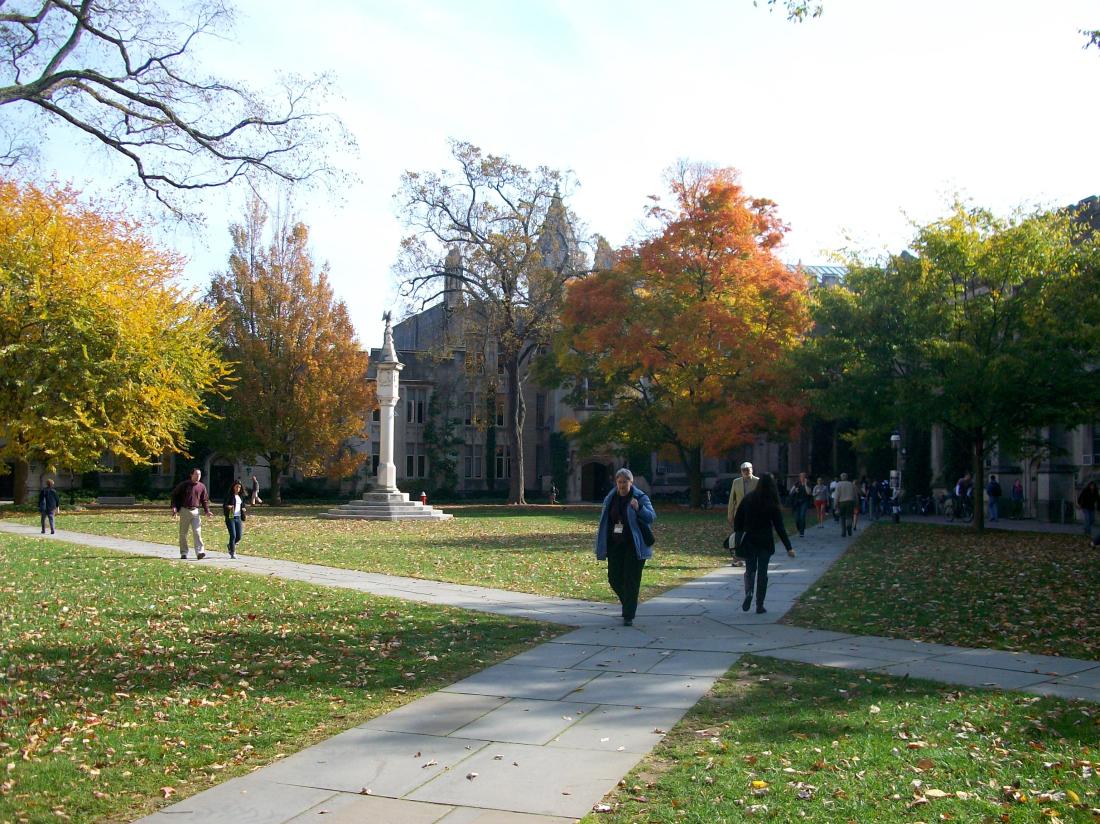
Oh, that, and Joni Mitchell, and the flaringly bright and beautiful crisp sidewalk-littering leaves of autumn:

McCosh leaves

QOTD (2010-10-22), “It Gets Better?” Edition

Joseph Litvak, as quoted by Eve Sedgwick in her Touching Feeling: Affect, Pedagogy, Performativity:

It seems to me that the importance of “mistakes” in queer reading and writing… has a lot to do with loosening the traumatic, inevitable-seeming connection between mistakes and humiliation. What I mean is that, if a lot of queer energy, say around adolescence, goes into what Barthes calls “le vouloir-être-intelligent” (as in “If I have to be miserable, at least let me be brainier than everybody else”), accounting in large part for paranoia’s enormous prestige as the very signature of smartness (a smartness that smarts), a lot of queer energy, later on, goes into… practices aimed at taking the terror out of error, at making the making of mistakes sexy, creative, even cognitively powerful. Doesn’t reading queer mean learning, among other things, that mistakes can be good rather than bad surprises?

Now, I almost had a temper tantrum late last night because I struggle so much with understanding theory, and with understanding why I need to understand theory, so I am not one to tell you what this blockquote is doing in the chapter of Sedgwick in which it appears. But I am one to tell you that, “say around adolescence,” and even as early as my preschool days, I was convinced, as I still am convinced now, that somehow knowing a shit-ton would give me a sense of belonging that I could not find by actually belonging. Knowing that if I was doing your Latin translations for you, you had to let me sit at your lunch table, helped me through middle school. And difference, in more ways than simple queerness (if queerness can be simple, of course), which I suppose some might call a “mistake” of my birth and my early childhood development, became for me a métier and a route to self-understanding. And instead of letting the kids whose Latin translations I was doing tell me what I was, I took my cues from the books whose authors were able to write those books because they had taken their cues from books, and we all fit ourselves into a genealogy of queer reading, generations of around-adolescents who had been saved by the promise of another world, whether that world was one of Socrates’ dinner-parties or one of an alternate European history where the girls could be Cyrano de Bergerac too.

The problem comes, however, when you find yourself reacting this way to a paragraph dropped into the middle of Sedgwick, and knowing full well that your personal experience is leading you to draw something very different from it than what Sedgwick means to draw, and vaguely sensing that if you were a little smarter, or a little better socialized, or a full member of the club, you wouldn’t be drawn to so desperately misread one of the giants of queer theory. You find yourself remembering—as I did last night, when I stared at the pages of this chapter and panicked—that even queer reading can keep fellow queer readers out; can set up new systems of exclusion and oppression even as it dismantles and deconstructs others. When I turn the language of theory back upon itself it becomes harder to hope that I can be “brainier than everybody else” while still being “miserable”: the language of theory remains unchangingly determined to tell me, “ur doin it rong.”

QOTD (2010-10-19)

From K.J. Dover, Greek Homosexuality, in which he’s explaining the character of Socrates in Plato’s Symposium, Phaedrus, etc.:

Plato’s Socrates believes that particular persons, animals, things, artefacts, acts and events which constitute our sensory experience, all possessing definable duration and location in space and all subject to change and decay, give us faint and fitful glimpses of a different world, a world of everlasting, unchanging entities, ‘forms’ or ‘ideas’, accessible to systematic reasoning…. The ultimate cause, towards which all rational explanation progresses, is Good itself; qua form, it is the goal of reason, and qua Good it is the goal of desire. Hence to perceive it is to love and desire it, and error blinds us to it; reason and desire converge upon Good, and in its vicinity fuse together.

This passage leaps off the page for me in a way in which, as good as Dover is, no other passage in this book does, and I think it’s because in its prose I hear echoes of the last few sentences of Pater’s Renaissance:

Well, we are all condamnés, as Victor Hugo says: les hommes sont tous comdamnés a morte avec des sursis indéfinis: we have an interval, and then our place knows us no more. Some spend this interval in listlessness, some in high passions, the wisest in art and song. For our one chance is in expanding that interval, in getting as many pulsations as possible into the given time. High passions give one this quickened sense of life, ecstasy and sorrow of love, political or religious enthusiasm, or the ‘enthusiasm of humanity.’ Only, be sure it is passion, that it does yield you this fruit of a quickened, multiplied consciousness. Of this wisdom, the poetic passion, the desire of beauty, the love of art for art’s sake has most; for art comes to you professing frankly to give nothing but the highest quality to your moments as they pass, and simply for those moments’ sake.

It’s not just the content of the Platonic Socrates’ views: it’s striking, I think, that Dover chose to encapsulate those views through language like “faint and fitful glimpses of a different world,” not so very different perhaps from Pater’s “pulsations,” which yield not necessarily the Good, but at least a better thing: “fruit,” “wisdom.” I’m ignorant of what there is to connect the two other than the obvious Greek-loving (in several senses) cultural context of Pater’s milieu, but I wonder if Dover was thinking along those lines at all when he wrote that paragraph. I wonder, after all, if I’m completely misguided to leap to Pater. What do you think?

QOTD (2010-10-16)

In which, in her Woman in the Nineteenth Century, Margaret Fuller eloquently states a set of precepts I should like to live by. I think this is worth quoting at length:

Yet the business of society has become so complex, that it could now scarcely be carried on without the presence of… auxiliaries; and detachments from the army of aunts and uncles are wanted to stop gaps in every hedge. They rove about, mental and moral Ishmaelites, pitching their tents amid the fixed and ornamented homes of men.

In a striking variety of forms, genius of late, both at home and abroad, has paid its tribute to the character of the Aunt and the Uncle, recognizing in these personages the spiritual parents, who have supplied defects in the treatment of the busy or careless actual parents.

They also gain a wider, if not so deep experience. Those who are not intimately and permanently linked with others, are thrown upon themselves; and, if they do not there find peace and incessant life, there is none to flatter them that they are not very poor, and very mean.

A position which so constantly admonishes, may be of inestimable benefit. The person may gain, undistracted by other relationships, a closer communion with the one. Such a use is made of it by saints and sibyls. Or she may be one of the lay sisters of charity, a canoness, bound by an inward vow,—or the useful drudge of all men, the Martha, much sought, little prized,—or the intellectual interpreter of the varied life she sees; the Urania of a half-formed world’s twilight.

Or she may combine all these. Not “needing to care that she may please a husband,” a frail and limited being, her thoughts may turn to the centre, and she may, by steadfast contemplation entering into the secret of truth and love, use it for the good of all men, instead of a chosen few, and interpret through it all the forms of life. It is possible, perhaps, to be at once a priestly servant and a loving muse.

Saints and geniuses have often chosen a lonely position, in the faith that if, undisturbed by the pressure of near ties, they would give themselves up to the inspiring spirit, it would enable them to understand and reproduce life better than actual experience could.

How many “old maids” take this high stand we cannot say: it is an unhappy fact that too many who have come before the eye are gossips rather, and not always good-natured gossips. But if these abuse, and none make the best of their vocation, yet it has not failed to produce some good results. It has been seen by others, if not by themselves, that beings, likely to be left alone, need to be fortified and furnished within themselves; and education and thought have tended more and more to regard these beings as related to absolute Being, as well as to others. It has been seen that, as the breaking of no bond ought to destroy a man, so ought the missing of none to hinder him from growing. And thus a circumstance of the time, which springs rather from its luxury than its purity, has helped to place women on the true platform.

Perhaps the next generation, looking deeper into this matter, will find that contempt is put upon old maids, or old women, at all, merely because they do not use the elixir which would keep them always young. Under its influence, a gem brightens yearly which is only seen to more advantage through the fissures Time makes in the casket. No one thinks of Michel Angelo’s Persican Sibyl, or St. Theresa, or Tasso’s Leonora, or the Greek Electra, as an old maid, more than of Michael Angelo or Canova as old bachelors, though all had reached the period in a life’s course appointed to take that degree.

QOTD (2010-10-12)

Just one sentence, from the preface to David M. Halperin’s One Hundred Years of Homosexuality:

The author and publisher of this volume have arranged to donate half of the author’s proceeds from its sale to the San Francisco AIDS Foundation.

Halperin’s book was published in 1990; the preface is dated June 1988. One could write an entire essay—nay, an entire book—on the meaning of Historical Moment and context in historiography just out of that sentence.

Unfortunately, I’m too tired.

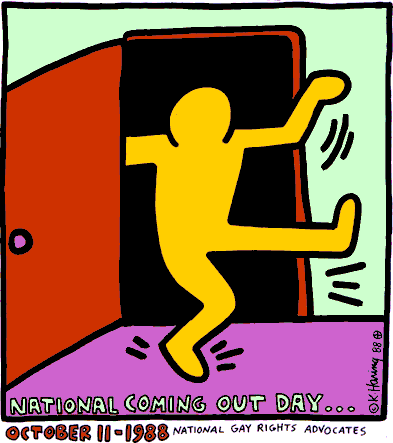
Come Out, Come Out, Wherever You Are!

Keith Haring National Coming Out Day
Today, October 11, is National Coming Out Day here in the U.S. As you can see from the Keith Haring poster, National Coming Out Day comes from a time in American queer history when “SILENCE = DEATH” was the watchword, and so it is tempting perhaps to think that it belongs to a time that is no longer, when urgency and militancy overtook the case for same-sex marriage and other, more concrete and legalized understandings of LGBT civil liberties. But in fact, that’s not so: the specter of a particularly large round of young queer people’s suicides means that there are radical political groups holding die-ins again.

But even as we find militant urgency surrounding us in a stark reminder that historical narratives cannot ever be written as entirely teleological marches toward progress, we can also think of National Coming Out Day as a reminder that you needn’t be a militant to save people’s lives; you needn’t pull a Harvey Milk and declare that you will risk assassination in the name of “destroy[ing] every closet door.” All you need do is be here, be yourself, and be alive. You can go about the rest of your life, and the rest of the things you do to make the world a better place, safe in the assurance that if you live an out and unashamed life, you are, in the paraphrased words of another eminent cultural icon of teh gayz, convincing by your presence.

Of course, it doesn’t hurt either if you’re willing to put a little part of your life and yourself into being a mentor to the queer kids and the not-yet-queer kids who happen to look to you for help. Tell them your stories and listen to theirs. I have found, through a life made not just easier and more bearable; but wonderfully entertaining, enriching, and loving, by good queer mentors, that it is easier to say “homophobia” or “transphobia,” to say “girlfriend” or “boyfriend” in the way you want to say them, to talk the language of cruising or of gay-marriage politicking, if you have heard someone else do it first. And it is easier to believe that you can be a queer, gender-nonconforming woman in academia if you have seen a woman stand in front of your classroom or sit with you on a committee who is also wearing a men’s dress shirt and slacks, you know?

Coming out is at times a complicated, a perplexing, and a daunting prospect. But when you do so, whether you have any sort of life as a public figure or not, you do so for the kids who need to see queer adults around them to know that it’s worth growing up to be one too. Something I’ve always admired about gay history is the familial closeness of queer communities, even when faced with incredible adversity. Think of what queer community could do for each other in the time when Keith Haring created that poster, think of today’s queer kids who still need a ton of support, and do the right thing and tell them you’re One of Those People too.

QOTD (2010-10-09)

From Tom Stoppard’s highly-recommended play The Invention of Love, a dramatization, basically, of all sorts of Oxford drama surrounding Greek love, with a focus on AE Housman. Here is Stoppard’s Wilde talking to Stoppard’s Housman in the Underworld, where they’re both reflecting on their lives; Housman has just told Wilde that he wishes Wilde had been able to live in ancient Greece, that his life was “a chronological error.” Wilde replies thus:

Dante reserved a place in his Inferno for those who wilfully live in sadness—sullen in the sweet air, he says. Your ‘honour’ is all shame and timidity and compliance. Pure of stain! But the artist is the secret criminal in our midst. He is the agent of progress against authority. You are right to be a scholar. A scholar is all scruple, an artist is none. The artist must lie, cheat, deceive, be untrue to nature and contemptuous of history. I made my life into my art and it was an unqualified success. The blaze of my immolation threw its light into every corner of the land where uncounted young men sat each in his own darkness. What would I have done in Megara!?—think what I would have missed! I awoke the imagination of the century. I banged Ruskin’s and Pater’s heads together, and from the moral severity of one and the aesthetic soul of the other I made art a philosophy that can look the twentieth century in the eye. I had genius, brilliancy, daring, I took charge of my own myth. I dipped my staff into the comb of wild honey. I tasted forbidden sweetness and drank the stolen waters. I lived at the turning point of the world where everything was waking up new—the New Drama, the New Novel, New Journalism, New Hedonism, New Paganism, even the New Woman. Where were you when all this was happening?

AEH At home.

In Stoppard’s telling of the story, my sympathy comes down unequivocally on Housman’s side. I don’t know much about Housman’s life—only dimly recall that when we did oral reports on classic poems in high-school English, we dwelt on the martyrdom evident in “Reading Gaol,” while “To an Athlete Dying Young” passed us by without very much imputation of the love that dare not speak its name. But Stoppard makes me think as if Housman has a nobility to be matched against Wilde’s admittedly ostentatious vulgarity; even as both we and Housman admire Wilde for standing up in public, and feel some sympathy for his confession that he still loves Bosie after all that, I find myself thinking that I have much more in common with Housman than I ever will with Wilde. Those of us who are scholars, who make our lives out of quibbling close-readings and maybe write a bit of poetry here and there, who do not make spectacles of ourselves in witness-boxes to be read years later as champions of free expression and martyrs to a cause that did not yet have a name, much less a name like “gay liberation,” I think must sometimes struggle to find in our lives the proof that it was worth it—because we must find something, as Stoppard’s Housman must, to make conversation about with Charon on the ferry ride, and general audiences tend to find the minutiae of Latin philology, or its equivalent, pretty boring.

But Wilde had to start somewhere. He had to be taught Latin and Greek and philosophy and things. And, I suppose, if you were the one who taught Oscar Wilde to scan Virgil—or, better yet, if you were the tutor for whom Wilde wrote his first essay about Plato—I think you could give yourself a pat on the back all the same, even if you spent most of a very exciting period in intellectual and cultural history very much at home.

The Tomb of the Unknown Teenager; or, An Open Letter

Dear Teenager,

Just a little over a year ago, I was one of you. I walked the hallways of my giant public high school in southern California, a great sea of mostly-anonymity where if you were singled out, it was only to be taunted and never to be praised. Where it seemed as if you would never be the kid selected to receive the book prize or to captain the team, where it was easier to eat lunch with your teachers than in the morass of your peers, where a difference that had started out for you as a source of pride quickly became in the hands of your fellow students a source of shame. I relive in my mind the scenes of high school in the 21st century, a weird environment in which it is safe to go to the meetings of a Gay-Straight Alliance, but not to walk into the girls’ bathroom while wearing short hair and baggy jeans; in which the health teacher wanted, deep down, to teach comprehensive sex ed, but was too nervous; in which every year in homeroom they passed out the numbers of a suicide hotline, and yet when a girl did, after all, kill herself, they nervously swept the story of suicide under the rug.

Not all 2,400 students enrolled in my high school in a given year made it out intact. Some died, whether by their own hands or through accident or illness. Some were forced by the poisonous environment of that place to compromise their identities, their senses of self, their self-honesty and their self-knowledge. Many became depressed, or turned to drugs and drink as coping mechanisms. While no doubt if you went to high school in the United States you knew at least one person who was subject to all these fates, I can at least attest to the validity of the last category: high school was a struggle for me, a struggle with self-loathing and depression and the curse of being different. And in saying that I made it out alive and intact, and managed to stay functional enough throughout the experience to do the tests and the applications and keep my grades up and go on to a better place a continent away, I don’t congratulate myself. The only thing there is is that I was lucky, and I thank the higher power I don’t believe in every day that I had the good fortune to have support from my family and an unabiding desire to achieve that helped me to get far enough to realize that better worlds do exist outside of that one.

But the luck is not in having better worlds, it’s just in realizing that they exist, and hanging on long enough to get to them. And the great thing about that being where the luck comes in is that it can be managed and mitigated. Many people have responded to the fact that six reports of the suicides of LGBT teenagers surfaced in the media in the month of September by pointing out that life does get better, that it will get better, and that if we can just hang on long enough, we can all reach a point in our lives when that’s true. And that, of course, is what I want to do by telling you my story about how it was bad for me, but it got better.

Because, you see, when I came across the country to New Jersey, it wasn’t just that I was for reasons of social inequality of which I’m not proud coming across the country to an elite, selective, private university; it was that I was breaking out of the poisonous insularity of a world obsessed with labels, social statuses, and the destructive deployment of stereotypes, where to be visible and to be invisible are curses of equal measure. I live away from my family (though I have a good relationship with them, and talk to them frequently), and so I’ve had the opportunity to build a new family of my own out of the peers and mentors who populate my new life, whom I work and study and eat meals and socialize with. I live in a world big enough to avoid the people I don’t like; I make my own decisions; if I would like to be invisible, I can hide in my room, and if I would like to be visible, I can sit in a common space or call a friend. On that note, I have friends. I didn’t, really, all those years ago. I have felt safer and more in control and happier in college than I ever have. Read the archives of this blog: they’ll tell you so.

This is not to say that college, if you have the opportunity to go away to college, is necessarily where it gets better. Tyler Clementi killed himself last week, and he was a college freshman, and it was because his roommate and his neighbor committed a disgusting act of invasion of privacy and played upon all the worst social instigators of shame and depression. But if your first few weeks of college, when you’re thrust into an unfamiliar environment with people whom you didn’t choose, is not when it gets better, then hang on: it will be in your second semester, your second or third or fourth years, your first time living in a new city by yourself, or maybe after you graduate, when you have more freedom and autonomy. Maybe it gets better when you have your first sexual experience or your first relationship. Maybe it gets better when you spend some time in a foreign country. Maybe it gets better when, after some time away, you move back home and reconnect with your family. Maybe it’s when you get help for any problems you might have. Maybe it’s whenever you finally have the freedom not to have to be someone you’re not. But whenever it is, however it is: you’ll be able to do it. I promise.

Today I live in a college dorm, in my own room, my own space. Today when people come over to my room, I offer them tea and coffee and Baroque music plays in the background on Pandora. Today when people come over I watch their eyes slide over my walls, covered in postcards of male and female nudes, in gay-activist iconography, and in pictures of my family; or over the titles on my bookshelves, from Alcott and Auden to Wilde and Woolf; I hear them laugh at the Dr. Seuss magnets on my fridge and the Ernie and Bert stuffed animals on my windowsill. Sometimes, they’re too polite to publicly deride my taste in granny-square crocheted pillows and tastefully tacky tchotchkes. And I’m proud, oh so proud, to have people over because this room and the things I put in it are a space I would not have had and things I would not have dared acquire or publicly display when I was thick in the throes of teenagerhood. The public declarations of queerness, of geekiness, and of pretension which damned me to pariahdom just a couple years ago are now a sense of self in which I take refuge. And my life is so much better for it.

Someday—maybe not now, but someday—you’ll have a room of your own, which you can decorate how you choose. You’ll be able to have people over, and it will be so yours that they won’t dare to say anything to deride your taste, to attack you for putting your identity up on your walls. And well, if they do, you’ll be so you that nothing they can say will make a difference—because after all, you can shut the door behind them and refuse them entry. This is, of course, a metaphor as well as literal reality; when it gets better, your mind and your choices will be your own, and no one will be able to force you into feeling pain or fear or shame.

It isn’t easy to get to this point. It requires a lot of resolve, a lot of courage, and maybe a friend or a family member or a therapist who can help you through it. Not all teenagers are lucky enough to start out with these things. But it is not as difficult as it might once have been to find someone a continent away who feels the way you’re feeling, and can listen to you feel it. It is no longer necessary to be and to feel completely alone. And there are people out there who can tell you—as I am telling you now—that no matter how awful it seems right now, things will get better. And you’ll find beauty, and happiness, and love, and pride. And until you do, we’ll all, all of us out here on the internet, be here to help you to find your strength.

It gets better. I promise.

Love,
Emily
QOTD (2010-10-02)

The final paragraph of Emma Goldman’s 1917 essay “Woman Suffrage”:

The misfortune of woman is not that she is unable to do the work of man, but that she is wasting her life force to outdo him, with a tradition of centuries which has left her physically incapable of keeping pace with him. Oh, I know some have succeeded, but at what cost, at what terrific cost! The import is not the kind of work woman does, but rather the quality of the work she furnishes. She can give suffrage or the ballot no new quality, nor can she receive anything from it that will enhance her own quality. Her development, her freedom, her independence, must come from and through herself. First, by asserting herself as a personality, and not as a sex commodity. Second, by refusing the right to anyone over her body; by refusing to bear children, unless she wants them; by refusing to be a servant to God, the State, society, the husband, the family, etc.; by making her life simpler, but deeper and richer. That is, by trying to learn the meaning and substance of life in all its complexities, by freeing herself from the fear of public opinion and public condemnation Only that, and not the ballot, will set woman free, will make her a force hitherto unknown in the world, a force for real love, for peace, for harmony; a force of divine fire, of life giving; a creator of free men and women.

QOTD (2010-09-30)

Though I no longer think that this paragraph from Eleanor Flexner’s classic 1959 Century of Struggle lends itself to a JP topic (as I did an hour ago; my mind has since moved on), I do still like it quite a bit:

The founders of these earliest women’s colleges had this in common with some suffragists: they believed higher education would be the panacea to remedy all evils, just as some suffragists thought that giving woman the vote would open the way to a new golden age (an illusion cherished by reformers in all ages). Sophia Smith in her will put her dream into words: “It is my belief that by the higher and more thorough Christian education of women, what are called their ‘wrongs’ will be redressed, their wages adjusted, their weight of influence in reforming the evils of society will be greatly increased, as teachers, as writers, as mothers, as members of society, their power for good will be incalculably enlarged.”

Now, however, I’m thinking I might write about critiques of the U.S. suffrage movement from the left. Thoughts on this point are of course appreciated.