QOTD (2011-04-16)

Symonds, “The Genius of Greek Art” in Studies of the Greek Poets:

Guided by no supernatural revelation, with no Mosaic law for conduct, they trusted their αἴσθησις (percipient reason), delicately trained and preserved in a condition of the utmost purity. This tact is the ultimate criterion in all matters of art—a truth which we recognize in our use of the word aesthetic, though we too often attempt to impart the alien elements of metaphysical dogmatism and moral prejudice into the sphere of beauty. This tact was also for the Greeks the ultimate criterion of ethics…. [W]e ought still to emulate their spirit by cheerfully accepting the world as we find it, acknowledging the value of each human impulse, and aiming after virtues that depend on self-regulation rather than on total abstinence and mortification.

He was no aesthete, that man—problems in Greek ethics, indeed.

Apologia Pro Studio Humanitatum

If you are one of those people who, in the wake of a transatlantic agenda to delegitimize the academic profession and the teaching and practice of “useless” subjects that profession enshrines, have struggled to find the words to suggest that maybe such delegitimization might not be such a good idea after all, Nicholas Dames’ article “Why Bother?” in the latest issue of n+1 is required reading. Reviewing three of the most eloquent and popular recent defenses of “useless” subjects and the academic profession—Martha Nussbaum’s Not for Profit: Why Democracy Needs the Humanities, Louis Menand’s The Marketplace of Ideas: Reform and Resistance in the American University, and Terry Castle’s The Professor and Other Writings—Dames ends with this moving conclusion drawn from his words of praise for Castle’s An Academic’s Progress of a memoir:

Richard Rorty once argued that Western culture needs the novel, in order to force us to imagine lives and destinies different from our own. Perhaps the humanities, in their current plight, need to be novelistic again. Not necessarily in their fictional mode, such as the moribund campus novel genre with its essentially demystifying comedy, but the novelistic ability to marshal narratives and details that give us back some sense of why the humanities exist for individuals — how, to put it bluntly, they still rescue lives. One doesn’t enter the academy to become a disillusioned professional (although that will happen along the way). One doesn’t enter it to equip businesses with flexible analytic intellects (although that will also happen). One enters it, shamefacedly and unhappily, perhaps, but enters it nonetheless, in order to devote oneself to something greater than personal resentments — to salvational or transformational modes of thought. Because, put another way, all the grievances that take aim at higher education express real suffering, and that suffering has causes and modes of expression older than most sufferers usually know. The humanities should be, if not their solace, then their weapons of choice. Prig and cynic and naïf she may be, but the newly minted academic knows this — after all, she most likely came from their midst — and one good way of explaining as much is to explain how that knowledge feels. Without such explanations, which might soften resentment into curiosity or sympathy, there may soon be very little left to be embarrassed about.

I read this article—and am writing this post—from a crowded English train, surrounded by the remains of an issue of the Guardian (crossword puzzle completed), a train-station takeaway americano, and a book, stickered with the seal of the Oxford History Faculty Library, that I should really be reading for research purposes. Tony Judt’s words on the decline and fall of the post-privatization British rail system are ringing in my mind as I contemplate the forlorn-looking and extortionately-priced offerings of the refreshments trolley. Dressed in corduroy and herringbone, pecking away at my MacBook, my ticket for Oxford in my jacket pocket, I am nothing if not the intended audience for Dames’ slightly unorthodox answer to the “How do we defend humanists and the humanities in these strange days of declining-and-falling, neoliberal cost-cutting?” And so perhaps this is why I find his the most persuasive gesture towards an answer I have come across in many months, and the closest to articulating my own thoughts on the subject. Dames’ answer to “Why Bother?” is neither strictly utilitarian nor merely tautological. It rests on an understanding of what knowledge and intellectual curiosity are and can do, and why people undertake lives of the mind, that I share and believe with an almost religious fervor. And it comes on the heels of a compelling and compassionate review of a memoir that, as I noted when I read it, comes closer than any campus novel to mirroring my own experience of the young intellectual’s bildung—priggishness, cynicism, naïveté and all.

But what sits uncomfortably about Dames’ answer is that it could not be more ideologically opposed to an argument like Nussbaum’s, defending the humanities for the sake of the good they can bring to society at large. As Nussbaum defines it, this good is tangible, almost quantifiable, and the problem therefore (as those more qualified than I to dispute claims made by Martha Nussbaum have noted) is that her argument doesn’t counter the assumption that value must be tangible, discernible, measurable, or that it can consist (even in measurable terms) of intellectual and spiritual fulfillment. But it is a good that is general, that speaks to the need for the humanities of those outside the university walls as well as in. It explains why those doing the defunding and the devaluing need those whom they are trying to devalue and to defund, and why humanities education and research can be beneficial to those who don’t stay in the academy all their lives. Dames, by contrast, seems rather not to get the joke of Castle’s elegant pastiche of the eighteenth-century novels she studies. It seems as if he invests the role of the plucky young protagonist whose life is changed by books and whose angst is managed by the order of an academic career with heroic importance—and one has to wonder, as it seems one always does, if the psychological satisfaction of those who make lives in the academy is really worth so much as to be the backbone of a humanities-justification argument. One wants to believe that the professor, or even the cynical graduate student, has as much right to love what she does as the member of a state legislature voting for or against her continued employment, and one knows from lived experience that only a teacher who believes in the goodness, and the changing power, of what she teaches is capable of passing that love onto her students. I for one would like to be able to say that Dames resolves the question that still keeps me awake at night: whether it is not just purely selfish to follow a calling which gives me so much pleasure, when I am plainly only one of a few who will benefit from my putative academic career.

We can resolve this dilemma—at least temporarily—but only if we make recourse once again to our battered “for its own sake” tautology. The thing is that I don’t believe in dismissing out of hand any ideas, expressed in expressive language, that I find moving enough to peck out a couple thousand words about on the train. And so I feel inclined to say that Dames’ ideas are valuable to this ongoing conversation—that they humanize the humanists. But the conversation can’t stop with a validation of the motives and the psychological struggles of the privileged few. It needs to find language with which to relate the cosmology of those who think for a living, and those who teach as a vocation, to anti-profit-motive values that involve those in the real world as well.

I’d posit that the humanities offer not just the Terry Castles of this world, but everyone, the chance to decide for themselves what it means to live a good life, and to act in accordance with the principles they have devised. The humanities offer all of us alternative epistemological paradigms, that don’t require an output or an end or a profit. They offer doubt, but they also offer possibility. What they don’t offer is empiricism, equations, or the assumption that there are answers. But for all that, they are no less admitting of possibilities—for a good humanist will recognize the necessity of scientific methods to fill in the gaps in her worldview. The humanities allow us to make ourselves, and our world, as we would have them be. And they do, in the end, promise a place for the seekers after knowledge and the people whose calling is to expand those possibilities of thought and action still further.

Making the case for the humanities and those who teach them today involves preaching the value not just of those apparently special individuals for whom humanistic inquiry lies at the root of existence, but also of those for whom it plays any part, however small. Those who seek to impart their evangelical message to those in the halls of power can couch their requests in the rhetoric of outcomes and utility, or they can do what primary-school teachers—and parents—are doing right now all over the world, and assign their students Harry Potter in an effort to encourage them to read and to recognize not just the benefits but also the joy of reading. They can start small, they can meet their students (first-graders and members of Congress alike) where they are, and then—oh then!—guide them one step forward towards realizing that they had the right answers, the reading-comprehension but also the literary-critical, key inside them all along. Infinite patience and infinite kindness are as impossible things for us to ask of the world’s intellectuals public and private as they are of ourselves (or of our children’s first-grade teachers), but we can certainly start small—with the conviction that what we do, as Dames argues, matters—and from there become slowly and surely better.

Happy Poem in Your Pocket Day!

Today is Poem in Your Pocket Day. My pockets are digital, and this, “One Art” by Elizabeth Bishop, is one of my favorite poems.

The art of losing isn’t hard to master;
so many things seem filled with the intent
to be lost that their loss is no disaster.

Lose something every day. Accept the fluster
of lost door keys, the hour badly spent.
The art of losing isn’t hard to master.

Then practice losing farther, losing faster:
places, and names, and where it was you meant
to travel. None of these will bring disaster.

I lost my mother’s watch. And look! my last, or
next-to-last, of three loved houses went.
The art of losing isn’t hard to master.

I lost two cities, lovely ones. And, vaster,
some realms I owned, two rivers, a continent.
I miss them, but it wasn’t a disaster.

—Even losing you (the joking voice, a gesture
I love) I shan’t have lied. It’s evident
the art of losing’s not too hard to master
though it may look like (Write it!) like disaster.

I Don’t Usually Do This Kind of Post, But; or, Problems in IvyGate’s Knowledge of Late-Victorian Intellectual History

There’s been a bit of buzz on the internet (or, well, okay, fine, the Ivy League internet; yes, I know I’m an elitist bastard) recently about an 1899 Harvard admissions exam that the NY Times posted on its website, seemingly largely consisting of dismay at how difficult it must have been to get into Harvard or a school like it in 1899. Here’s IvyGate, whose post caused me to become very irritable:

If you thought getting accepted to an Ivy League school was tough today, you should count your blessings that you weren’t born in the 1880s. In addition to having diphtheria and bad teeth and a pompadour like a mangy cat, you’d also be forced to take a comically rigid entrance exam and speak ancient Greek.

The New York Times recently unearthed a Harvard entrance exam from 1899, and man, is it ugly. The text spans three major disciplines–classical languages, history and math–and requires its victims to jump through flaming hoops in topics like Greek Composition, Random-Ass Geography, and Hard Numbers.

In their usual pained attempts to be sarcastic, IvyGate seem to have forgotten the first rule of history, which I hope they learned before taking their AP U.S. History test to get into their own fancy schools: change over time. No, of course secondary-school students aren’t taught the same things now that they were in 1899. Classical studies are (sadly, some might argue) out of fashion in favor of modern subjects; since we all have TI-83s now, it’s no longer as much a mark of mathematical competency to do complicated arithmetic as it is to differentiate and integrate single-variable equations. And, in reference to the Columbia entrance exam the post also references, obviously before 20th-century literature came along, people read different things—and yet I’ll wager most of us who go to Ivy League schools read at least some of those works of literature in high school, such as Macbeth, “The Rime of the Ancient Mariner,” and House of the Seven Gables, and have covered more of them (such as Milton) since entering college.

As to the Latin and Greek—well, it’s a question of fads, not so much a question of competency. Most people applying to university in America take a modern language; if you go to a fancy school in America today, you might still do Latin, and possibly even Greek (though it’s not particularly likely). I did Latin on my own for three years, and while I couldn’t do well on the Harvard exam if I sat it today, I would certainly have been able to answer all those questions after three years with the language. This is very similar to the sort of stuff I was asked to do as a Latin student, particularly the English-to-Latin translations where they give you a lot of clues as to which words they’d like you to use. I’m sure if those questions were in French or Spanish, most people would be able to conjugate some verbs and do a little translation and composition in the language. It’s not clear to me that this is any more difficult than taking an AP language test—and in fact, it was probably easier. Why, you ask? Well, because the boys who applied to Harvard in 1899 were probably groomed to it in a way few students are today. They attended a much smaller array of elite east-coast schools, which knew what to teach in order to get their students into the universities. Anyone with their sights on Harvard in the late 19th century would probably have been heavily coached to be good at their Greek verse and to know fun facts like the dates of the battles of Philippi and Actium, just as a lot of people applying to university today do SAT prep classes. University students in 19th-century Britain and America were rewarded for pretty foreign-sounding things by our standards (on the other side of the Atlantic, both Symonds and Wilde won prizes at Oxford for their Latin verse stylings!) but hey, we now award prizes for community service and school spirit. Go figure.

Bottom line, it was probably much easier to get into Harvard in 1899, because the number of people who could even enter the admissions pool was so limited. You obviously had to be a white man, and more than that to even have a shot you had to go to a fancy high school, probably in the northeast and even more probably in Massachusetts, where you would be taught ancient subjects ad nauseam. If you even had the opportunity to sit this exam in the first place, you’d probably do well.

As for us, in our age of uber-competitive, 6-8% admission rates for these schools, the insane regimes of prep classes and extracurricular activities to which prospective applicants feel pressured to subject themselves, and the widespread disappointment that spreads across the New York Times readership every year at this time as people realize that 21st-century college admissions isn’t a meritocracy, it’s a madhouse? Yeah, I’d take declining a few Greek nouns, describing the differences between Athens and Sparta, and using a slide rule any day.

But oh wait: it’s a moot point—I’m a woman. No Harvard Greek for me in 1899—and there’s the rub, really.

On Continuity and Change; or, In Which I Make a Motivational Speech

Just under two years ago, my life changed when I looked at a painting. It was the summer of 2009 and I was a frustrated editorial intern in the office of a progressive 501(c)3 in Washington, DC, groping my way through nine lonely-making weeks of hardening cynicism about what DC is for and how little power anyone in it has to make it a less messed-up place. I began the internship thinking I wanted to be a journalist, and by the sixth week, I knew that as laudable as the people who use their pens for good in DC are, it wasn’t my calling. I was looking for a way out—and so I went to the National Gallery.

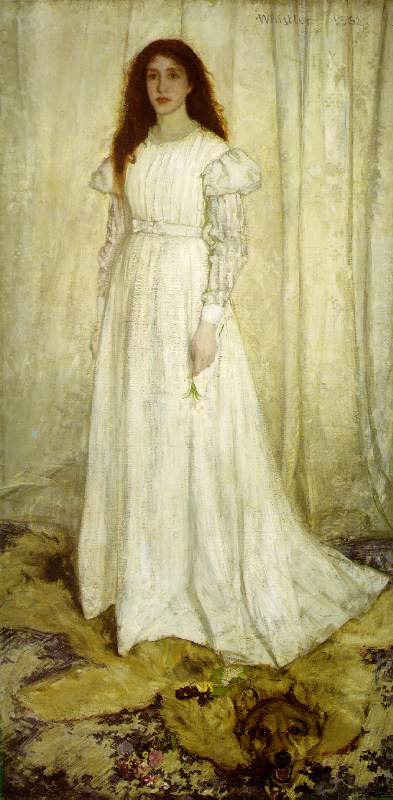
My visit to the National Gallery was the first time I chose on my own to go to an art museum. I knew virtually nothing about art, how to look at it, how to appreciate it, what it meant to look at a painting. I roamed from room to room, seeing for the first time paintings by artists from Watteau to Eakins to Cassatt. And I stopped dead when I happened by chance across an enormous painting by James McNeill Whistler, perfectly framed in an archway so as to stand out amidst all the other 19th-century offerings in the National Gallery. Called Symphony in White, No. 1, the painting is a full-length, life-size picture of a woman—not so much a portrait as a depiction of something unreal and ethereal, the rough brushwork unlike the hyperrealism of many of Whistler’s contemporaries, the vacant expression in the woman’s eyes deflecting attention from her face and in turn towards the folds of her white dress, and to her shoe, peeking out from under its hem, as she points her toe at the head of a grotesque bearskin rug. It’s an awe-inspiring image: two years ago, without yet having the words in me to describe what I was seeing, I sat down and looked at that painting for solid minutes. I had never done such a thing before, but I stared at the Symphony, it stared back, and the vacant stare looking down on me seemed to assume a cosmic significance. It sounds trite to say this now, but it was at that moment that my life changed. Struck as I was by the painting’s beauty, I resolved to work to increase the number of beautiful things in the world, and decrease the number of ugly things. I wanted to think about things that were good, and I wanted to do things with my life that would not make me cynical.

As I walked out onto a sunny, humid National Mall, I knew I was going to be an academic, not a journalist. When I found myself telling this story to a stranger in a coffeeshop the following week, I knew it was true. And I haven’t wavered since. The hold Whistler and his contemporaries (artistic, literary, and otherwise) have maintained on me since that day is a big part of what has driven me headlong into the nineteenth century as my period of study, and as I have learned more about their historical context I have modified quite a bit the juvenile creed of aesthetic hedonism with which I began. Instead of reading the Symphony in White goddess’s (for so I came to think of her) stare as an exhortation simply to seek beauty, I came to see it as an invocation of duty: a call to better myself and the world around me, to believe in my power to do good on my own terms, to (in the words of the very Victorian man, himself no aesthete, who has become the center of my life) “live with steady purpose in the whole, the Good, the Beautiful,” and to always aim not just to be and to do good, but (in the words of a much-admired mentor and friend) to be and to do “better.” In an 1890 essay “On the Relation of Art to Science and Morality,” John Addington Symonds wrote that “art is able to assert man’s moral nature at moments when it seems in other spheres to have been paralysed or vitiated.” So it was with me in the National Gallery in the summer of 2009. I looked at a painting by the artist most famously derided by Ruskin, whose blank-eyed model bespeaks the painter’s lack of interest in giving his painting a moral, and imbued that painting with all the meaning I could muster out of all a young adult’s desperate search for purpose and ethical paradigm.

Today I took a break from the exhausting enterprise of organizing my Symonds source material and headed into London, because this is the first weekend of the Victoria and Albert Museum’s special exhibition on the aesthetic movement and I couldn’t wait to see it. I now spend my days, and my thoughts, with a circle of intellectuals who all engaged in some way with the questions the aesthetes raised about the relationship between ethics and art, and I am preoccupied above all with trying to understand what it meant to be someone to whom such questions mattered so much. This afternoon, I had already spent an hour and a half or so in the exhibition, soaking up material culture and fun facts and beautiful Kelmscott Press books and more Burne-Jones and Rossetti than I could even begin to process, when I rounded a corner and let out an audible gasp: there she was. My goddess. And for the first time, I believe, since Whistler first exhibited his series of three Symphonies in White, she was flanked by her companions, who usually live at the Tate and at a museum in Birmingham—though none is as majestic as she. She dominated the wall in the V&A as she had in the American National Gallery. Just as I was two years ago, I was struck by her size, by her majesty, by the ability of her stare to be at once vacant and to contain multitudes. I wanted to do something to tell her what it meant to me, to see her again. I wanted to cry, or possibly to genuflect. I wanted to say, thank you. Thank you for changing my life.

Two years ago I was a lost kid whose sense of home was rapidly being destabilized by the culture shock occasioned by living 3,000 miles from home in (DC and Princeton alike) another world. Two years ago, I was an anxious kid who cried a lot because I was convinced Princeton had only admitted me for being the child of an alumna, because I failed to live up to the impossibly high standards I set for myself, and above all because I couldn’t imagine any way to do good in the world that would allow me also to preserve my sense of self, my sense that it is okay (and in fact necessary) to be myself. I didn’t know that I had to help myself before I could help others. When I saw Symphony in White, No. 1 again today, I looked her in the eye—as a historian, as a student and a teacher, as someone who, as often as I fail at living the virtuous life to which I aspire, wakes up every morning willing to try again. I am someone who finds the question “Where are you from?” impossible to answer, but call the University—qua idea—my home. I am someone who believes I have a right to exist, that I am important, that my life has a purpose, and that I am capable of fulfilling it to the best of my ability. It is no coincidence that it was after I came back from Washington that I started to recognize I have the capacity to make a difference in the lives and the minds of those around me; after all, it would be a mortal sin to my white-clad goddess not to act upon one’s calling.

Recently, I’ve been evincing a lot of skepticism of the Dan-Savage-constructed “It Gets Better” narrative: the uncomplicated teleological happy ending, and the notion that simply crafting such a narrative can be a solution to awful, scary, stomach-turning things like teenage suicide. But I have also recently been evincing a desire to move beyond mere skepticism, and so here I am. I am sitting in a room on Broad Street, dreaming spires visible from my window, buried in a mass of notes from which I’m going to make an original contribution to my field. And it’s from here that I look up to the National Gallery postcard of Symphony in White, No. 1 over my desk and ask: does it get better?

Yes, dear reader. Yes it does.

QOTD (2011-04-06); or, Why I Will Not Be Using the Word “Hermeneutic” in My Thesis

Twenty years before Freud published his famous analysis of the Schreber case, arguing that Schreber’s extraordinary fantasies were a result of paranoia stemming from repressed homosexuality, John Addington Symonds published his A Problem in Modern Ethics. Therein, he highlights these lines from a case study of an anonymous “Urning” in Krafft-Ebing’s Psychopathia Sexualis:

… when he first becomes aware of the sexual stirrings in his nature, and innocently speaks about them to his comrades, soon finds that he is unintelligible. So he wraps himself within his own thoughts…. He imagines that he alone of all the people in the world is the subject of emotions so eccentric…. How many unexplained cases of suicide in young men ought to be ascribed to this cause!

Those who have studied Freud in his historical context will be aware that, although his role in the formation of modern psychoanalysis was pivotal, he wasn’t the only person at the turn of the twentieth century thinking about the mind and mental health in relation to desire. Scientists like Krafft-Ebing who collected and edited personal narratives about individuals’ sexual histories (something which Symonds was himself very actively involved in in later life, though thanks to Edmund Gosse none of his research has survived) no doubt had specific pathological narratives in mind which they sought to highlight through their selection and organization of the case studies. The case study Symonds presents us with in Modern Ethics is no exception, but what’s striking is how this narrative maps onto the model of homosexual desire that Freud (in)famously gives us in Schreber. In the Krafft-Ebing case study, a severe mental-health risk (suicide) is instigated by the idea that someone would “wrap himself within his own thoughts”—in modern psychoanalytic terms, repress his sexual identification, covering it over with conscious thoughts—and that this coping mechanism would cause him to believe—as the paranoiac does—that he is the only person who feels as he does, and that therefore he is at risk of persecution from everyone. It’s the link between repression and paranoia that emerges in the Krafft-Ebing case study (and, in particular, in the bits Symonds highlights from it, performing his own editorial work!) that seems so strikingly to prefigure Freud. For we historians, this is an interesting muddling of the timeline: we whose scholarly duty seems to be to warn other critics against applying critical frameworks to historical moments prior to their invention need to keep in mind that critical frameworks do not suddenly come into being with the jolt of electric current that accompanies the flipping of an “on/off” switch. Rather, they develop—as all ideas and paradigms do—gradually over time, thanks to the contributions of many individuals. Freud may loom large in the history of psychoanalysis and indeed of sexology, but to a certain extent he is also affected by the way that people think and express their thoughts in the period at which he starts to think and write about the mechanisms of sexual desire. I haven’t done the reading to be able to do more than speculate, but I wonder in what ways Freud’s immersion in the genre of the case study, which has its narrative conventions just like any other genre, affected the nature of the frameworks he extrapolated from his own case studies!

These all may seem like very elementary points to be making, and I don’t need to do the JSTOR search to make an educated guess that they’ve been made before by readers of Freud more sophisticated than I. But the bottom line that any given intellectual figure is both shaped by his or her historical context and yet exists as an individual apart from it seems too often forgotten by scholars of all stripes. Every day I read secondary literature about Symonds and his circle which believes it appropriate to refer to Symonds as a gay liberationist (in the framing of one ’90s queer theorist I was reading yesterday, a sort of Foucault avant-la-personne) or for that matter to dismiss him as a “minor man of letters” whose form somehow camouflages into the prized Morris wallpaper of his drawing-room. For scholars whose discipline is all about questioning categories, I find that queer theorists aren’t always as perfect as they might be at distancing themselves for the categories they in turn have created, and the world-historical figures—the Freuds and the Foucaults—they have elevated. Of course, no one is perfect, nor should they be. It is rather the lack of interest in trying to see the world from their subjects’ point of view that irritates me.

But then, I suppose, that’s why I’m a historian, not a queer theorist. From each according to her abilities, to each according to her needs.

QOTD (2011-04-03)

Some Symonds well-suited to the fourth Sunday in Lent, from Walt Whitman: A Study:

Nor does the supreme doctrine of redemption and self-sacrifice lose in significance if we extend it from the One, imagined a pitiful and condescending God, to all who for a worthy cause have endured humiliation, pain, an agonizing death. Not to make Christ less, but to make him the chief of a multitude, the type and symbol of a triumphant heroism, do we think of the thousands who have died on battlefields, in torture chambers, at the stake, from lingering misery, as expiators and redeemers, in whom the lamp of the divine spirit shines clearly for those who have eyes to see.

In Oxford I see cross-topped spires from my bedroom window, I hear chapel bells sound the hour, and I could, if I wished, go to choral Evensong every day of the week. I do go once a week, though, and I go because it helps me to understand how Symonds could write sentences like these, how the straight and unyielding spires of Oxford could and can be bent to the needs of those who think better in layers of metaphor than they do in the uncompromising and unambiguous recitation of Anglican doctrine.

I have been thinking about it, and I don’t think I will go to Christian services when I’m back in the States. I’ve realized that to me Evensong is about the same things that my Symonds project is about: about the romance of Oxford’s “forsaken beliefs” and “impossible loyalties,” and about having it both ways, being simultaneously faithful and apostate, cheerfully Hellbound and yet making a slow Pilgrim’s Progress toward the Celestial City all the same.

QOTD (2011-03-29)

Symonds to A.R. Cluer, 1873:

Thus property and Communism are both logical, both intelligible and capable of yielding perfect deductive results, but quite irreconcilable in their integrity. The problem is how to be illogical and human in conduct, to effect that for-ever-fluctuating compromise which is life…. And I firmly believe that the world will be best served by each man discovering what his natural ἐργον [work] is, and doing that as well as he can. The world is a symphony in which flutes and horns have places as well as violins. But a certain set of politico-economic prigs would fain have all men be fiddles—and themselves first fiddles.

Suspicion of Binaries; or, A Problem in Greek Methods

Sometime in the fall at Princeton, while conversationally performing in front of a dining-hall audience, I found myself solemnly intoning the injunction, “Remember to always be suspicious of binaries.” The gravity and earnestness with which I’d made that remark turned it into a catchphrase, a fact which I capitalized on as I continued to use it to undergird anything I had to say about queer theory and/or the history of sexuality for the rest of the semester. I also played a game last term of trying to see how often I could work the phrase, or variations on it, into my tutorial essays. I’m proud to say I was largely successful.

And so, after all that, it is rather perturbing that binaries seem to be undergirding a lot of the ideas central to Emily “Suspicious of Binaries” Rutherford’s JP. So much about the development of male homosexuality in Victorian context seems to be best expressed as dualities: there are the “Two Loves” of Wilde trials fame, the double lives led by men who acted clandestinely on their desire for other men, and the concept of “double-mindedness” which was popular in pre-Freudian psychological conceptions of homosexuality, and is discussed a lot by Symonds in his Memoirs. (The psychoanalytic binary is one that you can deconstruct, as Whitney Davis does in a cool book called Queer Beauty that I read yesterday: people like Symonds seem at the same time to have conceived of their sexual desires as regressive in the Freudian sense but also progressive, on whose basis it was possible to found a freer, more democratic society. Symonds didn’t express it that way, though, so the binary still holds.) In the wider culture, and in cultural criticism as the Victorians practiced it, there is the wildly popular Arnoldian dialectic of Hellenism and Hebraism; and there are also two competing notions of what “Hellenism” means to Victorian culture, as Linda Dowling discusses in Hellenism and Homosexuality in Victorian Oxford: the martial, imperial, virtuous, Republic sense, the Arnold-and-Jowett sense; or the sensuous, boy-loving, Phaedrus sense used as a basis on which to argue for the ethical goodness of same-sex love in the 19th century. This last binary lends itself particularly to suspicion: the myth of Achilles and Patroclus bridges the two Hellenisms, for instance; furthermore, there is a strong argument to be made that there are at least three Hellenisms, if not more, as the Hellenism in which Symonds finds space to justify homoerotic desire has a lot more in common with Arnold’s and Jowett’s rather prescriptive understandings of culture and ethics and what the Greeks had to do with them than it does with the consciously sexualized Winckelmannian tradition that seems to attract Pater and to a certain extent Wilde.

It is in being suspicious of this last binary in particular that I, too, find myself of two minds: re-reading Dowling yesterday for the first time since the very beginning of this project, before I knew half of what I know now about Victorian intellectual culture and sexuality’s place within it, I found myself wondering about the political implications of placing Symonds so polemically in the Arnold/Jowett camp. Writing in 1994, Dowling understandably goes the other way—tying Symonds together with Pater as Wilde’s two key influences (which, to be fair, they probably were, but in a more dialectical way than Dowling’s equation suggests), and slotting all three writers into a teleological, liberationist story of the development of homosexuality. When I first happened upon Symonds, almost two years ago now, I wholeheartedly believed this teleology, and in fact it’s what drew me to Symonds. I loved the idea of someone creating the language of homosexuality, of practically bringing it out of the closet, and like Dowling could see a lot of parallels between the culture Symonds creates seemingly out of whole cloth and the matrix of today’s gay male culture.

But now, I think, I’ve come to be as suspicious of teleologies as I am of binaries—and just as I’ve gone off pouring my energy into state-by-state same-sex-marriage politics, I’ve gone off thinking that Symonds is some kind of Victorian Harvey Milk, or even some kind of equally-easily-canonized Wildean martyr à la Ellmann’s biography. Instead, I find myself believing that writing the kind of history I want to write involves understanding what it meant to be like a Victorian and to think like a Victorian, and therefore doing that kind of thinking myself. I no longer know, then, whether the work Symonds did to create a new discourse of homosexuality, and to live within it himself, counts as the Victorian version of gay liberation. I no longer know whether the pathos-ridden desperate seeking that pervades his correspondence with Whitman is about a sort of proto-closet. It might be, or it might not. It’s a bit of a Schroedinger’s Cat syndrome—and if anything is a metaphor for the problems of binaries, surely it is Schroedinger’s poor bedraggled Cat.

Round about the time that I thought it was funny to go round Princeton telling everyone to be suspicious of binaries, I found myself sitting with a friend in the Rocky dining hall late one night, having a minor freakout because I’d been assigned for class to read an essay by Eve Sedgwick that I didn’t understand. That night, what Sedgwick had to say about what she calls “reparative reading” went way over my head, and I cried to my friend about how, after all these years, I still don’t “get” literary theory; the next day in class, I stayed, unusually, mostly silent for a class discussion I felt as if I couldn’t follow. The last day of class, when we were recapping and making connections between all the material we’d covered that semester, I prefaced a comment I made about Sedgwick’s theory of reparative reading with “I still don’t know if I understand what ‘reparative reading’ means, but…” And I felt well and truly at sea.

But. But I had to go to Oxford to learn that being suspicious of binaries isn’t always the most useful permanent state of mind. Sure, it’s nice when you want to make puns by sticking deconstructive slashes into the middle of compound words, and is really quite useful to keep in the back of your mind whenever you find yourself spurred to generalize or be presentist about big categories like women or non-white people or working-class people or, for that matter, homosexual men. But thinking like a Victorian to understand how Victorians thought sometimes means accepting having two loves, being of two minds, organizing ideas according to discrete taxonomies or dialectics. It means knowing that people have embraced Pausanias’s binary of the base and the heavenly loves, or Aristophanes’ story of how we got two sexes, or even Adam and Eve or Darwinian separate spheres. It means reading The Nature of Gothic and Unto This Last even though Ruskin wasn’t too nice to women in Sesame and Lilies. It means (in a metaphor I came up with the other day that I’m rather taken with) standing in the middle of Parks Road with Keble College Chapel on your left and the University Museum of Natural History on your right, knowing that the Victorian Gothic can stand for High-Church reactionary conservatism and the march of scientific progress alike. It means Symonds and Wilde both loved their wives and children, of a fashion, even as they had appallingly little consciousness of what their own quests for self-definition put their families through. It does, to be sure, mean being able to know when a binary is Victorian and when it’s modern, and how to disavow teleologies like Dowling’s that seem largely to be retrospectively and too-neatly constructed.

I still can’t claim to understand Sedgwick. But to me reading non-paranoiacally, reading reparatively, means reading ethically, giving your sources the benefit of the doubt, forgiving them their trespasses, giving them the chance to tell you what they meant. It means knowing that being a late-Victorian critic entails very different thought processes and very different ethical prescriptions to being a critic in the post-poststructuralist age. It means worrying that being suspicious of suspicion just digs you deeper into the critical-theory hole. It means believing that caring for and inhabiting your sources can make you as good a historian as knowing what to say in response when theorists talk. And it means, in addition to being of two minds, that one must be of two times as well: to carry out this project, I must be able to move seamlessly between a Victorian mindset and a 21st-century mindset—to have it both ways, and perhaps to be more credulous than suspicious of both.
QOTD (2011-03-19)

In his Walt Whitman: A Study, Symonds blockquotes, but doesn’t really discuss, this passage from Whitman’s preface to the 1880 edition of Leaves of Grass:

To this terrible, irrepressible yearning (surely more or less down underneath in most human souls), this never-satisfied appetite for sympathy and this boundless offering of sympathy, this universal democratic comradeship, this old, eternal, yet ever-new interchange of adhesiveness, so fitly emblematic of America, I have given in that book [Leaves of Grass], undisguisedly, declaredly, the openest expression. Besides, important as they are to my purpose as emotional expressions for humanity, the special meaning of the “Calamus,” cluster of “Leaves of Grass”… mainly resides in its political significance. In my opinion, it is by a fervent accepted development of comradeship, the beautiful and sane affection of man for man, latent in all the young fellows, north and south, east and west—it is by this, I say, and by what goes directly and indirectly along with it, that the United States of the future (I cannot too often repeat) are to be the most effectually welded together, intercalated, annealed into a living union.

Symonds goes off on a tangent about the Phaedrus in response to this, and of course it isn’t totally ridiculous to compare Whitman’s vision of democracy to ancient Athens’. But I have been thinking a lot about mentalités in the past few days, and about clashes of cultural context. Just as we in the 21st century seem to have an awfully hard time “getting” what it was like to think like a Victorian, haphazardly imposing our understandings of sexual identity and morality on the Victorians’, I wonder if it is impossible, or at least really quite awfully difficult, for Symonds to ever get to grips with what democracy and politics and These States mean to a man who knows that adhesiveness and the love of comrades have a political significance, but who is not a classical scholar. Of course the parallels to Hellenism would seem obvious to Symonds, but I can’t help that think that he’s letting his sentiment get away from his discipline as a cultural historian when he assumes that Whitman, who was not nearly so well-versed in Plato, would have agreed.